

Knowledge Hub
7
5
min read
MVNO/MVNE Enablement Platforms: A Complete Guide for Modern Telecom Operators
What Are MVNO and MVNE Enablement Platforms?
Why These Platforms Matter More for Modern Telecom Operators
7 Core Capabilities of a Modern Enablement Platform
5 Key Benefits of Deploying MVNO/MVNE Enablement Platforms
Common Challenges MVNOs Face Without Proper Enablement
Common Deployment Models: SaaS, Managed Service, and Modular Stacks
MVNO/MVNE enablement platforms often decide whether a mobile launch takes off with real momentum or gets trapped in delays, friction, and costly complexity.MVNO and MVNE enablement platforms give operators the foundation to launch services, connect with host networks, manage customers, bill accurately, and scale faster.
In this article, you will see how these platforms work, which capabilities matter most, where gaps appear, and how the right setup supports growth.
Let’s get into what really makes these platforms work.
What Are MVNO and MVNE Enablement Platforms?
MVNO and MVNE enablement platforms are the systems that help a mobile service launch, run, and grow without building every function from scratch.
In practical terms, the platform connects the steps behind every mobile sale. If a customer buys a plan online, it can help verify identity, activate the service, apply the plan, and start billing in one flow.
That is why enablement matters. Without it, operators often face slow launches, manual work, disconnected systems, and avoidable service issues.
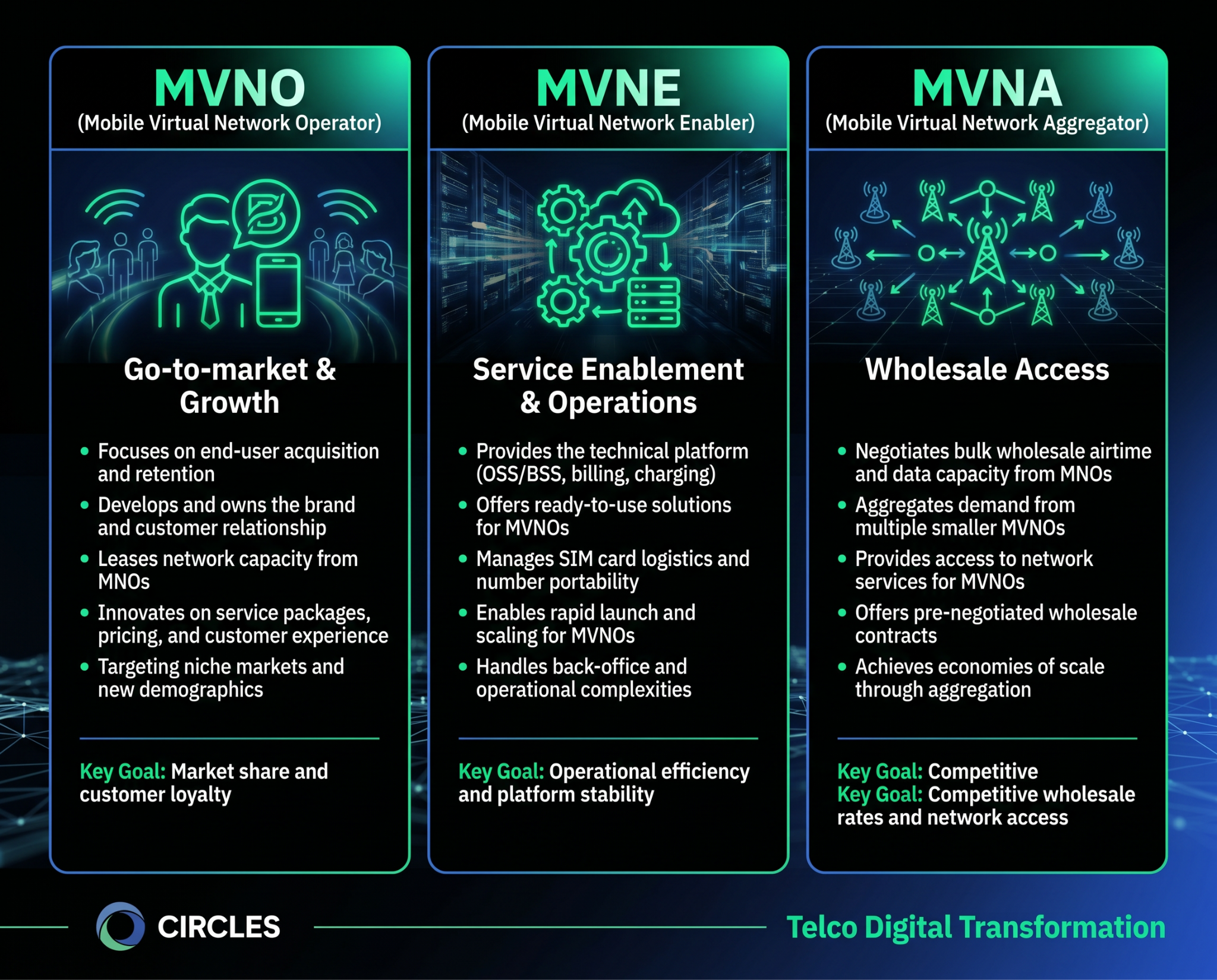
MVNO vs MVNE vs MVNA
There are three closely related terms that often come up in this space: MVNO, MVNE, and MVNA. They are linked to the same mobile ecosystem, but each one plays a different role in how services are launched, supported, and brought to market.
Here is a simple breakdown of the differences between the three and the role each one plays in the mobile value chain.
Why These Platforms Matter More for Modern Telecom Operators
Modern operators are expected to do more than launch a mobile service. They need to activate customers quickly, support digital journeys, manage billing cleanly, and roll out new offers without slowing the business down.
That is where MVNO/MVNE enablement platforms matter. They support the operational layer behind onboarding, SIM or eSIM activation, plan setup, customer management, and service delivery. When these parts are disconnected, launches slow down, and service quality often suffers.
They also play a bigger role now because telco digital transformation is pushing operators to modernise legacy systems, reduce manual work, and support faster product changes.
That shift is also showing up in market demand, with Juniper Research1 projecting the global MVNO subscriber base to grow from 333 million in 2026 to 438 million by 2030, while identifying MVNO-in-a-Box platforms as a primary growth engine. A strong enablement platform helps operators respond to that growth with more control.
7 Core Capabilities of a Modern Enablement Platform
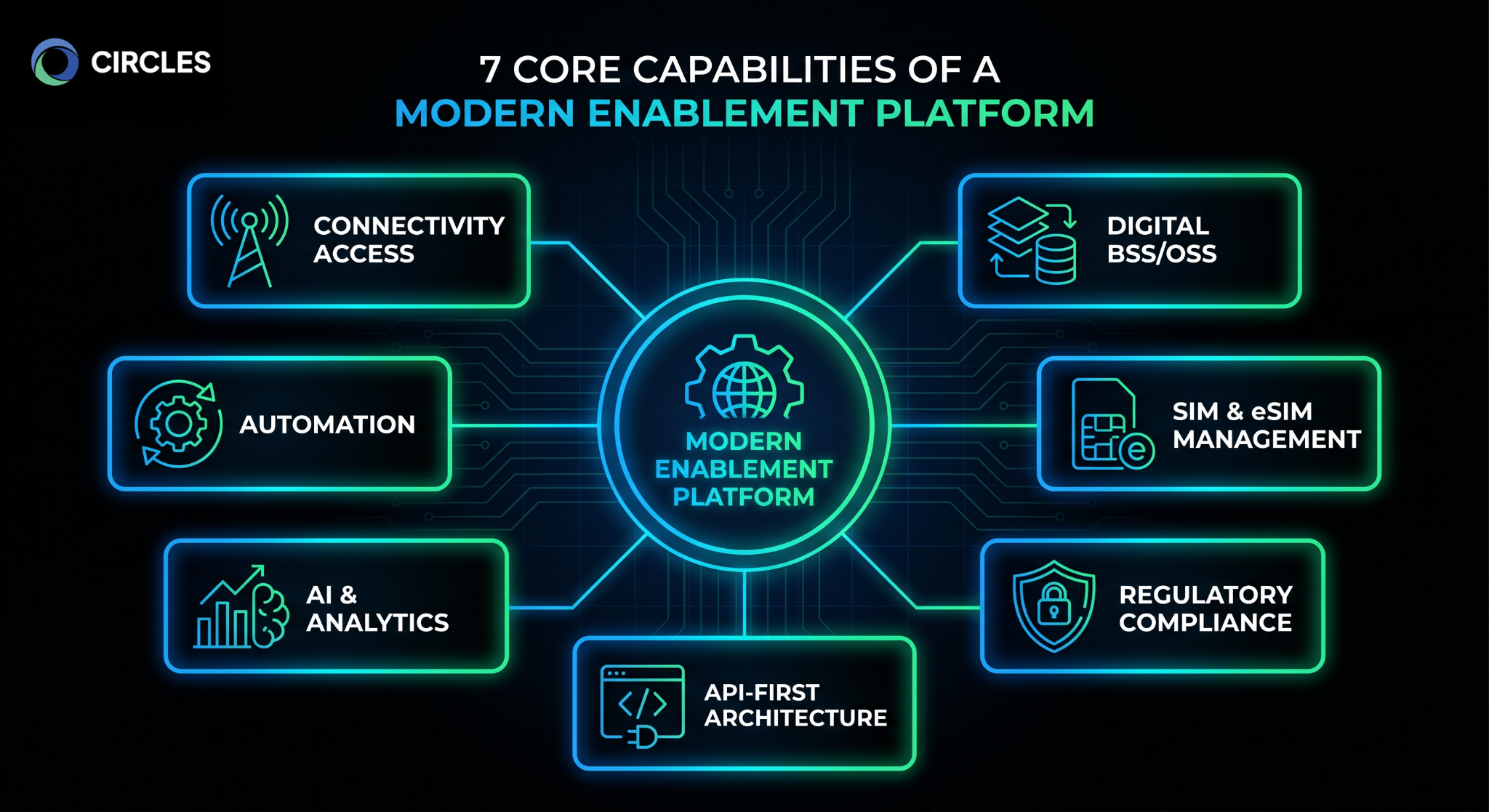
Now that the roles, trade-offs, and business value are clearer, the next step is to look at the core capabilities that actually make an MVNO/MVNE enablement platform work in practice.
Here are the 7 capabilities that shape how well the platform can launch, support, and scale a mobile service.
1. Connectivity and Network Access Enablement
Before an MVNO can sell anything, it needs a working link into the host network. This is the layer that supports voice calls, SMS delivery, mobile data sessions, roaming access, and the exchange of usage records needed for charging.
If the setup is shaky, customers may face failed activations, dropped access after sign-up, missing roaming service, or usage that does not bill properly.
2. Digital BSS/OSS for MVNO Operations
This core capability keeps the day-to-day service moving properly. It covers the systems that handle sign-ups, plan setup, SIM and eSIM activation, billing, top-ups, usage updates, and service changes.
This is where modern BSS and OSS operations matter most, because even a simple action like changing a data plan or turning on roaming can go wrong when the backend flow is weak.
3. SIM Management and Provisioning
SIM management and provisioning handle the exact steps that make a mobile service usable. This includes assigning a physical SIM or eSIM profile, linking the ICCID and mobile number, activating the right data plan, and processing SIM swaps when a phone is lost, damaged, or replaced.
If this flow fails, customers can get stuck with delayed activation, the wrong plan, or a number that does not work properly.
4. Regulatory and Compliance Readiness
Before a customer can activate a line, several checks usually need to happen quietly in the background. The platform should support SIM registration, identity checks, consent capture, number porting rules, and clear audit trails.
If those steps are patched together poorly, activations can stall, records can go missing, and simple onboarding can turn into a compliance problem fast.
5. API-First Architecture for Faster Integration
An API-first setup makes it easier to connect the platform with billing tools, CRM, host network systems, payment gateways, and customer apps without building every link from scratch.
That matters when an operator needs to launch online sign-up, real-time usage checks, eSIM activation, or plan changes across different systems without long manual integration work slowing everything down.
6. Embedded Analytics and AI for Operational Intelligence
Built-in analytics should show more than headline growth numbers. Operators need to see failed eSIM activations, payment drop-offs at checkout, unusual data spikes, roaming pass uptake, repeat support contacts, and plan changes by segment.
AI can then spot patterns such as rising churn after the first bill, repeated onboarding failures on one device type, or fraud signals linked to SIM swap requests.
7. Automation and Closed-Loop Operations
Things will go wrong at some point, so the platform needs to respond without waiting for someone to notice. If an activation fails, a port-in gets stuck, or a billing update does not go through, it should trigger the next step straight away.
That might mean retrying the action, flagging the case, or sending the customer a live update before frustration builds.
5 Key Benefits of Deploying MVNO/MVNE Enablement Platforms
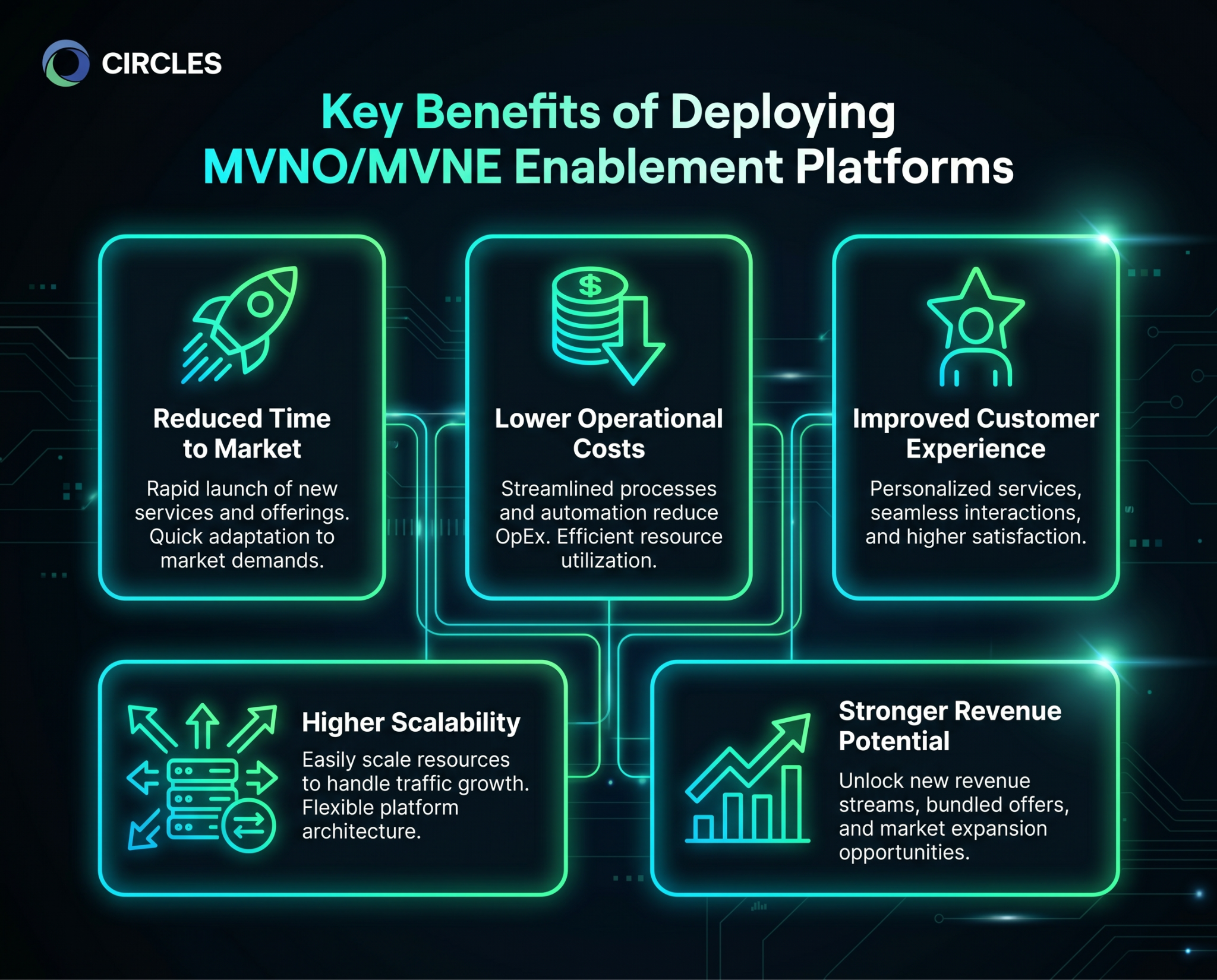
It is one thing to understand the features of an enablement platform, but another to see why they matter in day-to-day telecom operations.
To make that easier, here is what MVNO/MVNE enablement platforms can help telecom operators do more effectively.
1. Reduced Time to Market
A faster launch usually comes down to how much you need to build from scratch. When onboarding, billing, SIM setup, eSIM activation, and plan configuration already sit on one platform, teams can move far quicker. That difference becomes much clearer when you look at delivery timelines:
Gigs2 notes that launching an MVNO in-house can take 12 to 30 months, while cloud-based MVNE platforms can reduce that to as little as 6 to 8 weeks. That is a major advantage for telecom operators that want to launch a sub-brand, test a prepaid offer, or roll out a travel eSIM product without months of backend work.
2. Lower Operational and Integration Costs
Costs rise quickly when teams have to manage separate tools for billing, activation, CRM, support, and reporting. A stronger enablement platform reduces that sprawl by bringing more of those functions into one setup.
That can mean fewer custom integrations, less manual rework, lower support overhead, and fewer billing or provisioning errors that take time and money to fix.
3. Improved Customer Experience and Personalisation
Customers notice the service, not the backend, so the experience has to feel smooth from the start. A better platform supports faster sign-up, cleaner activation, real-time usage views, easier plan changes, and more accurate billing.
It also helps operators tailor offers more precisely, such as giving heavy data users different bundles, roaming passes, or upgrade prompts based on actual behaviour.
4. Higher Scalability and Flexible Growth Models
Growth gets harder when every new offer needs fresh system work behind it. A stronger platform makes it easier to add prepaid plans, postpaid options, travel eSIMs, enterprise accounts, or even a second brand without rebuilding the setup each time.
That gives telecom operators more room to test ideas, enter new segments, and scale without creating extra operational strain.
5. Stronger Revenue Potential for Both MVNOs and MNOs
When the setup works properly, there are fewer missed sales and fewer leaks in the day-to-day flow.
An MVNO has a better chance of converting sign-ups, charging correctly, and keeping renewals on track. An MNO can open the door to more wholesale income, support several partner brands at once, and spend less time untangling usage records or settlement issues.
Common Challenges MVNOs Face Without Proper Enablement

When the enablement layer is weak, problems usually start in places that seem small at first. A customer may finish sign-up, but the line does not activate, the selected plan does not attach properly, or the first bill shows something unexpected. These issues do not stay in the backend for long. They quickly affect customer trust, support workload, and the pace of growth.
Here are 5 common challenges that tend to appear when the setup behind the service is not strong enough.
Once these problems build up, they start feeding into each other. A failed activation can become a complaint, then a refund request, then a lost customer, which is much harder to recover from later.
That wider impact also shows up at market level: a BEREC-commissioned WIK-Consult study4 found that mobile prices fell by 15 to 25 percent in countries with MVNO access obligations, showing how stronger enablement conditions can shape competition and customer outcomes more broadly.
Common Deployment Models: SaaS, Managed Service, and Modular Stacks
Telecom operators do not all need the same kind of setup, so the deployment model can change how easy the service is to launch and run. Some teams want to move quickly with less technical work. Others want outside help with operations. Some prefer more control, even if that means more work behind the scenes.
Here are the 3 most common deployment models in more detail.
How to Choose the Right MVNO/MVNE Enablement Platform
Choosing the right platform is not just about features, but about whether it can support how your telecom operation actually needs to run.
To make that easier, here are the key areas telecom operators should look at when evaluating an MVNO/MVNE enablement platform.
Technical Criteria to Evaluate
A platform can look polished in a demo, but the real question is whether it can handle the technical work behind a live mobile service without creating problems later. The safest way to assess that is to look at the exact functions a provider should be able to support well.
When reviewing a provider, check for these technical points:
Operational and Business Criteria
A provider may look strong technically, but the platform still needs to fit how your telecom operation will run once customers are live. That includes launch pace, offer flexibility, reporting, finance workflows, and the level of support your team can rely on when issues appear.
When reviewing a provider, look closely at these operational and business points:
Security, Compliance, and Risk Management
This area is easy to overlook until something goes wrong. One weak permission setting, one missed identity check, or one suspicious SIM swap request can quickly turn into a customer issue, a compliance issue, or both.
When reviewing a provider, check these points closely:
Future-Proofing with eSIM, 5G, and IoT
A platform should support more than the service you are launching now. It should also give telecom operators room to adapt as next-generation networks and digital transformation continue reshaping telecom operations.
eSIM changes activation in practical ways, including QR-based setup, faster digital onboarding, easier device switching, and travel offers without physical SIM delivery. 5G can bring heavier data use, new charging logic, and more flexible service control.
IoT adds another layer, with large SIM volumes, low-data devices, long device lifecycles, and billing patterns that differ from consumer plans. The scale is already significant, with the Ericsson Mobility Report5 forecasting cellular IoT connections to reach about 4.5 billion by the end of 2025 and approach 8 billion by 2031.
FAQs
What Does It Cost To Launch An MVNO Through An MVNE?
The cost depends on platform scope, integration depth, compliance requirements, support model, and wholesale terms. The bigger the complexity, the higher the cost.
How Long Does A Typical MVNO Launch Take?
A typical launch timeline depends on host access, platform readiness, integrations, compliance checks, and testing. Simpler digital offers move faster than multi-product builds.
Can An MVNO Switch Hosts Later?
Yes, but it takes careful planning. Host changes usually affect integrations, SIM profiles, number management, billing flows, and the customer experience during migration.
Does Every MVNO Need An MVNE?
No. Some MVNOs manage more capabilities themselves, but many use an MVNE to speed up launch, reduce complexity, and avoid heavy infrastructure work.
Conclusion
Choosing the right platform affects far more than launch speed, because it shapes how smoothly your mobile service runs, adapts, and grows as demands change.
The strongest MVNO/MVNE enablement platforms bring onboarding, provisioning, billing, analytics, and service management into one clearer operating layer with fewer gaps and delays.
When that foundation is solid, telecom operators can launch with more control, reduce manual work, respond faster, and scale without adding backend friction.
If you want to modernise your telecom stack without adding more operational drag, Circles gives you the platform, expertise, and execution support to move faster.
References:
- Juniper Research - MVNO in a Box Platforms to Drive MVNO Market to 438 Million Subscribers Globally by 2030
- Gigs - The MVNO Launch Checklist: 14 Requirements Every Tech Company Needs in 2026
- Mordor Intelligence - Mobile Virtual Network Operator (MVNO) Market Size & Growth Report 2031
- BEREC / WIK-Consult - Study on Wholesale Mobile Connectivity: Trends and Issues for Emerging Mobile Technologies and Deployments
- Ericsson Mobility Report - IoT Connections Outlook