

Insights
8
5
min read
Telecom Loyalty Economics: Turning Rewards Into Customer Value and Growth
Increasing Touchpoints, Making Rewards Relevant, Boosting Loyalty Economics
Loyalty is one of the few levers that can improve perceived value, increase brand engagement, and defend customer relationships, making it vital in a price-sensitive telco market facing downward economic pressure.
However, in a market where connectivity is increasingly commoditized and where customers are inundated with loyalty programs across different lifestyle habits, telcos need to be alert for how to keep their loyalty programs both relevant and sustainable.
This article is part of a series on the role that telco apps and loyalty programs play in app monetization. The previous article of this series covered 5 key questions that app monetization projects need to answer here. This article explores what loyalty programs can do to further move commercial metrics.
What Telcos Are Saying: Relevance and Customer Value Are Crucial to Loyalty
Loyalty programs are under pressure to be more relevant to today’s shifting consumer preferences. In its latest loyalty report, BCG found that as a person joins more loyalty programs, that person’s loyalty and engagement to individual loyalty programs have declined.1 Being part of more programs means that there are more programs competing for that same person’s time, energy, and attention.
The study also found that younger consumers are increasingly willing to switch brands and loyalty programs. To retain customers in such a market, telcos are focusing on relevance and product value for customers in their loyalty programs.
Virgin Media O2’s Priority aims to be something that customers would miss if it disappeared, and this aim is pursued by creating experiences that create emotion and memory, such as concerts and sports team meet-and-greets.3
T-Mobile Tuesdays put customers first by aiming to exceed people’s expectations every week with relevant perks and experiences. This is done to make T-Mobile’s customers feel recognized, appreciated, and rewarded in a genuine way.4
Recently, T-Mobile celebrated 10 years of T-Mobile Tuesdays while having delivered more than 1.4 billion “thank yous” since 2016, which include 7-11 deals, free subscriptions to MLB.TV, movie subscriptions, and even fried chicken giveaways that resulted in stores using up all their stock on that day.
The key takeaway from Priority and T-Life is that loyalty programs need to provide rewards and perks that are continually relevant to customers.
Capturing Opportunities in the Participation Gap
Simon-Kucher’s 2025 Global Telecommunications Study mentions that loyalty program participation can increase customer lifetime value by 43 percent.2
Yet, though 80 percent of the respondent telcos offer a loyalty program, only half their customers subscribed to them.
Loyalty is being invested into, but this participation gap shows that there are still opportunities to be grasped by telcos.
Awareness plays a role in addressing this participation gap. One telco found that their loyalty program had increased the affected cohort’s NPS and lowered churn, but very few of their customers were aware of the program. Marketing this program boosted the number of active users while also preventing more than 10,000 customers from churning.5 When growing loyalty programs, both the quality and quantity of participants should grow together.
The Subscription Loyalty Paradox
As opposed to retail sectors, telcos cannot reward customer loyalty based on purchase frequency, as connectivity commitments are multi-year contracts, with some in the telco industry dubbing this the ‘subscription paradox.6
Fortunately, there are ways to solve this. Customers can be rewarded with higher tiers based on the number of different services they have subscribed to with their telcos,7 or rewarded them for engaging with other non-connectivity-related touchpoints.
Being aware of this paradox leads telcos to consider how loyalty can create new reasons for customers to engage, expanding the relationship and perceived value, thereby increasing loyalty before the next renewal or churn moment. Telco leaders also need to balance customer value with contribution margin, partner economics, and measurable cohort impact.
Awareness, Personalization, and Having the Right Partners Are Key
While T-Life’s and Priority’s successes show that customers want a greater variety of rewards that are relevant to their lifestyles, today’s customers are also expecting personalized rewards. BCG’s latest loyalty report found that while everyone of all ages wants rewards or benefits with tangible value, audiences between 18 and 34 prefer free content and media, personalized benefits, and digital engagement through social and mobile channels while older audiences prefer monetary benefits.1
Philippines’ Globe Rewards provides an interesting example. Noting an increased customer price-sensitivity due to the current cooling economy, their rewards program allows customers to use points for quick rewards like Jollibee vouchers or even offsetting their monthly utility bills.8
A Global Loyalty Organization research report further cements the idea that customers love earning and redeeming rewards from telcos that they can use in daily life:9
In short, telcos are increasing the relevance and popularity of their loyalty programs by adapting and personalizing the rewards to customers’ changing needs. On top of increasing value for customers, telcos can also look out for how their loyalty programs can further contribute to profitability.
Creating Loyalty Program Economics That Works
To refine their loyalty programs, telcos need to consider what customers find valuable, improve their engagement across more touch points, find the right partners to team up with, and consider how the commercial value is delivered. These then need to be measured carefully, such as tracking the loyalty program’s economic viability through a separate profit and loss statement specific to the program and tracking the impact of the program on loyalty program subscribers such as NPS improvements and ARPU increases.
Fortunately, there is a loyalty program that was recently launched in Singapore in 2025 that is worth discussing.
One Potential Solution: A Loyalty Program Marketplace That Offsets Bills and Provides Relevant Rewards

A top-performing loyalty program needs to increase customer touchpoints, make rewards relevant, and give the telco a clearer path to commercial value. This is where a marketplace-led loyalty model, like Circles.Life’s ZerofyX marketplace is worth considering.
Customers' daily spending is spread across transport, dining, shopping, entertainment, travel, devices, and other services, which allows a marketplace-led loyalty model to bring part of that spending journey into the telco app. This cashback marketplace lets customers spend with participating partner brands (Spend), earn cashback value (Earn), and apply that value to their mobile bill, telco services, devices, or other partner rewards (Zerofy).

This loyalty program changes the way that customers view a critical telco touchpoint: billing. Instead of treating their bills as another administrative task to complete, customers can now look forward to how much of their monthly telco bill has been offset by their rewards points, giving them a positive reason to return to the app outside routine issues or customer support needs.
This approach also gives telcos valuable behavioral data, including partner offer activation, cashback redemption, bill-offset behavior, repeat app visits, marketplace revenue, and cohort-level movement in retention, ARPU, or CLTV.
Discipline is still needed when executing this program. The program requires careful planning to ensure that relevant partners, simple redemption processes, clear reward economics, and rigorous measurement are implemented. Doing so successfully provides telcos a practical way to connect loyalty, everyday spending, app engagement, and perceived customer value in one loop while providing them a sustainable source of non-connectivity revenue.
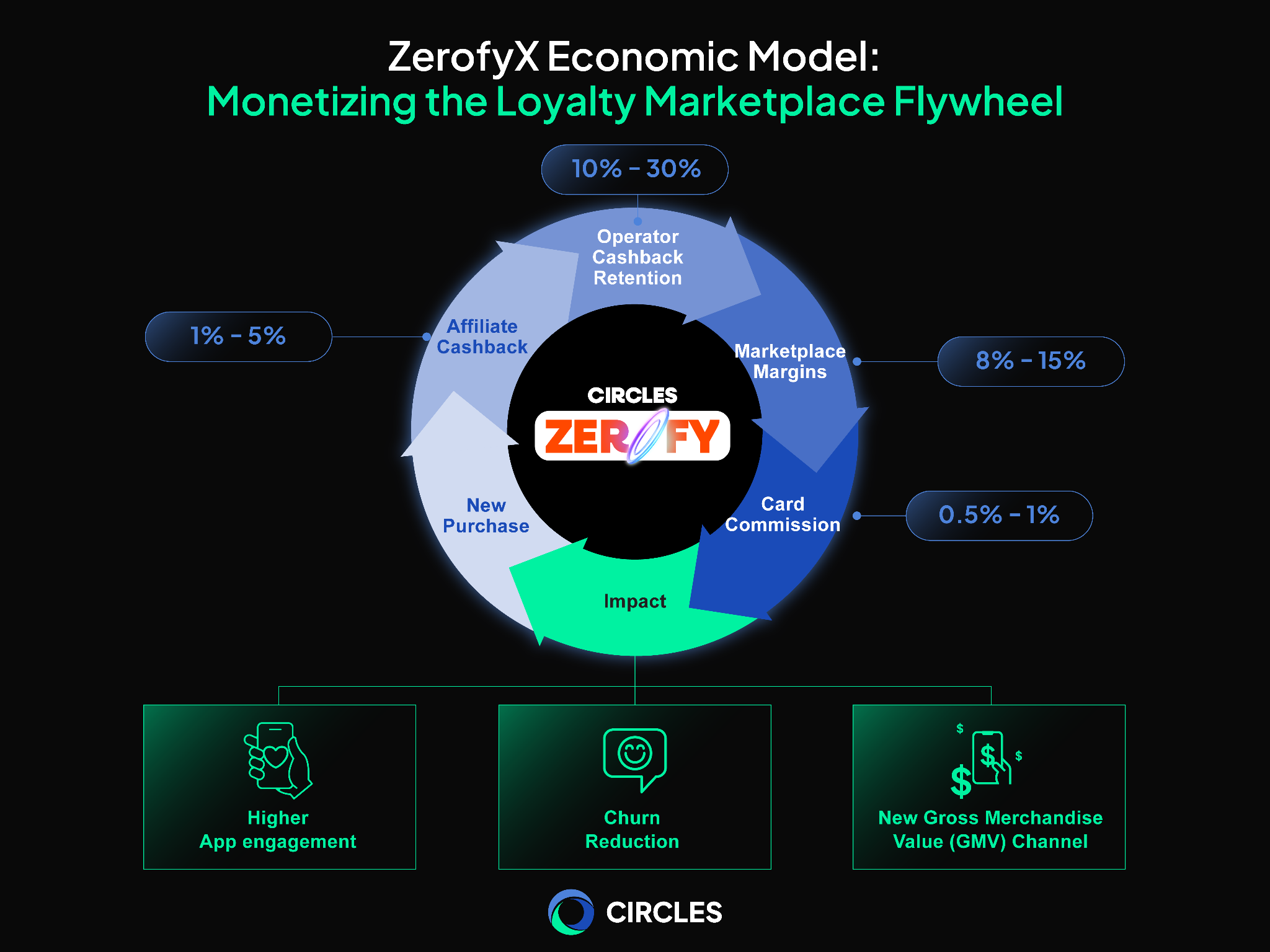
Moving From Loyalty Activity to Loyalty Economics
Having relevant partners and rewards for customers remains vital to the success of a loyalty program, but connecting the program and desired customer behaviors to commercial outcomes is what makes these programs sustainable and profitable.
Savvy telco CEOs understand that the mandate is to seek loyalty models that can improve perceived value, create more reasons to engage, support partner monetization, and strengthen the customer relationship. The monthly bill is usually a reminder of cost, which is why telco bill-linked rewards matter. If loyalty can turn that moment into visible value through offsets, viewing one’s progress with offsetting that bill becomes a loyalty moment.
That is where the conversation moves next: from rewards activity to loyalty economics, and from rewards that sit outside the bill to rewards that can help offset it.
ZerofyX is also part of Circles’ SaaS offering, meaning it can be woven into a client telco’s existing app, loyalty proposition, partner strategy, or digital brand experience.
Contact Circles today to explore how ZerofyX helps operators turn monthly bills into loyalty moments for your telco.
References:
- Loyalty Programs and Customer Expectations Are Growing | BCG
- Simon-Kucher (2025) - Loyalty pays: Monetization insights from the Global Telecommunications Study 2025
- Virgin Media O2: “Loyalty Isn’t a Scheme; It’s How We Prove We’re Worth Staying With” | LBBOnline
- T‑Mobile Tuesdays Turns 10: Celebrating the Weekly Perks Millions Love
- DMA - Glow Case Study
- TELUS Rewards: Reimagining Loyalty in the Subscription Economy
- #478: Leaders in Customer Loyalty: Brand Story | TELUS Transforms Loyalty by Delivering Value at Every Connection Point
- Globe Rewards 2026: Turning Every Point into Everyday Benefits
- Telco Loyalty in 2025: The Questions You Asked (And the Answers You Actually Wanted)