

Insights
7
5
min read
MWC 2026: Of Horizontal Telco Clouds and AI Monetization
Ecosystem Collaboration and Cloud Advancements Help Telcos Leapfrog the AI Race
While AI and the IQ Era were MWC 2026’s core themes, one more industry-shaping trend emerged at the event: new collaborations between diverse stakeholders that are creating profitable new opportunities.
These cross-industry collaborations are emerging and are essential for realizing the full value of today’s digital advancements. In fact, GSMA, the host of MWC 2026, itself launched Open Telco AI, a global initiative aimed at accelerating telco-grade AI between operators, vendors, AI developers, and academic institutions.
This marks the third trend that Circles’ post-show analysis series will be covering: how industry collaborations powered by advancements in telco clouds and AI monetization can help telcos leapfrog the AI race. The earlier two trends that have been covered are the following:
- AI is a structural transformation opportunity for telcos.
- Agentic AI and autonomous networks are changing the game for telcos.
GSMA’s Open Telco AI initiative is just one collaboration example. More traditional partnerships are also available to help telcos catch up in the AI race.
Advancements in Platforms and Cloud Can Help Telcos Catch Up
AI Radio Access Network (AI RAN) and AI-powered networks were some of the most popular phrases heard at MWC 2026. Telco OSSes are now being embedded with ‘AI control towers’ that can manage and optimize telco networks automatically. Meanwhile, agentic AI is also being used to improve customer experiences and make back-office processes more efficient. But without a way for telcos to quickly adopt these advancements, they won’t benefit from them.
One major bottleneck to telco AI adoption is legacy BSS/OSS friction with newer software, made more challenging by fragmented vendor software systems. In Mobile World Live’s Industry Survey 2026, data quality and availability were ranked the highest barrier to scaling AI across the telco, with integration with legacy systems coming in second.1 Running AI-Native operations on twenty-year-old software suites would take a lot of preparation and complex integrations, which would slow down time-to-market.
One key to helping telcos leapfrog onto AI-powered software advancements is the rise of the horizontal telco cloud. These cloud advancements are now providing safer, proven options for telcos to get in on the AI race by lowering software migration risks.
Performance and SLA Concerns Led to Vendor Software Fragmentation
Previously, telco networks have been largely built on multiple vendor stacks with fragmented management tools, lifecycles, and hardware requirements. This was needed because early public or horizontal cloud platforms couldn’t meet the strict low-latency, reliability, and security needs of telco services.
As a result of these requirements, each vendor had their own siloed, specialized, monolithic environments for the software they provided to the same telco, causing a complex and fragmented telco software ecosystem.
All these ‘spaghetti’ siloed vertical stacks drain CapEx and OpEx, preventing telcos from gaining efficiency.2 For processes like Network Functions Virtualization (NFV), the ambition was to run on a horizontal cloud model, similar to standard cloud environments, but early attempts fell short due to performance limitations and the lack of cloud-native design in telecom workloads.
But today, a common telco cloud can provide a single, common platform that stretches from the core data center to the radio site and out to public and private clouds. By standardizing everything in a consistent but flexible environment, telco networks can be managed in a consistent way.2
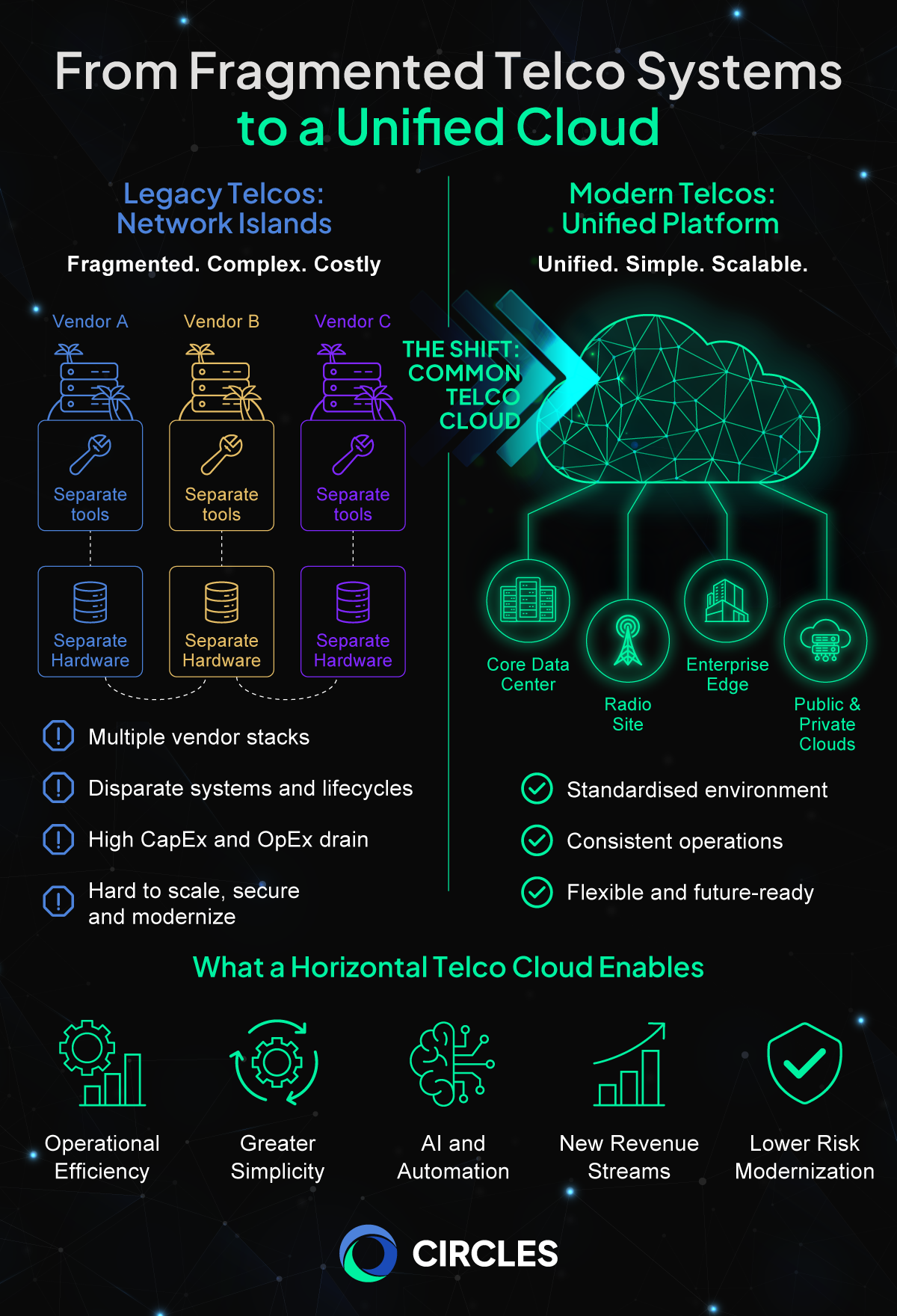
Moving to cloud-native telco AI software makes the AI adoption leap manageable for telcos who want to catch up in the AI race. By shifting to a full suite of software on a cloud, migration risks to business-critical functions can be lowered, maintaining the stability of legacy services while building the future using the same set of cloud-native tools.2
Projects that are building towards telco-friendly horizontal cloud platforms are gaining traction, such as the Linux Foundation’s Sylva Project. Project Sylva aims to provide open source releases to build a common cloud infrastructure that is tailored for the challenges and technical requirements of the telco ecosystem. Initiatives like these pave the way for telcos to unify their cloud platforms and de-risk the jump to modernization.3
By adopting a common, automated cloud architecture, operators can transform their networks into self-healing "brains" powered by advancements like AI RAN and network functions virtualisation (NFV) that are no longer hampered by a fragmented software infrastructure.
In short, collaboration with hyperscalers, cloud providers, and AI-powered telco software providers can help telco AI laggards to leapfrog to the forefront of the AI race in a relatively low-risk way. One example of this is Circles’ telco platform powered by Embedded AI in partnership with OpenAI, which supports cloud, on-premises, and hybrid cloud deployments.
Control Over Telco Data and Digital Sovereignty Strategic Imperative
Control over data, infrastructure, and AI systems is becoming a defining factor in telecom strategy, shaping how operators build, partner, and compete.
As AI becomes central to telecom operations, the data that powers it is emerging as a critical strategic asset. This is elevating digital sovereignty from a conceptual priority to an operational requirement. Operators increasingly need transparency, control, and auditability over their data and AI systems to ensure resilience and long-term competitiveness.
This shift is now influencing infrastructure decisions. Telcos are moving toward open and hybrid cloud models that allow greater flexibility and reduce dependence on single vendors, particularly when it comes to data lock-in. By separating software from hardware, operators can retain control over how their networks and AI capabilities evolve.
At the same time, broader geopolitical dynamics are reinforcing the importance of data sovereignty.4 In markets such as Europe, there is growing momentum behind regional cloud ecosystems and federated edge infrastructure, supported by both operators and public sector initiatives such as Project Sylva that enable European telco data to be more easily stored within Europe. This reflects a wider industry view that localized data control and data residency will play an important role in future network architectures.
AI Monetization - From Experimentation to Application
Meanwhile, the urgency for telcos to monetize AI is at an all-time high. In this next "industrial phase" of AI, best-effort connectivity alone will no longer suffice for telco growth, and AI will need to be seen as a lever for revenue growth as opposed to just for cost savings.
Currently, most telcos see AI as a cost savings and efficiency lever, while one in four are focusing on revenue targets for AI projects. This highlights a key gap between AI’s perceived potential and its current commercial impact.5
Leaping ahead of the curve, some telco leaders are already launching AI-powered monetization initiatives like the following:
Performance-based Connectivity: Strategic Priorities Beyond Speed
One monetization opportunity that telco leaders are seizing is providing differentiated, performance-based connectivity that can power advanced applications from agentic AI for enterprises and consumers to physical robotics.
The latest research shows that at least 65 operators globally are already launching commercial offerings based on 5G Standalone and network slicing to create better connectivity outcomes that people may be more willing to pay for.5 This is part of a change of thinking away from “megabits per second” to connectivity outcomes baked on connectivity quality, resilience, and service trustworthiness, such as:
Ericsson’s consumer research found that 40 percent of respondents could identify opportunities where they would “opt for assurance (of guaranteed network performance), with almost half willing to pay for it.6”
Physical AI
MWC 2026 was also filled with AI-powered devices and services that could power the next tech generation. One standout feature was a new generation of smart glasses, such as Alibaba’s Qwen Sunglasses, that have a heads-up display and are powered by Alibaba’s Qianwen AI that can power use cases like real-time translation.7
Other Notable AI-based Monetization Methods
Telcos have a variety of ways to start monetizing AI as well, such as GPU as a service (GPUaaS), AI platforms, IoT, and cloud gaming. GSMA highlights that these opportunities and dynamics are also pushing telcos towards partnership-led models where telcos can reposition themselves as the following:3
MWC is demonstrating that the proof-of-concept and wait-and-see period for AI adoption could be coming to a close, but there’s hope. With how flexible the industry is becoming, the right revenue model can be obtained through creativity and the right partnerships.
From Capability to Competitive Advantage
The telecom industry is entering a decisive phase. With 5G standalone, cloud-native architectures, and AI now in place, the focus has shifted from adoption to value realization.
Execution will define the winners. Operators that can translate AI and infrastructure investments into measurable outcomes, including faster time to market, lower costs, and new revenue streams, will gain a clear advantage. Those held back by legacy systems and slow transformation cycles risk falling behind.
The shift toward modular, lower-risk transformation reflects this reality. Speed, flexibility, and return on investment are now critical.
Circles are aligned with these needs. Its asset-light SaaS model and digital-first platform enable operators to modernize quickly without heavy legacy transformation. More importantly, it acts as a monetization and growth layer, helping telcos convert technical capability into real business performance.
Derisking The Jump With Cloud-Native Telco Software
At Circles, we have watched this evolution closely through our own DMO (Digital Mobile Operator) brands and our global software deployments. Various observers have noticed that telcos need to seize developments like advancements in telco cloud and agentic AI as a chance to structurally transform themselves for the IQ era.
True digital agility requires infrastructure flexibility. Whether an operator chooses a public cloud for its scale, on-premises for its sovereignty, or a hybrid model for its balance, the underlying software must be consistent.
Circles’ SaaS solution provides a common platform that helps telcos transition into techcos with a proven migration track record, reducing the risk of moving business-critical functions onto new systems. Its flexible architecture supports both cloud and on-premises deployments, allowing operators to modernize without the complexity and cost associated with traditional BSS transformation. By reducing dependence on legacy systems and enabling faster deployment of digital services, Circles supports a more agile and efficient approach to innovation.
At the same time, Circles’ end-to-end telco AI platform helps operators avoid vendor lock-in by offering a unified and flexible software stack. This enables operators to modernize their systems without disrupting existing operations, allowing them to focus on turning connectivity into measurable outcomes and infrastructure into revenue. More importantly, the platform is designed to deliver business impact, acting as a monetization and digital growth layer that accelerates service launches, enhances customer engagement through AI, and supports new revenue models with improved unit economics.
Circles’ full-stack telco software is also powered by a close partnership with OpenAI while supporting cloud, on-premises, and hybrid cloud deployments. You can find out more about Circles’ AI-powered telco platform, Circles X, in the video below:
The next phase of telecom transformation will be defined not by AI adoption, but by execution and ROI. Circles is positioned to help operators make that shift, turning digital capability into sustained revenue growth.
References:
- Industry Survey Report 2026 - Mobile World Live
- Opinion: From legacy virtual machines to the network brain: Why 2026 is the year of the common telco cloud
- Project Sylva
- Global push for 'digital sovereignty' risks complicating global data flows, innovation | IAPP
- How 5G Standalone is transforming telco revenue in APAC
- Winning in the market with differentiated connectivity offerings
- Watch Out, Meta. I Tried Alibaba's Qwen Smart Glasses and They're Mega Impressive - CNET