

Knowledge Hub
5
min read
Open APIs and Interoperability in Telco Systems
Open APIs matter when telco systems cannot keep pace with digital demand, and interoperability becomes the line between progress and constant workaround.
Open APIs in telecom give BSS, OSS, customer apps, billing platforms, product catalogues, and partner systems a shared way to exchange data, so teams can connect services without rebuilding every integration from scratch.
In this article, you will learn how open APIs support interoperability, system integration, industry standards, business value, and API-first adoption.
Let’s open the stack.
What Are Open APIs in Telecom?
Open APIs in telecom are agreed-upon ways for different telco systems to connect and share information without requiring a new custom build each time.
Think of a mobile plan change in a customer app. That one action may need to check the product catalogue, update the customer account, adjust billing, trigger service activation, and send a confirmation message. Without open APIs, each step can depend on separate links between separate systems, which slows work down and makes changes harder to manage.
Open APIs give BSS, OSS, apps, billing tools, partner platforms, and network systems a shared language. This helps teams move data, request actions, and expose useful capabilities in a more consistent way.
They also matter in BSS/OSS transformation and TaaS models because telcos need modular systems that can connect faster, scale more easily, and support new digital services without rebuilding the whole stack.
The Role of Open APIs in BSS and OSS Integration
Now that you know what open APIs help with, it is time to see where they connect the customer-facing and network-facing sides of telco systems.
With that said, here are the 5 roles of open APIs in BSS and OSS integration that make this connection possible.
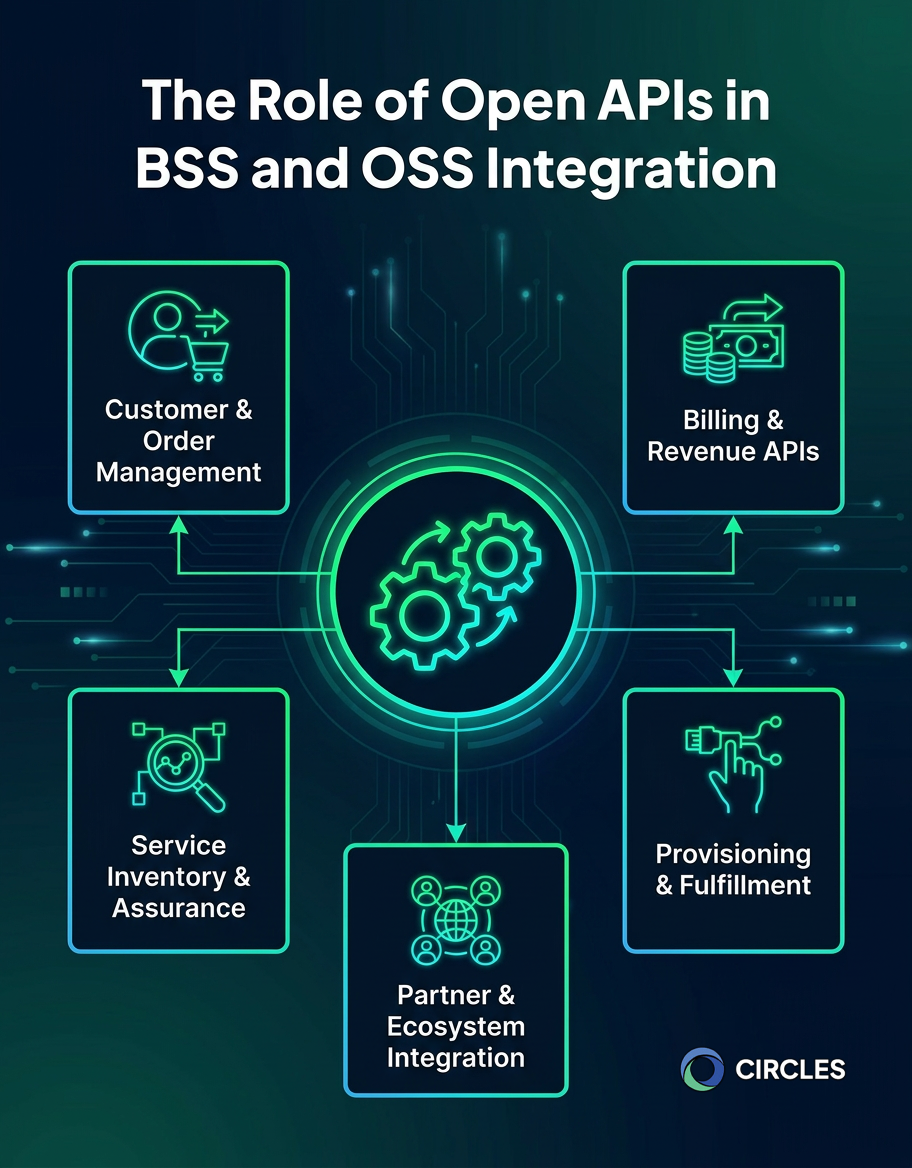
1. Customer, Product, and Order Management APIs
Customer, product, and order management APIs connect what customers see with the systems that process each request behind the scenes. They link profiles, product catalogues, eligibility checks, shopping carts, order capture, and order status updates, so the sales journey does not break between screens.
When a customer buys an eSIM plan, the API flow can check the offer, confirm the plan is available, create the order, update the account, and send the request to fulfilment without manual copying or delays.
2. Billing, Charging, and Revenue APIs
A small add-on can create a long trail behind the scenes. A roaming pack, prepaid top-up, refund, discount, or plan upgrade may touch usage rating, tax rules, invoices, payment status, and partner settlement.
Billing, charging, and revenue APIs keep that trail from getting messy. They help the right charge appear in the account, the bill view update, the payment record sync, and the transaction move into revenue tracking without teams checking each system by hand.
3. Service Inventory, Assurance, and Trouble Ticket APIs
Service inventory, assurance, and trouble ticket APIs help teams see what is running, what is broken, and who is affected. They connect active services, network resources, alarms, performance data, fault records, support cases, and technician updates in one working flow.
When a broadband service drops, these APIs can match the customer to the service record, check related network alerts, open a ticket, show the support team the issue, and update the customer once progress changes.
4. Provisioning, Activation, and Service Fulfilment APIs
This is the point where a sale becomes a live service. The order has been accepted, but the system still needs to assign a number, prepare the SIM or eSIM profile, check entitlements, configure the network, and update the service record.
Provisioning, activation, and service fulfilment APIs help these steps move without constant handoffs between teams. For a new mobile plan, that can mean the customer signs up, receives activation in the app, and starts using the line sooner.
5. Partner, Channel, and Ecosystem Integration APIs
Think of this as the bridge outside the operator’s own stack. Retail channels, resellers, digital partners, marketplaces, and enterprise platforms often need access to offers, pricing, eligibility, activation status, and order updates.
Open APIs let them plug into selected functions without exposing the full system. A partner can submit an order, check fulfilment, receive service updates, or support a customer, while the operator keeps control over permissions, data access, usage limits, and security rules.
5 Key Drivers Behind Open API Adoption
Now that you know how APIs help BSS and OSS connect, it’s easier to see why operators are taking open API adoption more seriously.
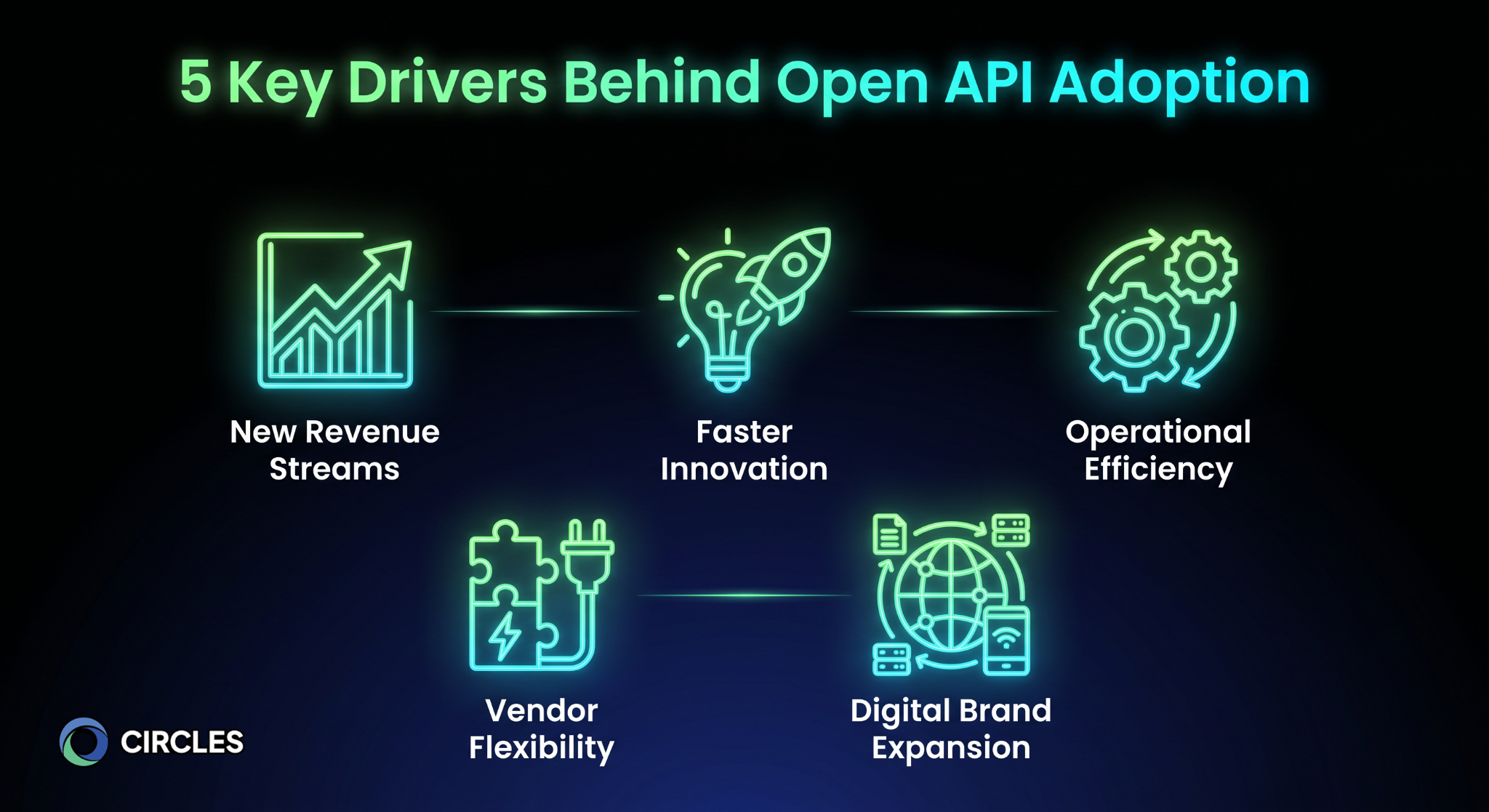
Here are 5 key drivers behind open API adoption in modern telco systems.
Major Industry Standards You Should Know
Open APIs only work well when operators, vendors, developers, and partners follow shared rules instead of building every connection in their own way.
Here are the major industry standards you should know before looking at how open APIs support wider telco interoperability.
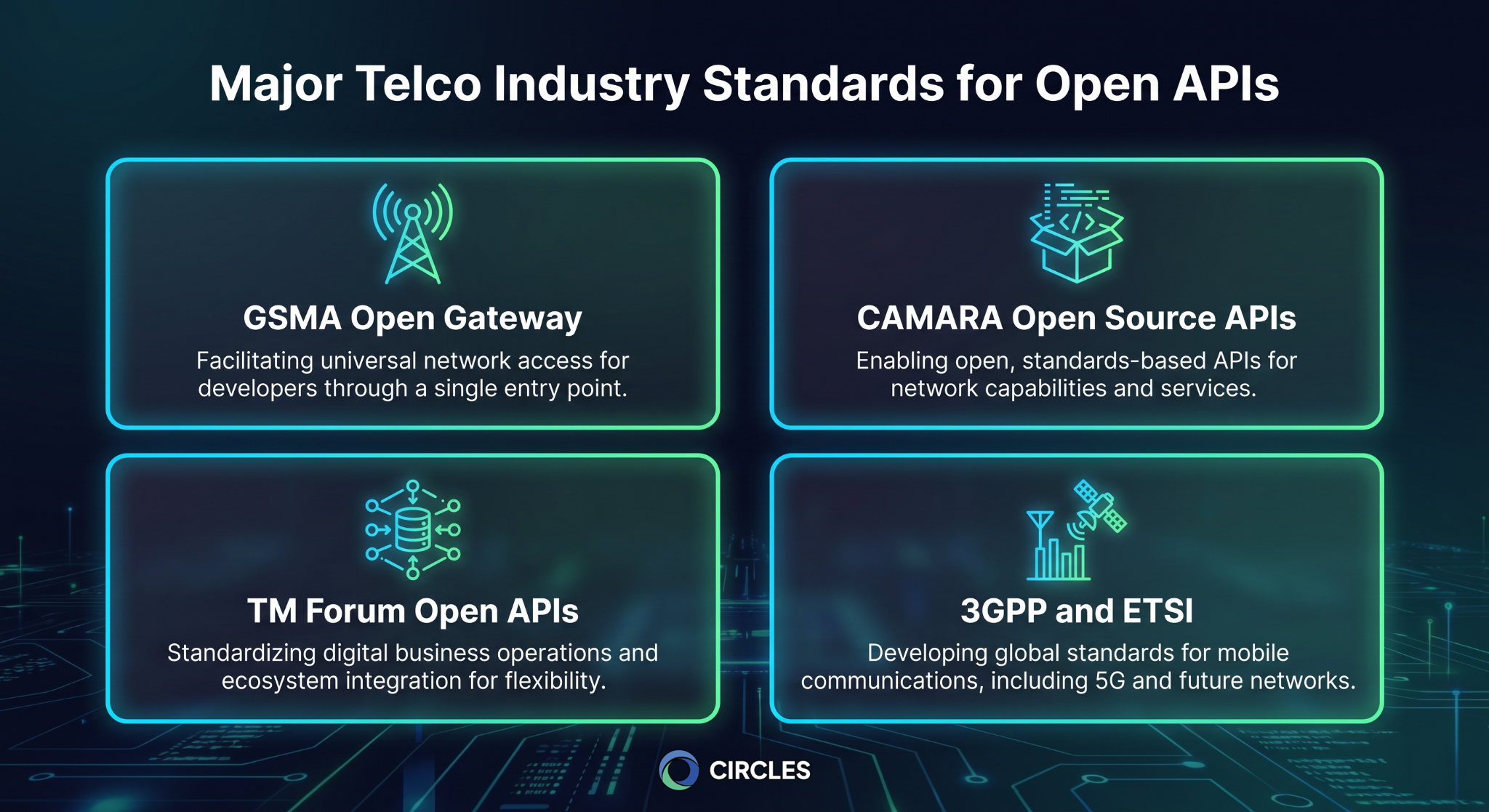
1. GSMA Open Gateway
GSMA Open Gateway gives operators a shared route for exposing network features through APIs, instead of asking developers to rebuild for each operator.
Its adoption is already moving at scale: GSMA Intelligence1 reported that 67 mobile operators had committed to Open Gateway APIs by December 2024, covering around 75% of global mobile connections.
For telcos, this makes use cases such as number verification, SIM swap checks, device location, quality on demand, and fraud prevention easier to expose while keeping control over security, permissions, and network data.
2. CAMARA Open Source APIs
Think of CAMARA as the workshop where many network APIs are shaped, tested, and refined before wider use. Its work includes areas such as number verification, SIM swap, device location, quality on demand, and edge discovery.
This helps telcos avoid fragmented API builds and gives developers a more predictable way to use network features across different markets.
3. TM Forum Open APIs
The clearest use case for TM Forum Open APIs is inside BSS and OSS. A telco may need a product catalogue, customer profile, order capture, billing account, service inventory, and trouble ticket systems to share updates.
These APIs give those systems a common structure, so teams are not forced to build another custom connector every time one platform changes.
4. Other Key Standards: 3GPP and ETSI
3GPP and ETSI sit closer to the network layer than the business stack. 3GPP defines how mobile networks behave, including 5G core functions and service exposure. ETSI supports areas such as network function virtualisation and multi-access edge computing.
Together, they help operators build virtualised, software-defined networks where new components can still work across vendors, domains, and markets reliably.
How Open APIs Help Telco Businesses
Open APIs do more than connect systems in the background; they shape how fast a telco can launch, serve customers, work with partners, and adapt when the market changes.
Here are some of the various ways open APIs help telco businesses turn connected systems into practical business value.
5 Challenges Telcos Must Overcome
Open APIs can make telco systems easier to connect, but they do not remove every technical, security, and operational problem on their own.
Here are the 5 challenges telcos must overcome before open APIs can deliver real interoperability across the business.
1. Legacy System Integration
Legacy system integration is usually the first hard stop. Many operators still depend on older billing engines, customer databases, provisioning tools, and network inventory systems that were not built for API-led work.
Adding APIs on top can help, but it does not magically fix poor data quality, hidden dependencies, or brittle workflows. A plan change may still fail if the old system cannot update customer records, charging rules, and service status at the same time.
2. Security and Data Privacy
Once APIs open a path into customer or network data, the real question is who gets through, how often, and for what reason. A partner checking location, billing status, identity, or service availability should meet clear consent rules, token checks, usage caps, encryption, audit logs, and live monitoring.
The risk is not theoretical: Market Growth Reports and Analysys Mason research4 found that 64% of telecom operators report frequent unauthorised API access attempts.
Blockchain-enabled trust and security in telecom may help record sensitive actions more clearly, but the basics still carry the load: gateways, privacy controls, and partner access rules.
3. Developer Skill Gaps
Not every team that runs a telco platform is ready to design APIs well. A network engineer may know provisioning deeply, while a billing team may understand rating rules, but API-led work also needs documentation, versioning, testing, cloud architecture, security reviews, and clean error handling.
Product teams need to explain use cases clearly, too. Without shared standards, one team may build something reusable, while another creates another fragile link.
4. Clear Monetisation Models
A useful API is not always a profitable one. Telcos still need to decide what they will charge for, who pays, and how usage gets measured. Number verification, quality on demand, location checks, fraud signals, and partner access may each need different pricing logic.
Some fit per-call pricing, while others need bundles or service tiers. Without a clear model, APIs can attract interest but fail to become a serious revenue channel.
5. Global Interoperability
The same API can behave very differently once it crosses borders. One market may require extra identity checks, another may have different billing fields, roaming rules, data storage limits, or regulator reports.
Vendors also vary by country, so the backend is rarely identical. Telcos need common standards, but they also need room for local rules. Without that balance, a digital brand or partner service can work well in one country and stall in the next.
What Telcos Should Consider Before Adopting an API-First Model
An API-first model should start with the services that already cause friction, not with a broad plan to open everything at once.
Telcos can look at journeys such as eSIM onboarding, plan changes, roaming add-ons, partner sales, billing updates, service activation, and fault reporting. These are the places where customers wait, agents chase details, or teams copy data between tools.
The basics also need checking. Customer records, product catalogues, billing rules, service inventory, and partner data should be clean enough to share. If not, APIs may simply move messy data faster.
Each API also needs an owner, documentation, version control, access rules, usage limits, testing, and monitoring.
The real question is this: what should become reusable, and what needs fixing first?
FAQs
What Is The Main Difference Between An Open API And A Private Or Internal API?
An Open API uses shared, published rules for wider system or partner access, while private APIs usually serve controlled internal teams or systems.
Do Operators Need To Modernise Legacy Systems Before Adopting Open APIs?
No, but legacy systems must be assessed first, because weak data, old workflows, and brittle integrations can limit what APIs can safely expose.
How Do Open APIs Support 5G And Advanced Network Capabilities?
Open APIs help expose capabilities such as quality control, location, slicing, identity checks, and service status to authorised apps, partners, and platforms.
What Are The Biggest Risks Of Exposing Network APIs?
The biggest risks include unauthorised access, data leakage, poor consent handling, weak monitoring, unclear ownership, and misuse of sensitive customer or network signals.
Conclusion
Open APIs are no longer a technical nice-to-have; they are becoming the working layer behind faster telco change.
In modern telco systems, Open APIs help turn interoperability into something practical, so customer data, billing, service activation, network updates, and partner requests can move without constant rebuilding.
That does not mean every system needs to change overnight, but it does mean operators need the right platform foundation to make change easier, safer, and more scalable.
Ready to build on that foundation? Explore how Circles helps operators launch, grow, and scale modern digital telco experiences.
References:
- GSMA Intelligence - Open Gateway: State Of The Market H2 2024
- Arthur D. Little - Open Digital Architecture: The Next Frontier For Telecom Operators
- Mordor Intelligence - Telecom API Market Size, Growth Analysis & Industry Research Report 2030
- Analysys Mason - Open RAN Progress Drives Confidence It Will Deliver On Operators’ Strategic Objectives
- STL Partners forecast, cited via Telecoms.com — Network APIs Finally Reached An Inflection Point In 2025