

Knowledge Hub
7
5
min read
AI in Telecommunication: Use Cases, Benefits, And Challenges
Telcos are under pressure to reduce churn, cut operating costs, modernize legacy systems, and grow revenue, and AI is becoming one of the strongest ways for operators to respond.
At its core, AI helps telecom operators analyze data, automate decisions, improve network performance, personalize customer experiences, and unlock new revenue opportunities across digital services.
In this article, we’ll explore what AI for telco means, the core technologies behind it, its most valuable use cases, key benefits, adoption challenges, and how operators can start using AI effectively.
Let’s get into where AI creates real value for telcos.
What Is AI For Telco?
AI for telco means using artificial intelligence on the everyday work of a telecom operator: reading network alarms, predicting churn from usage drops, spotting SIM swap fraud, helping agents explain bills, and suggesting the next best plan before a customer leaves.
It works because telcos already collect rich signals from call detail records, app behaviour, top-ups, roaming usage, support tickets, payment history, and network performance. AI connects those signals so teams can act sooner, not after the damage is done.
Used well, it helps a telco reduce service queues, fix faults faster, personalize bundles, prevent revenue leakage, and launch digital services with less manual work. The real value is practical: better decisions, fewer delays, and smoother customer journeys every day.
Why AI Matters For Telecom Operators Now
AI matters for telcos now because customers move faster than legacy systems. A subscriber can run out of data, complain in the app, compare a rival plan, miss a payment, and request a port-out before the next churn report lands.
AI helps operators spot these signals earlier and respond while the customer is still willing to stay. It can:
The pressure is not only external. Network teams manage heavier video traffic, gaming sessions, IoT devices, 5G usage, and outage alerts. Care teams handle eSIM activation issues, failed payments, bill shock, plan changes, and repeat support tickets.
AI reduces the manual work behind these moments. It can summarise tickets, route complaints, suggest next-best offers, automate checks, and help telcos launch digital services with less friction.
The business case is becoming clearer too: NVIDIA’s 2025 telecom survey1 found that 83% of respondents said AI helped increase annual revenue, while 77% said it helped reduce annual operating costs.
5 Core Technologies Behind AI In Telecom
AI in telecom works by using different technologies for different jobs, from predicting churn to spotting network issues and supporting customer care.
With that in mind, here are the five core technologies that make AI useful for telcos in real-world operations.
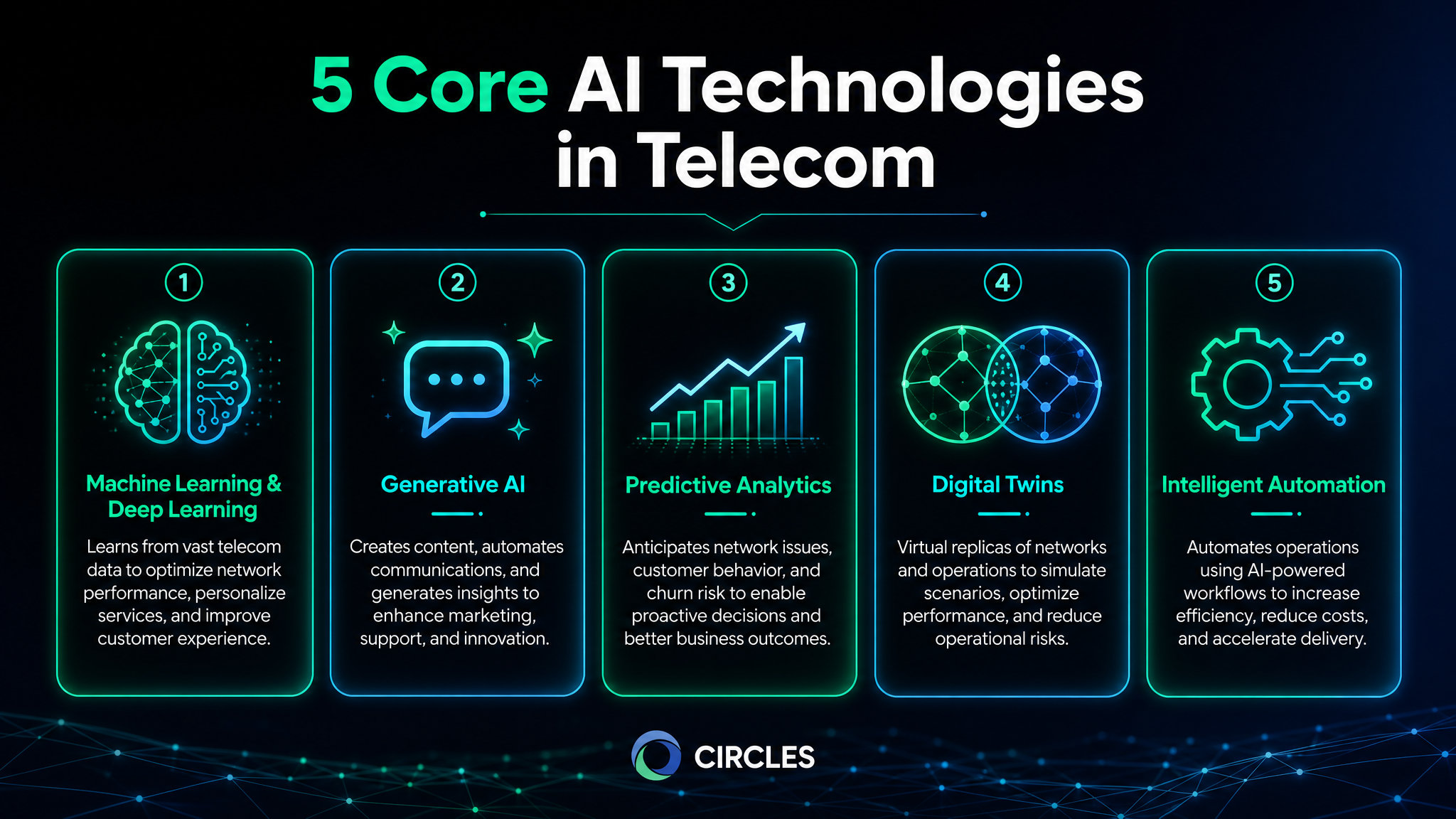
1. Machine Learning And Deep Learning
Machine learning helps telcos analyse massive amounts of customer and network data without waiting for manual reports. It can compare prepaid top-ups, app clicks, late payments, roaming spikes, dropped calls, support notes, and cell-site load in one view.
Deep learning handles messier clues, such as call recordings, SIM swap attempts, fraud patterns, and sudden traffic surges.
The payoff is practical: teams can predict churn, ease congestion, protect accounts, and fix service issues before complaints or revenue loss grows.
2. Generative AI
A customer asking about roaming charges or eSIM setup should not wait while an agent searches five systems for the full story. Generative AI can summarise past chats, read account notes, and draft a clear reply using the telco’s knowledge base.
The same approach helps marketing and product teams turn a new data bundle into prepaid campaign copy, app messages, FAQs, support notes, and sales scripts.
McKinsey2 reported real telco gains from this kind of work, including a European operator that increased marketing campaign conversion rates by 40% and a Latin American operator that raised call-centre agent productivity by 25%.
3. Predictive Analytics
Say a prepaid user usually buys a data pack every Friday, then misses two weeks and starts opening porting pages in the app. Predictive analytics helps a telco catch that pattern early.
It can also flag late-paying postpaid users, busy cell sites near stadiums, likely roaming demand before holidays, and repeat outage complaints in one area. Instead of waiting for reports, teams can send a save offer, add capacity, brief agents, or fix service before customers leave.
4. Digital Twins
A digital twin lets a telco rehearse changes before touching the live network. Picture a stadium before a concert, with thousands of phones uploading videos, using maps, and buying roaming add-ons. Teams can test extra capacity, cell-site settings, outage paths, and energy-saving rules in the model first.
If a weak spot appears, they can adjust the plan before customers feel it. That makes upgrades, 5G rollouts, and service recovery safer, cheaper, and easier to explain internally.
5. Intelligent Automation
When a SIM activation fails, the customer should not wait while care, billing, and provisioning check different screens. Intelligent automation can read the account status, payment result, device type, eSIM download, and provisioning error, then open the right workflow.
It can approve a small refund, update a ticket, change a plan, or send an outage alert. For telcos, the win is simple: fewer handoffs, fewer repeat calls, and faster fixes for routine customer problems without making them chase support again.
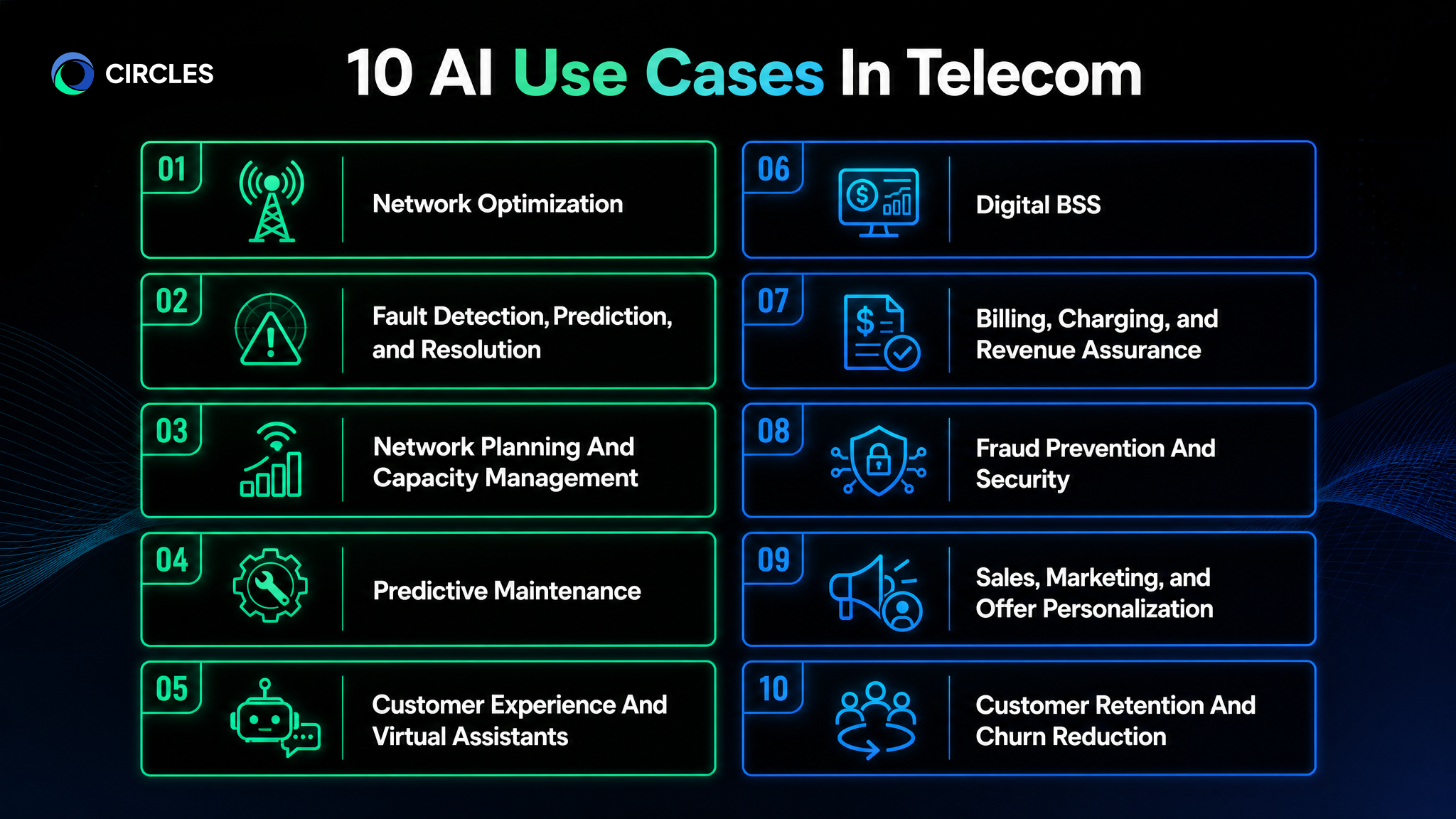
10 AI Use Cases In Telecom
Now that the core technologies are clear, the next step is seeing how they show up in real telco work, from network performance to customer care, billing, fraud, and retention.
With that said, here are the 10 AI use cases that show where telcos can create the most practical value.
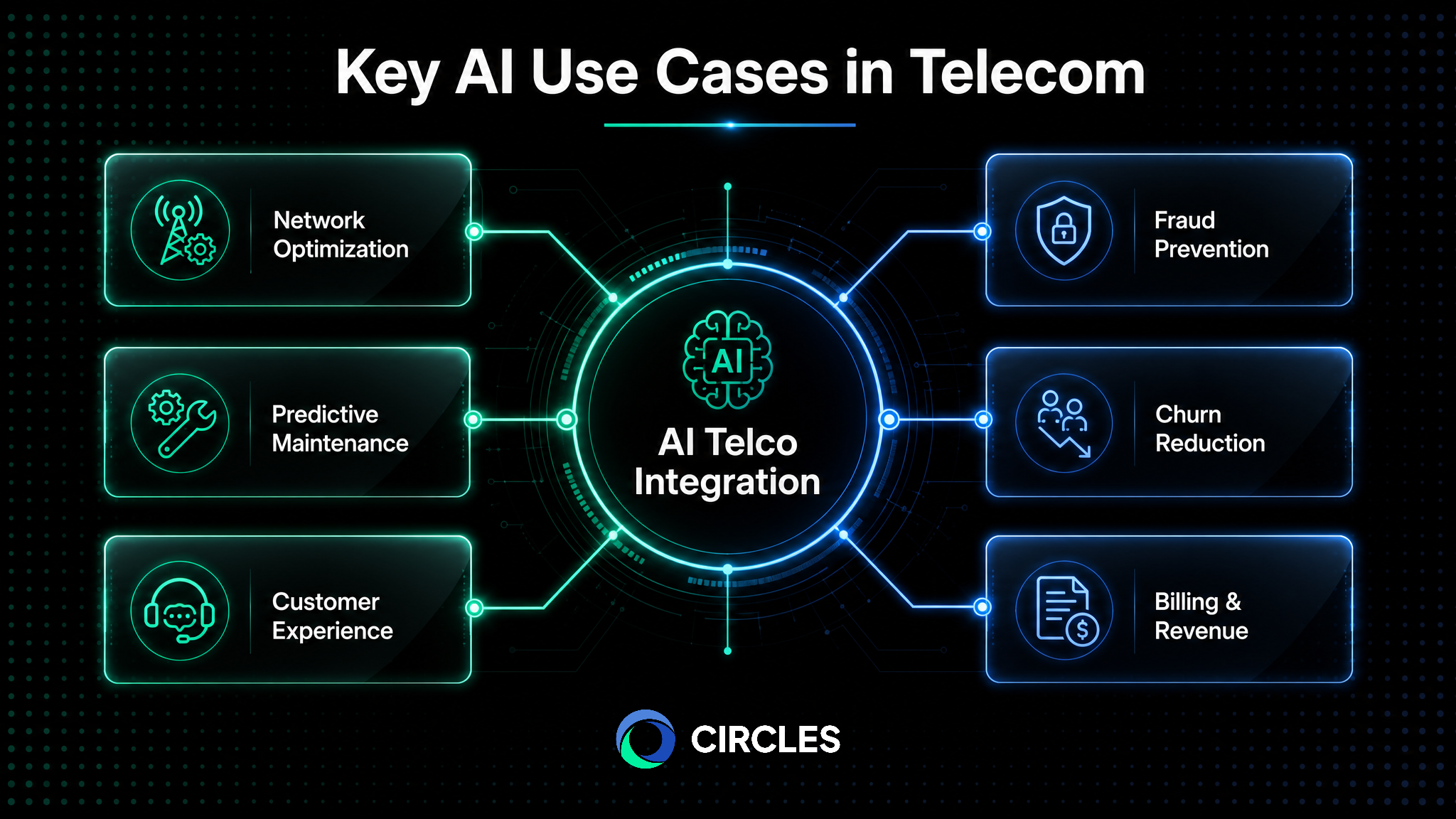
1. Network Optimization
Network optimization is where AI can give telcos fast, visible gains. It can read traffic loads, dropped-call rates, signal strength, device movement, and cell-site congestion to spot weak areas.
During a concert, commute, or sports event, AI can help shift capacity, reduce buffering, and keep high-demand locations running before customers start reporting slow service.
2. Fault Detection, Prediction, and Resolution
When a fibre line breaks or a router starts dropping sessions, alarms can flood the NOC in minutes. AIOps for telcos helps compare error codes, tower logs, weather reports, trouble tickets, and past outages to find the likely cause.
Engineers see which customers are affected, what changed, and which fix to try first, so downtime and repeat complaints fall faster for everyone.
3. Network Planning And Capacity Management
Before adding a new tower or small cell, planners need more than a coverage map. AI can compare school openings, condo projects, stadium events, commuter patterns, handset types, and evening video traffic by site.
That helps telcos see where capacity will tighten, where backhaul needs upgrading, and which areas may struggle when 5G adoption or home broadband demand rises.
4. Predictive Maintenance
A hot base station cabinet or weak backup battery is easy to miss until service drops. AI can track tower temperature, fan speed, fibre signal loss, power usage, battery health, and repair history.
When the signs point to failure, field teams can visit early, replace parts, and avoid emergency truck rolls that disrupt customers during peak hours or bad weather.
5. Customer Experience And Virtual Assistants
A customer asking why their bill jumped should not repeat the story in chat, app, and call centre. AI can read usage, roaming charges, add-ons, payments, and past tickets, then guide customer experience chatbots or agents with the right answer.
Customers get quicker help, while human agents spend more time on complex cases like fraud, churn risk, or escalated complaints. PYMNTS Intelligence and AI-ID3 reported that 87% of telecom executives see high potential for AI to improve customer experience and relationship management.
6. Digital BSS
A failed plan change is not always a billing problem. It could be the product catalogue, payment check, order record, or provisioning step. This is where OSS/BSS transformation matters, because AI can pull those clues together and point teams to the next fix.
It can also catch order fallout, suggest data packs, refresh customer profiles, and help digital telco teams launch offers without so many back-office delays.
7. Billing, Charging, and Revenue Assurance
Billing problems are common in telco because usage, roaming fees, discounts, taxes, refunds, and renewals often pass through several systems. A small mismatch can become a missing bundle credit, duplicate charge, failed renewal, or unpaid data session.
AI can check these records before invoices go out, helping teams catch leakage, reduce disputes, and explain bill changes clearly.
Grand View Research4 reported that customer analytics was the largest AI in telecom application segment in 2022, accounting for 28.2% of revenue, which shows how closely AI value is tied to understanding customer usage and account behaviour.
8. Fraud Prevention And Security
Fraud teams often see small clues first: a SIM swap request at midnight, a new device in another city, five failed passwords, or one card funding many accounts.
AI can compare those clues with recharge history, account edits, roaming use, and call spikes. That helps stop account takeover, promo abuse, payment fraud, and suspicious international traffic earlier.
9. Sales, Marketing, and Offer Personalization
Telco marketers often guess which offer fits: data boost, family plan, roaming pack. AI can read usage, app clicks, recharge timing, device type, location, and past campaign response.
It can send a gamer a low-latency bundle, offer travellers roaming before departure, or nudge heavy users toward a better plan, improving conversion without spamming everyone with irrelevant messages at scale daily.
10. Customer Retention And Churn Reduction
A customer rarely leaves out of nowhere. Maybe their top-ups shrink, data use drops, payments slip, upgrade offers go untouched, or app reviews turn sour after coverage problems.
AI helps connect those clues before the port-out request arrives. Teams can then fix the service issue, send a realistic save offer, or prioritize a high-value account.
Benefits Of AI For Telcos
AI helps telcos handle the issues customers care about most: confusing bills, slow support, failed SIM activations, weak coverage, and offers that arrive after the customer has already moved on.
Here are the key benefits of AI for telcos.
Challenges Of AI Adoption In Telecom
For telcos, the hard part is rarely the idea itself. The problems usually appear when old systems, messy data, unclear ownership, and rushed pilots get in the way.
Here are the main challenges telcos need to plan for.
How AI Supports Major Telecom Initiatives
Major telecom initiatives often sound exciting on paper, but they bring real operational pressure, from heavier 5G traffic and millions of IoT devices to new digital services, energy targets, and faster launch cycles.
The next sections show where AI helps turn those big initiatives into work telcos can actually manage.
5G
5G is not just faster mobile data. It adds busy traffic around stadiums, malls, offices, fixed wireless homes, and private network sites. AI can forecast congestion, tune cell capacity, flag service drops, and show where small cells or backhaul upgrades are needed.
It can also help manage network slices for gaming, video calls, factory sensors, and enterprise apps that need low delay. That control matters as 5G traffic grows because the RAN accounts for more than 80% of total energy usage in mobile networks, according to Ericsson7. AI can help telcos optimise power use, reduce waste, and keep high-demand services stable.
IoT
IoT is what lets a delivery truck send its location, fuel level, and engine status while it is still on the road. It is also how a smart electricity meter reports usage throughout the day without a site visit.
For telcos, AI helps manage that flood of small signals. It can spot a silent meter, flag odd truck data, detect security risks, and predict traffic spikes before customers or operations teams feel the problem.
IoT Analytics8 forecasts connected IoT devices to reach 21.1 billion by the end of 2025 and 39 billion by 2030, which shows why telcos need better ways to monitor device behaviour at scale.
Next-Generation Digital Services
Selling data alone will not carry every telco forever. Many are adding cloud gaming, streaming bundles, mobile wallets, security tools, family controls, and in-app marketplaces. AI helps decide who should see each service by checking usage, device type, payment habits, location, and past offer response.
A gamer might get a low-latency pack before a tournament weekend. A parent might see family safety tools after adding new lines. That makes digital offers feel useful, not random or noisy.
Metaverse
Metaverse services will only work well if the network feels instant. A virtual concert, training room, digital store, or multiplayer event can strain video quality, latency, identity checks, payments, and device support at the same time.
AI helps telcos predict demand before a campaign or event, move capacity closer through edge sites, flag weak locations, and support users struggling with headsets, logins, or purchases. That makes immersive services easier to test, scale, and sell.
Virtual Reality
A frozen frame in a VR classroom or field training drill is more than annoying; it can break the lesson. These sessions need steady bandwidth, low latency, clean audio, and quick headset support.
AI helps telcos predict demand before training hours, spot packet loss, flag weak mobile cells or home broadband lines, and reroute traffic when sessions start to lag. It can also guide agents through headset setup, login errors, and payment issues.
The Future Of AI For Telco
The future of AI for telco will be less about small one-off tools and more about connected decisions across the business. A churn signal from the app, a failed payment, a weak coverage complaint, and a recent porting search should not sit in separate systems. AI can help telcos connect those signals and act while the customer is still reachable.
Operations will also become more proactive. A busy cell site near a stadium, a failing backup battery, or a cluster of dropped sessions could be flagged, matched with past incidents, and routed to the right team before complaints flood the contact centre.
Telco-specific AI will matter more too. Generic models can write summaries, but operators need AI that understands SIM swaps, roaming disputes, prepaid top-ups, eSIM activation, product catalogues, OSS alarms, billing rules, and revenue leakage.
The winners will use AI where it clearly improves a real outcome: fewer repeat calls, faster fault fixes, better offer take-up, lower churn, cleaner billing, and smoother digital journeys.
NVIDIA’s 2025 telecom survey1 found that 84% of respondents interested in generative AI plan to offer gen AI services to customers, which points to a future where AI supports both operations and new revenue models.
FAQs
What Data Does A Telco Need Before Using AI?
A telco needs clean customer, usage, billing, payment, support, network, product, and consent data before AI can make useful recommendations.
Which AI Use Case Should A Telco Start With First?
Start with a measurable pain point, such as churn prediction, billing disputes, failed SIM activations, fraud detection, or network alarm prioritisation.
How Can Telcos Make Sure AI Recommendations Are Accurate?
Telcos should test recommendations against real outcomes, monitor errors, use human review, and retrain models when customer or network patterns change.
How Can Telcos Measure Whether AI Is Actually Working?
Track practical outcomes such as lower churn, fewer repeat calls, faster fault resolution, reduced revenue leakage, and higher offer acceptance.
Conclusion
AI will not solve every telco challenge on its own, but it can help operators act earlier, work smarter, and serve customers with more context.
The biggest gains come when AI is tied to real problems, from churn and billing disputes to network faults, fraud, digital BSS, and personalised offers.
For telcos, the opportunity is not just automation. It is building faster digital businesses where data supports better decisions across customers, products, operations, and revenue.
If your team is ready to turn AI into practical growth, Circles can help you launch, run, and scale a digital telco business with confidence.
References:
- NVIDIA - State Of AI In Telecommunications: 2025 Trends Survey Report
- McKinsey & Company - How Generative AI Could Revitalize Profitability For Telcos
- PYMNTS Intelligence / AI-ID - Rerouting The Telecom Industry: Generative AI’s Impact On Communication Services
- Grand View Research - AI In Telecommunication Market Share Report 2030
- Nokia - Nokia AVA Energy Efficiency SaaS Model Selected By Globe Telecom Philippines
- Barros - The Case For A Horizontal Federated AI Operating System For Telcos
- Ericsson - AI-Driven Sustainability
- IoT Analytics - State Of IoT 2025: Number Of Connected IoT Devices Growing 14% To 21.1 Billion Globally