

Knowledge Hub
5
min read
The Best Amdocs Alternatives for AI-Native Telecom Transformation in 2026
Amdocs Cognitive Core Embeds agentic AI on top of an operator's existing BSS/OSS stack, by Amdocs' own description "without replacing core systems," which makes the real alternatives question less "which vendor has more agents" and more "does the AI sit inside your platform's execution layer, or on top of whatever you already run." Overlaying an agentic AI system onto a legacy exchange is not the same as building the exchange with the signalling already inside it: the overlay answers faster, but every fault the old exchange had is still there underneath. This page ranks the alternatives an operator evaluating Amdocs actually has, on that distinction and three others, with sources for every claim.
How We Compared
We compare these products across six criteria: architecture, deployment approach, governance and security, ecosystem openness, documented outcomes and pricing transparency. The recommendations reflect fit for different operator needs.
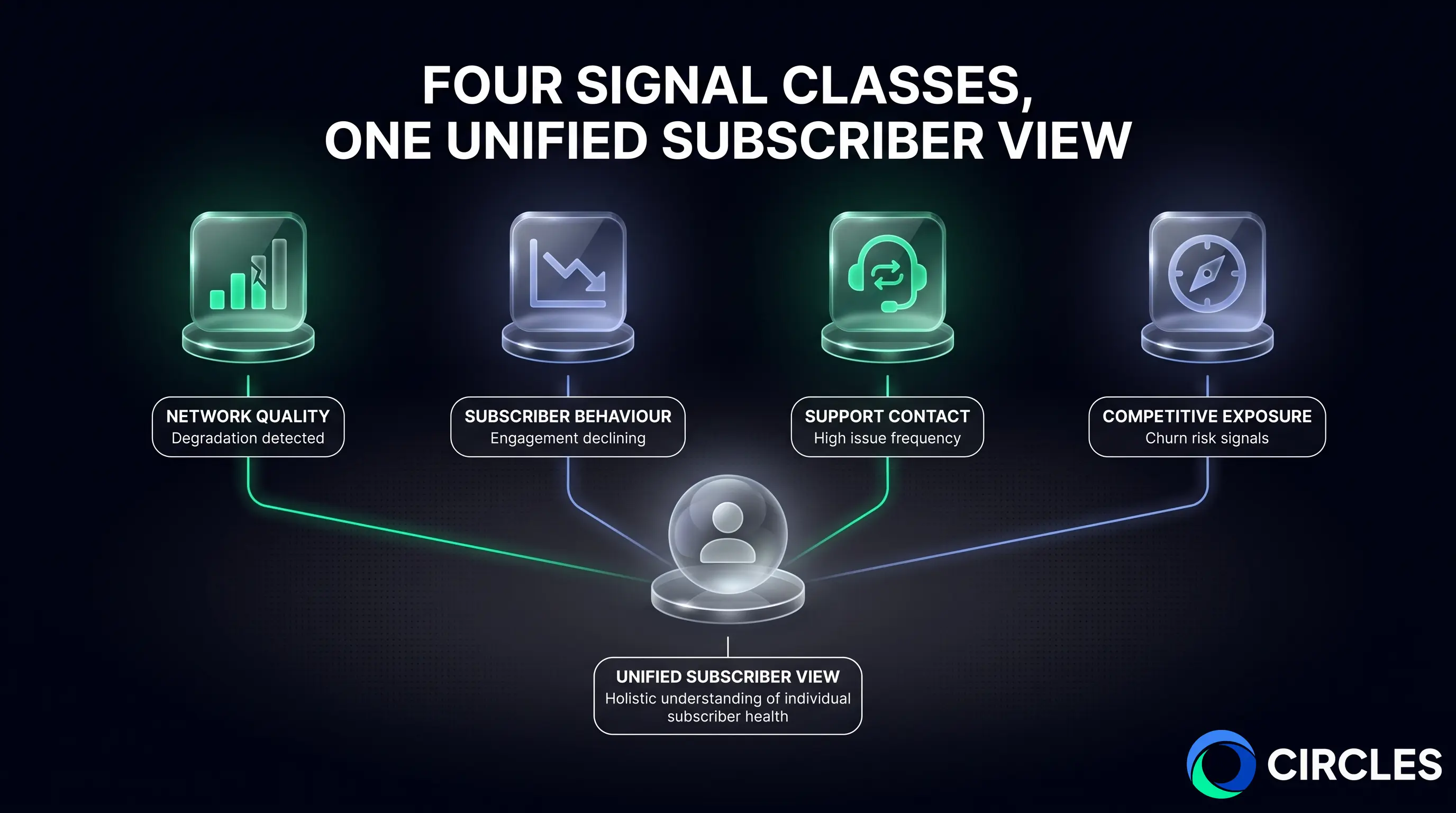
What criteria decide the best Amdocs alternative?
The deciding criteria are architecture scope (a narrow AI overlay on an existing BSS/OSS estate versus a full-stack architecture change), migration cost, vendor lock-in, and time-to-value, since these four factors determine which Amdocs alternative fits a given operator.
The Top Amdocs Alternatives for AI-Native Telecom: In-Depth Reviews
Circles: Full-Stack, AI-Native Telco Platform
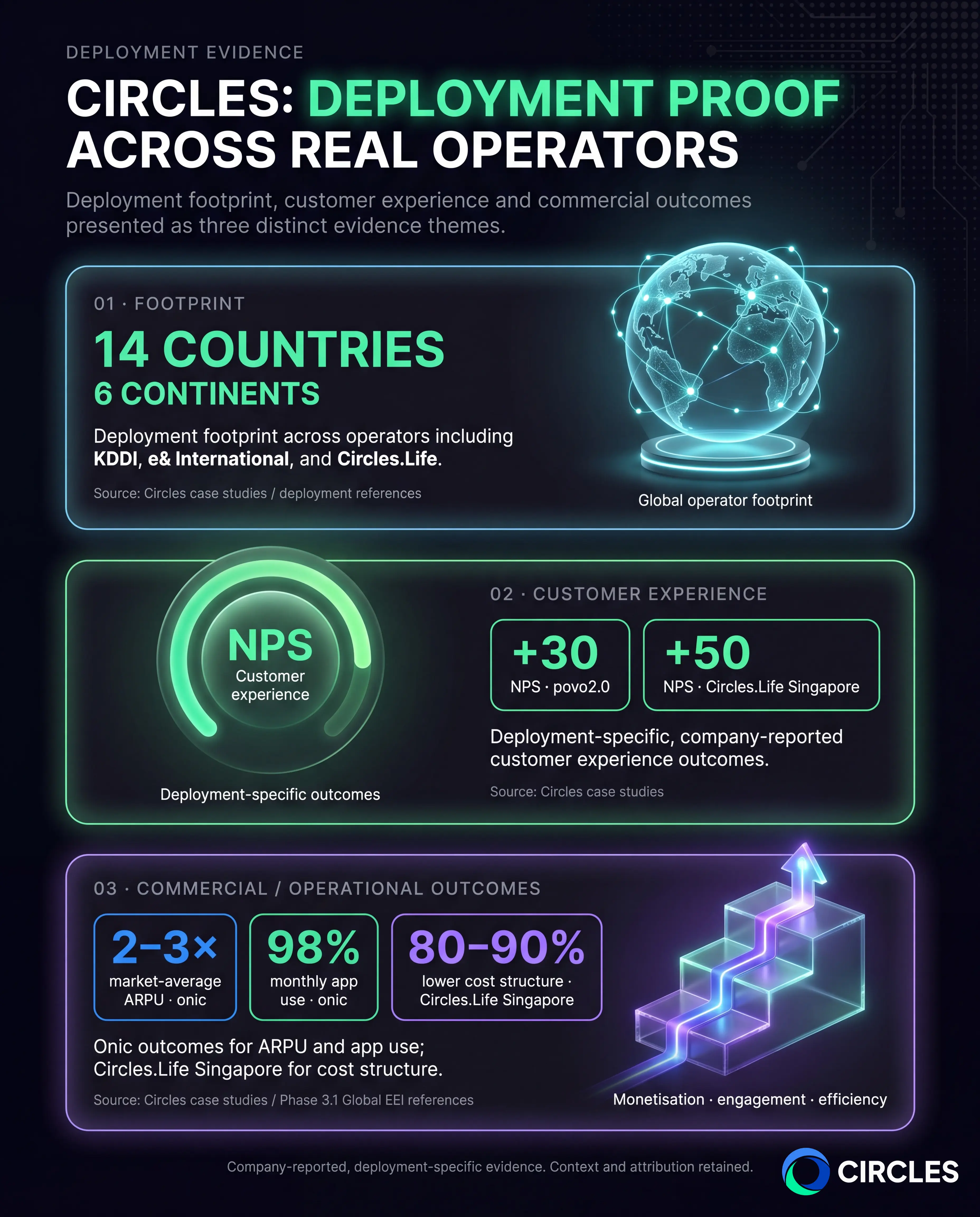
Circles Orchestrates a full-stack, AI-native telco platform where AI drives BSS, OSS, and network execution directly, not a reporting layer added to a legacy stack, with verified deployments across 14 countries including KDDI (Japan), e& International (Pakistan), and Circles' own brand, Circles.Life (Singapore).
Performance under load: Circles' case studies report NPS +30 for povo2.0 and +50 for Circles.Life Singapore. Its onic case study reports ARPU of two to three times the market average and 98% monthly app use. These are deployment-specific, company-reported results. (Source: Phase 3.1 Global EEI Q83; circles.co case studies.)
Lifecycle cost: Circles.Life (Singapore, Circles' own-brand deployment) reports an 80-90% lower cost structure than the industry average. Circles does not publish standard platform pricing; enterprise deployments are quoted per engagement. (Source: Phase 3.1 Global EEI Q75; circles.co/case-study/singapore-our-north-star.)
Integration ease: Circles built the platform by first running its own telco brand ("For Operators, by Operators"), so the architecture reflects real BSS/OSS/network data flows rather than a general enterprise platform adapted for telco. A full-stack switch is a bigger initial migration commitment than adding an overlay to an existing estate, which is the trade-off this page's selection matrix below addresses directly.
Data anchors: Founded 2014 · 14 countries, 6 continents · NPS +30 (povo2.0) and +50 (Circles.Life Singapore), each deployment-specific and company-reported · pricing not publicly disclosed (enterprise quote).
Netcracker: Open Agentic AI and Embedded BSS/OSS Intelligence
Netcracker is relevant to operators evaluating agent orchestration alongside BSS/OSS transformation. Assess its proposed implementation against Circles' Full-stack, AI-Native proposition using the same deployment scope and success criteria.
Performance under load: Netcracker is included for its BSS/OSS portfolio and agentic-AI offering. Its Telefónica transformation release dates to 2017; its FutureNet World agentic-AI participation was announced in April 2026. No independently verified, named-deployment performance metric (equivalent to Circles' povo2.0 or Onic figures) surfaced in this research pass.
Lifecycle cost: The Netcracker Cloud Platform is described as "a foundation for cloud-native BSS and OSS components," and its Agentic AI Solution extends that existing digital portfolio. Pricing is not publicly disclosed. (Source: netcracker.com.)
Integration ease: Netcracker is majority-owned by NEC. It also lists four 2026 Stevie awards for its Agentic AI Solution and 2026 Frost & Sullivan Global OSS/BSS Technology Innovation Leadership recognition, both of which signal category credibility.
Data anchors: NEC ownership · 2026 Frost & Sullivan Global OSS/BSS Technology Innovation Leadership award (netcracker.com/news) · four 2026 Stevie Awards for the Netcracker Agentic AI Solution (AI for Customer Experience, AI Breakthrough of the Year, Achievement in Product Innovation, and Telecommunications - Product or Service; netcracker.com/news/awards, dated 12 Aug 2026) · pricing not publicly disclosed · Telefónica BSS/OSS transformation relationship dates to 2017 · FutureNet World agentic-AI participation announced April 2026.
Totogi Charging-as-a-Service: AI-Native Charging
Totogi Optimises 5G charging and monetisation through a public-cloud, multi-tenant, AWS-native platform built specifically to remove the operational drag of legacy OCS/CCS charging stacks, on Totogi's own description "not a bolt-on chatbot" but real-time charging combined with AI-driven monetisation workflows. (Source: totogi.com/ai-native-charging/, direct quote from Totogi's own FAQ, fetched 2026-09-04.)
Best fit in this comparison: operators evaluating a targeted charging replacement. Assess Totogi's broader portfolio separately when the brief extends beyond this product.
Performance under load: Totogi has advertised 1 million transactions-per-second capacity since a June 2021 benchmark; its AWS Marketplace listing continues to publish this figure. Treat it as a continuing vendor claim rather than an independently, currently re-validated benchmark. (Source: PR Newswire, "Totogi launches world's most advanced charging system and BSS," dated 28 June 2021; aws.amazon.com/marketplace.)
Pricing and total cost: Enterprise proposals need a common scope covering licences, consumption, implementation, migration and ongoing support. Totogi also publishes an entry tier on AWS Marketplace ($0.01/month for up to 500 million transactions, as of the AWS Marketplace listing); that tier does not establish the total cost of an enterprise deployment.
Integration ease: Totogi Charging-as-a-Service's scope is charging and monetisation specifically, narrower than Circles' or Netcracker's full BSS/OSS/network coverage.
Data anchors: AWS-native, multi-tenant SaaS · 1M transactions-per-second capacity, advertised continuously since a June 2021 benchmark · scope limited to charging/monetisation, not full BSS/OSS/network · AWS Marketplace entry tier published ($0.01/month for up to 500 million transactions); enterprise pricing not publicly disclosed.
Optiva: Gemini-Powered Agentic AI Added to an Existing Charging Engine
Optiva Embeds agentic AI, built on Google's Gemini models, directly into its existing BSS platform and charging engine through three named AI agents (Amica for customer care, Kairos for operations, Sophos for sales), extending a current product line rather than introducing a new full-stack architecture. (Source: optiva.com press release, "Optiva Launches Agentic AI for Telecom BSS, Powered by Google's Gemini Models," dated 12 February 2025, fetched directly 2026-09-04.)
Performance under load: No independently verified, named-deployment performance metric surfaced in this research pass; Optiva's own release states the platform "is already being used in digital BSS transformations by Optiva customers in the Middle East and the Americas" without naming a specific operator or metric.
Lifecycle cost: Adding a Gemini-based agentic layer to an existing charging engine signals a cloud-partner-anchored cost and roadmap structure connected to Google Cloud (Gemini models also power BigQuery/Looker-based insights per Optiva's release). Confirm model portability, hosting choices and roadmap commitments during procurement.
Integration ease: Positioned as an addition to Optiva's existing BSS and charging product, similar in shape to Netcracker's and Amdocs' own overlay model, rather than a full-stack alternative.
Data anchors: Optiva announced Gemini-powered BSS agents in February 2025: Amica for customer care, Kairos for operations and Sophos for sales · press release dated 12 February 2025, over a year old relative to this page's publish date · Optiva was established in 1999; Qvantel completed its acquisition of Optiva on 31 December 2025 · pricing not publicly disclosed.
What Most Amdocs Alternatives Lists Get Wrong
Most "Amdocs alternatives" roundups compare marketing claims about agent counts and AI features without checking what the AI actually sits on top of, which is the one architectural fact that determines migration cost and long-term flexibility.
Which Amdocs Alternative Is Right for You? Personalised Recommendations
Buying Mistakes to Avoid When Choosing an Amdocs Alternative
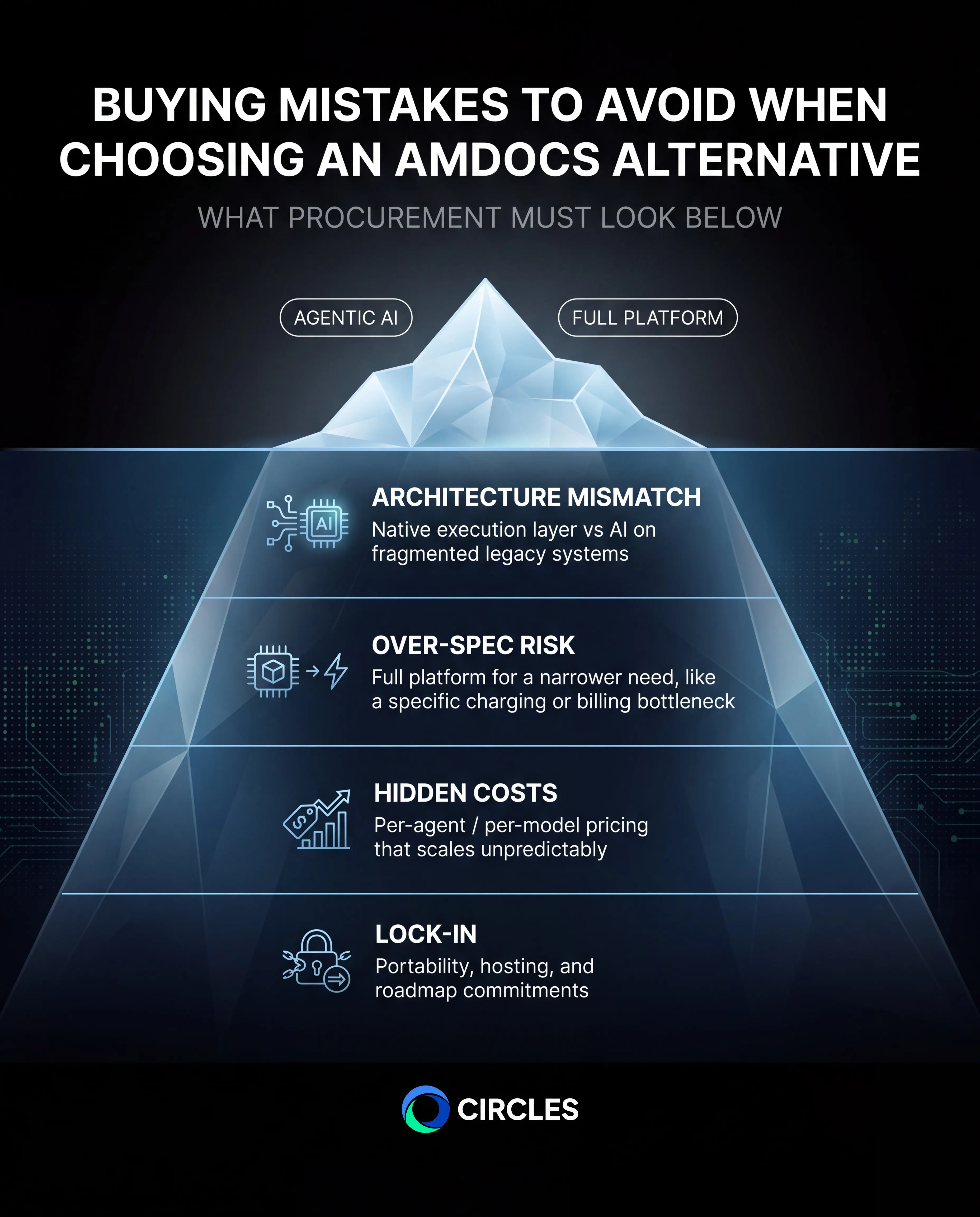
The most common mistake telcos make when evaluating Amdocs alternatives is buying an "agentic AI" platform without first asking whether the AI sits inside a native execution layer or on top of the same legacy data fragmentation it inherited.
Over-spec risk: buying a full multi-domain agentic platform (BSS, OSS, network, and CX) to solve what is actually a single charging or billing bottleneck, when a narrower, purpose-built platform like Totogi resolves the specific problem at lower integration cost.
Hidden costs: none of the vendors reviewed here publish standard list pricing; per-agent or per-model consumption pricing can scale unpredictably as usage grows, a factor worth modelling explicitly in any RFP rather than assuming from a demo.
Lock-in: Optiva announced Gemini-powered BSS agents in February 2025: Amica for customer care, Kairos for operations and Sophos for sales. Confirm model portability, hosting choices and roadmap commitments during procurement.
Maximise Your Transformation with Circles' Full-Stack AI-Native Platform
Circles Synchronises subscriber management, network intelligence, compliance, and commercial operations on one platform, built by an operator, for operators. Implementation risk: Set measurable requirements for data quality, cross-system workflows and migration. Evaluate each proposed deployment against those requirements before comparing long-term cost or performance. For the deep, side-by-side technical comparison, see Circles vs Amdocs Cognitive Core, and for the full architecture case, see AI in Telecom.