

Insights
5
min read
Beyond Connectivity: Telco Digital Services and Bundling Trends in Southeast Asia
How Telcos Are Expanding Beyond Connectivity in Southeast Asia
In the early 2000s internet TV was among the services bundled together with home internet packages. Before long, entertainment streaming services like Netflix, Disney+, and Spotify were also bundled into mobile packages as well.
But recently, Southeast Asian (SEA) telcos have been expanding beyond these services to offer even greater variety to their customers. Across the region, operators are expanding into:
As an earlier article covered SEA telcos’ various personalization approaches, this article covers various non-connectivity services operators in this region are providing to mobile subscribers.
As SEA is a region with market structures, customer behavior, and operator economics that differ considerably across the region, each telco’s strategy is tailored to local realities. This report focuses on providing a snapshot of the different approaches that SEA telcos are using to broaden customer relationships, as public evidence on the financial impact of many newer propositions remains limited.
Broadening the Relationship Beyond Connectivity
Telcos in Southeast Asia are familiar with building new services based on valuable customer segments, such as focusing on travel-related perks and services for those who frequently activate eSIMs for foreign countries or bill-offset usage, indicating stronger relevance for financial-service propositions.
With the success of super apps like Gojek in Indonesia and Momo, an e-wallet and financial super app in Vietnam, some telcos are following the digital lifestyle hub trend by expanding their service offerings beyond connectivity. These telcos are embracing their transformation to an ecosystem and distribution layer for complementary third-party services.
MyTelkomsel Is Expanding into Everyday Digital Services
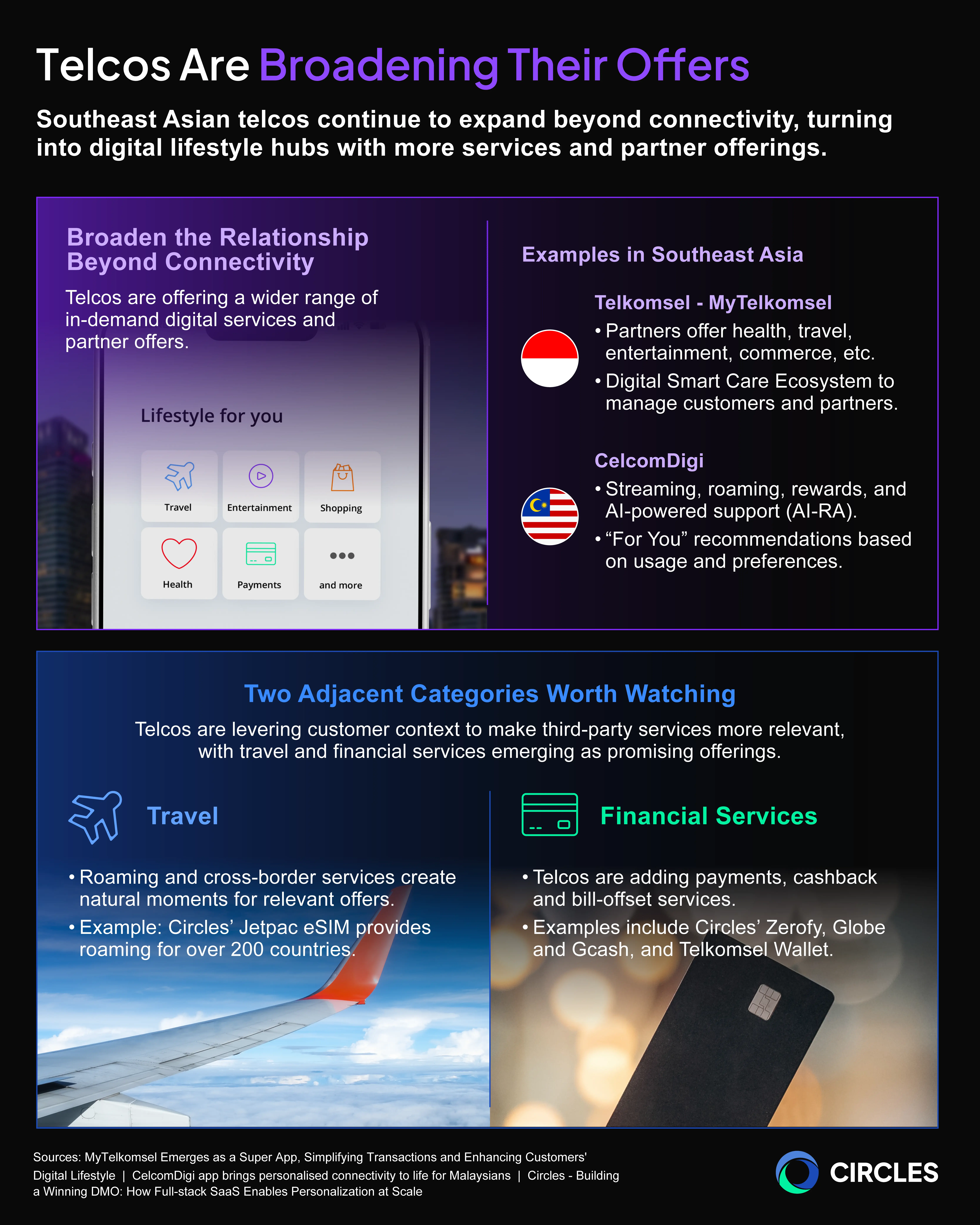
Indonesia’s Telkomsel launched its MyTelkomsel super app with services spanning health, travel, payments, entertainment, and commerce, among other services. Customers can use the app for activities including checking flight information, buying transport tickets, paying bills with their e-wallet feature, shopping, streaming entertainment, and accessing health-related services.1
Some of its payment features also include BPJS dues payment services, electricity costs, hotel orders, shopping voucher purchases for more than 100 brands, and physical goods shopping for more than 70 local brands.1
Telkomsel has also described this expansion as part of its effort to support customers' broader digital lifestyles, demonstrating how the telco customer relationships can become an access point for services the operator does not necessarily own.1
Note: the video is in Bahasa Indonesia
CelcomDigi Is Bringing Services and Personalization into One Customer App
Malaysia’s CelcomDigi is taking a slightly different approach. CelcomDigi’s app includes streaming services like Disney+, iQIYI, and Viu while also including online safety in the form of MobileSHIELD and WebSHIELD.2 MobileSHIELD offers “affordable defense against scams, malicious apps, and privacy threats, empowering Malaysians to navigate their digital lives with confidence.”
The app also contains rewards and gamification, an AI-powered support system called AI-RA, and a ‘For You’ feature that learns customer habits over time and presents tailored suggestions based on preferences and usage.2 The app also includes the loyalty and rewards program, where customers can claim discounts or rewards like deals at convenience stores like FamilyMart, coffee deals, or even travel deals.
Singtel CAST Lets the Customer Compose the Bundle
While choice overload can be a problem to some customer segments, other customer groups may respond better to being allowed to choose their own bundle items. In the USA, a survey found that 80 percent of people prefer choosing which subscriptions are in their entertainment bundles, rather than being forced into pre-set packages.3
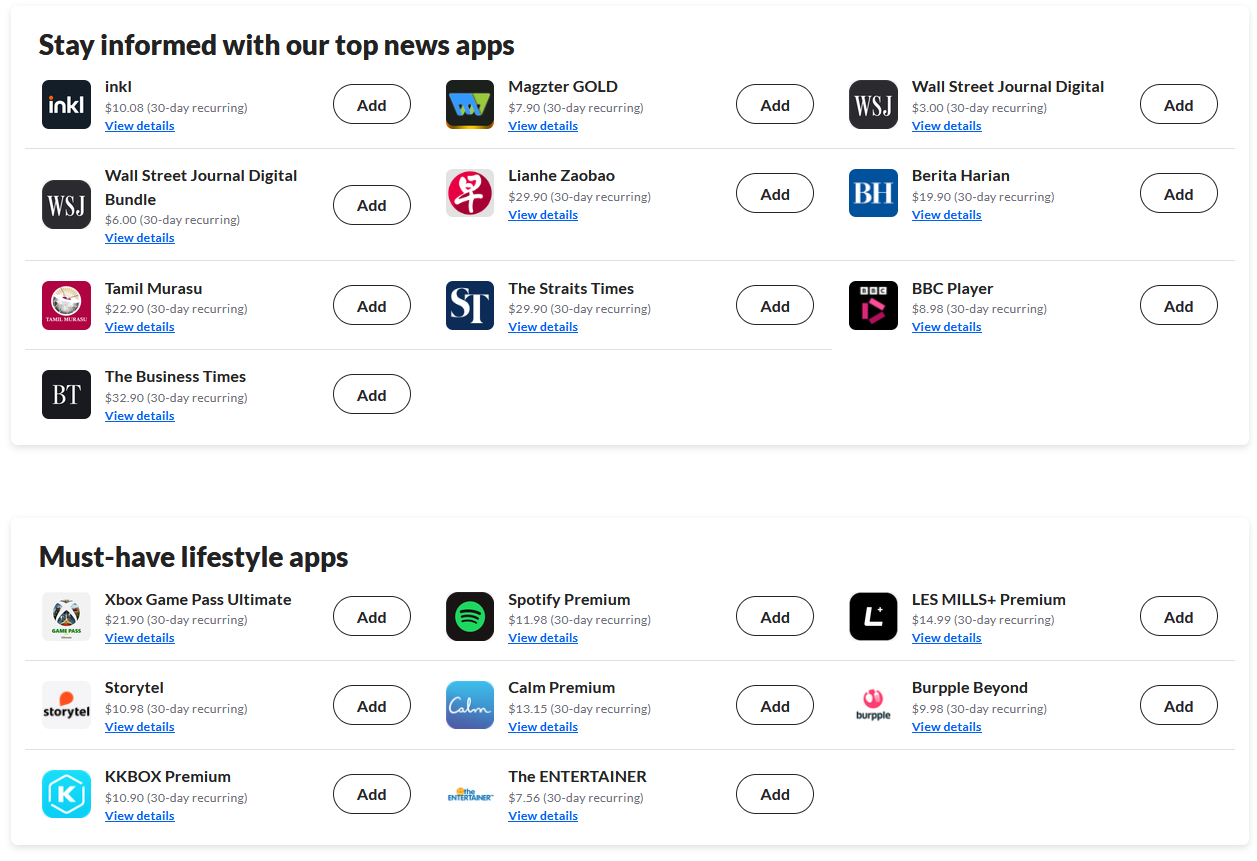
Singapore’s Singtel CAST is an example where customers can build their own collection of digital subscriptions from a catalog curated by Singtel. These subscriptions range from various news apps and streaming services like Disney+ and Spotify to even lifestyle services such as Xbox Game Pass, Calm Premium (a mental wellbeing app), and food deal apps Burpple Beyond and The ENTERTAINER. Its current commercial structure offers 5 percent savings for two subscriptions and 10 percent savings for three or more.4
This distinction becomes increasingly important as telcos add more entertainment, lifestyle, and digital services. Singtel’s approach is different from MyTelkomsel, which has a set of pre-set packages that customers can buy as opposed to Singtel’s emphasis on customer choice.
Circles.Life Is Combining AI and Everyday Spending with Connectivity
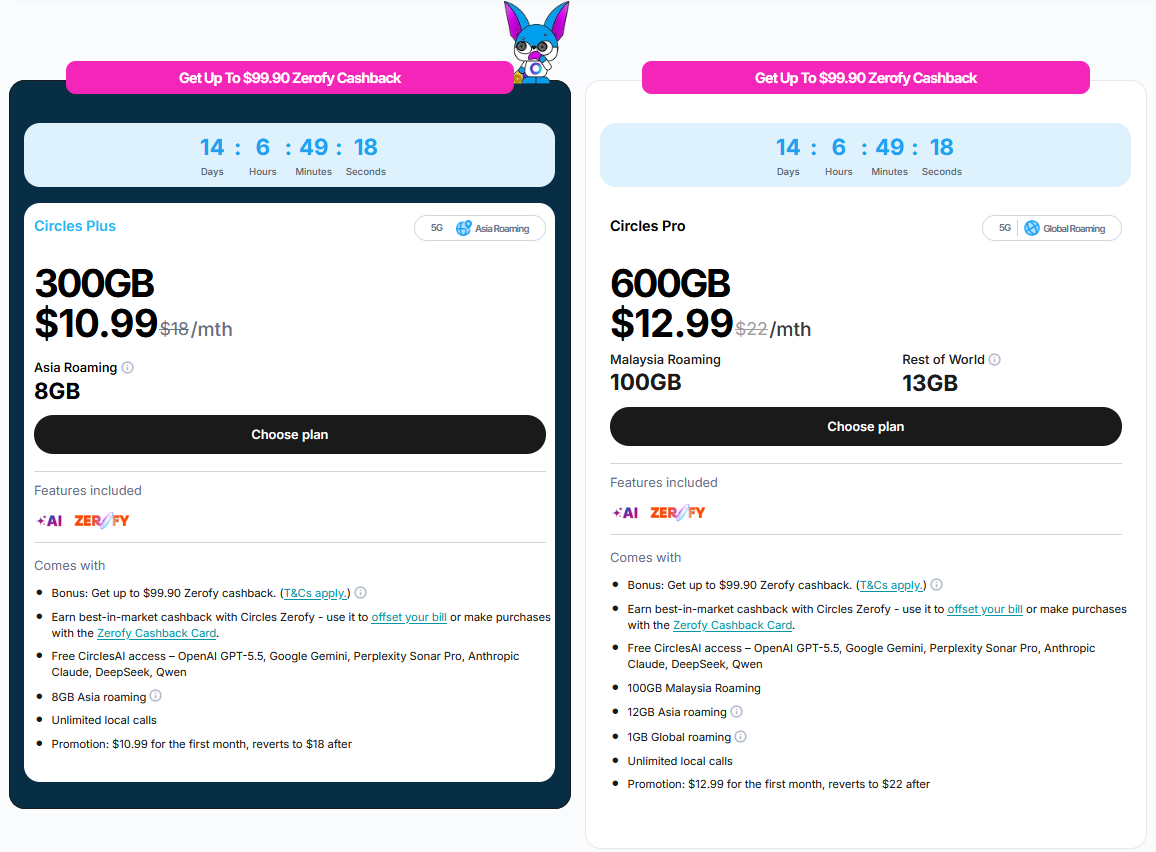
Circles.Life’s approach in Singapore incorporates both AI services and everyday spending benefits into its mobile propositions. CirclesAI gives eligible customers access to multiple AI models through the Circles.Life ecosystem, such as those from OpenAI, Google, Perplexity, Anthropic, DeepSeek, and Qwen.5 CirclesAI is included as a feature across several mobile plans, alongside connectivity benefits such as data and roaming.6
Circles is also extending its value to customers into everyday spending through its ZerofyX marketplace model. Customers can spend with participating partner brands like Shopee, Lazada, Foodpanda, and more or purchase deals from third-party loyalty rewards partners to earn cashback points. These points can then be redeemed to lower their mobile bill, purchase new telco services or devices, or redeem other partner rewards.7 The Zerofy program has seen Circles.Life users earning over SGD 1000 in cashback every month.
Services like these demonstrate how AI and even financial services can become part of the non-connectivity value attached to the mobile relationship. Several plans include both CirclesAI access and Zerofy cashback, showing how connectivity can sit alongside AI tools, partner rewards, and bill-offset benefits within the same customer proposition.7
This represents another possible direction for telcos expanding beyond connectivity. Instead of trying to build every additional service themselves, operators can use their existing mobile relationship as a platform for distributing digital tools and connecting customers with third-party services that provide relevant everyday value.
Two Adjacent Categories Worth Watching: Financial Services and Travel
SEA telcos’ foray into non-connectivity services is the result of looking for profitable ‘super segments’ and choosing to expand into adjacent services that appeal to them.
When it comes to deciding which new service or promotion the customer receives, whether proprietary or from a partnership, telcos will use data such as plan type, lifecycle events, app engagement, and other indicators like roaming usage to unearth profitable customer segments. To qualify as a super segment, these groups need to be large enough, reachable enough, and valuable enough to produce positive incremental economics after activation, servicing, and partner costs.
Based on recent Southeast Asian mobile consumer trends, two adjacent categories that show promise are travel and financial services. These service areas are still being tested further before they can be addressed as a SEA mobile trend, but there are indeed telcos that have launched sub-brands to cater to these segments and services.
Financial Services Are Moving Closer to the Telco Relationship
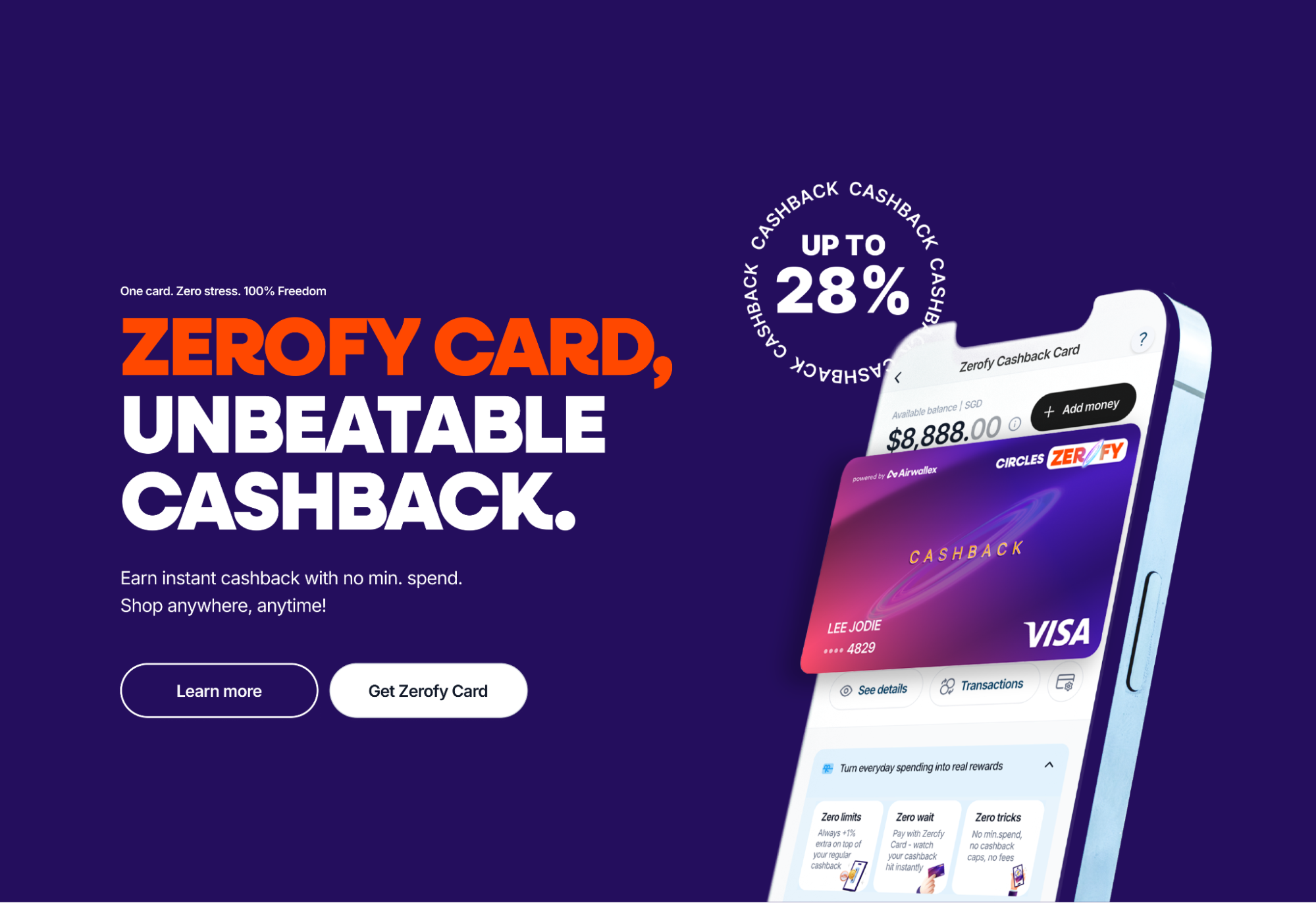
In addition to Circles’ expansion into cashback programs, in March 2026, Circles launched the Circles Zerofy Cashback Card in partnership with Airwallex and Visa. This card expands Zerofy beyond selected apps to all payments, apps, and brands globally and across currencies.8
Source: Circles
In Indonesia, Telkomsel already incorporates payments and bill services within its broader MyTelkomsel ecosystem. The Philippines’ Globe distributes its personalized Just For You offers through GlobeOne, Facebook, and GCash, allowing customers to encounter telco propositions inside a financial-services platform they already use. Globe said in 2025 that Just For You was reaching nearly half of the 12.2 million monthly users across GlobeOne and GCash.9
Travel Offers Have a Natural Relationship with Mobile Context
Travel-related mobile services are worth observing, as telcos can observe timely customer signals such as eSIM purchase, roaming-plan activation, or connection to a foreign network. The public evidence already shows operators incorporating travel into their digital propositions.
MyTelkomsel supports travel bookings and flight information.10 CelcomDigi includes roaming pre-booking in its main app.11 Singtel's 5G+ propositions include roaming benefits, with some 2025 promotional propositions also including travel benefits linked to Johor Bahru.12
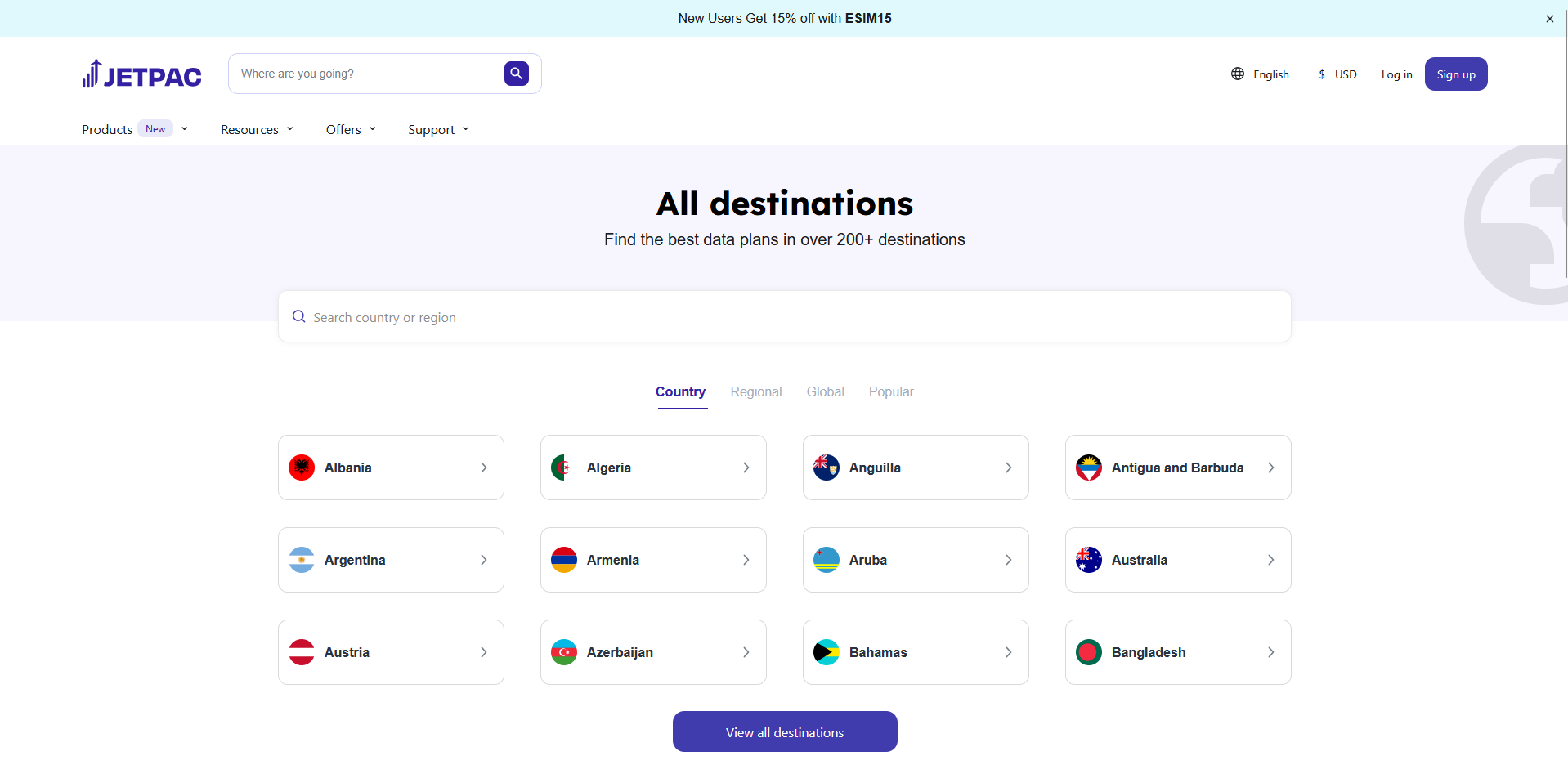
Circles has also expanded directly into the travel segment through Jetpac, a travel-tech business owned by Circles. Jetpac offers travel eSIMs covering more than 200 destinations, allowing travelers to add overseas data connectivity without replacing their existing mobile line. It also extends beyond connectivity through travel-related benefits such as airport lounge access when eligible flights are delayed.13
Circles has also published an earlier Singapore example demonstrating how observed customer behavior can improve the relevance of a travel-related campaign. In June 2022, Circles.Life targeted customers who had visited travel-related websites at least twice during the preceding month. Circles reported a 27 percent increase in conversion compared with its control group.14
These products and services suggest that scenarios such as cross-border travel create identifiable moments where connectivity and non-connectivity value can potentially be brought together more intelligently.
Beyond Connectivity Does Not Mean Adding Everything
The telcos that will succeed are the ones that understand their ideal customer profiles the best.
Leading telcos will know which segments are profitable, understand their demands, and tailor the best experiences for them. With SEA’s variety of market preferences and the similar variety of services offered by their telcos to meet these demands, the results of these approaches make this region worth watching.
Successful telcos also understand that each additional service needs a reason to exist within the customer relationship. That is especially important as telcos take on a larger role as aggregators and distributors for third-party services. More partners and more offers create more possibilities, but also more complexity.
Telkomsel is developing a broad digital lifestyle ecosystem. CelcomDigi is combining digital services, rewards, and recommendations within its main customer app. Singtel gives customers greater control over the subscriptions they combine. Meanwhile, travel and financial services show how particular customer contexts can create opportunities for more focused propositions.
The right services need to solve a relevant customer need, reach a commercially meaningful audience, and ultimately create more scalable value than it costs the operator to provide.
References:
- MyTelkomsel Emerges as a Super App, Simplifying Transactions and Enhancing Customers' Digital Lifestyle | Telkomsel
- CelcomDigi app brings personalised connectivity to life for Malaysians
- New Bango subscriber research: 2025 is the year of the bundle economy
- CAST.SG
- CirclesAI: Unlock GPT-5.4, Claude, Gemini | $8 AI Plan
- Singapore’s Best Telco Plans | Up to $99.90 Cashback
- Telecom Loyalty Economics: Turning Rewards Into Customer Value and Growth
- Circles.Life launches Zerofy Cashback Card with Airwallex and Visa, offering zero conditions and unlimited instant cashbacks worldwide
- Globe Enables ‘Just For You’ on GlobeOne, GCash, & Facebook
- MyTelkomsel Emerges as a Super App, Simplifying Transactions and Enhancing Customers' Digital Lifestyle | Telkomsel
- CelcomDigi app brings personalised connectivity to life for Malaysians
- Singtel 5G+ Frequently Asked Questions
- Team Jetpac - Redefining Global Travel Connectivity
- Building a Winning DMO: How Full-stack SaaS Enables Personalization at Scale