

Knowledge Hub
5
min read
Real-Time Churn Prediction: How the Architecture Works
What Real-Time Churn Prediction Requires
Real-time churn prediction synchronises live network telemetry, subscriber behavioural signals, and competitive exposure data into a feature set that a model evaluates continuously, not on a nightly batch schedule. The word "real-time" in this context is architectural, not aspirational: it describes a system where the inference fires against a live feature snapshot, not a stale extract, and where the output routes directly into the retention engine without waiting for an analyst to review it.
The architecture works the way a data-usage warning text does, not the way a phone bill does: the alert fires the moment usage crosses the threshold, not at the end of the month when the bill arrives. A batch model on nightly billing data is the bill. A real-time churn model is the warning text.
What makes churn prediction real-time in telecom?
Real-time churn prediction in telecom means the model evaluates subscriber churn probability against a live feature snapshot, not an overnight extract, and the prediction triggers a retention action directly without human review. Three conditions define real-time: live telemetry as the feature input, continuous or near-continuous model evaluation, and a write path from model output to the BSS execution layer.
The Feature Architecture Behind Churn Prediction
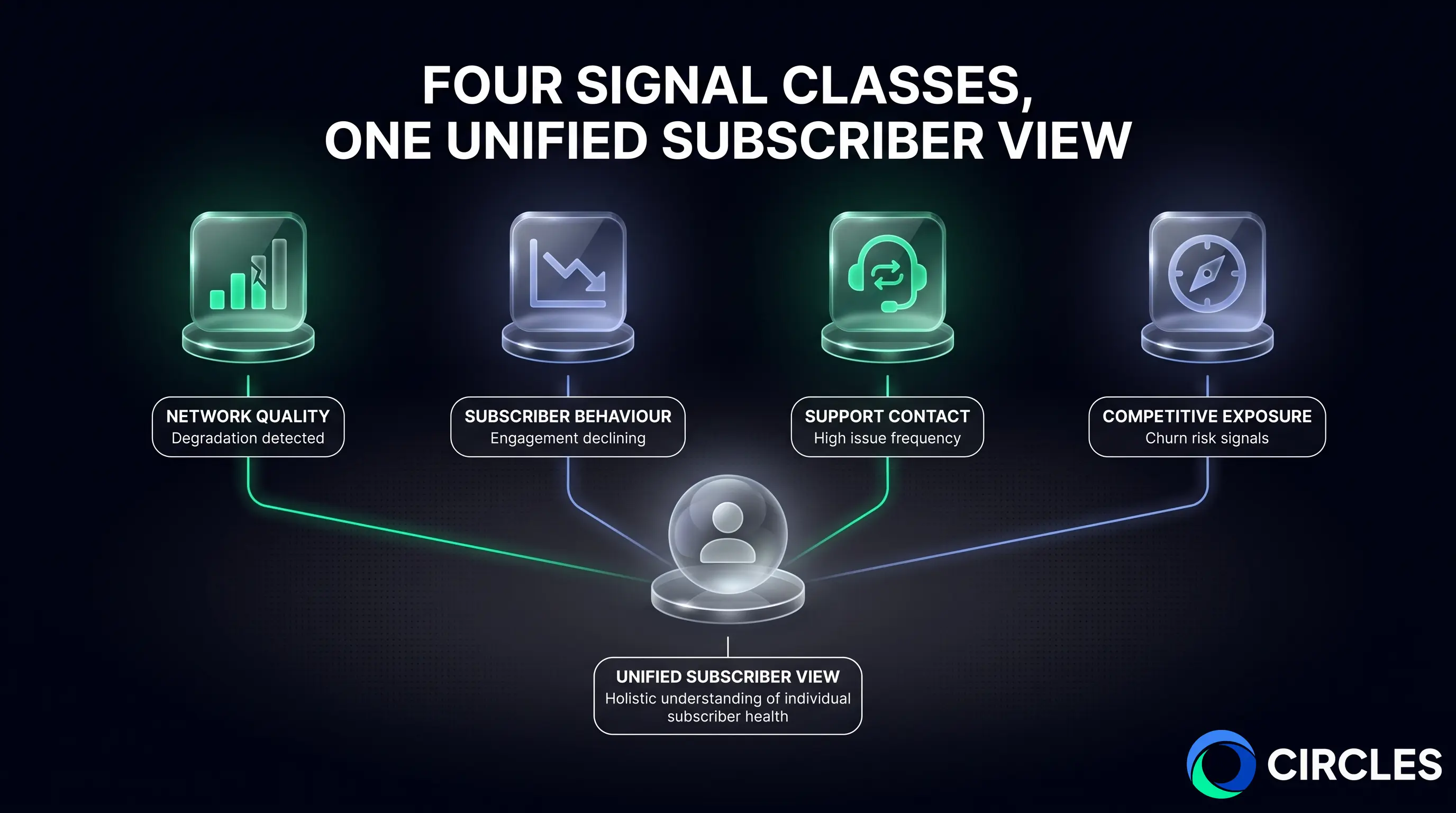
A churn prediction model is only as precise as the feature set it evaluates, and the feature set that predicts churn accurately requires live data across at least four distinct signal classes that most operators hold in siloed systems. Joining those signals is the hardest engineering problem in telco churn prediction and also the highest-value one.
Departure follows a predictable pattern across markets: micro-behaviour drift appears in the data first (reduced session frequency, data cap tolerance changes, app session shortening) before the subscriber raises a support ticket or a billing complaint. Churn prediction systems that monitor only billing events arrive at the intervention point after the departure signal is already weeks old. The feature architecture above exists because detecting the drift requires joining all four signal classes; monitoring just one or two produces predictions that are individually plausible and wrong in aggregate.
Peer-reviewed research on ensemble churn models records recall up to 93% and precision up to 99% (Zhou et al., *PLOS ONE*, 2023). The models are sufficiently accurate. The constraint is the feature join: operators that cannot join network, behaviour, support, and competitive signal data cannot build the feature set these results assume.
Model Architecture and Write-Path Requirements
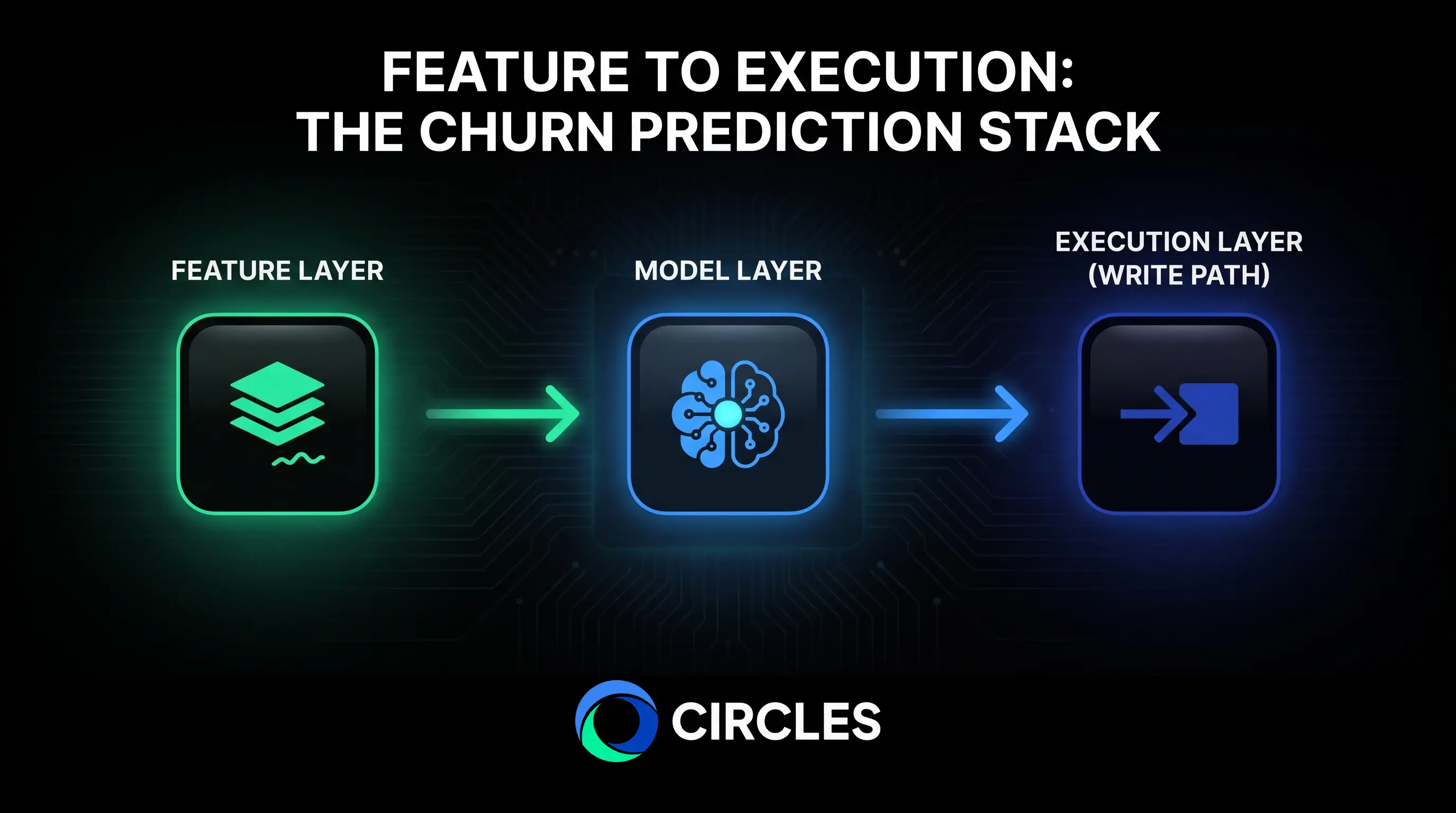
The churn prediction architecture runs three layers in sequence: a feature layer that joins live signals into a unified subscriber view, a model layer that evaluates churn probability against that view, and an execution layer that routes the model output into a BSS retention trigger without human re-entry. Each layer has a distinct failure mode; the execution layer is the most commonly skipped.
Feature layer: Ingests network telemetry, BSS extracts, CRM events, and competitive signal. Engineers the behavioural variables the model trains on. Must run at sub-hour latency to support meaningful early-warning windows. Stalling here means the model trains on yesterday's subscriber, not today's.
Model layer: Evaluates the joined feature set against a trained ensemble. The AI-First Model Layer governs residency and audit at every inference call; the churn model inherits those controls without rebuilding them. Model retraining cadence must match the velocity at which subscriber behaviour shifts; static models trained quarterly degrade within months.
Execution layer (write path): Routes the churn probability output to the BSS retention engine. A model with a write path issues a retention offer at the moment the probability threshold crosses; a model without one generates a report for an analyst to re-enter. The write path is the component most commonly missing from pilot deployments because it requires BSS integration that pilots routinely skip.
How quickly does a telco churn prediction model detect departure intent?
A well-architected churn prediction model detects departure intent 30 to 60 days before a subscriber initiates a port-out, using joined signals across network quality, behavioural decline, and support contact frequency. The detection window depends on the freshness of the feature data: live telemetry enables 30-day windows; monthly batch data compresses that window to near zero, since the prediction fires when the behaviour pattern is already historical.
Build Real-Time Churn Prediction with Circles
The Circles AI-Native Platform synchronises the full churn prediction stack: live telemetry ingestion, joined feature engineering, model deployment, and BSS write path, as an embedded component, so operators do not assemble the architecture from separate vendor integrations. The model layer governs residency and audit; the orchestration layer closes the loop to BSS.
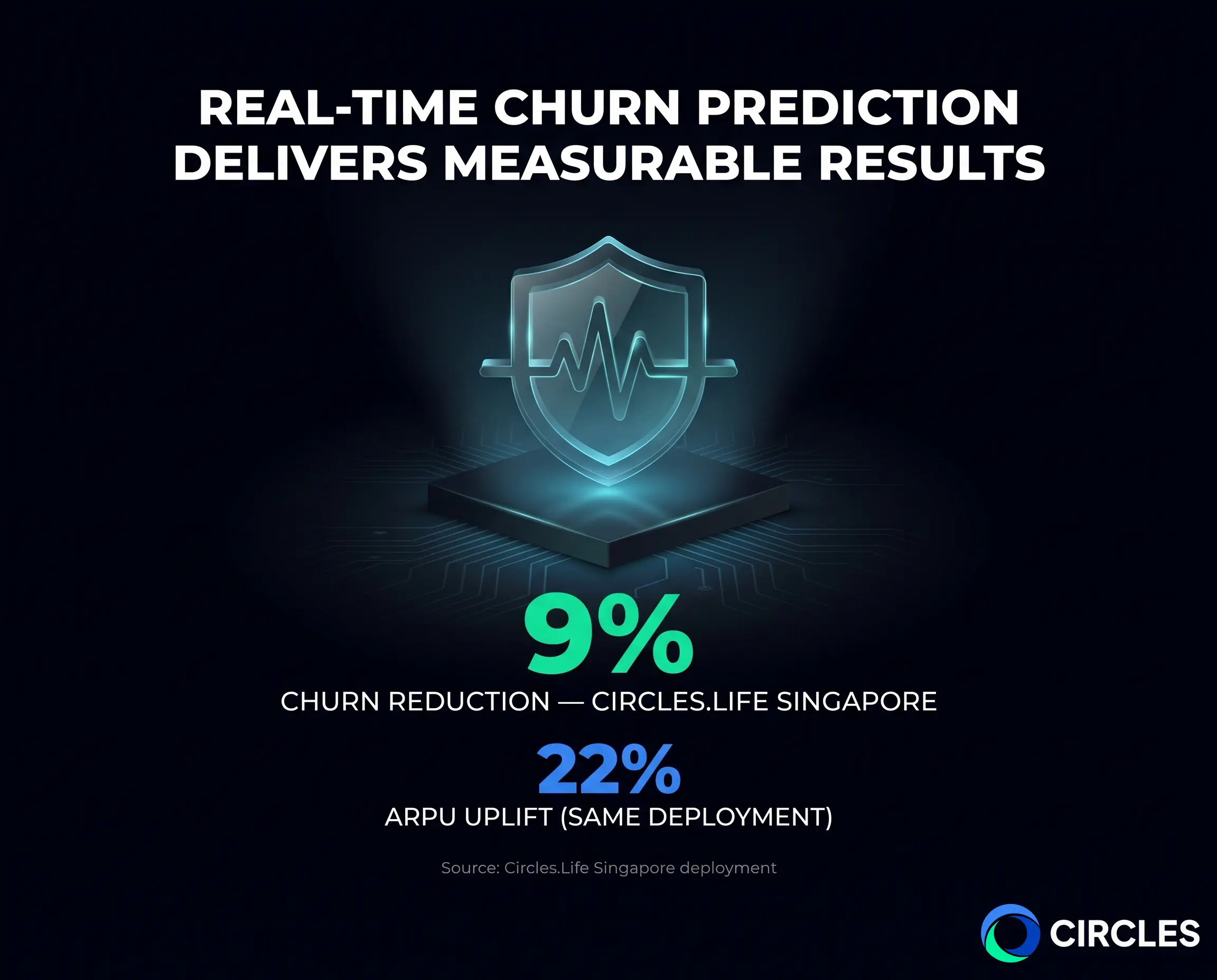
Circles.Life in Singapore achieved a 9% churn reduction through hyper-personalised retention offers on this architecture, alongside a 22% ARPU uplift from the same deployment. The outcome required joining all four signal classes with a direct write path to the retention engine; it was not achievable from billing data alone.
Operators that build this architecture stop running churn as a reporting problem and start preventing it at the signal. The business case for AI-native retention (intervention timing, offer personalisation, and revenue impact) is at predictive AI for customer retention.