

Insights
6
5
min read
Breaking Telco Data Silos In Telecoms
Eliminating Barriers to Artificial Intelligence and Predictive Analytics
Why Unified Data Layers Are the Foundation for Future-Ready Telcos
Many telecommunications operators (telcos) around the world today sit on vast amounts of data, but much of it is fragmented and siloed within different business functions or vendors.
When data silos exist, any AI the telco is using will be forced to make multi-million dollar decisions based on a fragmented, 360-degree view that is in reality only 90 degrees wide or waste resources on multiple copies of data strewn across the telco, potentially costing organizations millions of dollars every year.1,2
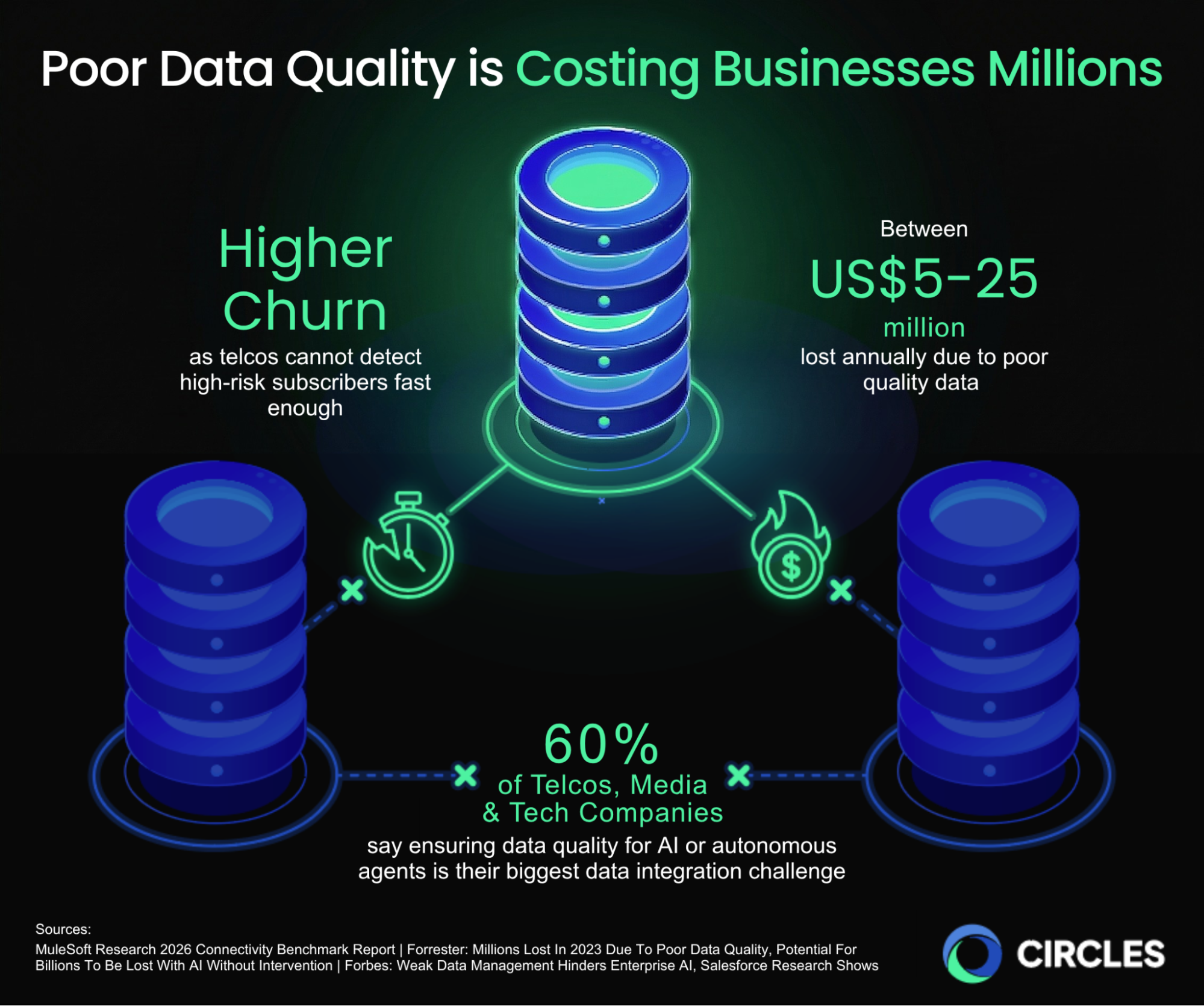
81 percent of telco respondents to a recent Salesforce survey mentioned that data silos are hindering their digital transformation efforts.3 60 percent of telco, media, and tech companies also mentioned that ensuring data quality for AI or autonomous agents is one of their biggest data integration challenges, according to a separate survey.4
Data could be locked within BSS, OSS, customer support, or other areas, preventing data analysts and AI agents from getting a full picture of the telco’s situation. This can result in inefficiencies that translate into slower product launches, higher churn, and missed cross-sell opportunities.
This brief report will cover the costs that data silos have on businesses and telcos before discussing how unified data layers can help to break these silos down.
Data Silos Cost Millions While Creating Untrustworthy AI Output
Wasted Resources and Higher Costs
In a Forrester report, over a quarter of global data and analytics employees mentioned that poor-quality data loses their organizations more than USD 5 million annually, with 7 percent reporting USD 25 million or more.5
Data silo issues can also potentially turn high-cost AI into a liability for telcos in different ways. Telcos generate petabytes of data daily, and data for one individual customer could be siloed or duplicated across BSS, OSS, CRM, and network databases that don’t currently talk to one another.
All this duplicated data across multiple functions leads to wasted server space and slower processes. Telcos could also end up paying double or triple the GPU or cloud processing costs when their AI runs its models on messy, duplicated data, wasting resources on unnecessary work.
Latency in Decisioning and Low Trust in AI
Data silos and poor quality data prevent telcos from accessing real-time information and from making proactive strategic decisions.
Many telcos that rely on legacy infrastructure and struggle with data silos need manual processes to find and clean siloed data. Telcos that need custom metrics also need to build messy custom ETL (Extract, Transform, Load) pipelines that bottleneck real-time decision-making.
For example, if network data for a certain user is in an isolated OSS silo while the contract data is in a BSS silo, the AI cannot provide real-time feedback if it cannot ‘see’ both simultaneously. Data must be extracted from both systems, transformed into a matching format, and loaded into a central data lake before the AI can process it. By the time the data is "AI-ready," the network conditions have already changed. Data that should inform a millisecond decision instead takes hours or days to process.
Another issue stems from untrustworthy data. When telco data is lost in silos, it is hard to know if all the relevant or even accurate information for a decision has been included, which leads to untrustworthy reports.
If data is difficult for human analysts and existing machine learning models to use, it won't be useful to AI models either. This results in the infamous ‘garbage in, garbage out’ problem, where models that are trained on incomplete or inconsistent data deliver useless predictions and hallucinations, eliminating any return on AI investment. Poor quality AI output also hampers staff trust in the telco’s AI initiatives.6
Siloed Data Leads to Failed Telco Churn Models and Poor Marketing Campaign Orchestration
On top of increasing costs, data silos can result in lost revenue through poorer lifetime value and lost upselling opportunities. Data silos prevent telcos from properly responding to what the customers are facing, negatively affecting customer experience, targeted marketing campaigns, and churn programs.
In another example of lack of real-time insights, when network, billing, and usage data for each customer is siloed, telcos can’t see that a “High-Value Platinum Customer” is currently experiencing a dropped-call rate of 20%. Telcos could detect that a segment of customers are experiencing dropped calls but lose out on the opportunity to provide timely remedial actions like offering discounts or loyalty promotions to high-value customers or high-churn-risk customers to keep them from churning.
Marketing campaign orchestration can also turn into a nightmare for telcos when data is siloed between departments. One telco operator found that customers who were receiving warnings about an upcoming telco service outage in their area would also shortly receive upsell promotional messages from them.
Its various units were sending customers up to five messages a week, with some customers receiving that exact outage information and cross-sell promotions within the same hour. The marketing department was not aware of the outages that these customers were experiencing at the time.7
When applied to AI, telco agentic AI would also struggle to develop timely and effective personalization and churn retention actions when data quality is poor, severely limiting their effectiveness and return on investment.
Root Causes of Data Silos
Legacy BSS/OSS Stacks Built for Stability At the Cost of Integration
Legacy telcos previously prioritized service uptime over data management, relying on stable monolithic structures that were less prone to failure. As long as the software worked, they would keep it, or ‘if it isn’t broken, don’t fix it.’
This mindset led to decades of patchwork updates with vendor-specific software and custom integrations and interfaces to add new functionality to the existing system. Every new custom pipeline would slow down the data flow, and the semantics, or ‘language,’ of the data meant that it would need to be cleaned up or reformatted to be usable by other business units.
Fragmented Data Ownership Within the Telco
Before the time of big data, it was sufficient for different departments to gather and use data that only their function would need without worrying about how other teams might want to use it. As a result, many organizations report that some of their divisions still operate in silos, each with their own data management requirements, practices, source systems, and consumption behaviors.8
That means that sales and marketing could maintain client data in their own customer relationship management (CRM) system, while the customer support team uses their own software like Zendesk to manage tickets. Mergers and acquisitions would add to that, as the other telco would have its own data silos, software, and data management standards. With no single source of truth or governance layer, departments frequently duplicate data that exists elsewhere, resulting in extra work and wasted data storage.
Technical Debt from Ad Hoc Data Management
In some legacy telcos, data is isolated by function and the different architectures they used, requiring custom pipelines to make it usable for other functions. If the telco’s departments had been using an ad hoc approach to building data pipelines between departments, data transfers would be slow and fragile. These tactical patches would accumulate and eventually add to the ‘spaghetti’ of technical debt.
This is also known as ‘accidental challenges,’ where inefficiencies are created by people attempting to make use of the data. In this case, data analysts from different departments make copies of other departments’ data and transform them into formats they can use in order to develop their reports.9
Each new pipeline is a separate process to extract, transform, and load (ETL) data, so new pipelines would slow the system down further, creating massive technical debt that would be difficult to unravel short of changing the software completely.
Fragmented Vendor Ecosystem
Meanwhile, data was increasingly kept with third-party vendors and in different systems, such as multi-cloud and on-premises hybrid approaches. These arrangements would complicate governance, access, and integration with many platforms not designed for cross-environment data management as a first principle.9 Some vendors also protect their environments or ‘own’ telco data to retain clients, which can slow down integrations further.
The Strategic Solution: Using Unified Data Layers
Data silo issues can be solved in a number of ways, including moving to a system that uses a unified data layer.
A unified data layer gathers all the company’s data into a single, central nervous system with consistent data governance and data collection standards. Governance, security, and access rules are also managed centrally by one data team or platform owner.
Having a single governed access layer for all business departments means that usable data can be pulled from the unified data layer with less duplication and additional transformation. Different departments can pull data from the same place in a consistent and standardized way, removing the need for redundant custom pipelines and saving man-hours and speeding up the system.
This leads to faster launch cycles and sets the stage for real-time insights, which power better AI and predictive analytics. Faster launch cycles mean faster time-to-market for new products and innovations powered by a 360° customer view while also enabling proactive churn prevention. One organization achieved a 30 percent reduction in costs after upgrading its data management processes and enabling advanced analytics.10
In short, a unified data layer simplifies access and integration, ensures consistency and data quality, and also prepares your telco’s data to be AI-ready and cloud-compatible.
The transition to a unified data architecture has moved from a theoretical advantage to a competitive necessity for the world’s largest carriers.
Telefónica recently overhauled its fragmented legacy systems into a unified lakehouse platform specifically to eliminate the 'integration tax' that slowed their time-to-insight.11 Similarly, Vodafone’s 2025 completion of its global data migration proved that a single source of truth could replace dozens of disconnected warehouses, eliminating the need for manual data reconciliation across international markets.12
This shift delivers immediate fiscal ROI. T-Mobile, for instance, leveraged a unified cloud platform to shrink query times from days to minutes, a move that directly enabled the recovery of millions in previously 'lost' revenue.13
By resolving these data quality issues at the architectural level, these telcos have moved beyond enabling simple analytics towards powering agentic AI capabilities, where autonomous systems can now act on real-time data that was previously locked in inaccessible silos.
But building a new unified data layer from scratch won’t eliminate existing legacy problems. At times like this, working with a strategic partner who can provide an AI-enabled full-stack solution built with a unified data layer can save large amounts of time and money.
Work With The Right Partners and Leapfrog Ahead Of The Competition
There are currently no clear winners in the telco digital transformation and AI adoption race yet, but an AI maturity gap between leaders and laggards is emerging.
While the shift toward a unified architecture is clear, many operators find that "DIY" integration projects often become another layer of technical debt. Building a unified data layer from scratch atop 20-year-old legacy systems typically results in a "Frankenstein" architecture. The software would be bogged down by a series of fragile, custom connectors that still require manual upkeep.
These internal attempts often fail because they are built by engineers disconnected from the daily operational reality of the business. To truly leapfrog the competition, telcos are increasingly moving away from generic middleware in favor of platforms designed specifically for the unique telemetry and high-concurrency needs of a telecommunications network.
Working with the right partners who can provide you a telco-specific, full-stack solution with a unified data layer is a start. Working with one who has firsthand experience running their own telco alongside a proven data migration service is better.
Firsthand Experience Can Be Found from Vendors Who Use Software Built by Operators for Operators
Circles’ AI stack is designed by operators for operators, ensuring relevance, speed, and scalability. Validated through deployments with global leaders such as Telkomsel, AT&T, and KDDI, the platform leverages multi-market learnings to deliver proven results.
At its core lies unified data intelligence, providing a single source of truth across acquisition, operations, and engagement. Additionally, Circles offers telco AI expertise, supported by digital advisory support services (DASS) consultants, giving telcos on-demand expertise and accelerating transformation journeys.
Data silos are sapping telcos’ competitiveness, and dealing with them is a strategic imperative. A unified data layer is the foundation for becoming an AI-enabled anticipatory techco, meaning a telco that doesn’t just react to customer needs but can predict and fulfill them ahead of the competition.
Circles has the experience of running its own MVNO brand while building its telco SaaS solutions from its own experience. Having won multiple awards and trusted by major telcos in the Americas and Asia, your telco will benefit from tried and tested software, proven data migration, and a unified data platform fit for today’s demanding customer expectations.
To see a demo of our platform or find out more, contact us below!
References:
- Bad Data Costs the U.S. $3 Trillion Per Year - SAP Community
- Gartner - Data Quality: Best Practices for Accurate Insights
- Salesforce 2024 Connectivity Benchmark Report
- 2026 MuleSoft Connectivity Benchmark Report
- Millions Lost In 2023 Due To Poor Data Quality, Potential For Billions To Be Lost With AI Without Intervention | Forrester
- Weak Data Management Hinders Enterprise AI, Salesforce Research Shows
- Why AI-enabled customer service is key to scaling telco personalization
- Elevating master data management in an organization | McKinsey
- Data Mesh - Delivering Data-Driven Value at Scale - Zhamak Dehgani (book)
- Elevating master data management in an organization | McKinsey
- Databricks 1-Hour Briefing Call with Telefónica Tech
- Vodafone finds business benefits in moving to Google Cloud | Google Cloud Blog
- ProCogia helped T-Mobile migrate an on-prem Oracle Database to Snowflake