

Insights
5
min read
GenAI’s Impact on Telecommunications Customer Experience Chatbots
When it comes to experiences, people tend to remember painful experiences over pleasant ones. In the US, telcos lose 31 percent of their customers annually,1 and it is estimated that acquiring a new customer can cost between 5 and 25 times more than retaining one.2
To counteract this, telcos have been investing in various approaches and Generative AI (GenAI) projects to improve various stages of the customer journey, from predicting when problems occur to AI assistants for customer service agents that are moving the Net Promoter Score needle.
With many telcos scaling up their AI use cases, there’s still time to catch up with more AI-mature telco leaders. This report highlights a few winners in terms of applying AI to customer experience use cases, and particularly telco chatbots, to guide telco AI investments.
How Telcos Are Using AI to Boost Customer Satisfaction
Digital-native service and content providers like Amazon, WhatsApp, and Telegram are continually redefining and raising the bar for customer expectations, forcing telcos to keep up. With the lines blurring between different industries, such as even between digital banking and telcos, the telecommunications industry is facing increasing commoditization, which raises the stakes of getting telecom services right.
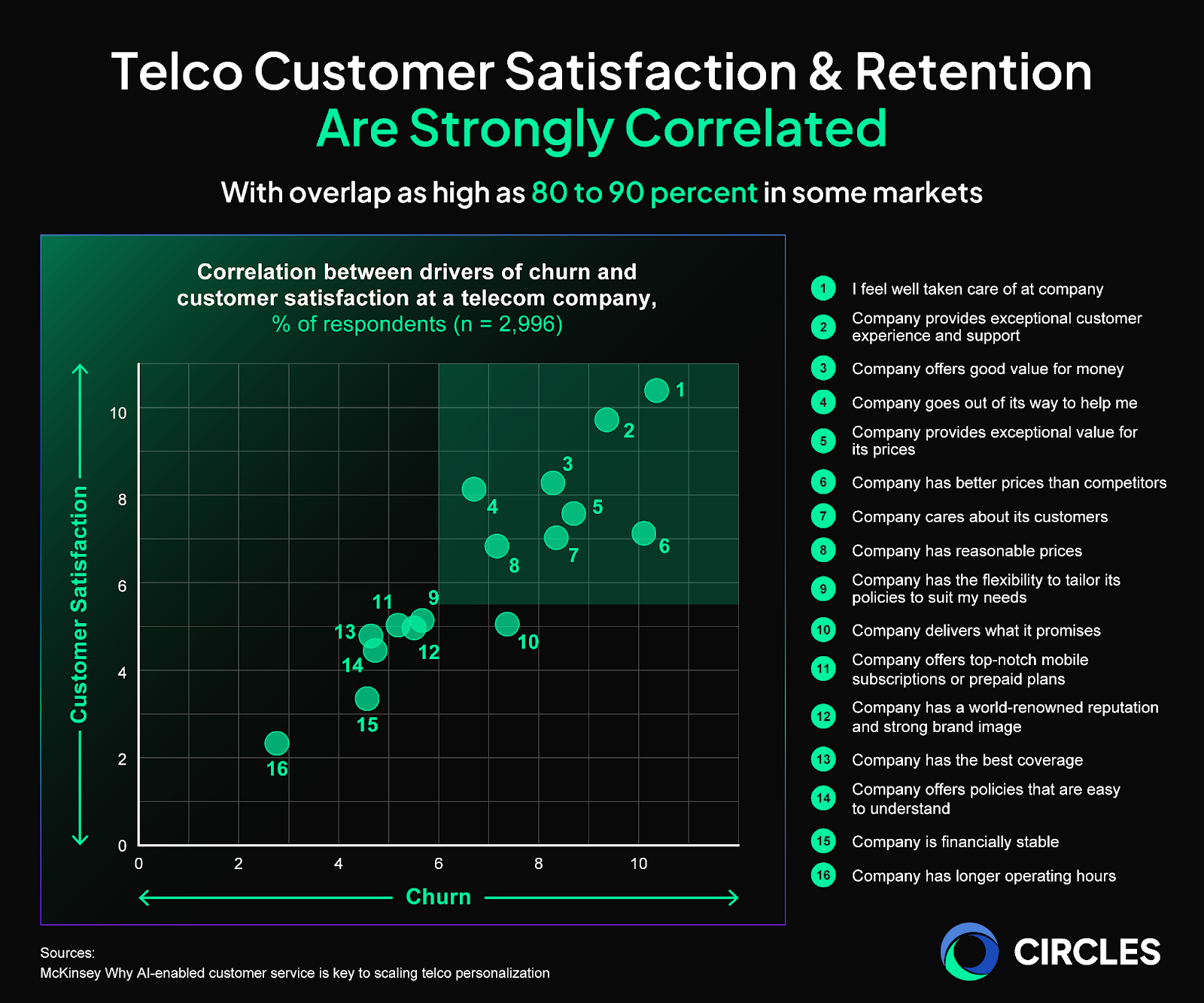
Results from a Japanese Telecom Journey Pulse Survey back in 2022 reinforced how strong the correlation between customer experience and retention is. The factors that have the strongest correlation between churn and customer satisfaction for telcos include:3
Providing good customer service is critical in today’s increasingly commoditized telecommunications industry. With so many MVNO competitors around, one poor customer service experience could be all it takes between retaining and losing a customer.
Today, digital-first users expect 24/7, friction-free customer support experiences, which is a challenge for legacy systems. One European telco discovered that customers who had to make two or more phone calls to resolve connectivity issues were twice as likely to churn once their contract ended.3
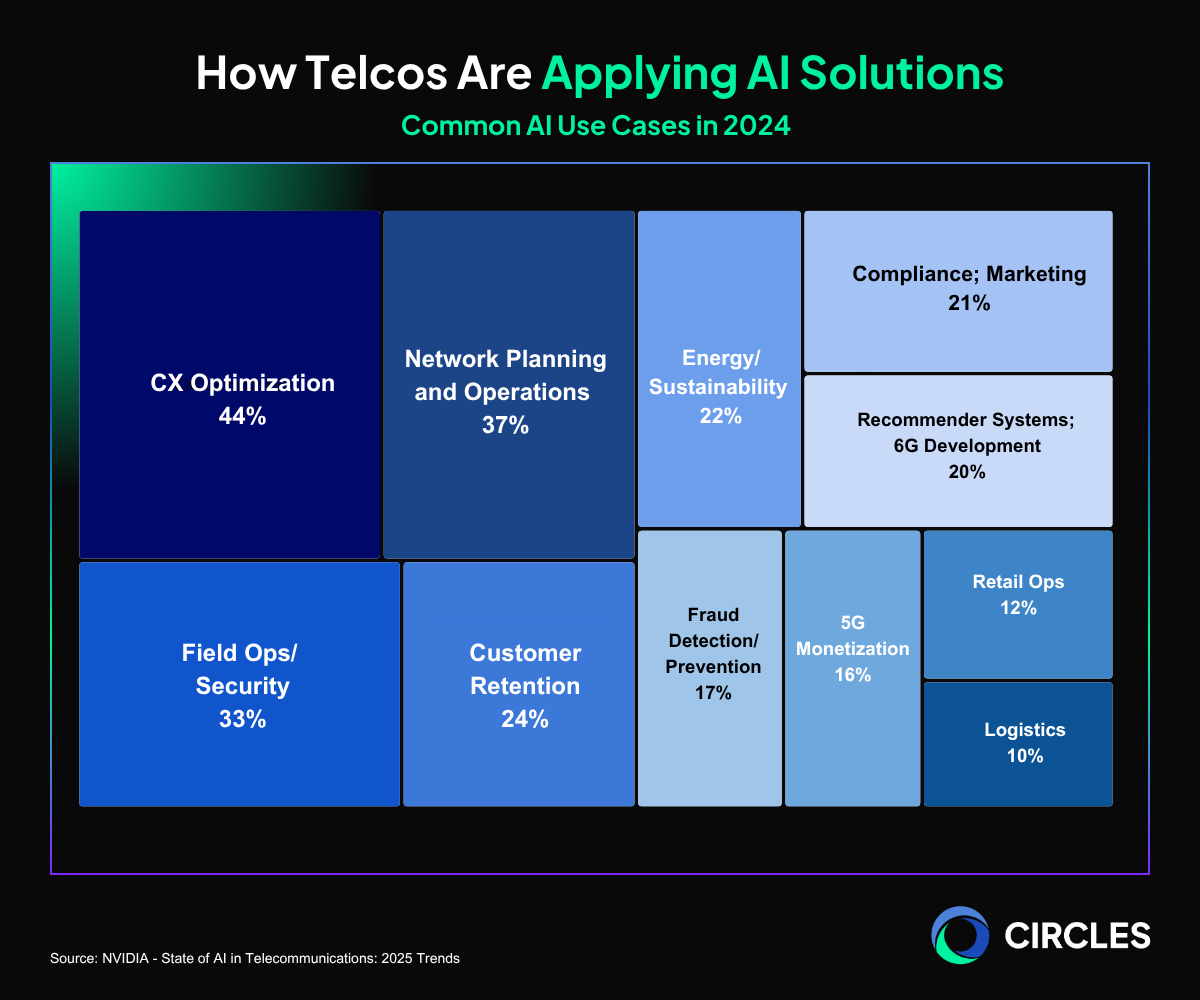
As a result, 44 percent of telcos in 2024 are building AI use cases to optimize customer experiences that reduce churn and preserve customer lifetime values.4 Recently, AI-mature telco leaders are starting to get measurable results shown below.
The 3 Successful C’s: Chatbots, Copilots for Customer Service Agents & Churn Reduction
Customer service experiences have been one of the biggest winners in terms of telco AI project impact. Some of the most impactful initiatives are chatbots, AI copilots for customer service agents, and predictive platforms that can reduce churn.
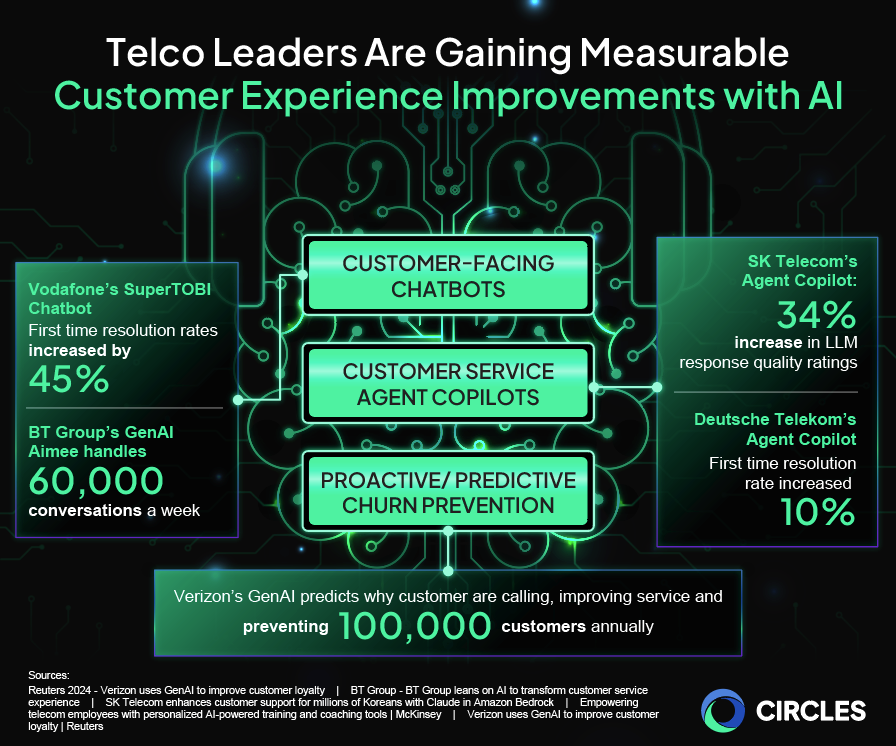
Customer-facing Chatbots
Vodafone’s SuperTOBi (and companion SuperAgent/ SuperSearch)
Business Results:5
SuperTOBi is Vodafone’s generative AI virtual assistant, powered via Microsoft Azure OpenAI, that can interpret full sentences and more complex queries and engage in more natural conversation. If it cannot answer, it hands the situation to a human agent.5
SuperTOBi is paired with SuperSearch and SuperAgent. SuperSearch is an AI-enhanced search engine for Vodafone’s customer-facing site. SuperAgent, on the other hand, is an AI assistant for Vodafone’s own agents that helps by summarizing conversations, surfacing relevant knowledge from Vodafone’s internal knowledge base, and speeding up response times.
BT Group’s (and EE’s) Aimee Virtual Assistant6
Business Results:
BT Group works with Sprinklr to integrate a unified CX platform that spans both BT and its mobile arm, EE, embedding conversational AI/ generative AI. The Aimee virtual assistant is a conversational AI agent that handles customer queries across multiple journeys, including sales, support, billing, travel support, and more.
It draws on BT’s customer data to provide personalized and accurate responses. In certain journeys, such as international travel, Aimee has reduced the demand for in-person chat/messaging by around 50 percent via more capable understanding and handling of requests.
The new platform also supports real-time support tools and guidance for human support agents. BT hosts its AI capabilities in a private cloud and has added guardrails and ethical controls around data privacy and AI behavior.
Customer Service AI Copilots
Deutsche Telekom’s AI-Powered Capability Building Engine
Business Results:
This is a personalized AI coaching and training engine built by combining McKinsey and QuantumBlack tools with Deutsche Telekom data.9 Its goal is to reduce variation in agent performance, raise the baseline, and scale better quality interactions across the organization.
This capability engine analyzes historical call data, field-service data, agent performance, and other signals to tailor individualized learning content, coaching prompts, and performance insights for each agent.
SK Telecom’s Telco-customised LLM10
Business Results:
SK Telecom works with Anthropic’s Claude model by fine-tuning and customizing the LLM for its telco use cases. Together, they developed a multilingual LLM (Korean, English, Japanese, and Spanish) that is optimized for telco domain tasks like technical Q&A, customer interactions, marketing, and service dialogues.
SKT’s implementation leverages Amazon Bedrock to fine-tune and host the model, including domain-specific retrieval-augmented generation (RAG) and prompt engineering strategies.
Churn Reduction via Predicting Customer Service Calls
Verizon’s GenAI for Customer Service & Loyalty
Business Results:
Verizon’s generative-AI solution ingests thousands of internal data points and processes inbound calls to correctly predict the reason a customer is calling 80 percent of the time.11
Based on the predicted intent and historical agent skill profiles, the system routes the call to the best-matched agent to maximize resolution efficiency. In a retail setting, when a customer arrives in-store, the AI system personalizes offers in real time (based on the known data) to reduce handling time.
More recently, Verizon introduced an AI assistant to support agents during interactions by surfacing relevant internal documents and response suggestions; this has helped reduce call times and enabled agents to shift toward revenue generation, like upselling, rather than purely support.
All AI/ LLM models run within Verizon’s network so that data is not exposed externally, safeguarding data privacy and control.
Co-Developing AI Solutions With Strategic Partners Is A Viable Option For Catching Up
Telcos have been racing to keep up with today’s tech trends, whether it was cloud servers, 5G and 6G infrastructure, or even moving towards digital-native BSS and OSS software suites. When it comes to adopting AI, telcos face three major challenges:
Data Readiness & Model Accuracy Needs:
Siloed data and a lack of data governance standards can hold back telcos from embracing AI.
Data silos can appear even within functions, such as churn-focused teams compiling and processing data separately from customer acquisition-focused teams.12 Poor data governance affects telcos’ ability to fully make use of their data and could lead to less productive and more manual means of preparing data for further analysis.
Platform & Infrastructure
Telcos need AI-ready platforms that can interface safely with their BSS/OSS and other systems. One approach could be building a “middle layer” so that legacy data can be used without replacing core systems.
However, continuing to use legacy systems could result in slower and more difficult updates, as any change requires the telco to coordinate with its network of external software providers that the old system is integrated with. Moving to AI-ready full stack software could be another viable option.
Domain-specific language could also pose an issue for LLMs. The telecommunications industry uses specialized jargon and technical standards,13 and the LLMs that telcos use need to account for this, such as what SK Telecom did with Anthropic.
Governance, Privacy, Trust
LLMs have hallucination risks and are susceptible to prompts that can manipulate them in dangerous ways, such as revealing, leading to the need for testing and governance. A GSMA red teaming exercise showed that with the right prompts, the AI could be misled into using the wrong information, like incorrect historical milestones, technology deployment timelines, and spectrum and protocol assignments.14
Working with players who have trained telco-specialized LLMs can unify all telco data into a single source of truth, while providing data governance standards can help telcos leapfrog their AI adoption journey.
Circles’ AI-Driven CX Platform: CareX and the Future of 360° Service
While global telcos are reaping early AI rewards, scaling success requires systems purpose-built for telecommunications. 43 percent of telcos are co-developing AI solutions with strategic partners4 and working with those with practical experience, such as Circles, can go a long way.
Circles has built digital-native mobile brands such as AT&T’s wim, KDDI’s povo, and e&’s onic into digital-first, AI-enabled sub-brands while launching AI innovations like the povo AI assistant in Japan. These partnerships demonstrate migration expertise, full-stack SaaS BSS/OSS, and AI readiness by design, enabling clients to accelerate transformation securely and efficiently.
On top of innovations like AI assistants and AI-powered innovation sandboxes like Xplore, Circles is also launching a new customer support chatbot: CareX.
Introducing CareX
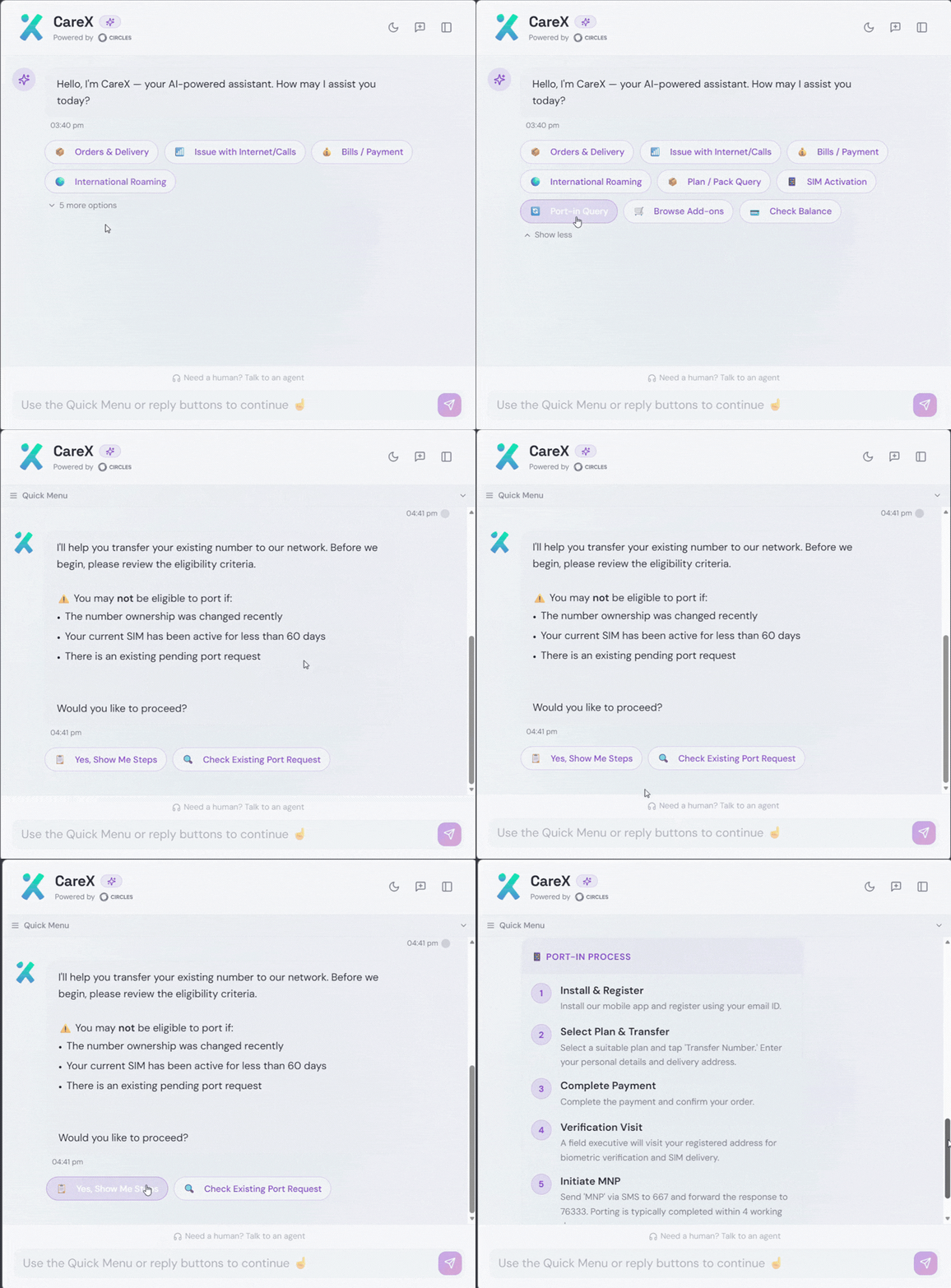
CareX is Circles’ AI-first conversational support platform built for the complexity of modern operators. By blending automation with human-assisted care, CareX allows operators to deliver consistent, scalable, and context-aware customer support. It embeds directly into your BSS stack, unifying scattered systems into one seamless experience. You can try out the demo here:
Unlike generic, non-telco chatbots, CareX is powered by 360° telco data and understands telco jargon. Its purpose-built agents can resolve various types of customer support requests while adapting across markets without custom development.
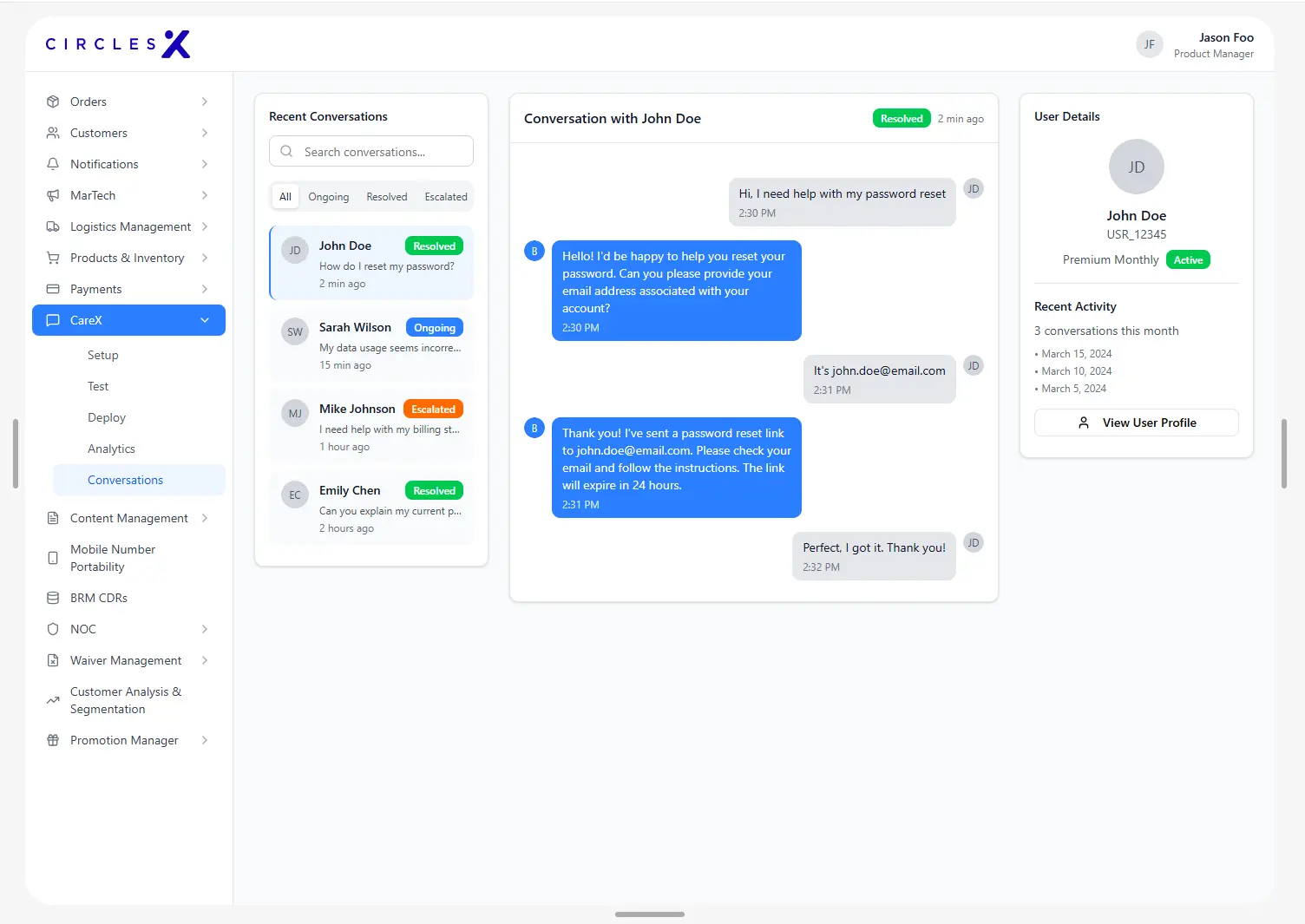
CareX helps via:
Action-Oriented AI with Data Sovereignty: CareX understands context, takes direct action, and scales securely while keeping subscriber data within the telco’s ecosystem.
One-Stop Suite of System Agents That Can Instantly Solve Cases: CareX includes over a dozen ready-to-use, purpose-built agents accessible from a single unified console, helping telcos save money on licensing and integration when entering new markets.
These agents include payment agentic AI that can detect and resolve failed transactions instantly along with usage, SIM/eSIM, refunds, and more, helping to reduce man-hour requirements from live agents.
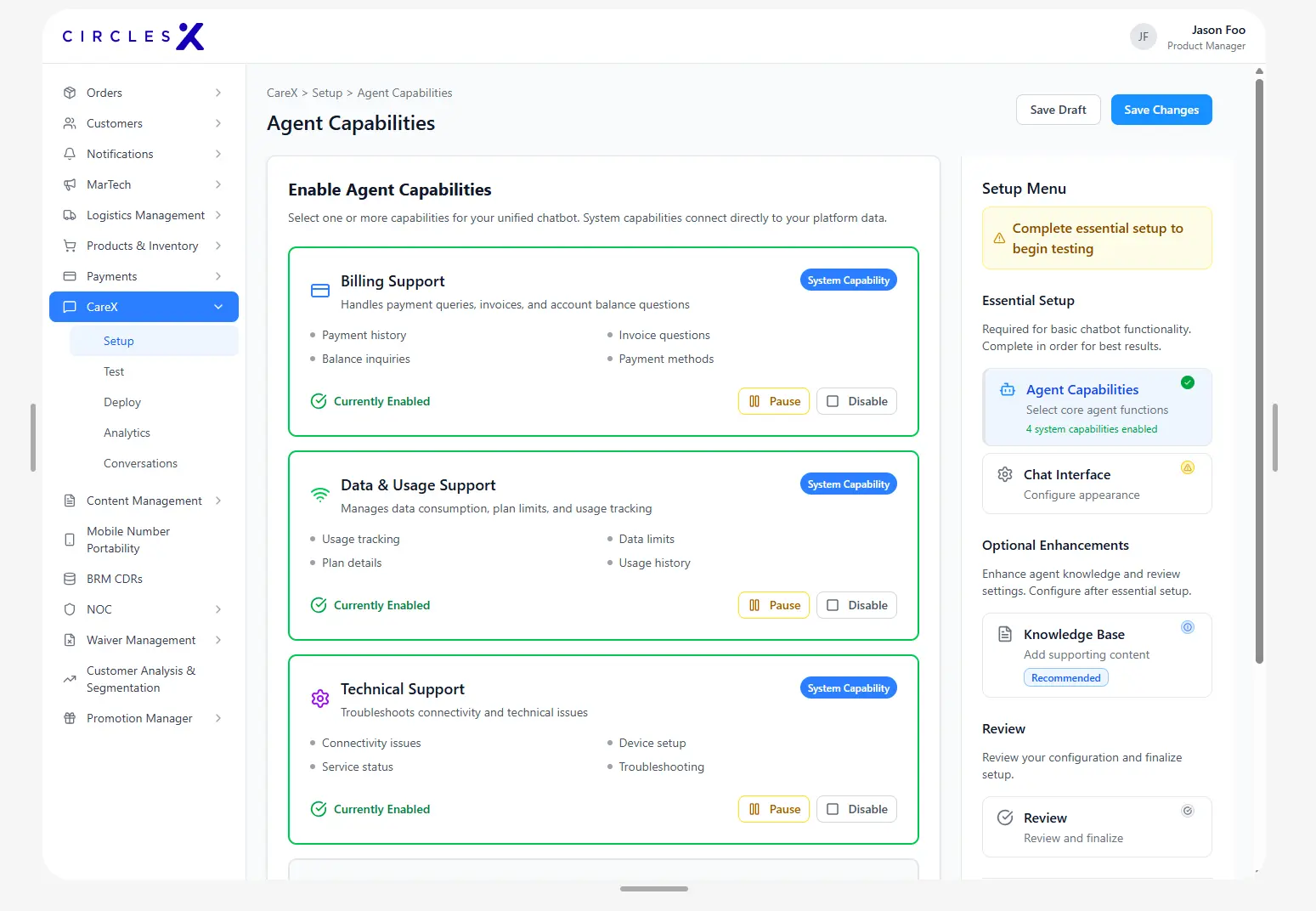
Code-Free Agent Customization and Deployment: Telcos can deploy market-specific CareX agents without writing a single line of code, supporting high-volume requests straight out of the box. These support order tracking, third-party API integration, and more, all without being bottlenecked by IT requirements.
Out-of-the-Box Support for Different Languages: CareX has multilingual support straight out of the box.
Content Agents and Knowledge Base Building for Fast, Accurate Answers: By uploading PDFs or scraping websites, operators can create a retrieval-augmented knowledge base with the full telco context. This allows content agents to operate autonomously and provide hyper-personalized, accurate responses specific to the telecommunications industry’s use cases and languages.
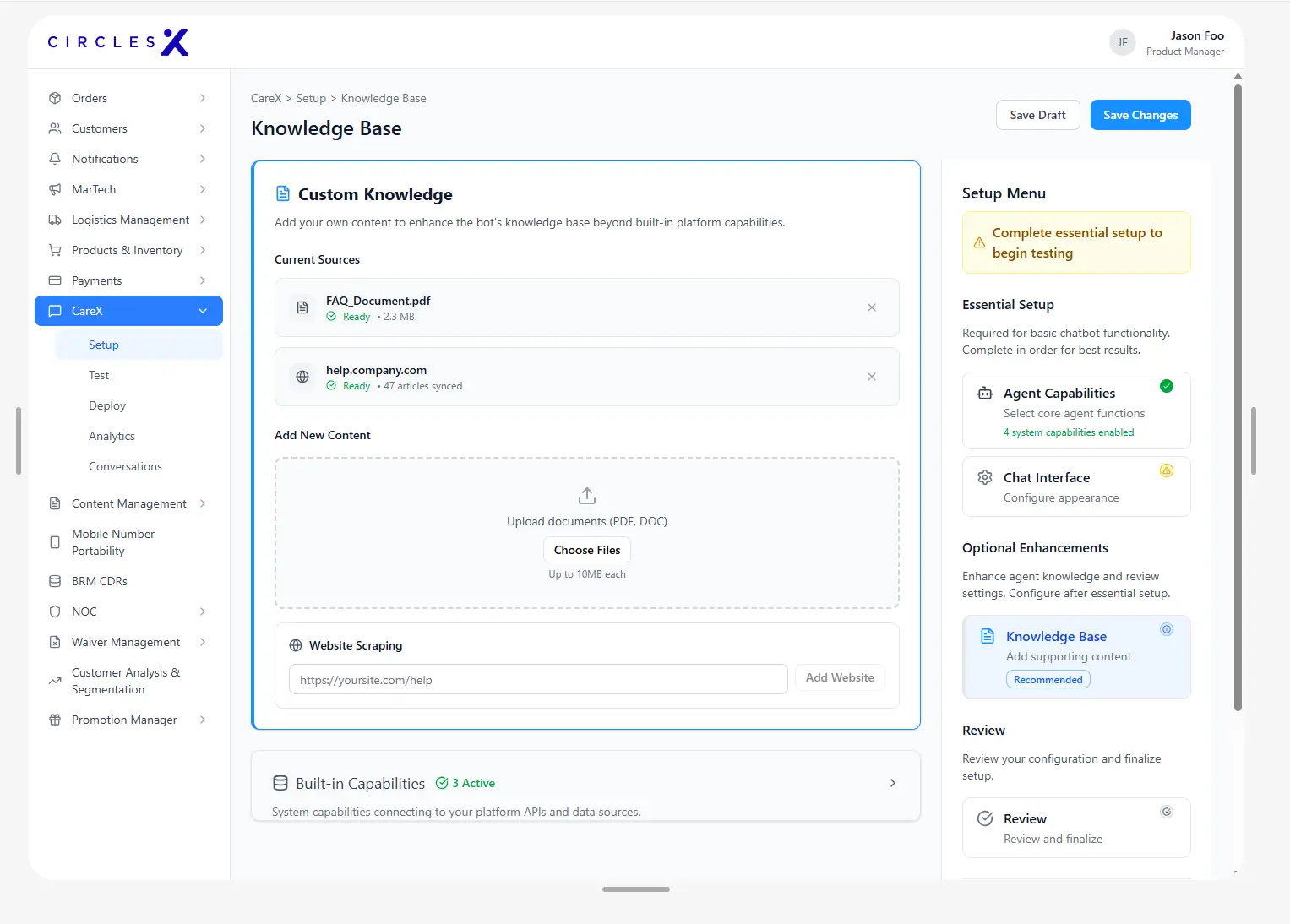
CareX is part of Circles’ broader AI ecosystem, which includes Xplore for innovation sandboxes and an AI Analytics Command Center for real-time insights. Together, these solutions represent a mature, full-stack GenAI platform that helps telcos evolve from reactive customer service to anticipatory care that delights customers and drives operational excellence.
From Reactive CX to Anticipatory Care
All of this is part of Circles’ vision to pioneer the world’s first AI Mobile Operator (AIMO), transforming telcos into Anticipatory Techcos. Anticipatory Techcos are telcos that can predict users’ needs and solve problems proactively while serving profitable new niches.
AI has made great strides in transforming customer experiences across the world, and operators that combine AI, data, and human empathy stand to win in this new environment. Winners can translate their investments directly into improved loyalty, higher ARPU, and long-term differentiation.
By collaborating with partners like Circles, operators gain access to a partner who has navigated these challenges firsthand, who can empower operators to evolve from connectivity providers into trusted, AI-powered lifestyle enablers that proactively anticipate and meet customer needs.
Contact us below to book a demo of CareX or to find out more about our services.
- Customer Gauge - What’s the Average Churn Rate by Industry?
- Harvard Business Review - The Value of Keeping the Right Customers
- McKinsey - Why AI-enabled customer service is key to scaling telco personalization
- NVIDIA - State of AI in Telecommunications: 2025 Trends
- Meet SuperTOBI - Vodafone’s new Generative AI virtual assistant now serving customers in multiple countries
- BT Group leans on AI to transform customer service experience
- BT Group Turns to AI for Transforming Customer Experience - Business News Week
- BT Group deploys GenAI to improve customer experience, partners Sprinklr, ETTelecom
- Empowering telecom employees with personalized AI-powered training and coaching tools | McKinsey
- SK Telecom improves telco-specific Q&A by fine-tuning Anthropic’s Claude models in Amazon Bedrock | Artificial Intelligence
- Verizon uses GenAI to improve customer loyalty | Reuters
- Why AI-enabled customer service is key to scaling telco personalization
- Closing the AI Accuracy Gap in Telecoms: The Critical Role of Domain-Specific Language Models
- GSMA - Building Trust in Telecom AI: Red Team Insights on TelecomGPT