

Knowledge Hub
7
5
min read
BSS Evolution and Monetization: Enabling Growth in the Digital Telecom Era
What Is BSS? Core Functions and Strategic Relevance
Evolution of BSS: From Legacy Systems to Digital First Platforms
Monetizing 5G and Digital Services with Modern BSS
Critical Enablers of BSS Transformation
5 Challenges in BSS Modernization and How to Overcome Them
Real-World Examples of BSS Transformation
Telecom operators are expanding into 5G, IoT, and partner-driven services, and many are rethinking how their telecom revenue systems support new digital services. Business Support Systems or BSS are central to this shift, and TM Forum describes BSS as the set of capabilities that manage charging, customer interactions, and product lifecycles based on its industry frameworks. STL Partners reports that modern BSS monetization strategies can reduce billing related costs by up to 20% for Tier 1 operators. For operators and digital-native businesses, upgrading BSS is no longer optional, as it provides the gateway to faster, more flexible growth.

What Is BSS? Core Functions and Strategic Relevance
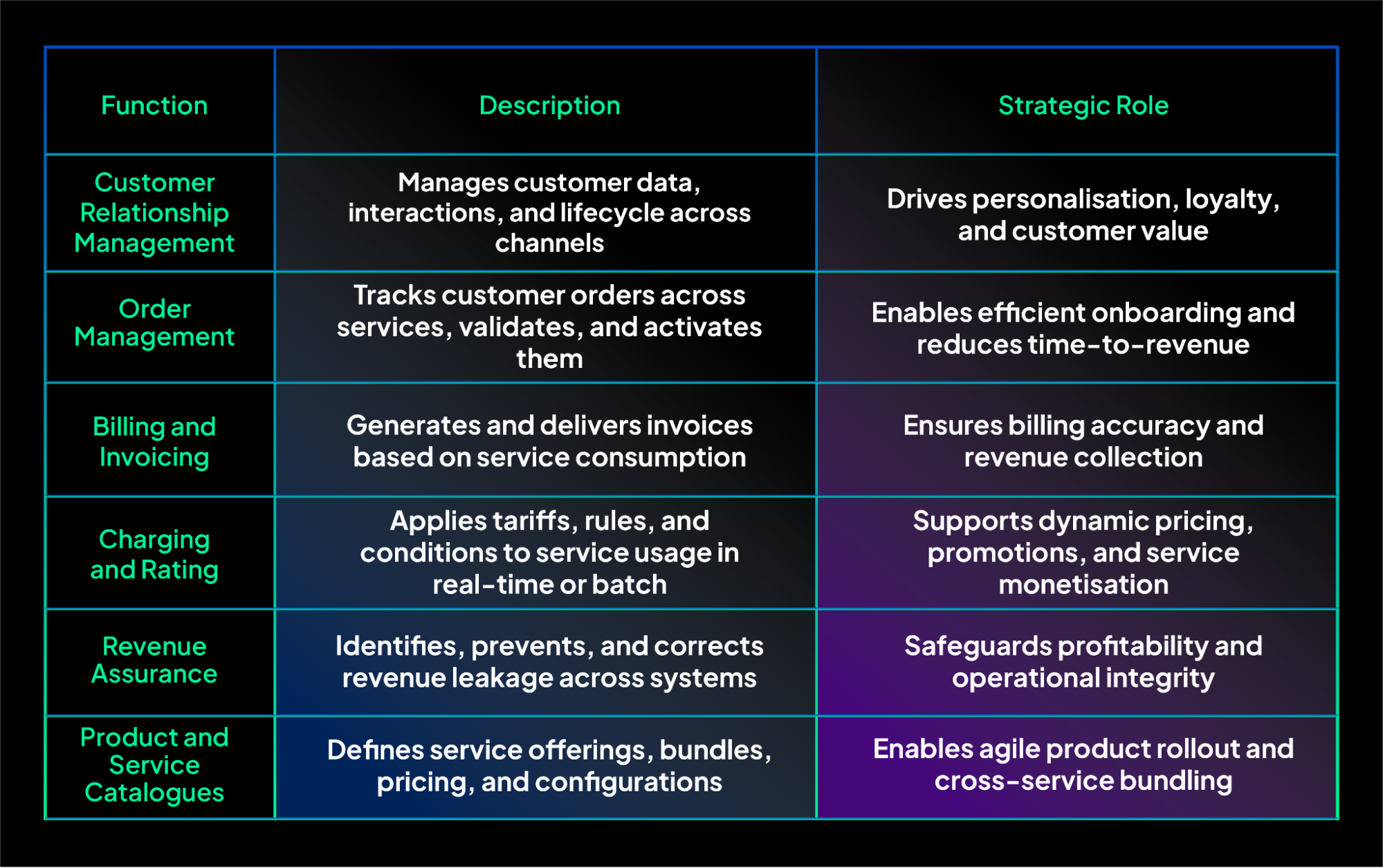
Business Support Systems, or BSS, refer to the suite of digital systems that manage the commercial layer of telecom operations. These systems cover customer management in telecom, product and service catalogues, charging and rating systems, billing and invoicing, revenue assurance, order management and related business workflows. According to the framework promoted by TM Forum and adopted widely across the industry, BSS handles the business‑facing processes that connect telecom operators with customers, services, and revenue flows.
In contrast, Operational Support Systems (OSS) manage network‑facing tasks such as service provisioning, fault management, and network performance monitoring. OSS ensures the network works, while BSS ensures the business around that network runs smoothly. The distinction between BSS and OSS remains fundamental for any operator looking to support both technical operations and commercial dealings.
BSS has strategic relevance because it directly shapes customer experience, pricing agility, service bundling, billing accuracy and revenue visibility. As telecom operators evolve toward 5G, IoT, hybrid connectivity and partner‑driven business models, BSS becomes central to delivering flexible, complex offerings. A recent forecast from Analysys Mason estimates that spending on BSS and related software by communications service providers will grow steadily between 2023 and 2028 as operators modernize legacy systems and adopt cloud‑native BSS platforms.
Modern telecoms depend on BSS to support converged offerings such as 5G subscription plans bundled with IoT services, enterprise connectivity, and partner apps. This makes BSS not just an operational necessity but a growth driver. By centralizing functions like customer data, order lifecycle, charging, billing and revenue assurance, BSS enables faster rollout of new services, dynamic pricing and monetization of new use cases including IoT, cloud services and multi‑party partner ecosystems.
Core BSS Functions and Their Strategic Roles in Telecom
Evolution of BSS: From Legacy Systems to Digital First Platforms
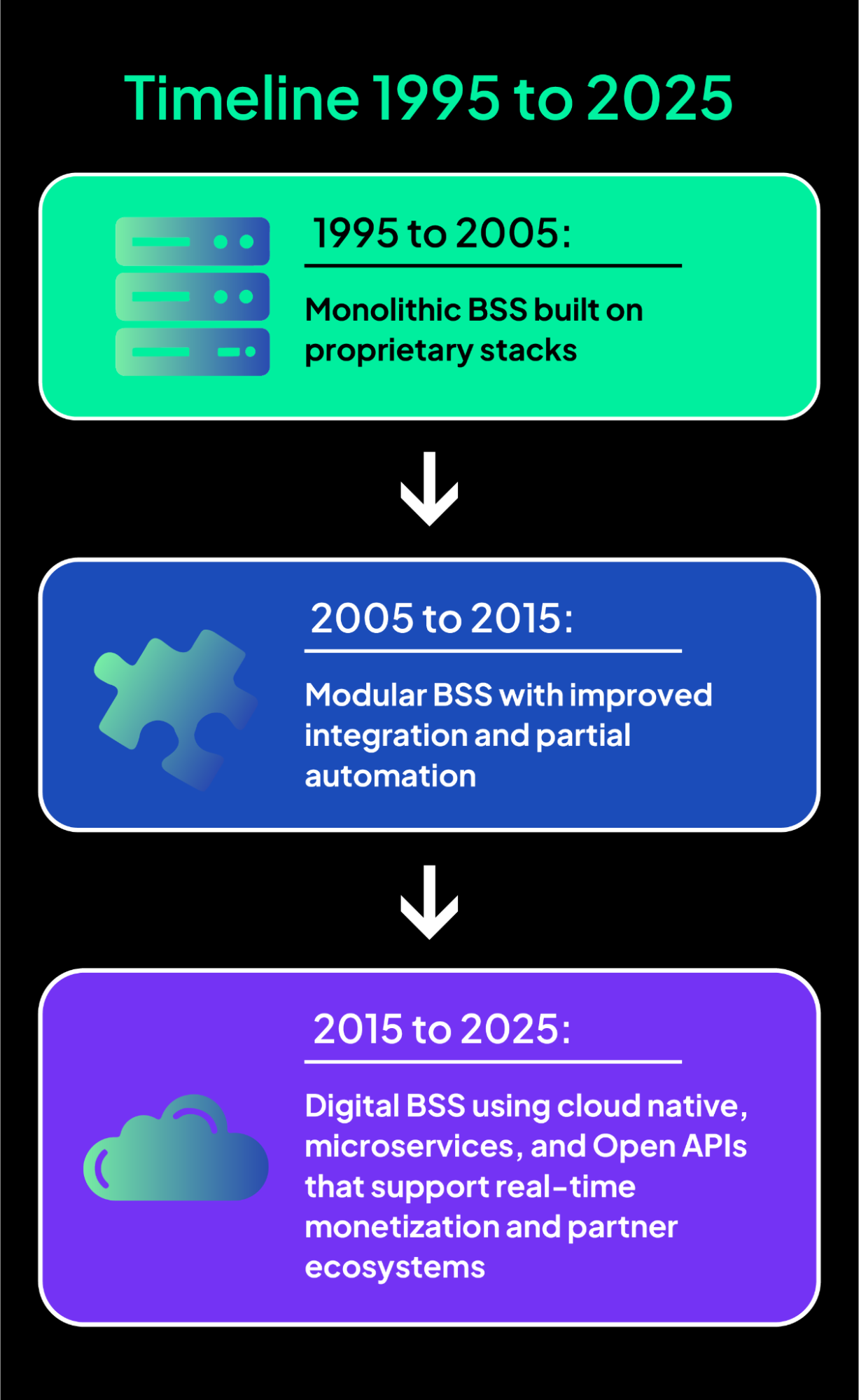
Business Support Systems have gone through a major transformation over the last three decades as telecom operators shifted from simple voice services to digital ecosystems built around 5G, IoT, enterprise solutions, and partner-based models. The evolution of BSS has happened in distinct phases that reflect changes in architecture, service expectations, and monetization needs. TM Forum’s Open Digital Architecture outlines how modern BSS domains need to be modular, cloud native, and fully interoperable to support real-time revenue systems and new business models. Industry reports from STL Partners and Analysys Mason also show increasing investment in digital BSS as operators move away from legacy stacks that slow down innovation and increase operating costs.
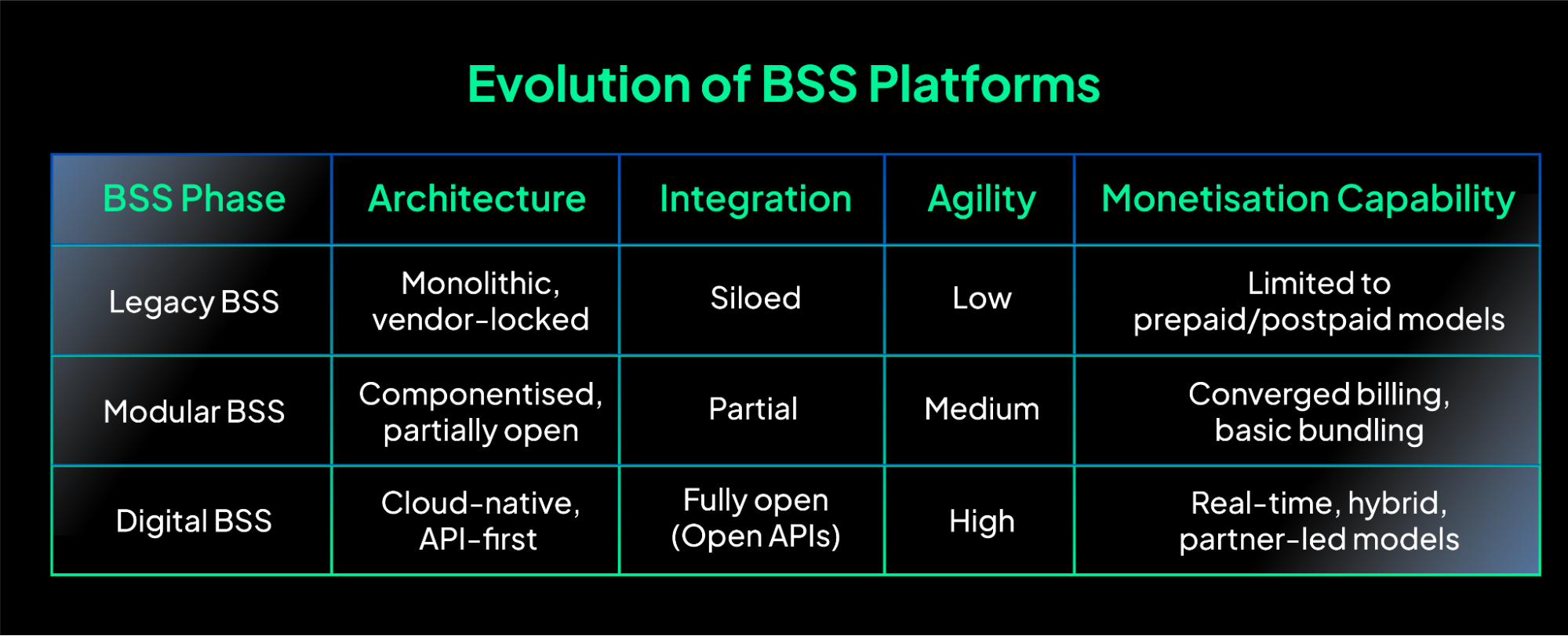
This section explains how the industry moved from monolithic, siloed platforms to cloud native, API driven systems that support fast delivery, automated scaling, and advanced monetization. The three phases below show how BSS capabilities expanded in line with technology growth and real-world operator requirements.
Legacy BSS – Monolithic and Siloed
Legacy BSS platforms were built for a world where telecom services were simple and mostly static. These systems were vertically integrated, designed around specific products such as postpaid voice or basic prepaid charging. They ran on proprietary technology stacks that made interoperability difficult and custom changes slow and expensive.
Operators often relied on manual workflows and rigid configurations, which limited product flexibility. Each BSS component such as billing, CRM, or order handling, usually operates in its own silo, creating fragmented data and inconsistent customer experiences. Time to market for new services was slow, and real-time charging was not feasible for many environments. These limitations made legacy BSS unsuitable for converged services or dynamic, usage-based offerings.
Modular BSS – Transition to IP-Based Integration
In the mid-2000s, operators began shifting to modular BSS architectures that enabled partial integration across functional layers. Components such as CRM, billing, and ordering were decoupled, allowing faster updates and more controlled integrations. The introduction of IP-based protocols improved communication between BSS and OSS domains and created a more unified operational flow.
Modular BSS also introduced more automation and supported a wider range of converged services. However, these platforms were still largely deployed on-premises and required heavy custom integration work. Scaling them was difficult and expensive. These systems improved agility compared to legacy stacks but still lacked the flexibility that digital service models required.
Digital BSS – Cloud Native and API Driven
Digital BSS represents the most advanced phase of evolution. These systems are cloud-native, horizontally scalable, and API-driven. Using microservices, container orchestration with Kubernetes, and CI/CD pipelines, they support continuous delivery and near-instant updates. Digital BSS enables real-time charging, catalog-driven product configuration, automated lifecycle management, partner onboarding, and SLA based monetization. These capabilities are essential for 5G, IoT, and B2B2X models where new services must be launched quickly and combined with external partner offerings. According to STL Partners, cloud native BSS adoption among Tier 1 operators continues to rise as they pursue lower operating costs and faster service rollout. A recent Analysys Mason BSS outlook also notes that operators are prioritizing cloud readiness and API driven architecture to enable new revenue channels.
Monetizing 5G and Digital Services with Modern BSS
Modern BSS platforms are essential for unlocking new revenue opportunities in the digital telecom era. As 5G, IoT, and B2B2X business models expand, operators need systems capable of real-time processing, complex pricing, partner integration, and rapid product innovation. Digital BSS enables monetization across end-users, devices, and partners, forming a foundation for flexible and scalable revenue models. STL Partners notes that operators adopting digital BSS experience faster time-to-market for new products and improved partner revenue.
These platforms allow operators to innovate on pricing, service packaging, and revenue sharing while meeting both consumer and enterprise demands. Centralized, cloud-native BSS reduces operational complexity and supports rapid scaling of digital services. By integrating analytics and AI, operators gain visibility into revenue trends and usage patterns, which enables smarter product decisions and targeted marketing campaigns. This integration of intelligence with operational systems ensures that BSS is not just a back-office tool but a strategic enabler of business growth.
Real-Time Charging and Converged Billing
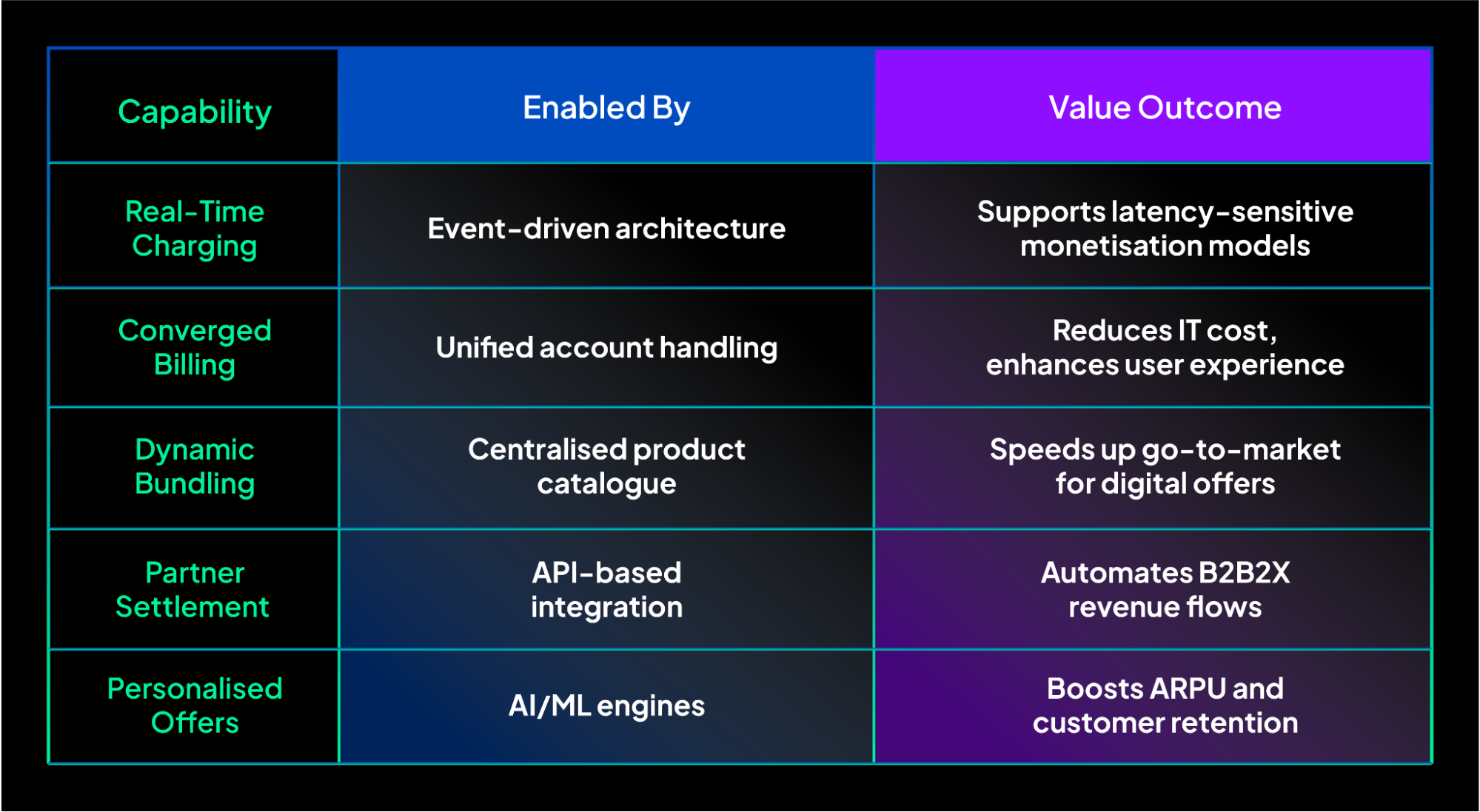
Real-time charging allows operators to price, meter, and apply business rules during live service usage, which is critical for latency-sensitive 5G services such as cloud gaming, virtual reality, and industrial IoT applications. Converged billing platforms combine prepaid and postpaid accounts into a single system, reducing operational overhead and simplifying account management.
Operators can implement tiered, usage-based, quality-of-service-based, or network slice-specific pricing. For example, a smart factory using 5G network slices may pay different rates for bandwidth, latency, and uptime SLAs, all managed in real time by BSS logic. Monetization extends beyond end-users to devices, enterprise applications, and partners in multi-tenant ecosystems. Vodafone emphasizes that real-time charging is a key enabler for flexible service models and faster product rollout.
By providing accurate and dynamic billing, operators also reduce revenue leakage and ensure transparency for both customers and partners. Real-time insights allow operators to adjust service offers and pricing strategies rapidly in response to changing demand, improving revenue capture while enhancing customer satisfaction.
Dynamic Product Bundling and Personalized Offers
Digital BSS platforms allow operators to create custom bundles in real time using centralized product catalogs and rule engines. AI and machine learning analyze usage patterns and generate upsell recommendations through self-care portals or customer service channels.
For example, operators can offer a bundle of video streaming, unlimited data, and gaming priority access as a real-time upsell during peak hours. Rapid bundling reduces time-to-market and allows operators to experiment with new offerings. Personalized offers increase the likelihood of conversion, boosting ARPU and customer retention. TM Forum highlights that operators leveraging AI-driven BSS personalization achieve stronger engagement and measurable revenue growth.
Partner Ecosystem Enablement and B2B2X Models
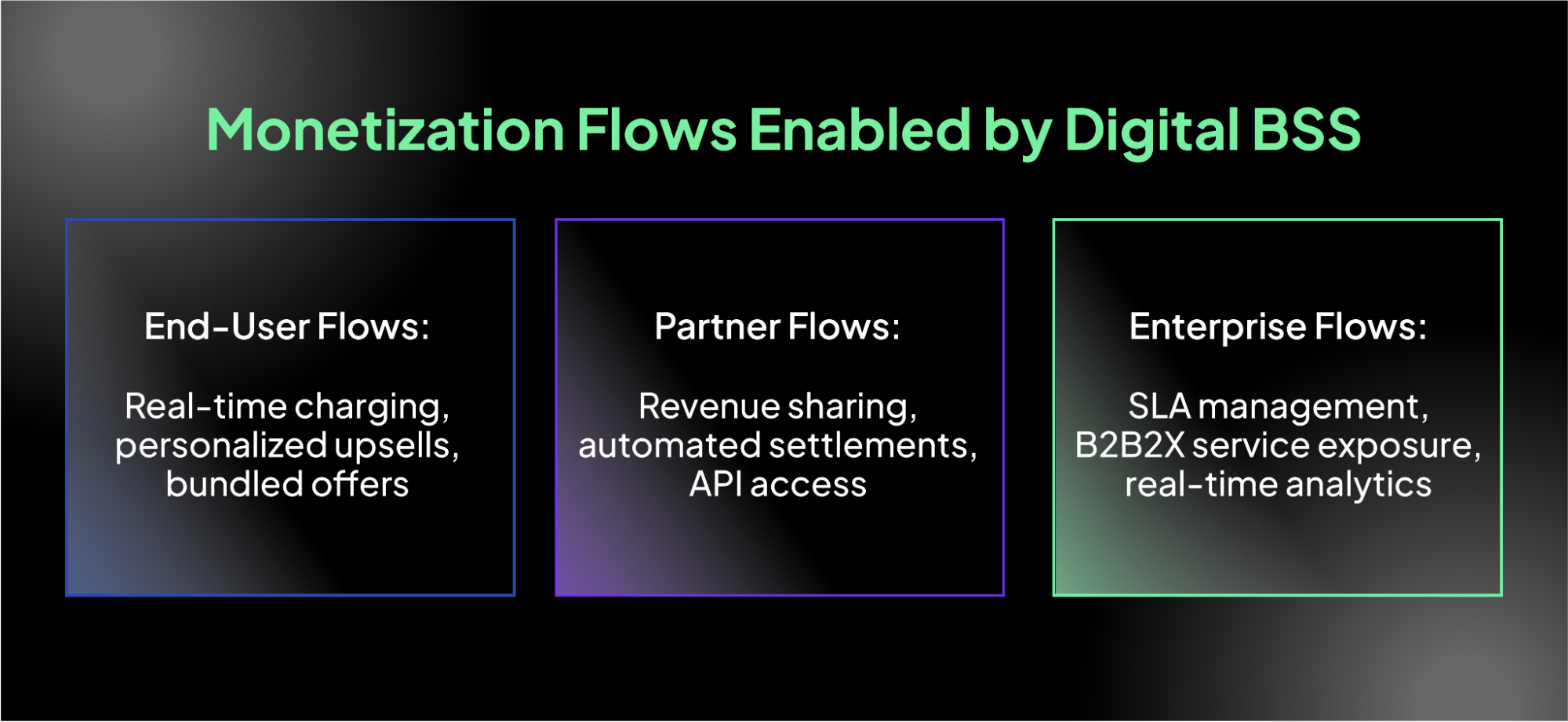
API-first BSS platforms allow operators to expose services such as billing, rating, identity, and location to enterprise partners or third-party developers. This enables revenue-sharing models across MVNOs, OTT platforms, device vendors, and wholesale networks.
IoT service providers can use a host operator’s BSS-as-a-Service platform to launch niche offerings with minimal overhead. Smart contracts and blockchain can automate settlement and dispute resolution. GSMA emphasizes that digital BSS is essential for scalable B2B2X monetization, allowing operators to grow revenue from partners and enterprise services while maintaining operational control.
Capabilities of Modern BSS in Monetization
Critical Enablers of BSS Transformation
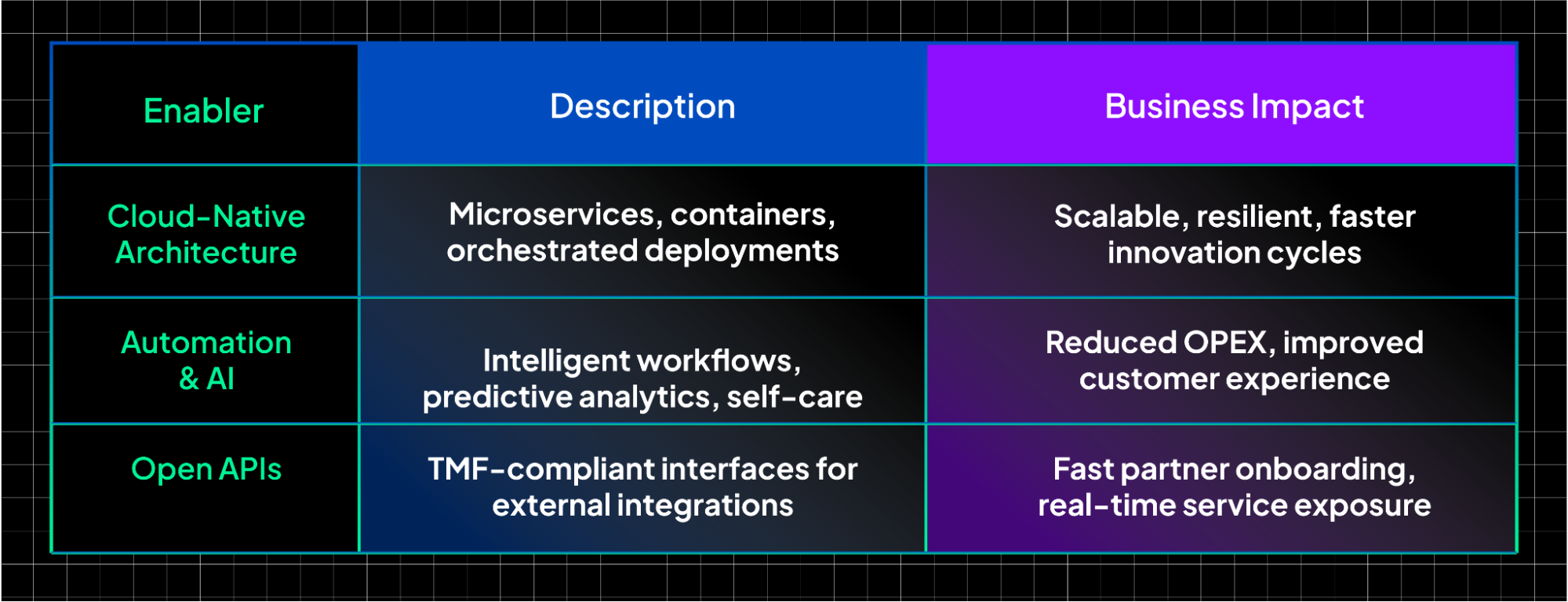
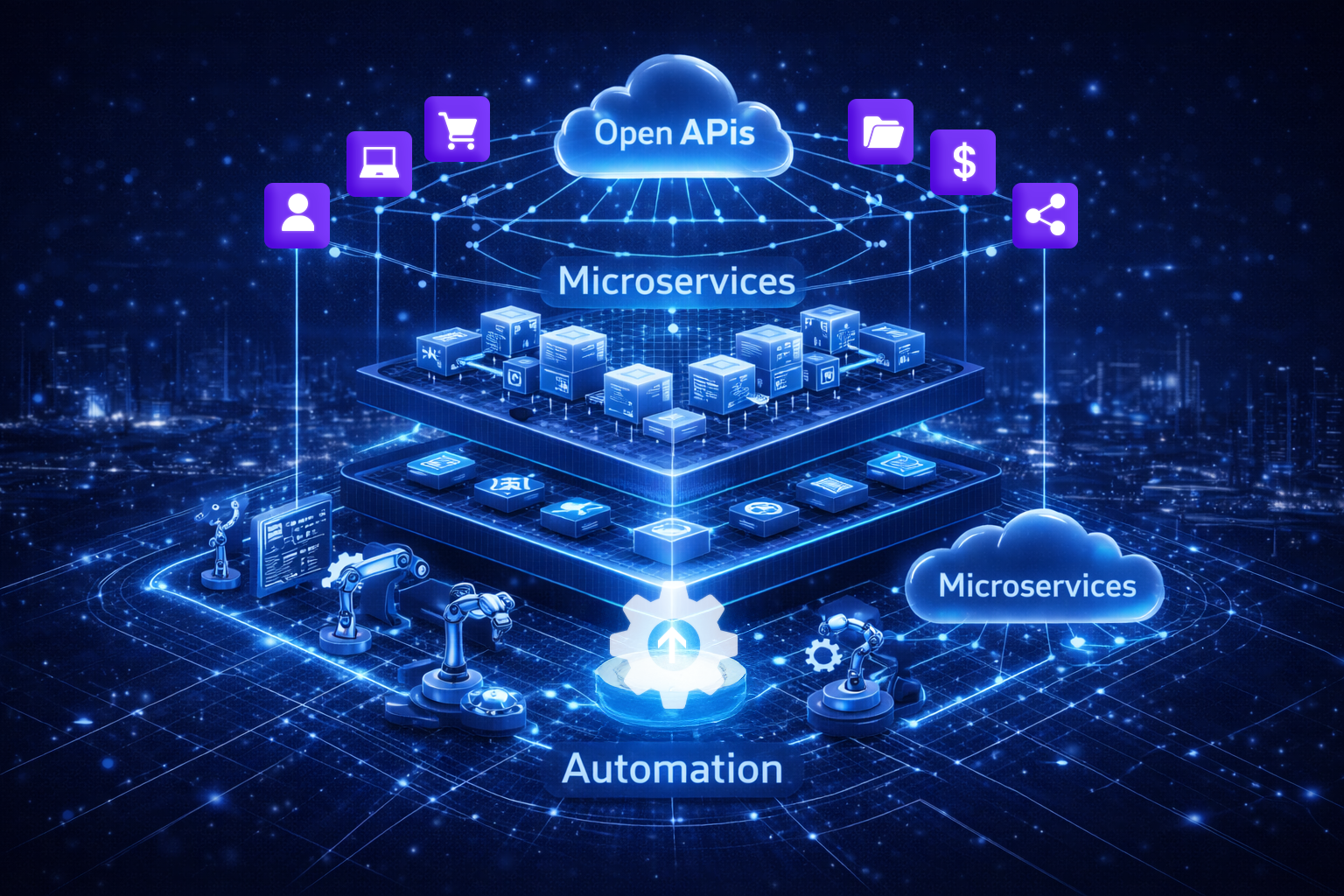
The modernization of BSS is driven by a combination of architectural innovation, automation, and open integration standards. Telecom operators are moving from rigid, monolithic systems toward modular, software-driven platforms that deliver scalability, service agility, and monetization readiness. Digital BSS relies on three critical enablers: cloud-native architecture, automation with artificial intelligence, and open APIs. Each enabler allows operators to deliver services faster, improve customer experience, and unlock new revenue streams across consumer, enterprise, and partner ecosystems.
Together, these enablers allow operators to not only manage current services efficiently but also adapt rapidly to emerging technologies and evolving customer expectations, ensuring long-term competitiveness in the digital telecom era.
Cloud-Native Architecture
Digital BSS platforms today are built using microservices, containers, and orchestration tools such as Kubernetes. This design allows components like charging, billing, and customer relationship management to be deployed, updated, and scaled independently. Benefits include elastic resource usage, faster recovery from failures, and lower infrastructure costs. Cloud-native architecture also supports multi-tenant BSS-as-a-Service offerings, enabling MVNOs, IoT providers, and B2B2X enterprises to access advanced capabilities without heavy upfront investment.
For instance, an operator can deliver white-label BSS solutions to multiple MVNOs, each with customized product catalogs, real-time charging rules, and billing configurations. Cloud-native BSS also facilitates the integration of partner services and accelerates the rollout of new digital offerings.
Automation and Artificial Intelligence
Automation reduces manual intervention in processes such as order-to-cash, billing reconciliation, and issue resolution, improving operational efficiency and reducing errors. AI-powered engines enhance decision-making by providing predictive analytics for customer churn, optimal pricing, SLA compliance, and network usage patterns. Operators can implement self-healing workflows, intelligent ticket routing, and usage-triggered promotions delivered directly through self-service applications or customer care portals.
Combined with cloud-native deployment, automation supports continuous integration and continuous delivery pipelines, allowing operators to release new features and services quickly. This approach shortens time-to-market for digital products and improves operational flexibility. Operators also benefit from analytics-driven insights, which help in creating personalized offers and dynamic bundling for both B2C and B2B customers. According to Gartner, operators adopting AI-driven automation in BSS achieve measurable cost reductions and significant improvements in service quality and customer satisfaction.
Open APIs and Standardized Integration
Open APIs, particularly TM Forum-compliant interfaces, ensure vendor-neutral interoperability and allow seamless integration with OSS, partner platforms, digital channels, and third-party services. Open API frameworks reduce the time-to-market for new offerings and enable flexible partner monetization models, self-service capabilities, and dynamic revenue-sharing arrangements.
For example, an IoT provider can provision services directly through an operator’s BSS APIs, enabling scalable partner-led monetization with minimal operational overhead. Open APIs also allow operators to integrate new business models quickly, such as B2B2X solutions, content services, and multi-partner billing arrangements. Open API adoption can accelerate ecosystem development and enable flexible, partner-driven revenue opportunities.
Core Enablers of Digital BSS Transformation
5 Challenges in BSS Modernization and How to Overcome Them
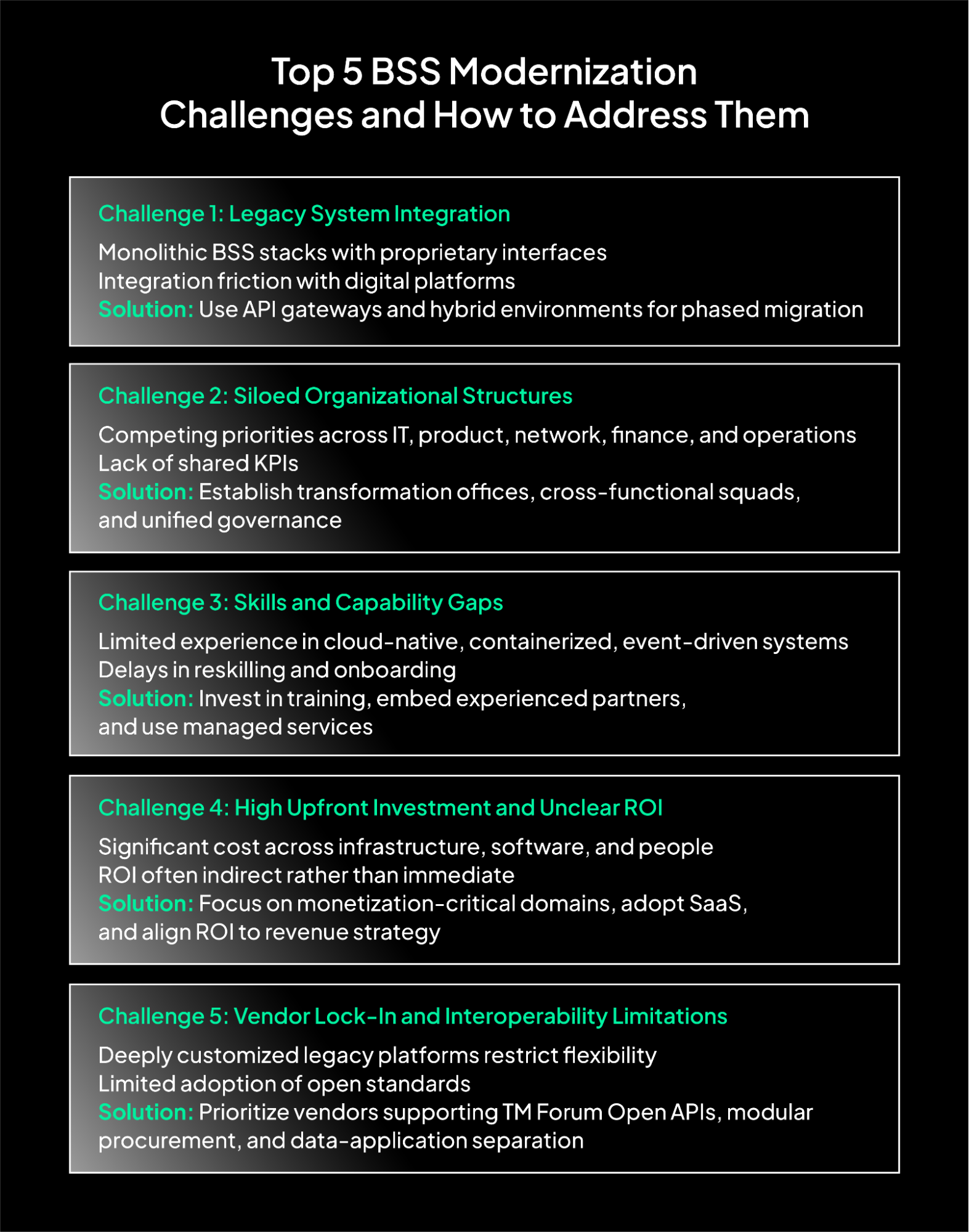
Modernizing BSS is critical for operators to remain competitive in the digital telecom era. However, the journey is complex and fraught with challenges. Decision-makers need a clear view of common obstacles and practical strategies to mitigate them. The following five challenges highlight both technical and organizational hurdles, paired with actionable solutions that help operators achieve a successful transformation.
Legacy System Integration
Many operators still rely on monolithic BSS stacks that are tightly coupled and built on proprietary interfaces. These legacy systems often lack API readiness, creating friction when connecting with modern, digital BSS platforms. Integration can require complex middleware, wrappers, or phased coexistence strategies, which can delay deployment and increase costs.
Mitigation: Operators can use API gateways and hybrid environments during migration to minimize disruption. Phased approaches, where legacy and new systems operate in parallel, allow gradual data and service transition while preserving ongoing operations. TM Forum recommends establishing clear API strategies and hybrid architectures to ensure smoother integration during transformation.
Siloed Organizational Structures
BSS transformation spans product, IT, network, finance, and operations teams. Siloed ownership can lead to competing priorities, a lack of shared KPIs, and slow decision-making. Without coordinated governance, modernization efforts often stall or become misaligned with strategic objectives.
Mitigation: Establishing transformation offices, cross-functional delivery squads, and unified program governance can align priorities across teams. Clear communication channels, shared metrics, and joint accountability are essential for driving progress. Axiata, for example, leveraged cross-functional squads to successfully coordinate its phased BSS modernization, ensuring alignment across multiple markets.
Skills and Capability Gaps
Cloud-native BSS platforms require expertise in Kubernetes, CI/CD pipelines, container orchestration, and DevOps tooling. Many telecom IT teams have limited experience with decentralized, event-driven systems, resulting in onboarding delays, operational risks, and potential platform instability.
Mitigation: Operators can reduce these risks by investing in focused training programs, bringing in experienced cloud native or DevOps specialists, and using managed services during the transition period. This approach helps teams build confidence with containerized environments and event-driven architectures while maintaining platform stability and keeping transformation timelines on track.
High Upfront Investment and Unclear ROI
Full-scale BSS modernization can take years and requires substantial investment across infrastructure, software, and personnel. ROI is often indirect—such as improved agility, lower OPEX, and faster time-to-market—rather than immediate revenue uplift. Finance teams may struggle to justify expenditure without clear monetization use cases and KPI-linked outcomes.
Mitigation: Operators can reduce risk by focusing on monetization critical areas, such as real-time charging or partner enablement, while spreading costs through SaaS or managed service models. Clear ROI models that link investment to outcomes like faster time to market, additional revenue from new offers, and improved operational efficiency help communicate value. Running pilot projects can provide early evidence of benefits and support broader rollout decisions with confidence.
Vendor Lock-In and Interoperability Limitations
Legacy BSS platforms are often deeply customized and tied to a single vendor ecosystem, limiting flexibility and making integration with new services or partners difficult. Closed interfaces also reduce the adoption of open standards and hinder future-proof architecture.
Mitigation: Prioritize vendors that support TM Forum Open APIs, adopt modular procurement strategies, and separate data from application logic. Operators can achieve a more flexible environment, reduce dependency on a single provider, and accelerate partner integration. Ensuring vendor neutrality and open interfaces helps maintain long-term agility and supports future monetization opportunities.
Real-World Examples of BSS Transformation
Telecom operators and MVNOs around the world have successfully modernized their BSS platforms, demonstrating tangible business impact. These real-world cases show how digital BSS capabilities—such as cloud-native architecture, real-time charging, and partner enablement—drive revenue growth, operational efficiency, and faster time-to-market for new services.
Vodafone – Converged BSS for Multi-Partner Ecosystem
Vodafone implemented a converged digital BSS platform to support multiple service lines across markets. The transformation focused on real-time charging, partner onboarding through Open APIs, and catalogue-driven product bundling. By unifying billing, CRM, and partner management, Vodafone simplified operations for MVNOs, IoT providers, and content partnerships.
Business impact: Vodafone accelerated time-to-market for digital offerings across more than 10 regions, enabling rapid deployment of new services while reducing operational complexity. The platform’s flexibility allowed the operator to support multiple partner models under a single framework. This modernization also improved revenue visibility and operational efficiency, demonstrating the strategic value of a modern, converged BSS.
Nokia – BSS as a Service for CSPs and Enterprises
Nokia’s Digital Operations Centre provides a cloud-native BSS-as-a-Service solution for telecom operators and vertical enterprises. The platform includes event-driven charging, zero-touch partner onboarding, and real-time SLA monetization, allowing operators to launch enterprise-grade 5G services. Dynamic charging models adjust automatically based on slice performance and service-level agreements.
Business impact: By offering BSS as a cloud service, Nokia lowers CAPEX barriers for operators and accelerates experimentation with B2B2X offerings. Operators can quickly test new enterprise services without heavy upfront investment, enabling agile monetization models. The platform has supported faster partner integrations and automated settlements, reinforcing the role of digital BSS in driving operational efficiency and revenue generation.
MVNO Case – Accelerated Go-to-Market with SaaS BSS
A regional MVNO leveraged a digital BSS SaaS platform to launch consumer and SMB offerings in under three months. The platform provided end-to-end capabilities, including onboarding, billing, customer self-care, and partner integration. Pre-built APIs enabled device management, usage-based charging, and seamless partner connections.
Business impact: The MVNO reduced operational costs, scaled offerings without major IT investment, and implemented agile bundling strategies. Rapid service deployment increased revenue flexibility and allowed the operator to respond to market demands quickly. The SaaS BSS model highlighted the benefits of modular, cloud-native platforms for smaller or emerging telecom players.Telesur is one of such telecoms which underwent the digital transformation.
Case Study Snapshot Cards:
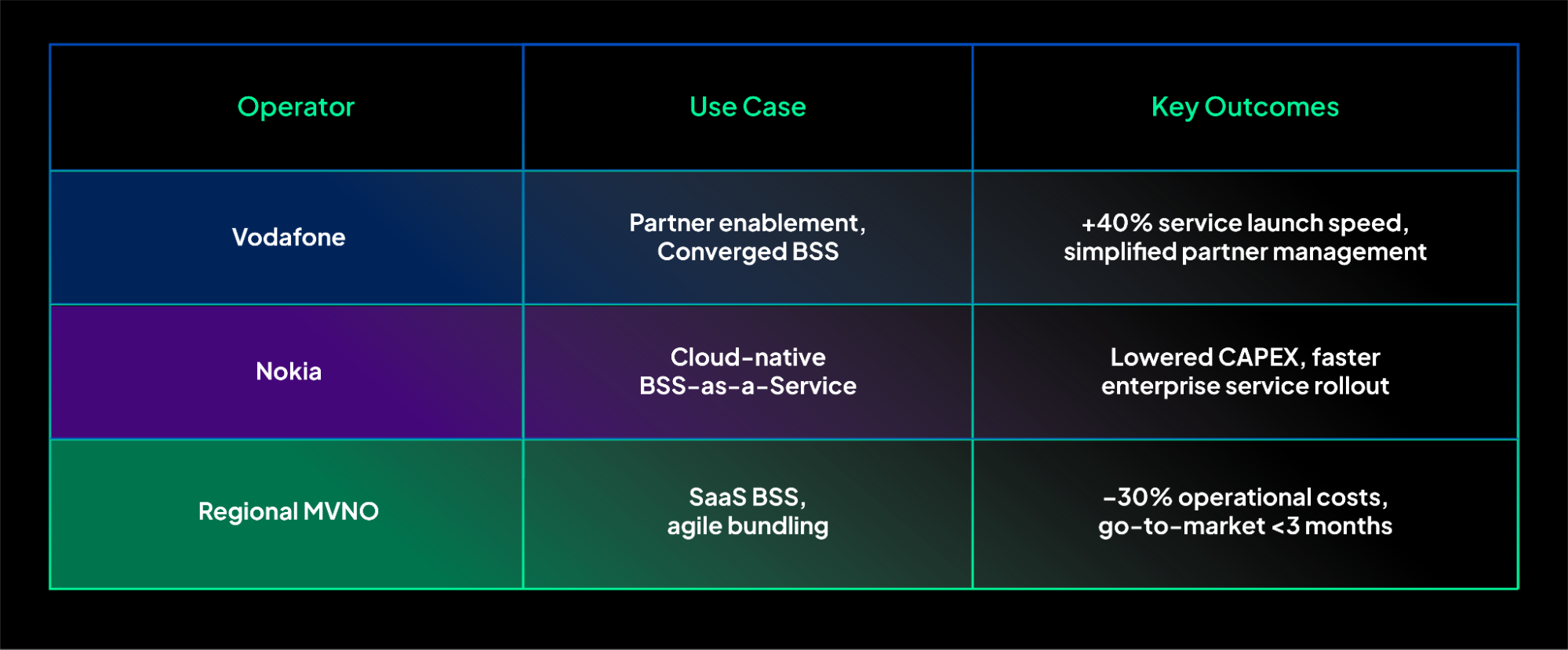
These examples collectively demonstrate that modern BSS platforms are not only a technical upgrade but a strategic enabler for operators of all sizes, empowering them to innovate, scale, and monetize digital services more effectively.
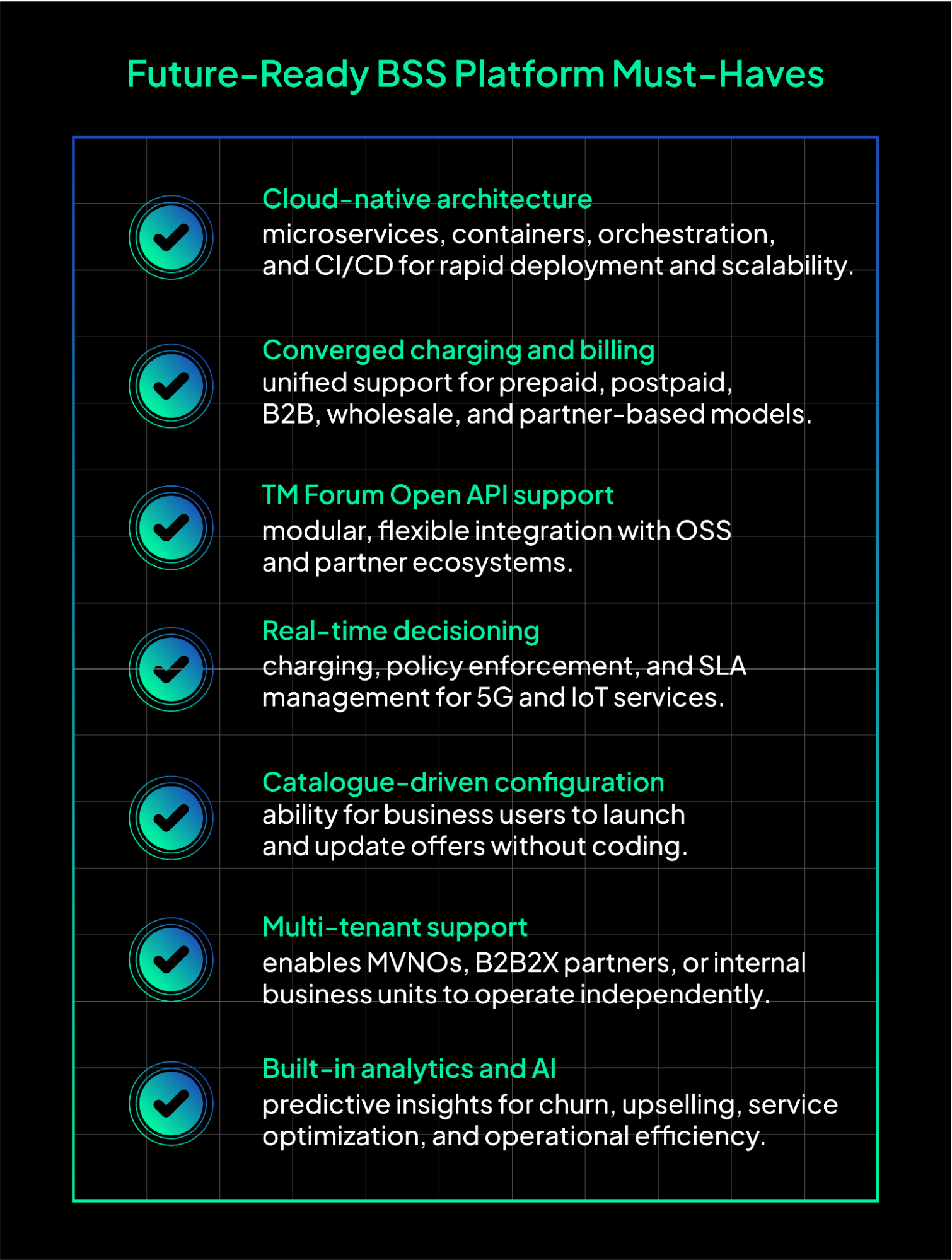
What to Look for in a Future-Ready BSS Platform
Selecting a future-ready BSS platform is critical for telecom operators and enterprises aiming to scale, monetize digital services, and maintain agility in a highly competitive market. Modern BSS solutions must go beyond traditional billing and CRM functions to provide cloud-native, API-driven, and analytics-enabled capabilities that support 5G, IoT, and partner-based business models. Evaluating platforms against clear architectural and functional criteria ensures organizations choose systems that can evolve with their service strategies and adapt to changing market demands.
Importantly, these platforms help operators respond to the growing demand for personalized services, dynamic pricing, and ecosystem-based business models. For instance, a cloud-native, multi-tenant BSS allows an operator to launch services for an MVNO or enterprise partner quickly while isolating data and configurations for each tenant. This flexibility is key for expanding into new revenue streams without creating operational bottlenecks.
Key Capabilities of a Modern Future-Ready BSS
Vendor and Solution Evaluation Criteria
Conclusion
Business Support Systems have become a strategic BSS foundation that powers telecom monetization, digital service innovation, and partner enablement across every market segment. Modern platforms now shape how operators launch services, manage ecosystems, and unlock platform based telecom growth with greater speed and intelligence. As networks evolve toward cloud native and real time environments, future ready BSS capabilities will determine how effectively operators scale, differentiate, and compete. Those who invest early gain faster innovation cycles, stronger ecosystem value, and long-term commercial advantage. This strategic shift confirms that modern BSS is essential for sustainable growth in the digital economy.