

Insights
8
5
min read
AI-Native Telcos Transformation Pillars: Vision and Leadership & Data, Architecture and AI Tools
The telecommunications industry has found itself amidst a new digital transformation cycle. With the future competitiveness of the industry at stake, telcos must manage the transition to AI-native operations while avoiding organisational and technological pitfalls that can derail telco transformation.
Telecommunications companies (telcos) have accepted AI as an inevitability, but the responsibility and cost of failure is great. In 2023, most telcos, were planning to incorporate AI into their workflows, with many not yet starting. In MWC 2025, nearly every booth in the event from both telco and non-telco participants featured AI-related capabilities.
The path to AI adoption itself doesn’t have a set of industry accepted playbooks yet, with major players like GSMA and TM Forum in the process of gathering experts and practitioners from across the industry to establish definitions, standards, and still in the process of building their set of best practices and playbooks as of the time of writing.
With industry titans also still debating on how best to digitally transform into AI-native telcos, what telco leaders and decision makers can currently do is to focus on the key pillars of a successful AI transformation, and having the courage to go all-in on AI-Native as opposed to incremental AI adoption.
Why Incremental AI Is Reaching Its Limits
In 2024, TM Forum’s GenAI Maturity Interactive Tool (GAMIT) report highlighted that many telcos were still in the proof of concept phase when it came to Generative AI adoption.1
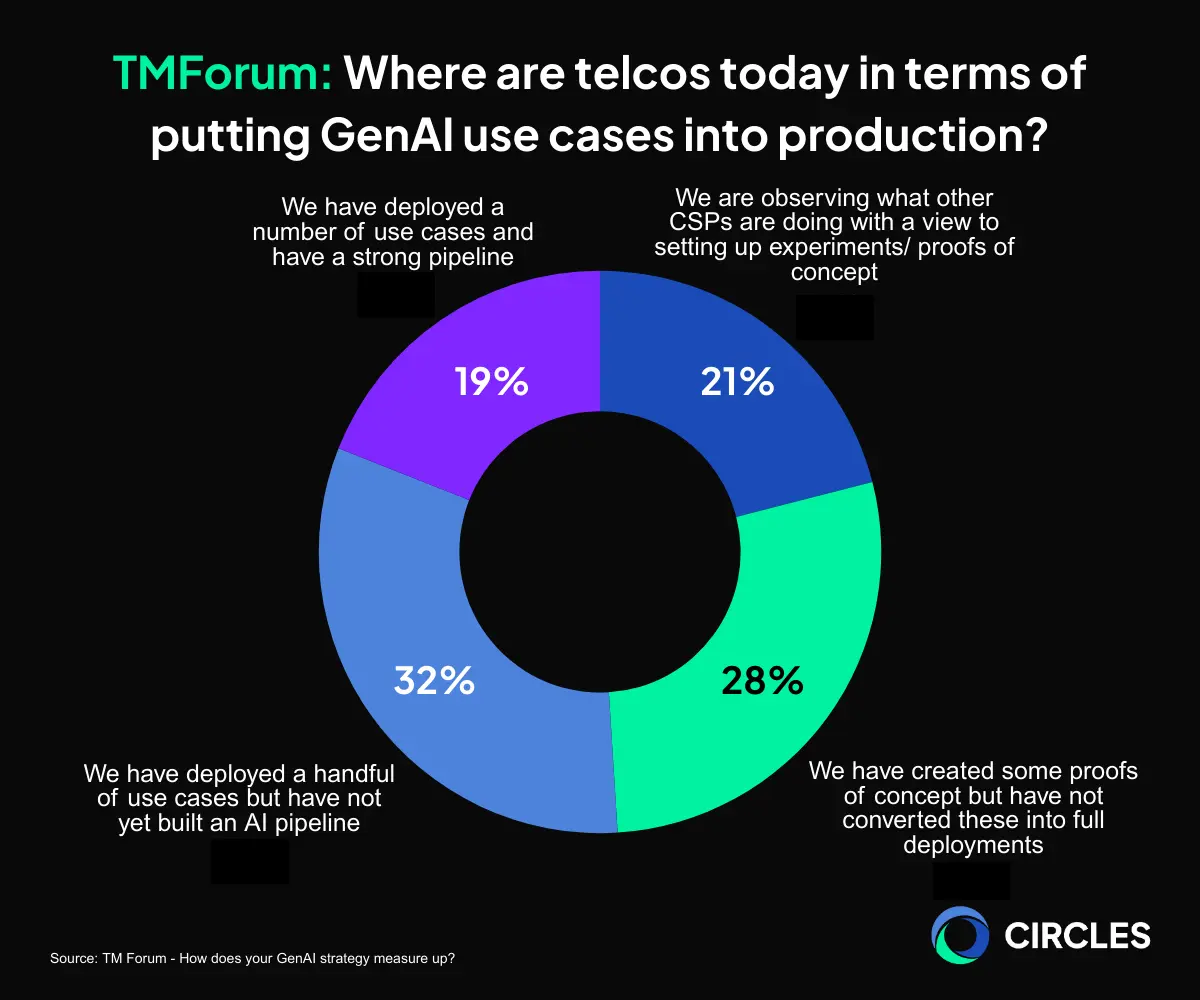
The telco industry has historically focused on service stability and security, with monolithic structures and an emphasis on service uptime. Risks are usually not taken lightly, and in many cases the prevailing attitude is ‘if it isn’t broken, don’t fix it’. Software stacks that work tend not to be changed for fear of system downtime, which can cause churn and loss of revenue.
McKinsey notes the following: “Organizations that talk about adopting AI but move at a slow pace, hoping that a few innovation projects developed at the fringes of the organization and in silos that will come together to create a snowball effect to holistically change how technology informs business decision making, are likely to fail.”2
But this mindset leads to years and years of technical debt and ‘bolted-on tools’ in some cases like bolting on AI as an overlaid tool instead of doing the required structural change that embedding AI at the telco’s core requires.
To escape the trap of incremental or bolted-on AI adoption, telcos need to take a bold step and treat AI adoption as an organization-wide transformation. The biggest driver of this level of transformation will be CEO-level sponsorship and full executive alignment throughout the transformation.2 Without a clear strategy and vision to rally the organization and commitments on the required long-term changes, AI-native transformations will not succeed.
However, there is no one-size-fits-all strategy or solution when it comes to AI-Native telco transformation. As every telco is different and there is currently no consensus reached about the ‘best’ way to become AI-Native, what is instead worth exploring are the key pillars and key questions that are highlighted by various telco industry blueprints.
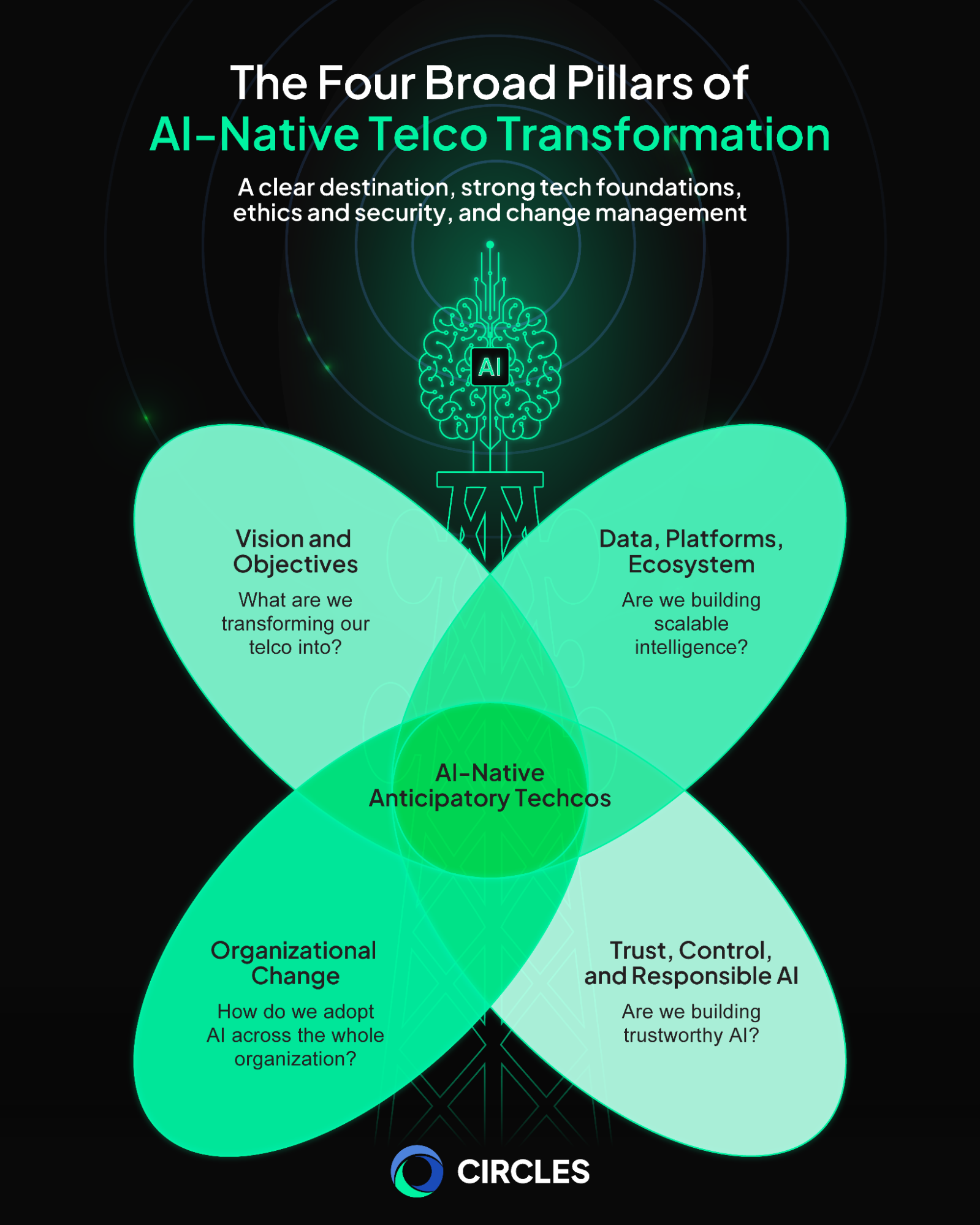
Key Pillar - Vision & Objectives: Leadership Intent & Strategic Clarity
Telcos know that they need to transform their telcos into strong AI adopters, but the key question here is ‘transform into what, exactly?’
Each telco is different, and the answer for a major national carrier could be different from an MVNO that targets a niche market. Regardless of the starting point, telco leaders are acknowledging that telcos must have a strategic purpose in the AI era beyond connectivity, in other words, having clarity on what their telco’s AI adoption needs to achieve.
With AI adoption’s possibilities being almost endless, telco leaders now need to chart a path towards what they believe their telco can achieve with AI. There are still schools of thought that emphasises using AI for cost reduction and efficiency strategies, but a strategy that uses AI to unlock growth at the same time is also key.
These possibilities include national carriers carving a new niche in the digital lifestyle ecosystem or specialising for small but profitable microsegments with various tailored AI-powered digital sub-brands, such as digital banks offering telco MVNO services. One guiding principle here is that AI-native transformations and value creation needs to be done to the benefit of telco customers.
A major part of the blueprints for AI-Native transformation is making “AI adoption predictable, transparent, and scalable across the business by building AI adoption as a cohesive framework that spans the whole organization and not in isolated initiatives” to increase the chance for AI-native transformation success.3 The importance of a clear vision has been noted by telco alliances like TM Forum and GSMA as well as other key telco players in their upcoming AI-Native transformation blueprints.
One successful example of an AI definition that drove positive impact looks like this:
A Gen AI use case that automatically creates personalized customer messages can’t mitigate churn on its own. But when a leading telco combined this with an AI-powered consumer analysis, a unified churn model, a real-time proactive decisioning tool, and an automated multivariate testing model, it transformed the entire end-to-end workflow. This operator now boasts the least churn in that country.4
After having a clear vision of what success could be, the next step is setting incentives and steps to turn this vision into a reality. This includes incentives for AI adoption to encourage organizational behavior and ROIs to measure success. The vision and plan also needs to balance short-term efficiency gains with long term innovation as well.
Key Pillar: Data and Tools - Build the AI-native foundation: data + models + secure execution
After establishing the vision, the next pillar focuses on building the tools and structures to deliver on that intent.
Building Scalable AI Systems
One of the clearest lessons from early AI adopters in telecoms is that AI scales through building scalable and reusable systems and not through bolting-on individual use cases. Verizon and AT&T are embedding generative AI across their operations and customer service, some regional players are building AI-ready facilities,5 and autonomous networks and agentic AI are gaining traction.
Bolting-on AI through isolated AI pilots run by various teams could result in various disconnected and fragmented AI initiatives. To build scalable, repeatable intelligence, telcos need to focus on building shared data foundations with strong data governance, interoperability, reusable models, and common platforms that allow AI capabilities to be deployed consistently across the organization.
Leading operators are investing in centralized, modular AI platforms that act as repositories of proven models, APIs, and tools that teams across the business can reuse. In one example, a North American telco built a gen AI platform comprising around 50 reusable services,4 reducing the time required to launch new use cases from months to just weeks while also enforcing consistent architectures and governance. Without this kind of shared foundation, teams are left to experiment in isolation, slowing value creation and increasing operational and risk exposure.
Data Readiness and Data Architecture
Data is the lifeblood of a telco’s AI systems, especially agentic AI. Every telco has a gold mine of data from telemetry to customer service plan usage and even the millions of customer touch points they have collected.
But what sets telcos apart is how well the ‘plumbing’ for data is built, meaning how well the data is organized and if it can be easily used by AI systems and various teams. Data readiness is a key issue for older telcos who rely on legacy systems with siloed data and data transformation pipelines that can’t keep up with today’s demands.
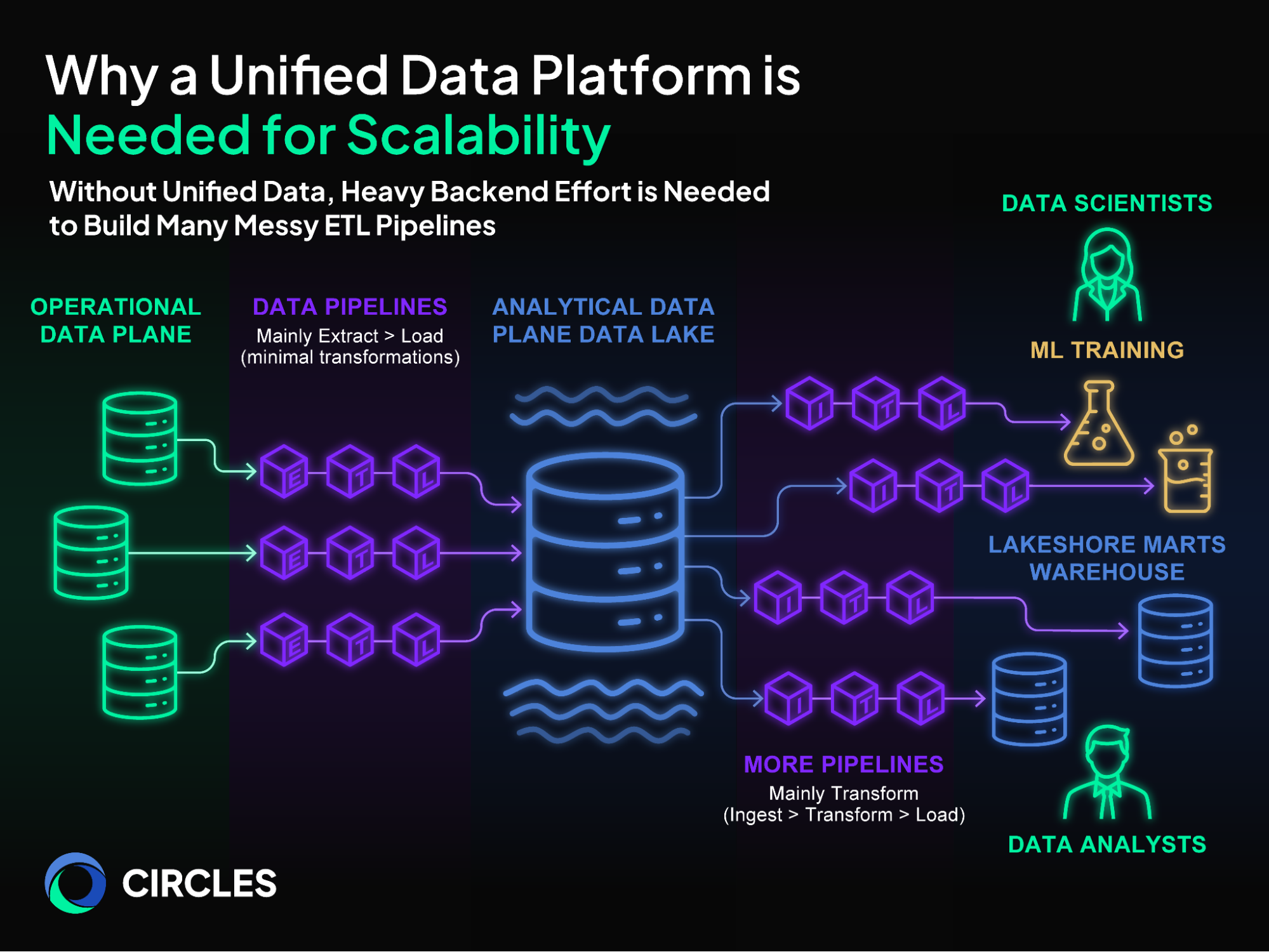
Organizing data can take various forms, such as strategies that move towards treating ‘data as a product.’ This means treating other teams and systems as ‘customers’ and ensuring that data is able to be accessed in real-time, is reusable and is governed across the enterprise in a way that can be used by everyone.
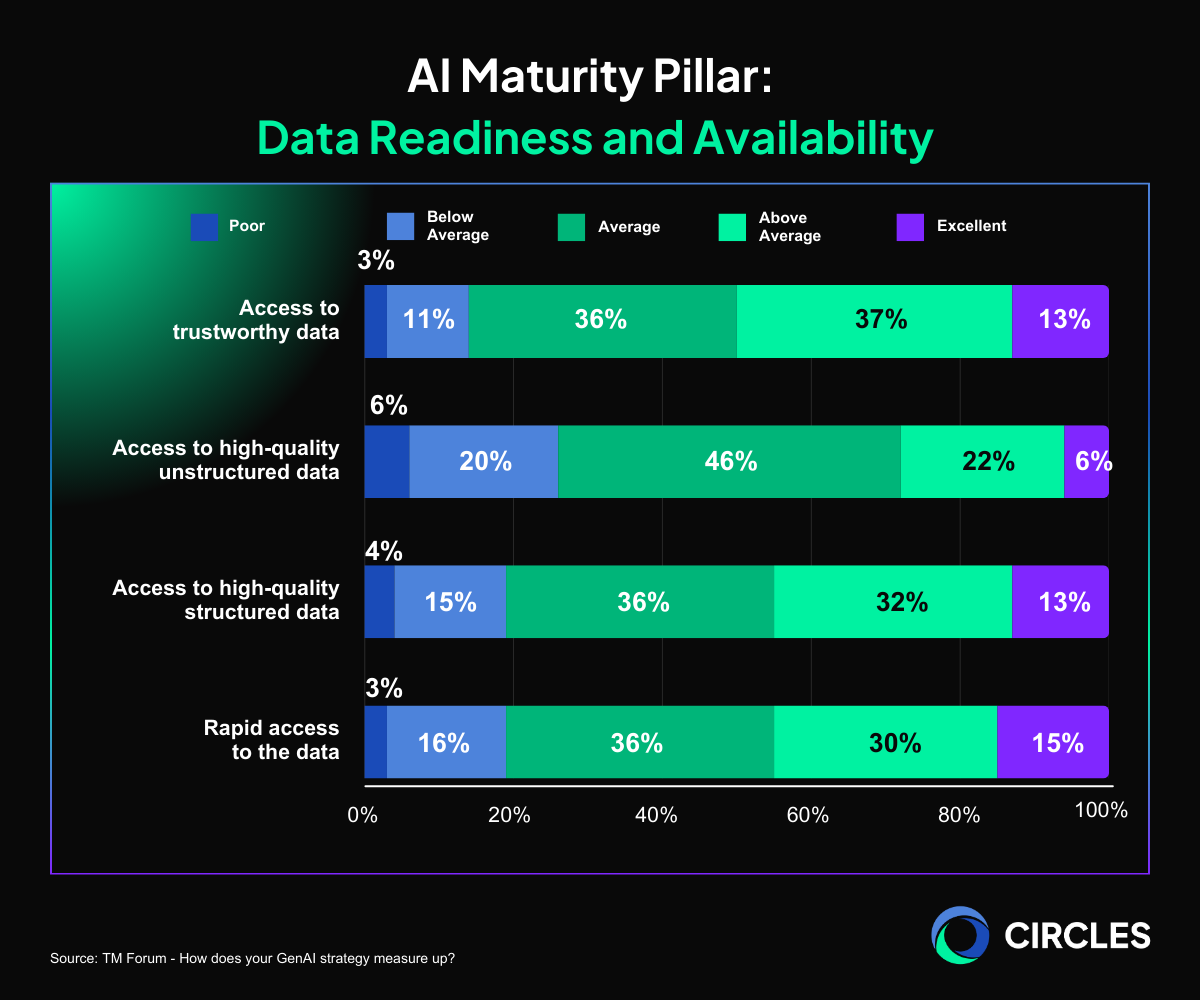
In a 2024 report by TM Forum,1 most telcos rated themselves between 1 and 3 (with the highest score being 5) in various generative AI data readiness metrics. Before telcos can consider building digital twins to test and optimize their networks, many telcos are exploring data architecture strategies like data hybrid lakehouse models, Data Meshes, and unified data layers.
The chosen architecture needs to combine customer, network, service, and operational data while making it accessible in real-time to the whole organization, forming the backbone of future AI initiatives. Partners who use unified data layers in their full-stack software, providing real-time reports across CRM, customer support, and more, are already helping telcos make the leap to become AI-Native telcos.
Going Beyond Connectivity: Ecosystem Partnerships
Finally, this pillar extends beyond internal capabilities to include ecosystem partnerships. Telco alliances highlight the importance of interoperability and edge capabilities to work with partners who are closer to end users, and cloud-native infrastructure. Other thought leaders point to the growing need for telco-specific AI models and partners that understand telco data, workflows, and regulatory realities.
But one key to value creation lies in the variety of partners that telcos can bring onto their new ecosystem. AI partners like OpenAI open the possibility of creating specific AI-powered services such as mental health chatbots or financial assistants. Operator solutions can enable a range of productivity solutions. All these provide telcos the chance to build new business models in areas like the digital lifestyle market or B2B service offerings, diversifying revenue sources.
In summary, while deploying new tools is important, AI-Native telcos focus on building foundations that make AI and data reusable, governed, and scalable. This is a major part of building an organization with AI truly at the core.
Conclusion: Vision Sets the Direction. Foundations Determine the Speed.
As telcos face the next technological revolution, one reality is becoming increasingly clear: AI-Native transformation starts with clear leadership intent, and does not get distracted by tools, models, or pilots.
While a standardised industry playbook is still under development, telco leaders cannot wait for perfect certainty. What they can do is to define what their organization is transforming into. This transformation needs to have AI at its core from how decisions are made, value is created, and customers are served. Without this clarity, AI initiatives risk becoming fragmented, incremental, and ultimately constrained by the very systems they are meant to modernize.
Once the vision is clear, the next pillar, AI-Native data and foundations, can be properly planned. Telcos need to ensure that real-time and reusable data is available for the whole organization, supported by platforms that enable scalable and repeatable intelligence. Telcos that build the right ‘plumbing’ build the foundation for the returns that scalable AI can provide.
Taken together, these first two pillars form the strategic and structural base of AI-native transformation. They answer two essential questions: “What are we becoming?” and “are we structurally ready to support that ambition?” Without clear answers to both, AI efforts stall before they reach meaningful scale.
These then set the stage for the next two pillars: responsible AI and organizational change. Stay tuned for the next article which explores how telcos can scale AI responsibly without losing control, and how operating models must evolve to turn AI capability into sustained organizational behavior.
Circles is pioneering the world’s first AI Digital Mobile Operator (AI-DMO), transforming telcos into anticipatory techcos. By uniting AI, data intelligence, and global ecosystem partnerships, Circles drives cost savings, revenue growth, and personalized experiences—empowering operators to evolve from connectivity providers into trusted, AI-powered lifestyle enablers that proactively anticipate and meet customer needs.
Want to see how telcos can use AI to take the next step to becoming AI-Native?
Contact us and book a demo today!
- How does your GenAI strategy measure up? Key findings from our Generative AI Maturity Interactive Tool
- The AI-native telco: Radical transformation to thrive in turbulent times | McKinsey
- AI-Native Blueprint Project – TM Forum
- Scaling the AI-native telco | McKinsey
- Turning AI Disruption into Telcos’ Growth Engine | BCG