

Insights
7
5
min read
AI-Native Telcos Transformation Pillars: Responsible AI & Change Management
As telcos move beyond defining AI ambition and building AI-ready foundations, the transformation enters its most decisive phase. Vision and architecture provide the direction for the AI-Native transformation, but safeguards are needed and organizational buy-in still need to be considered. The next set of challenges are questions of trust, control, and organizational readiness.
Telcos operate highly regulated, mission-critical infrastructure and are entrusted with vast amounts of sensitive customer data. As AI systems become more capable and autonomous, but not completely error-free nor perfectly secure, leaders must decide how accountability is preserved, and what security measures and safeguards must exist before AI can operate at scale. Without responsible governance, telcos put their systems and the data of their customers at great risk.
At the same time, even the most advanced AI systems fail to deliver impact if organisations do not change. Scaling AI requires operating model shifts, workforce enablement, and sustained change management led from the top.
This article focuses on two more key pillars of AI-Native transformation: how telcos can scale AI responsibly without losing control, and how they can turn AI capability into lasting organizational behaviour that enables lasting AI value creation. You can read more about the first two pillars, vision & leadership and architecture & AI tools here.

Key Pillar: Trust, Control, and Responsible Autonomy
Many telcos are familiar with safeguarding the data of others, adhering to rules like Europe’s General Data Protection Regulation (GDPR) or Singapore’s Personal Data Protection Act (PDPA). With massive amounts of data comes great responsibility to safeguard it, especially when AI comes into play.
AI systems, including agentic AI can create new points that bad actors can use to steal data from telcos. Meanwhile, the insights and decisions that AI systems need to make have to be fair and non-discriminatory. Investing in responsible AI (RAI) can be thought of as safeguarding the telco’s public image as an ethical user of AI trustworthy guardian of the public’s data.
In order to gain the benefits of automation that agentic AI and autonomous networks can provide, telco leaders have the vital job of setting AI’s guardrails and boundaries of where AI is allowed to act independently, and setting the principles so that AI can be used in a trustworthy and ethical manner. Clear direction from the very top is required about acceptable risk, accountability, and the pace at which autonomy and agentic capabilities should expand.
One way that AI-Native telcos can approach this is with progressive autonomy. Before leaping straight into fully autonomous systems, telcos can define safety nets and use human-in-the-loop checks supported by strong foundations in explainability, auditability, and accountability. This includes being able to answer these critical questions:
These questions can be reliably answered by ensuring that the right responsible AI principles are practiced and adopted throughout the telco. Some of these key principles can be distilled from various globally recognized AI governance frameworks, such as:1,2,3
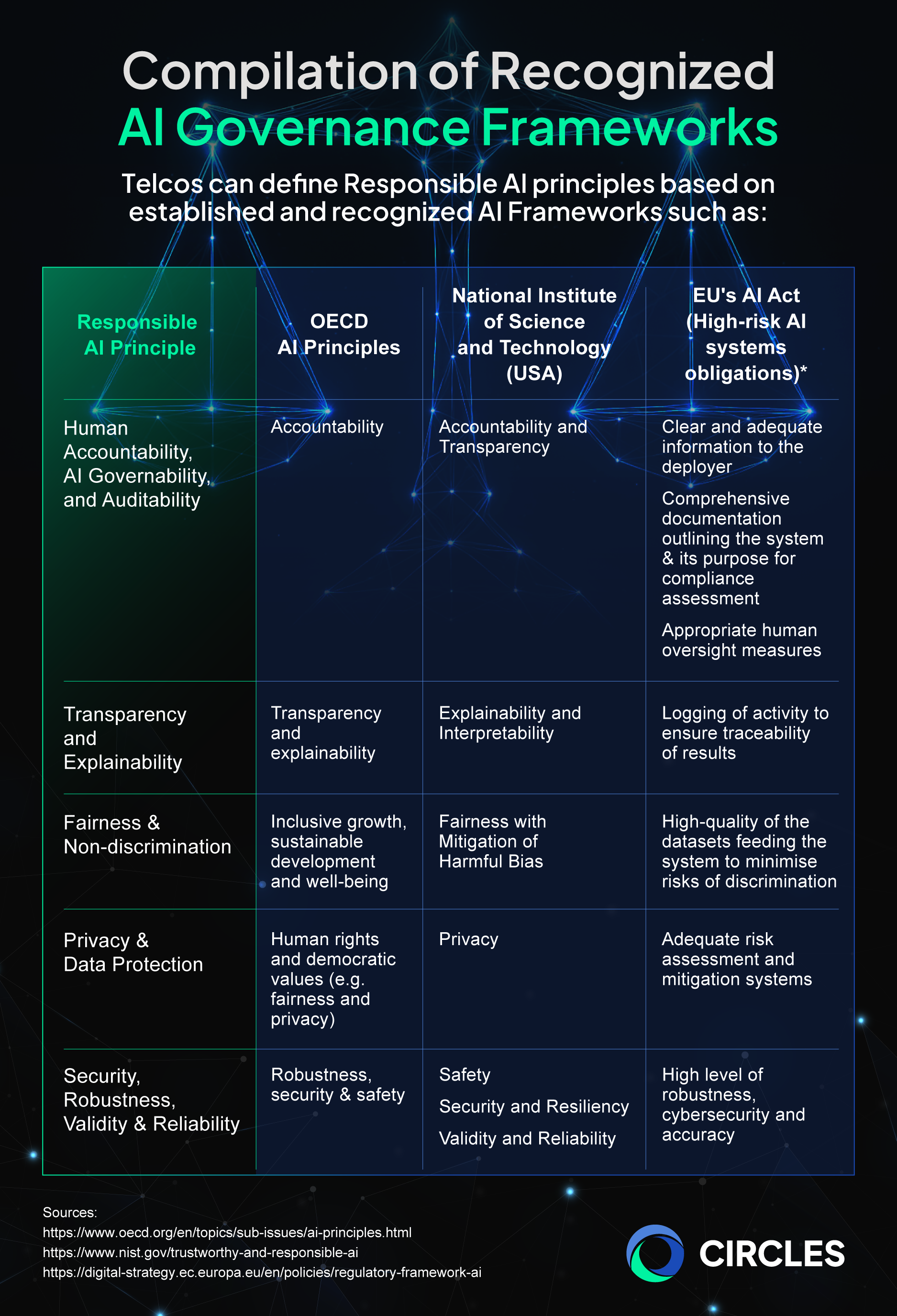
These can be summarized as:
AI-Native telco leaders embed these principles throughout their organization. GSMA’s blueprint provides a step-by-step guideline for this:4
In short, telco leaders need to keep this question in mind when handling responsible AI:
“Have we built AI systems that deserve to be trusted?”
When trust is engineered into every part of the system, AI can safely move from insight, to action, and eventually to autonomy. This is part of why partners like Circles design explainability and trust-by-design along with human-in-the-loop and other safety nets into its AI systems. Without building trust and responsible AI into the telco’s foundation, AI’s true potential cannot be realised.
Key Pillar – Operating Model & Adoption at Scale
Many digital transformations fail due to poor change management. Tech adoption can stall when other departments refuse to use new tools and processes.
In certain cases, the lack of a vision and operating model that can be shared between technology teams and business teams contributes to stalling tech adoption. In many organizations, AI development sits with tech teams or is seen as ‘just tech’s responsibility,’ business leaders expect value, and frontline users are just expected to adopt the new technology, all with very little alignment between these groups.
AI-Native telcos recognize that success depends on operating model changes and talent management. This starts with redefining how every part of the organization can work together with AI at the core and share ownership of outcomes and not just as something to “roll out” after development is complete.
This calls for carefully planned change management starting from the top. CEO-led communication and a clear vision sets the tone that AI can empower the organization. Discussions and involvement of various departments is crucial to understanding how AI can augment their roles, rather than replace them. Without this, early productivity gains often are limited to enthusiastic early adopters before stalling with the rest of the organization.5
Talent and workforce evolution are equally important. AI-native telcos invest not only in specialist roles such as data engineers, data scientists, and AI product managers, but also in raising AI literacy across the organisation. Frontline teams, managers, and business leaders need enough understanding to trust, question, and effectively use AI-driven tools in their day-to-day work.
In summary, telcos need to acknowledge that most AI transformation programs fail due to poor organizational change management. Without careful consideration of how telcos need to change how decisions are made, how work flows across teams, and how success is measured, telcos won’t truly realize AI’s potential.
For telco leaders, this pillar is a reminder that AI-Native transformation is ultimately a human, and an organizational transformation. Technology and AI is ultimately a tool whose potential can only be harnessed by people.
Conclusion: For An AI-Native Roadmap to Succeed, The Right Leadership Stance is Needed
There currently is no single, universally accepted playbook for becoming an AI-Native telco. The industry is currently abuzz with shaping definitions, standards, and blueprints, reinforcing that notion. This reflects the reality that AI-Native transformation is not a fixed destination, but a fundamental shift in how telcos think, decide, and operate.
What is clear, however, is that incremental and bolted-on approaches may risk holding telcos back. In an industry where margins are under pressure and customer expectations continue to rise, standing still is no longer a neutral option.
Standing at the cusp of a new technology revolution, telco leaders are reminded that the path forward isn’t just a ‘tech team project’ but a paradigm shift that demands clear and bold leadership intent.
Telco leaders must decide what they are transforming their telcos into, and how AI will reshape decision-making across the organization. From there, the work becomes one of building the right data and architecture foundations, defining ethical and responsible AI guardrails, and finally working together with their staff to ensure successful change management for lasting impact.
This is a significant undertaking, and it should not be understated. Becoming AI-native requires patience, conviction, and a willingness to rethink long-held assumptions about how telcos are run. But this is also an opportunity for telcos to Go Beyond Connectivity: to move beyond reactive operations, to create anticipatory customer experiences, and to redefine the role of the telco in an increasingly digital economy.
Circles is pioneering the world’s first AI Digital Mobile Operator (AI-DMO), transforming telcos into anticipatory techcos. By uniting AI, data intelligence, and global ecosystem partnerships, Circles drives cost savings, revenue growth, and personalized experiences—empowering operators to evolve from connectivity providers into trusted, AI-powered lifestyle enablers that proactively anticipate and meet customer needs.
Want to see how telcos can use AI to take the next step to becoming AI-Native?
Contact us and book a demo today!