


Why Adopting AI Incrementally Fails at Scale
Defining the AI-Native Telco: Moving from Reacting to Predicting
What Becoming An Anticipatory Techco Looks Like
Why Most Telcos Struggle to Get There Alone
The Leadership Leap: What CEOs Must Decide Now
Circles’ Journey to an AI-Native Telco: Turning Vision into Operating Reality
At MWC 2026 Barcelona, a familiar narrative resurfaced: the financial challenge facing telcos today. Slowing ARPU growth and rising investment demands continue to be a key theme. But the conversations in Barcelona also had a hopeful note to them: a set of emerging opportunities that could reshape how telcos create value in the years ahead.
Some of the MWC 2026 highlights included operators across the industry that are beginning to experiment with AI-driven operations, autonomous networks, enterprise 5G, and new forms of connectivity like 6G and satellite spectrums. Yet many deployments among telcos in 2025 were focused on efficiency gains, meaning that the next frontier lies in monetizing AI through applications, platforms, and services.
At the same time, the broader ecosystem is evolving quickly, seeing advancements in on-device AI use cases, enterprise AI use cases, and eSIM advancements. Meanwhile, quantum and advanced security frameworks are beginning to influence how operators think about long-term resilience.
Taken together, these insights from MWC 2026 suggest that the road to the next generation of telecom lies in how quickly operators can translate these advancements into meaningful customer value, new revenue streams, more autonomous operations, and beyond cost efficiencies.
Among these advancements, AI is often presented as the way to help telcos transition away from being ‘dumb pipes’ for data packets1 and return to the forefront of the technology race. But the danger now lies in moving quickly in the wrong direction and locking the telco into operating models that can’t scale intelligence, anticipation, or value creation. This is where choosing whether to ‘bolt on’ AI or adopt full-stack AI-Native software comes in.
Why Adopting AI Incrementally Fails at Scale
Bolting AI onto existing software and architecture feels safe but could lead to mediocrity. Old monolithic architecture and years of custom integrations were sufficient to keep things running in the past, but this level of technical debt could hinder AI.
Relying on old software means being stuck with siloed and fragmented data and custom data transformation pipelines that slow down real-time data. Scaling AI on legacy tech stacks is also slowed down by the need for custom integrations. Without real-time data and fast time-to-market, reaping AI’s rewards becomes difficult.
In TM Forum’s 2025 report on Generative AI readiness, around half of the telco respondents scored themselves at 3 or below in terms of multiple aspects of data readiness, with a higher score being better.
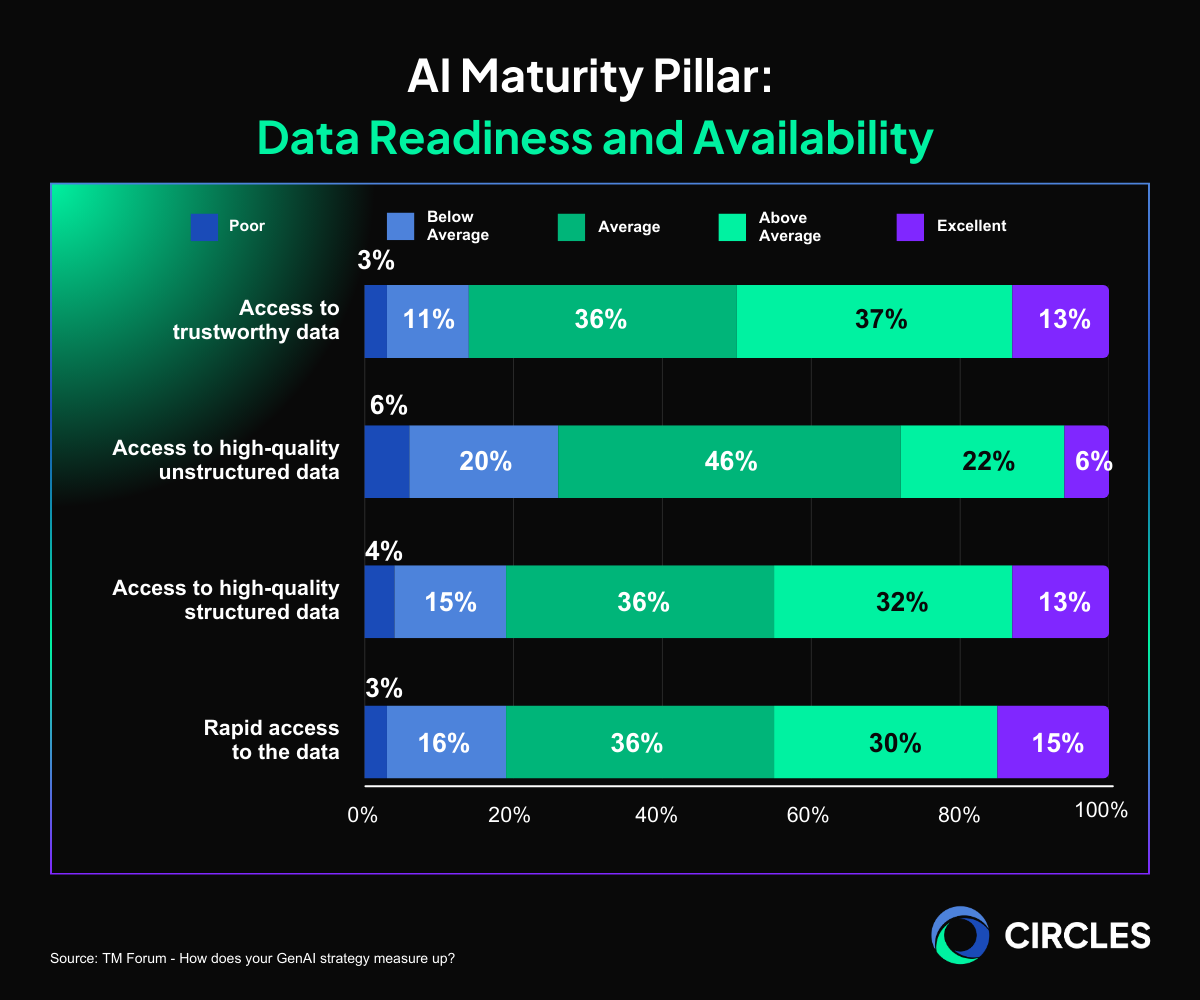
These issues can be overcome by building or shifting to AI-Native software. The migration process can clean and prepare the data for AI while solving siloed data issues, transforming it into high-quality data. Moving all the data to a pre-integrated full-stack, single source of truth also enables real-time insights to be usable by every department, truly democratizing AI’s capabilities and results.
Once all of this is in place, telcos can then reap the benefits of predictive insights, new business models, and cost savings. But to know what telcos can truly achieve by becoming AI-Native, a deeper understanding of what an AI-Native telco is required.
Defining the AI-Native Telco: Moving from Reacting to Predicting
From Augmented to Automated and finally Autonomous
An AI-Native telco is designed from the ground up with AI at its core, embedding AI into all aspects of its business, from its services and operations to even decision-making processes instead of adopting it as an add-on.
With that definition in mind, there is a distinction between the various stages of a telco’s AI maturity. Many telcos have launched Generative AI projects such as chatbots, internal and code creation, but becoming AI-Native goes beyond just these projects.2
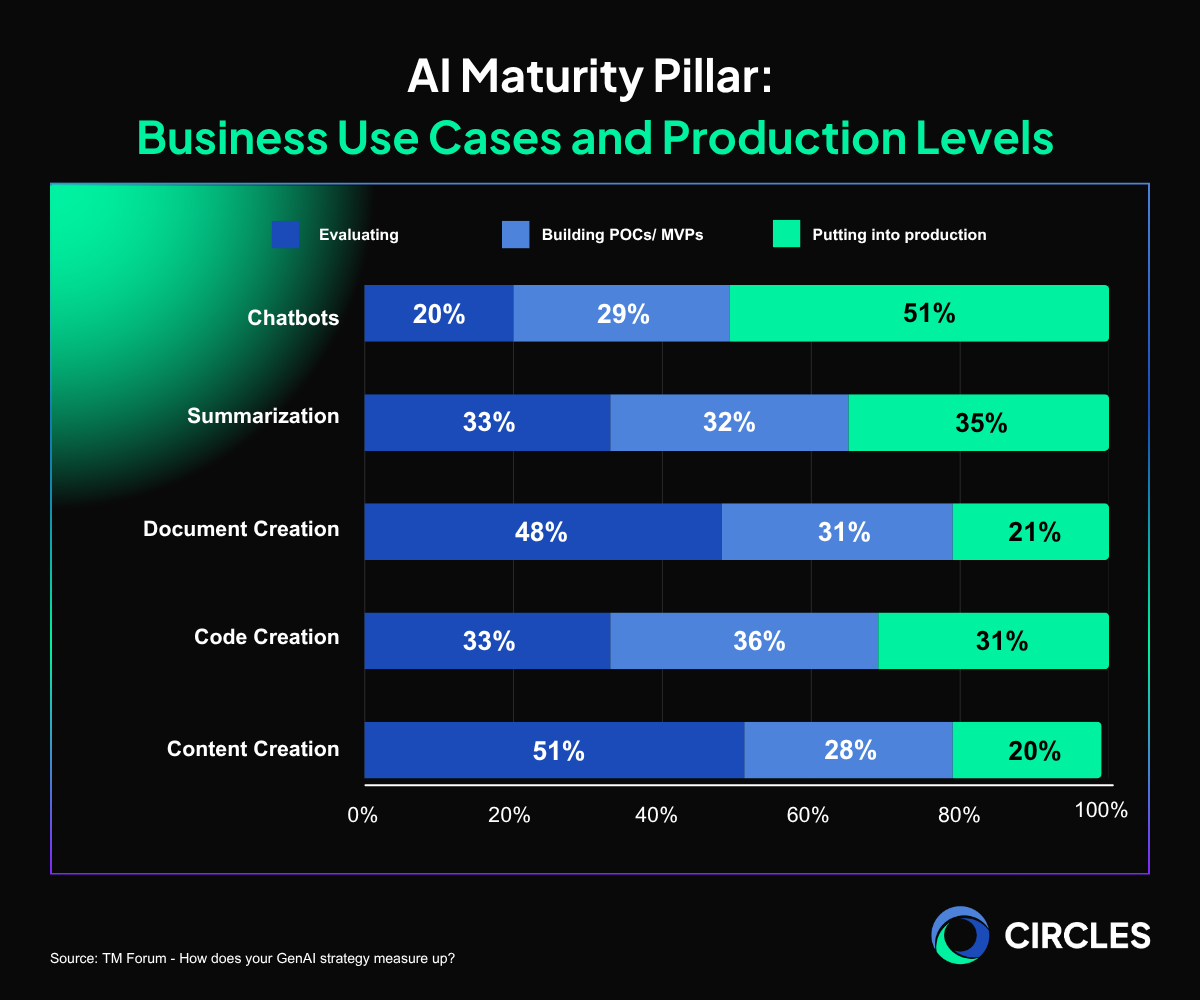
There are roughly three stages of AI maturity:3
Augmented: This is the plug-and-play stage. The telco uses AI tools like copilots to assist humans and enhance their productivity without replacing core business processes.
Automated: Here, agentic AI can take over specific tasks and automate some business processes. For example, telcos that have adopted customer service chatbots can see NPS improvements of around 14 points.4
Autonomous: This is the most mature stage where agentic AI systems can operate with minimal human oversight, managing end-to-end processes and making decisions in real time.
If telcos want to make the leap to reaping autonomous AI benefits, moving away from plug-and-play projects and becoming AI-Native is critical. To lead effectively in the age of the AI-Native techco, Circles’ CEO Rameez mentions in Forbes that telco leaders need to focus on:5
Vision over tools: leaders who make AI a core part of their telco infrastructure by embedding it deep into their workflows and redesigning operations around it.
Defining advantage with timing: Early AI adopters in the telco space are already reaping the rewards. The faster telcos act, the sooner they can move from being a connectivity provider to being an experience provider.
Building trust through execution and responsibility: Telcos have access to sensitive data, which needs to be handled carefully. Telcos need to embed accountability into every layer, such as through clear governance structures, training teams on ethical AI, and more.
Telcos that successfully make the shift to become AI-Native techcos are also better equipped to give more power back to consumers. Customers will have the freedom to hyper-tailor services and bundles that they love the most to their unique lifestyles, powered by a telco that can anticipate their needs before they even know about them. With rich and detailed data, consumers will also have the power to effortlessly find the right solution to any issues or queries they may have.
Leading telcos are partnering with AI labs to build telco-specific AI models and are already gaining positive impact, like cost efficiencies, which you can read about here. Telcos that go with slow incremental changes without a fast leapfrog plan to catch up with leading players’ AI capabilities risk becoming obsolete.
On top of remaining relevant, the rewards are even greater for telcos that successfully leapfrog to become AI-Native.
What Becoming An Anticipatory Techco Looks Like
Historically, telcos have been on the back foot in the tech industry race, needing to play catch up with trends set by other players, such as OTT players and streaming services. AI-Native telcos have the potential to go from connecting devices to anticipating humans: thinking ahead instead of reacting from behind.
Having AI at the core means working with AI-ready data in a single full-stack source of truth that powers comprehensive 360° consumer insights and operational data that powers various AI agents that convert these insights into action, all while feeding new insights back into the system as closed-loop learning for even greater progress. All this allows for high-velocity innovation, autonomous AI-driven operations that create sustainable low costs and free up manpower.
By having AI built at their core, telcos can analyze their market, make predictions in terms of consumer and business client needs, and gain operational excellence through anticipatory and autonomous capabilities:
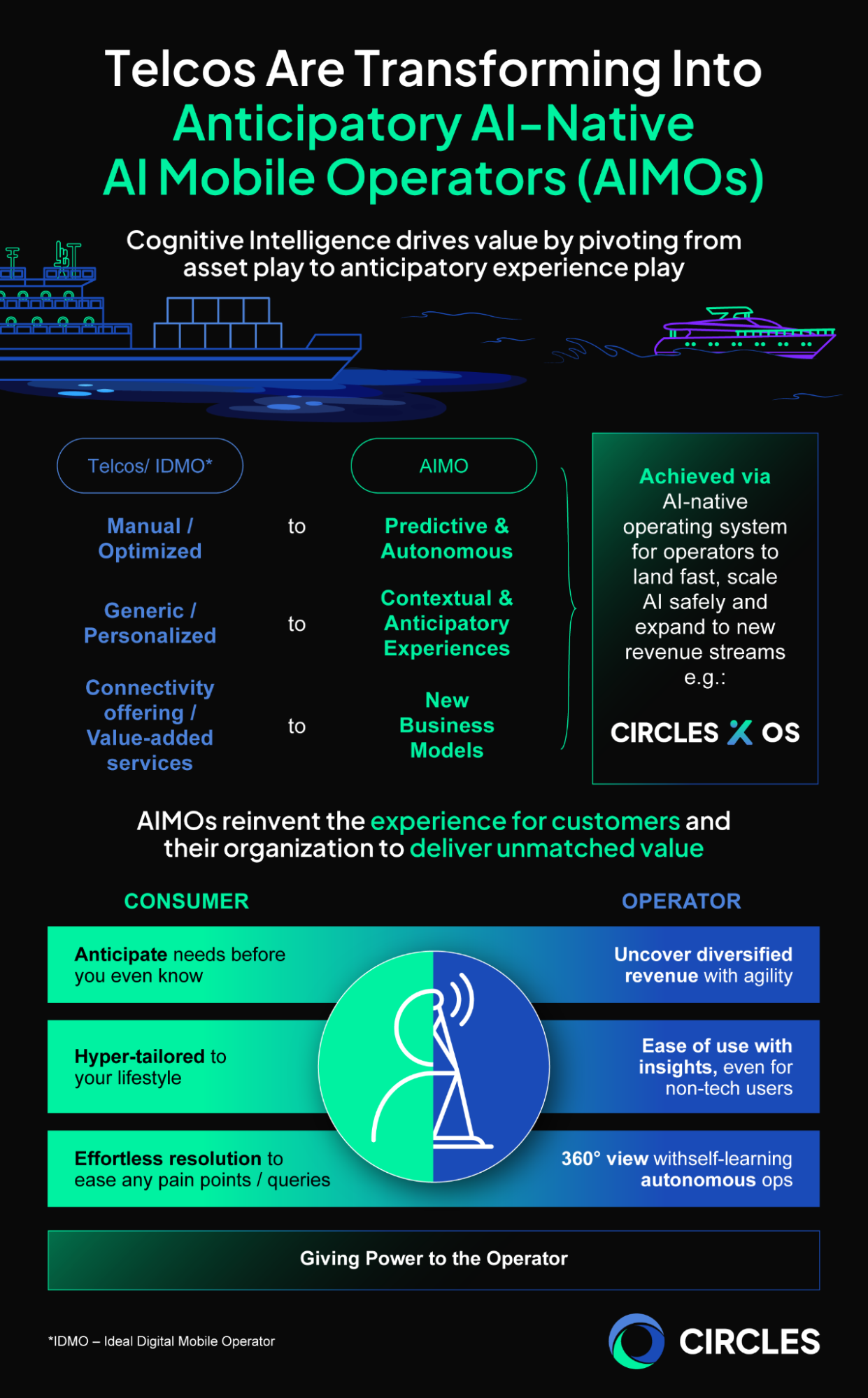
But all this still needs to positively impact the top and bottom lines. Tech for tech’s sake isn’t good for business.
The Anticipatory Techco Flywheel Optimizing for Business Outcomes
The true test of an AI-Native telco lies in producing positive business outcomes such as:
Revenue expansion: Higher average revenue per user (ARPU) driven by B2C non-connectivity services and higher engagement to optimize customer lifetime value and reduce ARPU leakage from churning.
Customer Experience: driven by best-in-class personalized user experiences that anticipate needs and measured by Net Promoter Score (NPS).
Cost savings: driven by high organic acquisition share, AI–optimized marketing, and autonomous operations with closed-loop evolution for better EBITDA improvement.
New business models: Redefining personalization and monetization by unlocking new non-connectivity business models and monetization streams, such as e-commerce, new services, personalized advertising, and more.
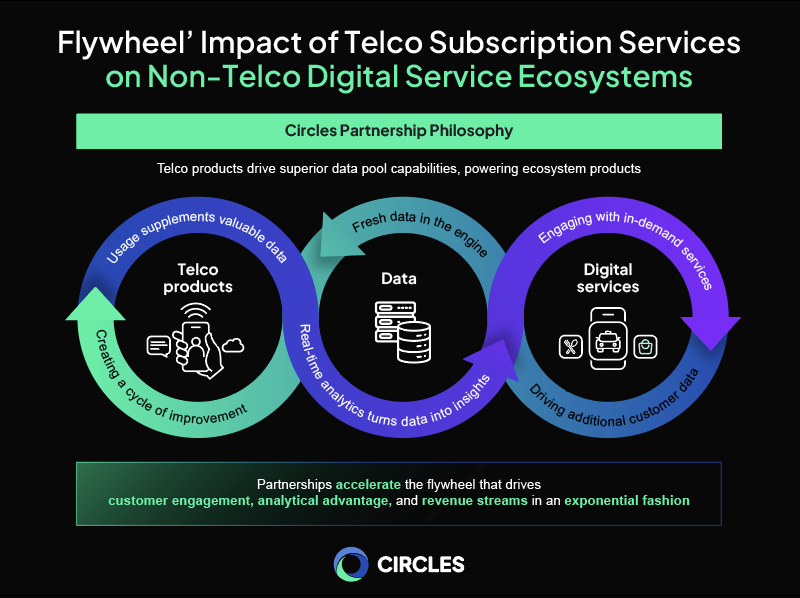
And by having a full stack AI-Native core that works with a single source of truth, AI-Native techcos can benefit from a virtuous cycle where data powers new services and experiences, which then generate new data and insights to create the next generation of offerings.
Intelligent operations are powered by a single source of clean data, providing the AI agents with a 360° view of customers and operations and powering autonomous decision-making and operations. Autonomous agentic AI at this stage frees up manpower and saves costs.
These AI agents then power anticipatory experiences by delivering tailored AI-led experiences and service offerings that anticipate customers’ needs and solve problems before they emerge. This becomes the backbone of high NPS-scoring customer experiences that build consumers' trust and engagement while reducing churn.
All these new insights into consumer preferences and behaviors also provide opportunities to work with non-traditional telco partners like digital lifestyle apps and services, leading to new services, products, and business models. With deep customer engagement, telcos have the chance to go beyond connectivity and break the boundaries of what a techco can be, raising ARPU.
Could telco apps one day feature AI assistants? Circles AI and povo AI are two examples of this available today. This approach has the potential to turn telco apps into super apps or personalized AI-powered apps, pushing the boundaries of what a telco can offer in people’s digital lifestyles. Some telco innovation teams, like Circles Xplore, are already exploring what’s possible, and going AI-Native is one way to pioneer what’s possible for telcos.
In the longer term, telcos could even transform into everyone’s lifestyle concierge of choice. This AI-powered agent can become an integral part of the telco app that anticipates what customers truly want before they know it, redefining the role that telcos play in people’s everyday lives.
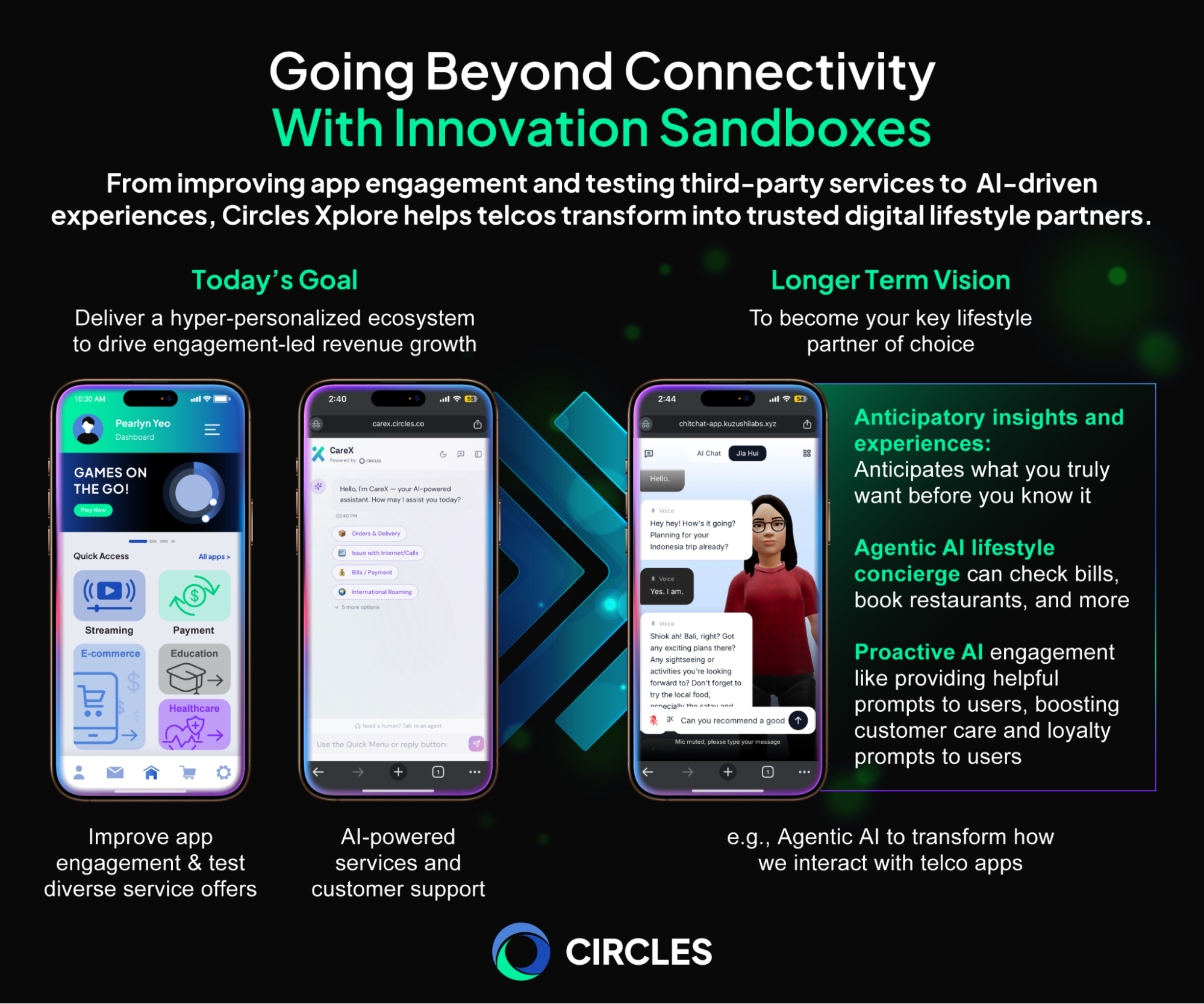
By using an innovation sandbox built into the telco app, telcos can rapidly test these new products and features. These learnings then feed back into the AI system. All of this value compounds when decisions get faster and smarter as the insights build on one another.
AI has the potential to provide operational and efficiency savings while even forming the heart of new personalized products for customers.
Why Most Telcos Struggle to Get There Alone
By now, most telco leaders understand that AI is the key to unlocking faster decisions, lower costs, better experiences, and new growth models. With leading telcos already harnessing the benefits that AI has to offer, the race to adopt AI has become about who can leapfrog towards becoming AI-Native the fastest. Telcos that fail to harness AI risk becoming obsolete. Yet for many telcos, progress remains frustratingly uneven.
Industry bodies such as TM Forum6 and GSMA7 consistently point to the same hindrances: fragmented data, legacy tech stacks, skill shortages, and governance models that weren’t designed for machine-driven decision-making. In many organizations, data and AI initiatives are silos, and accountability for outcomes is unclear.
The booths at MWC 2025 reinforced this reality. Despite impressive demonstrations of AI-powered RAN optimization, voice recognition anti-fraud measures, and customer experience improvements, truly autonomous telcos are still rare. Trust, verification, and operational readiness still matter, especially for infrastructure that underpins entire countries.
Anticipatory techcos require AI built at their core and not overlaid on top of old systems. Predictive capabilities require real-time insights, which is why bolting on AI onto systems that don’t have AI-ready data is not a viable solution. Data is fragmented and siloed in different departments’ servers or isn’t immediately in a format that is usable by other teams, slowing data analysis. Yet, bolting on AI and waiting for results from pilot projects feels safer and less risky.
Another issue that could arise from taking the wait-and-see approach arises when telcos run AI pilots without a structured AI strategy. Running multiple siloed AI initiatives results in wasted resources from overlapping projects and potential gaps in the architecture that weren’t properly planned for. Without having a structured, unified AI transformation strategy, telcos cannot unlock AI’s ability to move any business metrics’ needles.
All of this creates a form of transformation fatigue. Leaders know where they want to go, but the path feels fragmented. AI-Native ambitions stall where data, systems, and accountability are split. The challenge for many telcos today lies with executing AI adoption at scale.
The Leadership Leap: What CEOs Must Decide Now
Ultimately, AI-Native transformation is a form of digital transformation: it starts from the top and changes the entire organization.
Every telco CEO now faces a defining choice.
One path continues to optimize yesterday’s operating model with AI: applying intelligence to existing structures, extracting incremental gains, and accepting the limits imposed by technical debt.
The other path transforms the business for tomorrow. Embedding AI at the core, enabling anticipation instead of reaction, and positioning the telco as a techco that shapes and predicts value instead of merely delivering connectivity.
As GSMA leaders put it at MWC 2025, this is a moment to envision something bolder. Telcos know that AI isn’t just the next shiny thing; it matters because the economics, expectations, and competitive landscape demand it.
Telco leaders need to have the vision and the courage to transform their telcos into AI Mobile Operators (AIMO). This needs to be supported by a structured, unified telco transformation strategy supported by a full-stack AI-powered telco system that can unleash the true power of AI that creates real business value.
The question that remains now is: who will lead that transformation? Who will you work with?
Circles’ Journey to an AI-Native Telco: Turning Vision into Operating Reality
Circles started out as a digital-native operator who set out to develop great digital telco customer service experiences around the world. Unsatisfied by existing solutions, Circles built its own tech stack, which has laid the foundation for winning telco customer experience awards.
Circles has since embedded AI into the core of its full-stack telco software while optimizing for acquisition, engagement, operations, and monetization while being accountable to real business outcomes like NPS, cost efficiency, and revenue growth.
Rather than layering AI onto legacy systems, Circles’ platform is built on a full-stack, AI-Native architecture with a single source of truth to become an AIMO. This enables real-time data flows and insights that help unified AI agents operate with the right context supported by governance and trust that are designed from the start and not an afterthought.
This model is also validated at scale. Circles’ approach has been deployed across multiple markets like Japan, Latin America, and Southeast Asia. It has been shaped by real-world operator constraints, regulatory environments, and customer expectations. It reflects the practical lessons of running telcos and embeds them straight into the software.
Circles’ Digital Advisory Support Services model further reduces risk by pairing technology with operator-grade governance and expertise. Telcos do not need to bet the company on unproven experimentation. They can move faster by building on experience that already exists.
The shortest path to AI-Native is not experimentation. It is through working with partners who have experience running successful telco brands in multiple markets across 6 continents around the world. Working with the right partner can help your telco leapfrog past your technical debt woes and catch up with leading AI-powered telcos.
Circles is pioneering the world’s first AI Mobile Operator (AIMO), transforming telcos into anticipatory techcos. By uniting AI, data intelligence, and global ecosystem partnerships, Circles drives cost savings, revenue growth, and personalized experiences—empowering operators to evolve from connectivity providers into trusted, AI-powered lifestyle enablers that proactively anticipate and meet customer needs.
To find out more about how Circles has been helping telcos go beyond connectivity, contact us today!
References:
- CNBC - Telcos race to transition from 'dumb pipes' to tech players with help from AI
- TM Forum - How does your GenAI strategy measure up? Key findings from our Generative AI Maturity Interactive Tool
- Unlocking the future: TM Forum’s AI & data mission
- Circles - GenAI’s Impact on Telecommunications Customer Experience Chatbots
- Redefining Leadership In The Age Of The AI-Native Enterprise
- Unlocking the future: TM Forum’s AI & data mission
- Navigating AI Transformation: A Blueprint for Telcos - External Affairs