

Insights
5
min read
eSIM: The Telecommunications Digital Onboarding Revolution
Efficiency, Enhanced Experiences, Revenue Potential
On the 9th of September, Apple made the announcement that the new iPhone 17 Air will not support physical SIM cards. Instead, Apple’s latest iPhone will use Apple’s virtual eSIM technology that the company has relied on in the US for years.1
Apple’s announcement is among one of the various high profile pushes towards broader eSIM adoption in the telecommunications industry. In recent years, the telecommunications industry is being transformed by two converging trends: the accelerating adoption of eSIM technology and a shift towards digital-first customer onboarding. These trends are revolutionizing customer experiences, operations efficiency and can even lead to potential new revenue.
eSIM’s Definition and Why It Matters
An eSIM, or embedded SIM, is a digital SIM card embedded in devices such as smartphones, tablets, wearables, and IoT devices, eliminating the need for a physical SIM card.2 Today, eSIMs can be activated by scanning a QR code or using in-app provisioning within a telco's mobile app, with the latter offering a more integrated, intuitive, and device-native experience.
eSIMs are riding an adoption wave and are expected to have double-digit growth. According to the iMarc Group, the global eSIM market was valued at USD 11.93 billion in 2024 and is expected to reach USD 45.39 billion by 2033, indicating a compound annual growth rate of 14.29 percent. North America currently leads the market, holding a significant share of over 40.2 percent in 2024.3 This dominance is largely due to early adoption of 5G technology, high smartphone penetration, a strong presence of telecom giants, and favorable regulatory support.
eSIMs are riding an adoption wave led by some of the world’s largest economies, although adoption patterns can vary by region. In North America, the arrival of eSIM-only handsets has standardized digital activation, as shown by Apple’s September 2025 announcement. In Europe, widespread availability creates competitive pressure to accelerate entitlement deployment. Advanced 5G markets in the Asia Pacific are experiencing strong growth in eSIM usage, while Greater China and other regions are likely to increase rapidly as ecosystem conditions improve.4
The travel sector is another major driver of this shift. Juniper Research forecasts that the number of travel eSIM users will surge by 440 percent from 2024 to 2028, rising from 40 million to 215 million users. Average data costs for eSIMs are projected to be 35 percent lower than traditional roaming charges, at $5.50 per GB compared to $8.57 per GB.5
All these are driving greater eSIM adoption in the global telecommunications market. eSIMs also promise to revolutionize customers’ digital onboarding journeys and have various benefits for telco players as well.
The Digital Onboarding Revolution
Transformative Benefits of eSIM and Digital Onboarding
The eSIM digital shift aligns with growing consumer demand for quick, simple, and personalized mobile experiences. It allows telcos to meet customer needs faster while achieving greater agility and scalability in a few ways:
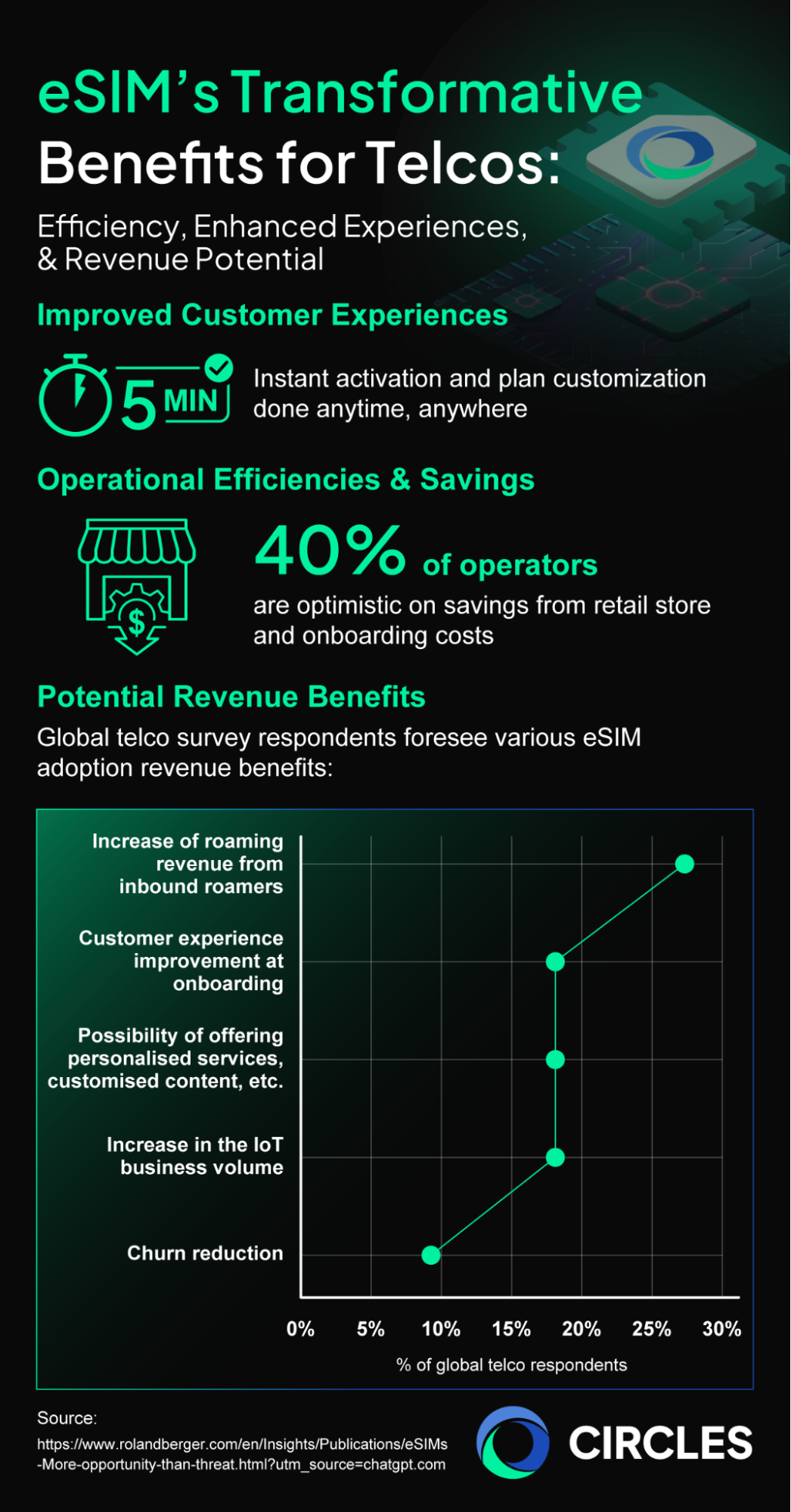
Enhanced Customer Experience:
Digital onboarding powered by eSIMs provides instant activation without physical contact, reducing the cumbersome processes of visiting stores and handling physical SIM cards. The activation and plan customization processes can be done in real-time anytime, anywhere. Customers can activate a plan within minutes, directly on their device, which positively impacts Net Promoter Scores (NPS) and customer loyalty.
Circles.Life offers a seamless eSIM in-app activation experience through its ‘Jetpac’ brand, allowing customers to download and activate eSIM profiles instantly without needing a secondary device or physical SIM. This streamlined onboarding has boosted their customer satisfaction and NPS scores.6
Operational Efficiency:
Telecom operators adopting digital onboarding channels reduce costs related to producing and distributing physical SIM cards and managing retail stores. For instance, 40 percent of operators who are leveraging digital onboarding are optimistic about savings in logistics and onboarding costs, such as the reduced need to supply physical SIM cards.7
Vodafone has highlighted "Cost Efficiency" as a key benefit of its eSIM solutions, particularly for enterprise customers. By eliminating physical SIM cards for large workforces, the company reduces the administrative overhead of managing, distributing, and replacing thousands of cards. This also cuts down on support calls related to lost or damaged SIMs.8
New Revenue Streams:
Flexible pricing models and on-demand connectivity plans can flourish with eSIM technology, capturing new segments like digital nomads, IoT device users, and intermittent mobile users with subscription or pay-as-you-go services. Roland Berger’s research survey highlighted that telcos foresee the following revenue-side benefits from eSIM adoption:
One example of a new revenue stream is the Orange Travel service to specifically capture the "digital nomad" and "intermittent mobile user" segments. It offers on-demand prepaid eSIM plans for travel to over 200 destinations, a flexible pay-as-you-go model that exists entirely separate from its standard monthly subscription plans.9
Target Demographics for eSIM adoption
On top of digital nomads that telco players like Orange are targeting, telco players can expand their eSIM target audiences to other demographics and use cases:
Get Your Free SaaS DemoReferences:
- Apple's move to eSIM-only strengthens global trend | The Star
- Statista - eSIM - statistics & facts
- IMARC Group - eSIM Market Size Report 2025 - 2033
- GSMA - eSIM-Only has arrived: what operators do next will define their future
- Travel eSIM users to grow 440% globally over the next 5 years
- Jetpac Global
- Why telecoms operators are optimistic on eSIM adoption | Roland Berger
- eSIM technology for an agile and efficient hybrid workforce
- Orange Travel
- eSIM Statistics 2025 by new SIM card technology
- eSIM Market Size, Growth, Trends - Share Analysis 2025 - 2030
- A Telco’s Digital Transformation Playbook: Connect, Delight, Beyond
- China’s top three telecom operators launch eSIM mobile services nationwide
- Smart Multi SIM brings eSIM support to non-eSIM Android phones