

Knowledge Hub
7
5
min read
From Automation to Autonomous Networks: How Agentic AI is Redefining Telecom Operations
From Reactive to Agentic: What’s the Difference?
Why Telecom Needs Agentic AI Now
Agentic AI in Network Operations
Reinventing Customer Experience with AI That Acts
Driving Smarter Revenue and Marketing Strategies
Enhance the Enterprise Business
Human + AI: The Best of Both Worlds
Governance, Trust, and Regulation in AI-Native Networks
Ready to Explore How Agentic AI Can Transform Your Business?
Artificial intelligence is no longer a side project inside telecom organizations. It is becoming infrastructure.
At Mobile World Congress 2026 in Barcelona, operators and ecosystem leaders made one thing clear: AI is not being layered onto networks. It is being embedded into their design. The industry narrative has shifted from using AI tools to building AI-native networks: systems engineered to sense, decide, and act autonomously.
This marks the transition from assistive AI to agentic AI.
Recent industry data confirms it. According to NVIDIA’s 2026 “State of AI in Telecommunications” survey, 90 % of telecom professionals said AI is already helping both increase revenue and reduce costs. Further, 89 % plan to boost AI spending this year. This is a surge that reflects not just optimism, but measurable results.
Telecom is entering the autonomous era.
Let us explore why agentic AI matters, how it is reshaping your industry, and what opportunities it unlocks for your business.
From Reactive to Agentic: What’s the Difference?
Traditional AI excels at classification, prediction, and recommendation. For example:
But agentic AI takes the next step. Instead of stopping at insights, it decides and acts. You define a goal, such as reducing churn or improving network performance, and the system identifies and executes a series of steps to achieve that goal with minimal human intervention.
Imagine this: Instead of generating a list of at-risk customers, an agentic AI identifies them, designs personalized offers, deploys those offers, tracks responses, and tweaks strategies in real time.
It is a power shift, and it is already starting to show results at scale.
Why Telecom Needs Agentic AI Now
Telecom networks are more complex than ever. You are managing 5G deployments, cloud-native cores, IoT devices, and preparations for 6G, all while operating in a cost-constrained environment. To meet these demands, AI must act, not just inform.
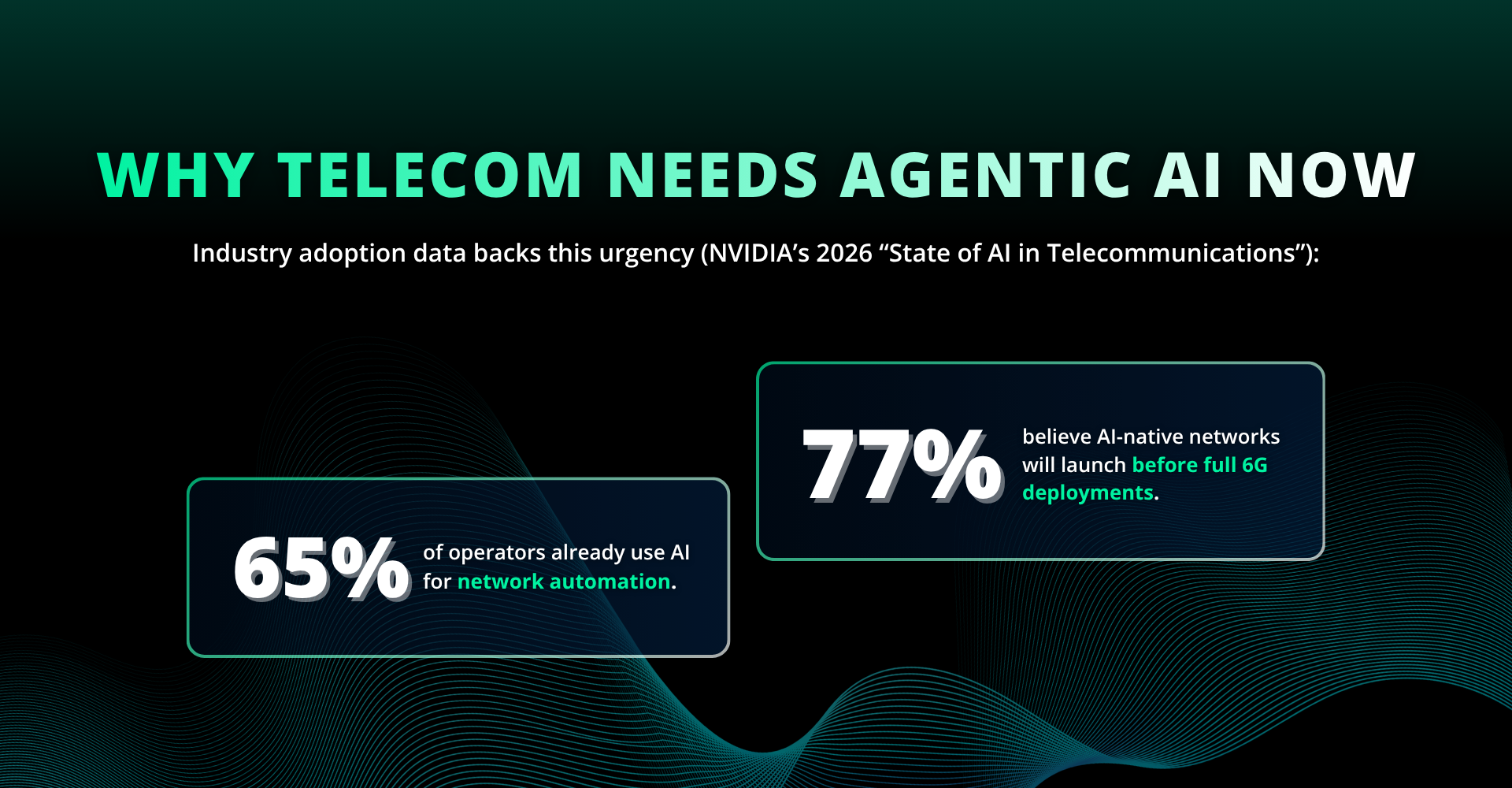
Industry adoption data backs this urgency (NVIDIA’s 2026 “State of AI in Telecommunications”):
Agentic AI thrives in complexity. It continuously senses operational conditions, makes decisions, executes actions, and adapts, essentially enabling networks to become self-managing and self-healing.
Agentic AI in Network Operations
Network operations are ground zero for agentic AI innovation.
Today, many teams use AI for fault detection or traffic forecasting. But agentic AI begins to close the loop.
Picture a sudden rise in packet loss or congestion in a 5G urban cluster. Instead of generating tickets or alerts, an agentic system could:
- Diagnose root causes on its own
- Adjust radio parameters or reroute traffic
- Monitor results in real time
- Refine future responses based on outcomes
This is where automation becomes autonomy: reducing manual intervention, lowering operational costs, and improving reliability.
Given the NVIDIA survey’s findings that AI-based network automation is becoming a primary source of ROI, it is clear that operators are already seeing value here.
Reinventing Customer Experience with AI That Acts
Customer experience has always been core to competitive differentiation. Traditional chatbots answer questions. But agentic AI resolves problems.
Imagine a customer complaint about intermittent data speeds. An agentic AI could:
These systems do not just solve issues faster, but they eliminate friction from the journey entirely.
The industry is seeing tangible shifts here too. With AI playing a central role in improving customer service ROI (second only to autonomous networks) it is clear that AI is lifting performance across key business metrics.
Driving Smarter Revenue and Marketing Strategies
Revenue growth remains a top priority in telecom and AI is proving to be a catalyst.
The NVIDIA survey found that nine in ten operators report revenue benefits from AI. But beyond basic analytics, agentic AI enables continuous, operationalized marketing strategies.
Instead of quarterly or monthly campaigns, you can have systems that:
This is not just automation, but it is autonomous revenue optimization.
Enhancing the Enterprise Business
The enterprise segment, with its complex SLAs, multi-layered solutions, and bespoke services, presents another strong use case for agentic AI.
In this context, an AI agent could:
This accelerates sales cycles and improves bid accuracy. For enterprise accounts, it also opens opportunities for proactive SLA monitoring, where AI agents can detect potential compliance risks before they affect performance.
Human + AI: The Best of Both Worlds
Agentic AI is powerful, but governance matters. Action-oriented AI requires clear guardrails. You need policies, oversight, and escalation paths to ensure alignment with business and regulatory requirements.
Agentic AI is not about replacing people. It is about unleashing human potential by automating repetitive execution, so your teams can focus on high-value strategic work.
As the NVIDIA survey underscores, agentic AI is where structural ROI begins, but the greatest value comes when AI and humans work together.
Governance, Trust, and Regulation in AI-Native Networks
As telecom infrastructure underpins national economies and critical services, autonomy must be policy-driven.
Agentic AI requires:
Autonomy without governance creates risk. Autonomy with guardrails creates advantage.
Telecom operators must embed trust into AI systems from the outset, ensuring alignment with security, regulatory, and ethical standards.
A Roadmap to Agentic Adoption
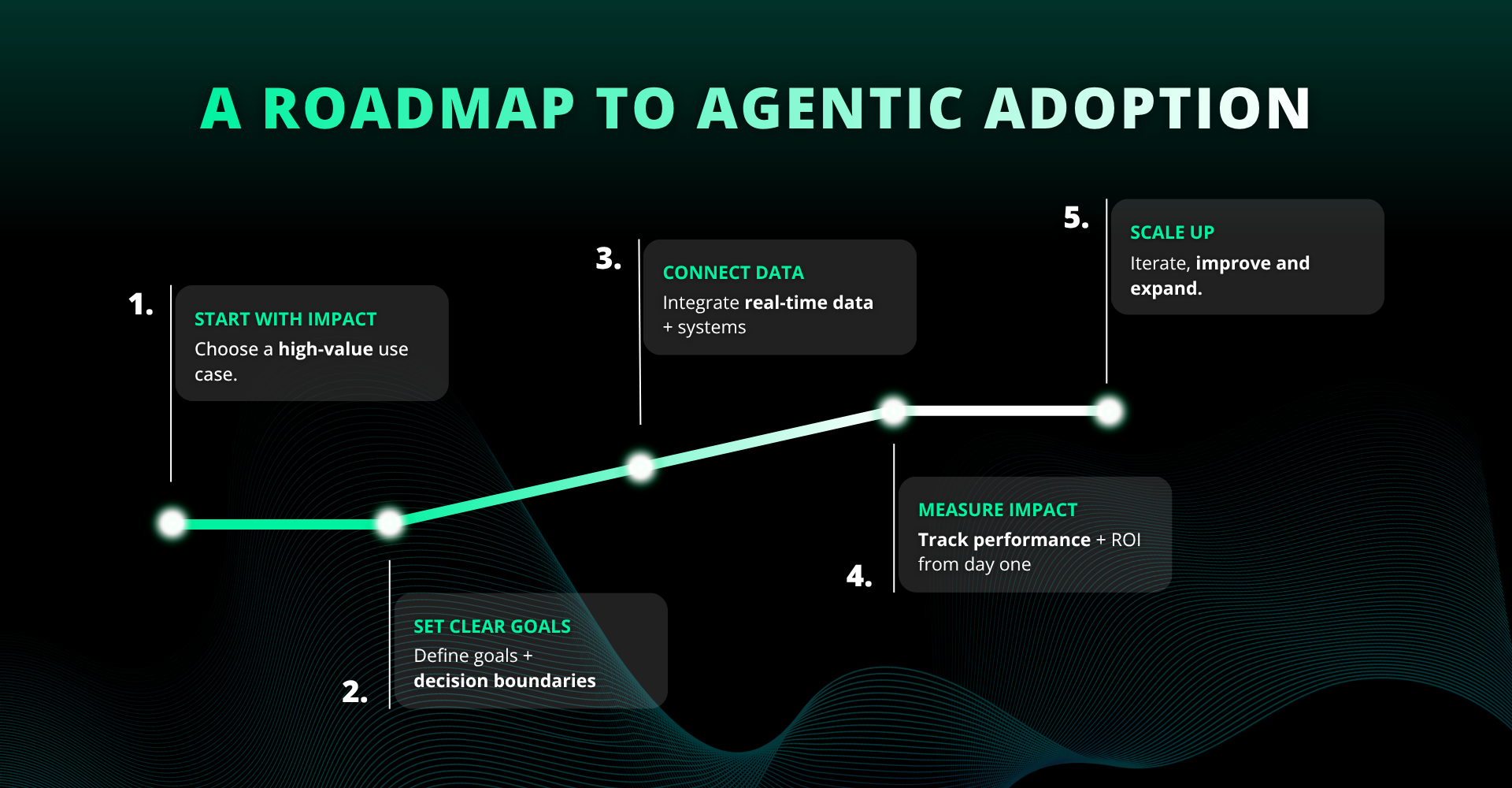
If you’re wondering where to start, here is a simple path:
- Choose a high-impact domain: such as network automation or churn management
- Define clear objectives and boundaries: what decisions the agent can make and when to involve humans
- Integrate data and tools: ensure reliable inputs and real-time access
- Deploy with measurement: track outcomes and ROI from day one
- Iterate and expand: as trust and performance grow
AI adoption is not linear. But even incremental agentic implementations can deliver measurable impact.
Final Thoughts
Telecom has always evolved with technology, from analog voice to digital data, from 4G to 5G, and soon to 6G. Now, the shift is not just in network layers, but it is in operating intelligence.
Agentic AI is not just another trend. It is reshaping how networks run, how customers experience services, and how revenue grows. The data is clear: operators investing in AI are already reaping the rewards, and the next phase (autonomous, agentic systems) promises even greater structural impact.
Ready to Explore How Agentic AI Can Transform Your Business?
If you are serious about operationalizing AI and not just piloting it, there is no better time to act. The opportunity is not just incremental: it is structural.
At Circles, we work with telecom leaders globally to build AI-native operating models, integrate intelligent automation across network and business domains, and unlock new revenue streams with agentic systems.
Let’s talk about how agentic AI can accelerate your strategy: https://circles.co/contact
Together, we can turn AI ambition into measurable impact.