

Insights
6
5
min read
MWC 2026: Scaling Telco AI in the IQ Era & The Structural Reset Opportunity
Agentic AI, Autonomous Networks, & Emerging AI Monetization Methods for Telcos
“The IQ Era” turned out to be a fitting name for MWC 2026’s overarching theme. This year, all of MWC’s major themes were related to AI and how it’s increasingly vital that “deep thinking, critical analysis, and clarity of purpose direct our actions.”1
But as keen industry observers have noticed, the telecommunications industry is currently shifting from AI experimentation to scaling AI across their organizations and ecosystems.
Telcos Are Under Pressure to Scale Up AI and Get Returns
Advancements in AI have rejuvenated the telco industry, creating a great opportunity for telcos to redefine their position in both consumer and business markets. The industry is now in a low-growth environment, making digital transformation that powers cost efficiencies along with new revenue sources critical.2,3
Over the last 30 years, telcos enabled the infrastructure that today’s market-transforming digital platforms and services run on. Despite this foundational contribution, there is a wide gap between the value that connectivity service providers (CSPs) have captured compared to the business models that they have enabled.
MWC 2026 highlighted various trends and advancements that telcos can use to restructure and redefine their place in the market, with AI at the forefront. Mobile World Live’s Industry Survey 2026 reports that 33 percent of their telco respondents have “making the most of AI” as their number one priority in 2026, with 44 percent seeing advanced AI as the most attractive new business area.4 But before diving deeper into this theme, it helps to understand where telcos have been investing in terms of AI.
2025’s Telco Launches Reflect Internal Bias, Focusing on Customer Experience and Network Operations
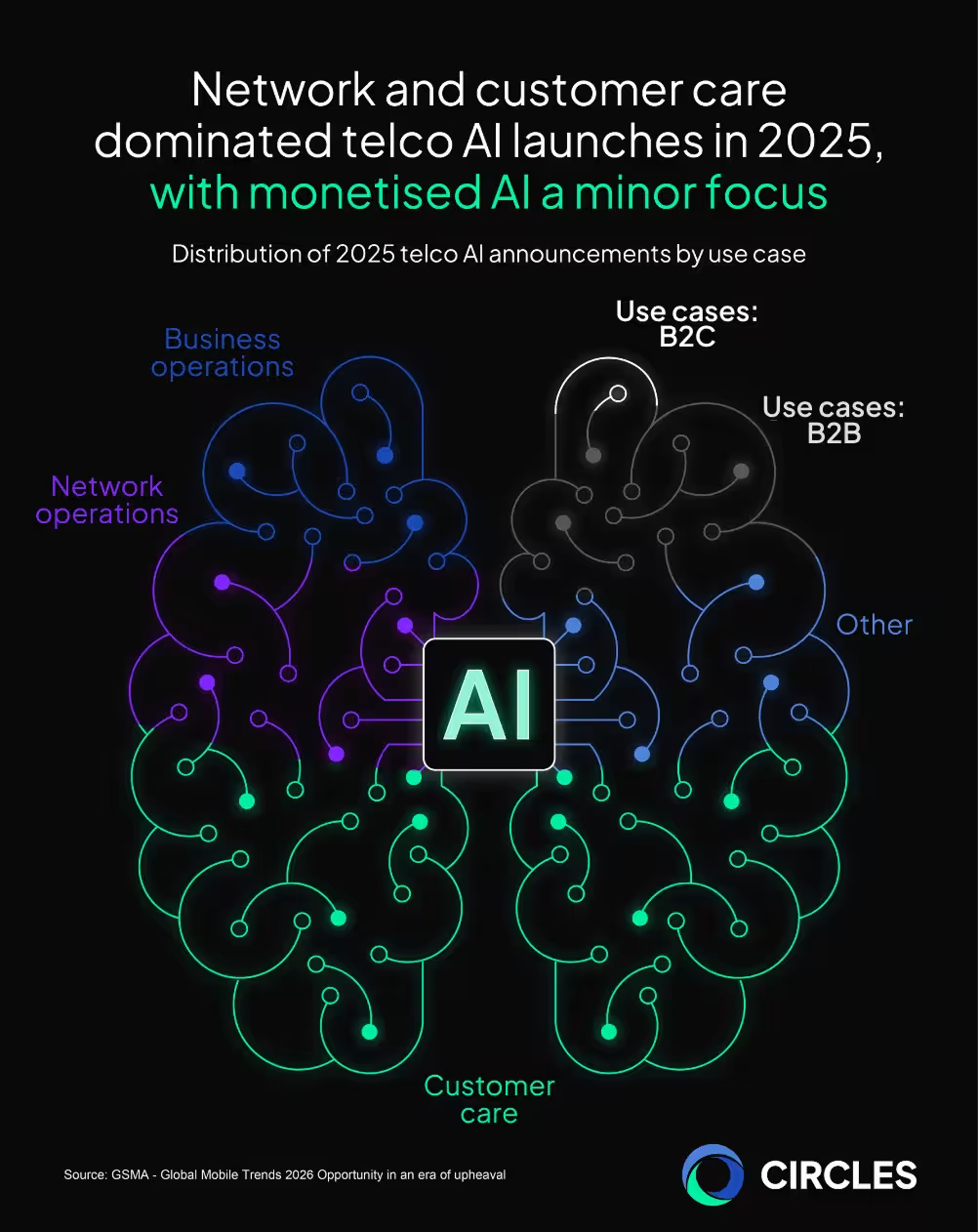
In 2025, telcos used AI in various different ways, including customer care, internal operations, and network operations use cases, along with data center builds and AI-centric service launches targeting B2B and B2C users. However, most of these are generally inward-focused and less focused on new revenues.
Major industry commentators have mentioned that the telco industry both needs to scale up its use of AI and is also under pressure to monetize AI. These include AI strategies that enable offerings such as predictive network automation, personalized customer experiences, and AI-driven B2B services, which can command premium pricing across a range of verticals.2 Another commentator brought up that telcos should leverage AI to enhance customer value management, loyalty initiatives, personalization, and more.5
During an interview with Georgie Frost of BCG at MWC 2026, Circles CEO Rameez Ansar shared his thoughts on the opportunity that AI gives telcos to transform digitally:6
So, of course 5G created pressure around the thing. Of course, there’s commercial pressure around revenues. There are cost increases that happen every year. That’s all been true, and companies have known it, and the telcos have known it.
But this again is an opportunity for telcos to say, “Can we take this AI thing that’s happening and do a quantum leap and really, you know, deserve the reimagination that we’ve always wanted?”

In short, operators are now under pressure to move from experimentation to deployment at scale. Those who are slow on the uptake will risk getting left behind during a time when boards and investors are expecting results.7
AI Moves from Hype to Structural Transformation, But Execution Is the Real Divide
If MWC 2025 was about AI hype, MWC 2026’s conversation focused more on AI execution. With many pilots done and AI leaders and laggards emerging in the telecommunications and technology space, nobody denies that AI is seen more as a structural reset of telecom operations and business models and is fundamentally reshaping how telcos operate and create value.
This shift reflects a broader industry transition. Telcos are moving beyond their traditional role as connectivity providers toward intelligent, business-oriented digital platforms, where AI underpins everything from network operations to customer engagement.
In this context, agentic AI, autonomous systems that can reason, plan, and act, represent a natural evolution of this transformation, especially in network management and customer experiences.
Agentic and autonomous networks were among the most talked about trends at MWC 2026. Agentic networks use coordinated AI agents to optimize, manage, and even autonomously evolve network operations.
One possibility is a future with autonomous networks where the core of a network is an AI agent that could determine when to update itself and make changes itself without software subscriptions or vendors.8 These systems have the potential to reduce manual intervention, improve resilience, and enhance overall network performance and customer loyalty while saving costs.
On the customer experience side, agentic AI is already being deployed across use cases such as customer care, sales, and service management. AI is now being applied across the telco stack: from network optimization and fraud detection to automating customer interactions and billing processes.
Some operators are using AI to improve the calling experience, a fairly neglected part of the customer experience. They aim to use AI for real-time translation along with network-driven functions like enhanced interactive video.9 According to NVIDIA’s 2026 survey, 60 percent of large telco enterprises have already deployed or are planning to deploy agentic AI in the next 12 months.10
However, while the vision is compelling, the reality is more nuanced.
The telecommunications industry is currently in a transitional phase, moving from experimentation to scaled deployment. Bain & Co. highlights that leading operators are beginning to operationalize AI with measurable business impact, while others remain stuck in pilot stages, widening the gap between leaders and laggards.7 In Mobile World Live’s survey, 52 percent of telcos are still running AI pilots, compared to only 35 percent with active deployments, indicating that most organizations have yet to scale AI across their operations.4 Concerns around governance, compliance, and even AI-enabled cyber threats are also rising.
At the same time, there is clear tension between opportunity and skepticism. AI is seen as the most attractive new business area, with strong interest in its potential to unlock new revenue streams. Notably, Mobile World Live’s survey highlighted that 73 percent of respondents consider AI overhyped, including 45 percent specifically for agentic AI.4 This suggests that while the strategic importance of AI is widely accepted, confidence in near-term execution, especially for autonomous systems, remains cautious.
There are also significant structural barriers to scaling AI. The survey identifies data quality and availability, along with integration into legacy systems, as the top challenges.4 These foundational issues reinforce that AI transformation is not just about deploying new tools. It requires rethinking underlying data architectures and operational models.
Despite these challenges, it is clear that telcos are now shifting from experimenting with AI to scaling AI up across their organizations. AI agents, such as customer support assistants like CareX, are already delivering tangible value in areas like customer care, where they enable more consistent, scalable, and context-aware interactions. By leveraging unified customer data across systems, these agents can resolve routine queries efficiently, freeing human agents to focus on higher-value interactions.
From Capability to Competitive Advantage
The telecom industry is entering a critical phase of transformation. As MWC 2026 highlighted, the foundational technologies such as 5G standalone, cloud-native architectures, and AI are now largely in place. The central challenge has shifted from technology adoption to value realization.
In this context, the competitive landscape will be defined by execution. Operators that can translate AI and infrastructure investments into measurable commercial outcomes, including accelerated time to market, improved cost efficiency, and new revenue streams, will establish a durable advantage. Those that remain constrained by legacy systems, fragmented data, and prolonged transformation cycles risk falling further behind.
The industry response is already evolving. There is a clear move toward modular, lower-risk transformation pathways that prioritize speed, flexibility, and return on investment over large-scale, multi-year overhauls. This reflects a broader recognition that agility and execution discipline are now as critical as technological capability.
Within this environment, Circles is well aligned with emerging operator needs.
Circles’ SaaS model and flexible architecture that supports cloud and on-premises deployments enable operators to modernize without the complexity and cost of traditional BSS transformation. By reducing dependency on legacy systems and enabling faster deployment of digital services, Circles supports a more agile approach to innovation.
More importantly, the platform is oriented toward outcomes. Circles functions as a monetization and digital growth layer, helping operators convert technical capability into business performance. This includes accelerating service launches, enabling AI-driven customer engagement, and supporting new revenue models with improved unit economics.
Circles’ full-stack telco software is powered by a close partnership with OpenAI while supporting cloud, on-premises, and hybrid cloud deployments. You can find out more about Circles’ AI-powered telco platform, Circles X, in the video below:
As the industry moves from experimentation to scaled execution, the role of partners will become increasingly important. Operators will require platforms that not only enable AI adoption but also de-risk implementation and deliver measurable returns.
In the IQ Era, the next phase of telecom transformation will not be defined by who adopts AI, but by who can operationalize it effectively and capture its economic value.
In a market characterized by both constraint and opportunity, Circles is positioned to support this transition, enabling operators to move from digital capability to sustained revenue growth and ROI certainty.
References:
- MWC26 Themes | MWC Barcelona
- GSMA: The Mobile Economy 2026
- The Strategic Role of Telecom Providers Across the AI Value Chain | World Economic Forum
- Industry Survey Report 2026 - Mobile World Live
- Key takeaways from MWC 2026 | Kearney
- BCG at MWC 2026
- MWC 2026: Telecoms at the Inflection Point | Bain & Company
- MWC 2026: 6 takeaways for the telecom industry
- MWC 2026 Wrap-Up: The Analyst Take on Satellite, 6G, Sovereignty, and AI | Ookla®
- State of AI in Telecom 2026 Survey Report | NVIDIA