

Insights
7
5
min read
US Telco Consumer Segments: Larger Household Sizes Reveal a New Growth Opportunity for Telcos
US Telco Customers: Satisfied, but Not Secure
In October 2025, Circles surveyed 1000 US consumers and found that high satisfaction may not strictly translate to loyalty: while 87 percent of US consumers were satisfied with their telcos, 70 percent of them would consider switching to a new provider if they offered a better experience at the same price.
The survey also captured responses related to digital experience, bundles, and lifestyle value and how these could factor into improving customer experiences. The first post of this series covered the overall insights for this study. The second post of this series covered how younger generations such as Millennials and Gen Zs were more likely to be ‘satisfied but switch-ready’ compared to Baby Boomers and Gen Xs.
This pattern of being ‘satisfied but switch-ready’ continues with larger households with children exhibiting this behaviour versus smaller households with no children. This disconnect between satisfaction scores and actual loyalty suggests that traditional metrics alone cannot capture how vulnerable many customer relationships are.
To dig deeper, this article covers how household structure, such as whether there are children aged 25 or younger in the home and how many people live in the house overall affect what people value more in their telco experiences. While this warrants further study, families and bigger households could be a possible new and digitally hungry growth engine for telcos.
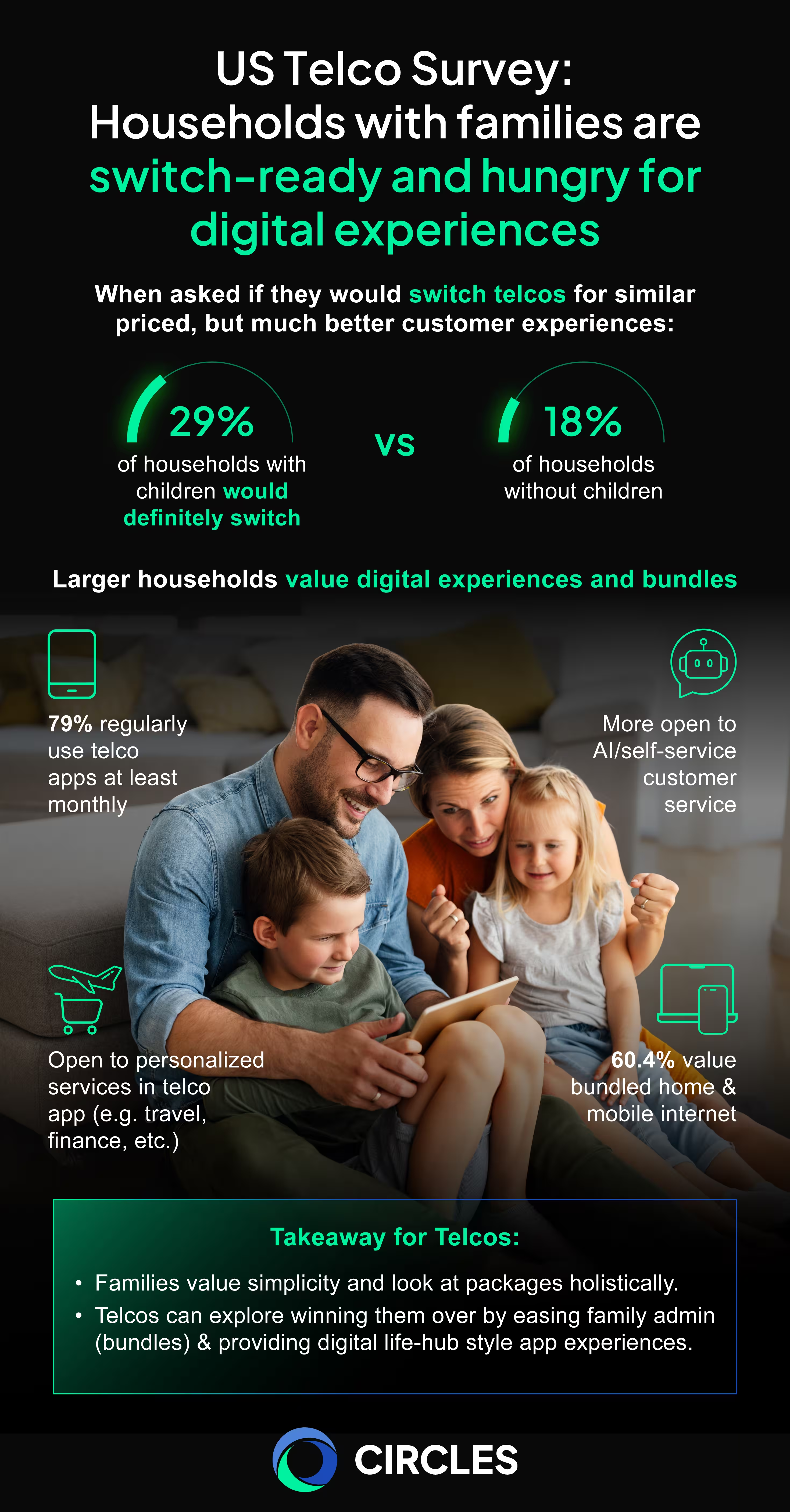
Families Are Slightly Happier With Telcos, But Much More Switch-Ready
On the surface, families indicate they are slightly happier about their telco experiences. 88.3 percent of respondents with children aged 25 or younger report being “very” or “somewhat” satisfied with their current mobile provider, compared with 85.2 percent of respondents without children in their household. Meanwhile, only 3.1 percent of parents are “somewhat” or “very dissatisfied” with their telcos, versus 5.2 percent of those in households without children.

Despite this slight increase in satisfaction, 74.9 percent of households with children below the age of 25 with them said they would consider switching to a provider that provides a significantly better customer experience at the same price vs 67 percent of non-parents. 29 percent of parents said they would definitely switch vs 19 percent of non-parents.
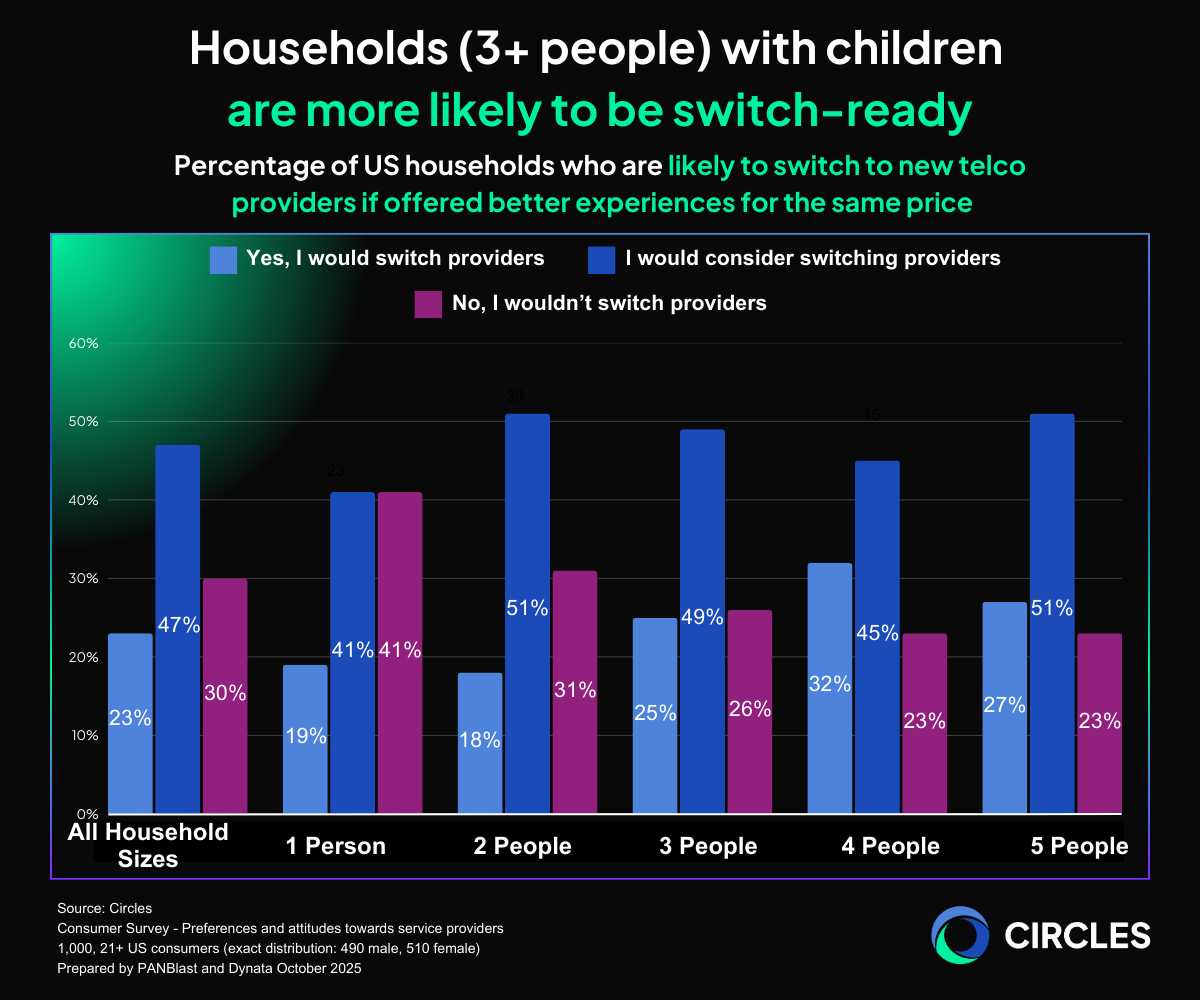
When extending this to household sizes, single-occupant homes still have slightly lower satisfaction but are similarly less likely to switch. Satisfaction and switching likelihood increase when household sizes reach 3 to 5 people.
Telcos can use this as a cue to validate with their own data if household sizes correlate with higher reported satisfaction. These trends currently paint families as highly valuable, highly mobile customers who will walk if their needs aren’t met.
What Families Value in Telcos: Price is Important, But They Are Slightly More Experience-Driven Than Non-family Households
Across the full sample, price (68 percent) and network reliability (69 percent) remain the top two decision factors for choosing a telco, as highlighted in the original analysis.
But when we segment by presence of children, subtle yet important differences emerge:
Families then begin to diverge sharply on value-add and digital-related factors:
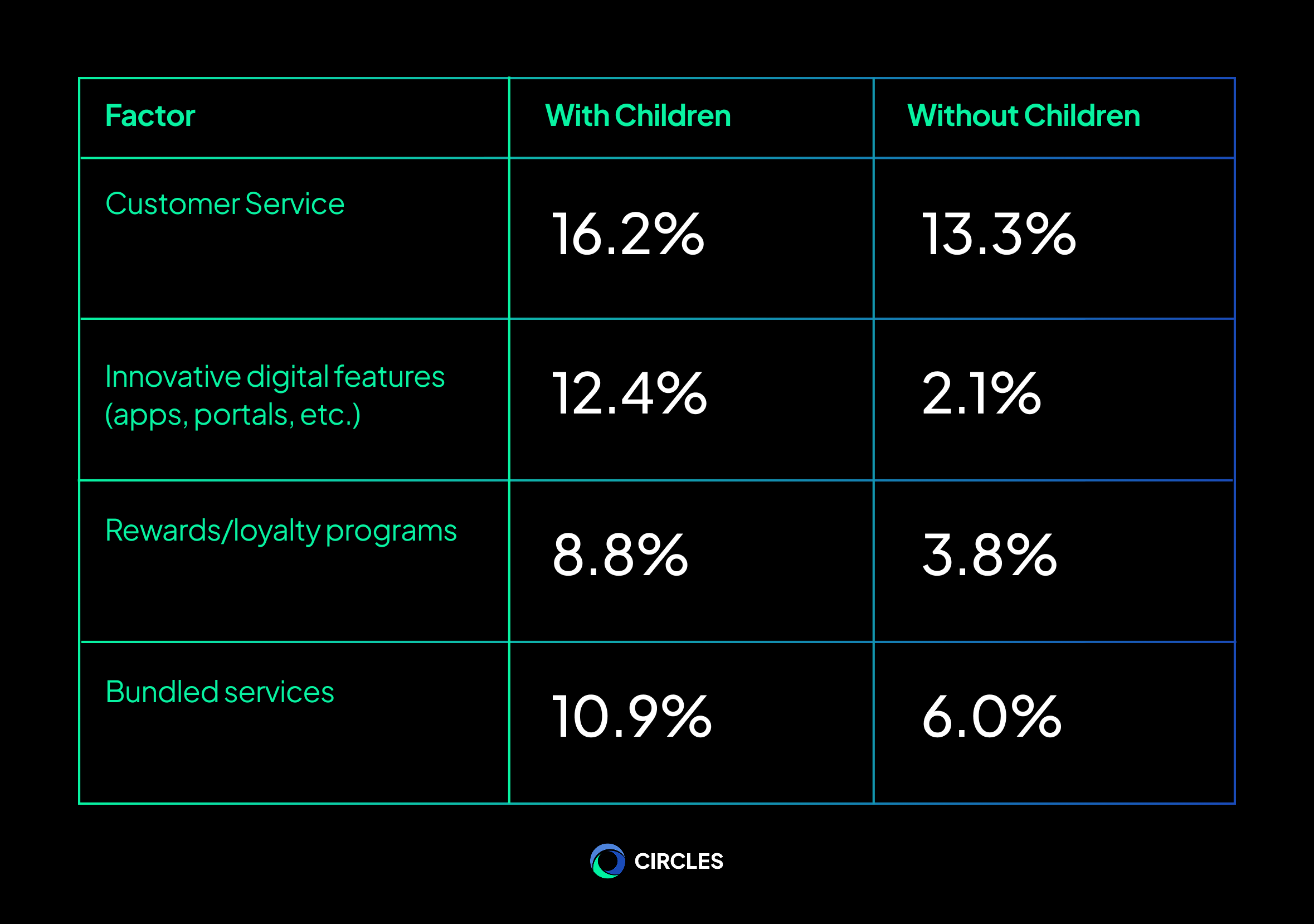
In short, parents and larger households still expect competitive price and coverage, are less likely to choose purely on price, and are much more likely to look at digital features, bundles, and loyalty rewards. For US telcos, this indicates that these existing app experiences and loyalty programs can be further optimized to attract market share from households with children.
In fact, these differences in preferences for digital experiences are more pronounced between these two groups as shown below.
Digital Engagement: Families Are Natural App-Power Users
In the second post that covered the survey’s age group differences, Millennials and Gen Z were found to be the heaviest app users. The family and household-size lens indicate a parallel dynamic.
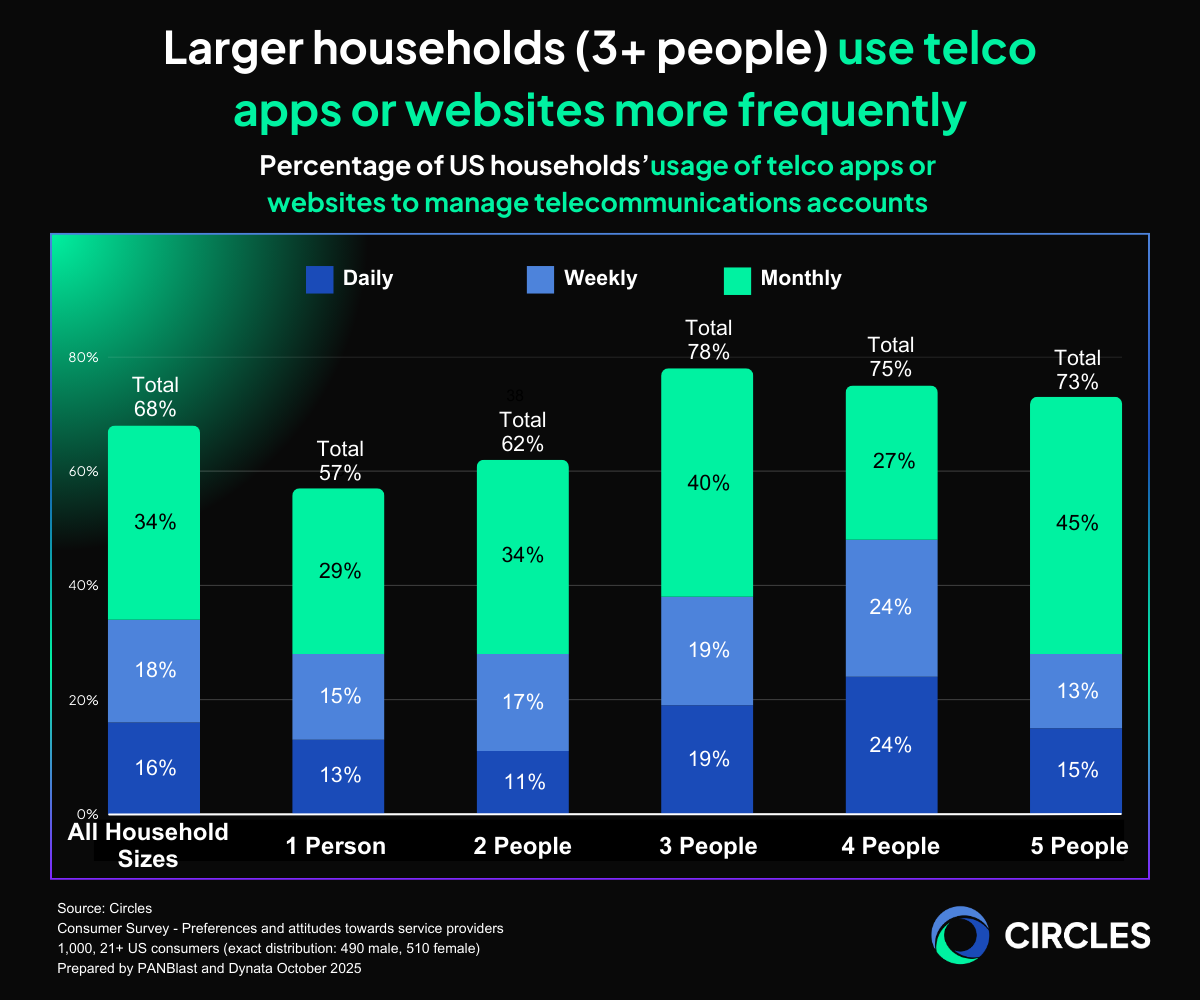
Parents are almost twice as likely as non-parents to be daily or weekly users of their telco app or website (47 percent vs 25 percent). Single-person households show the lowest digital engagement with 43 percent rarely to never using telco apps or the website, while households with 3 to 5 people show the highest.
This makes intuitive sense as more people require more phone lines, more bills, and more logistics to manage. A good app or website simplifies that burden. Telcos who factor in families’ household complexity into their user experiences for their apps and websites could help them engage this user group more deeply.
Beyond Connectivity: Families Want a “Life Hub” App
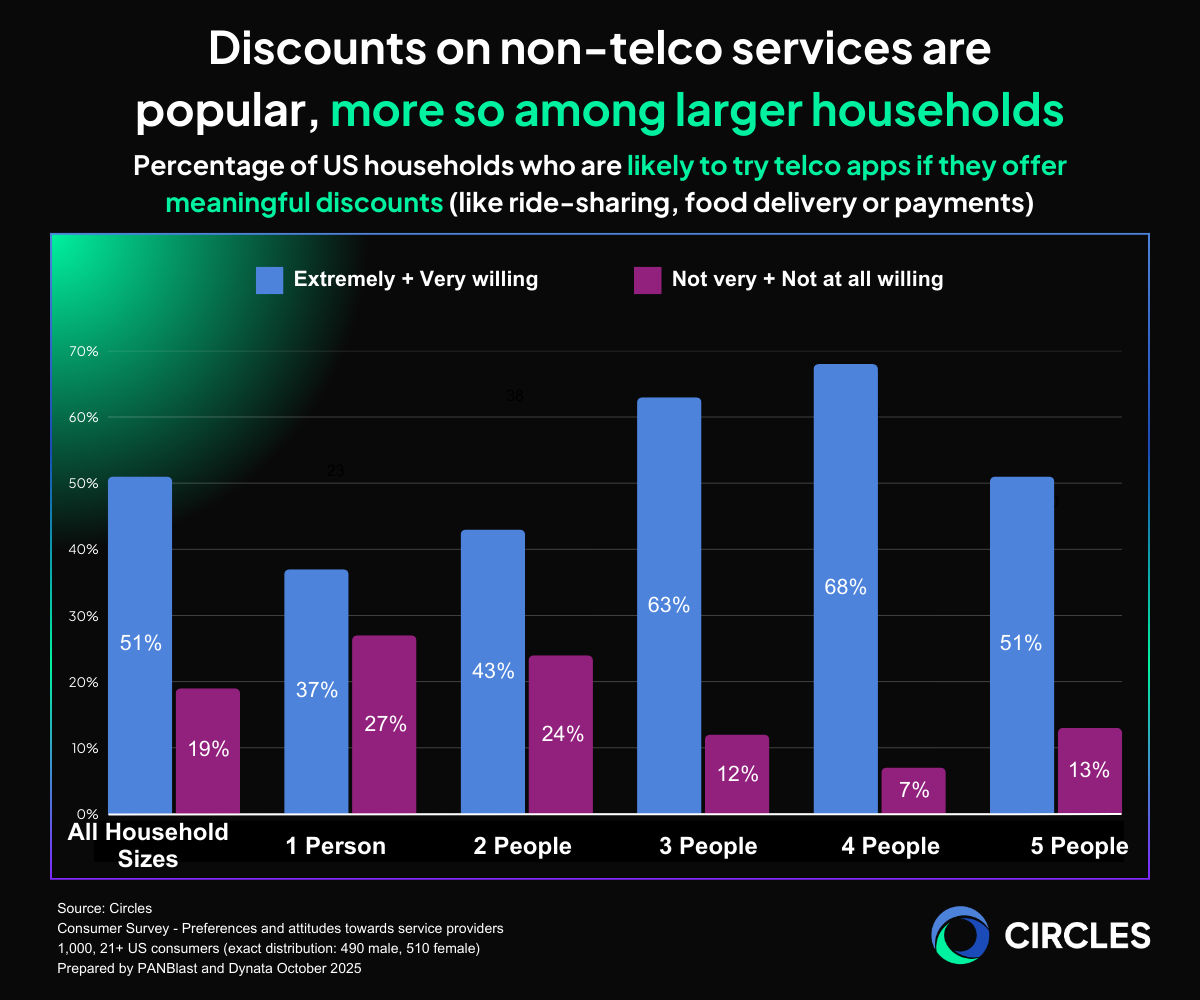
Across the sample, 87 percent of respondents said they would use their provider’s app more if it offered meaningful discounts on services like rideshare and food delivery.
The family analysis shows this effect is especially strong among parents. 66.3 percent of parents are extremely or very willing to use the telco app for discounts on non-telco services, versus 40.1 percent of non-parents. In contrast, only 9.3 percent of parents fall into “not very” or “not at all willing,” compared to 25.1 percent of non-parents. This pattern was also seen when comparing household sizes:
When asked how valuable it would be if their telco app helped with other areas of life (shopping, travel, entertainment), 50.8 percent of parents rated this as extremely or very valuable, vs 24.8 percent of non-parents. Meanwhile, non-parents are nearly twice as likely to say such features are “not very” or “not at all valuable.” Larger households without children show a similar pattern: the more people in the home, the stronger the interest in lifestyle value and ecosystem services.
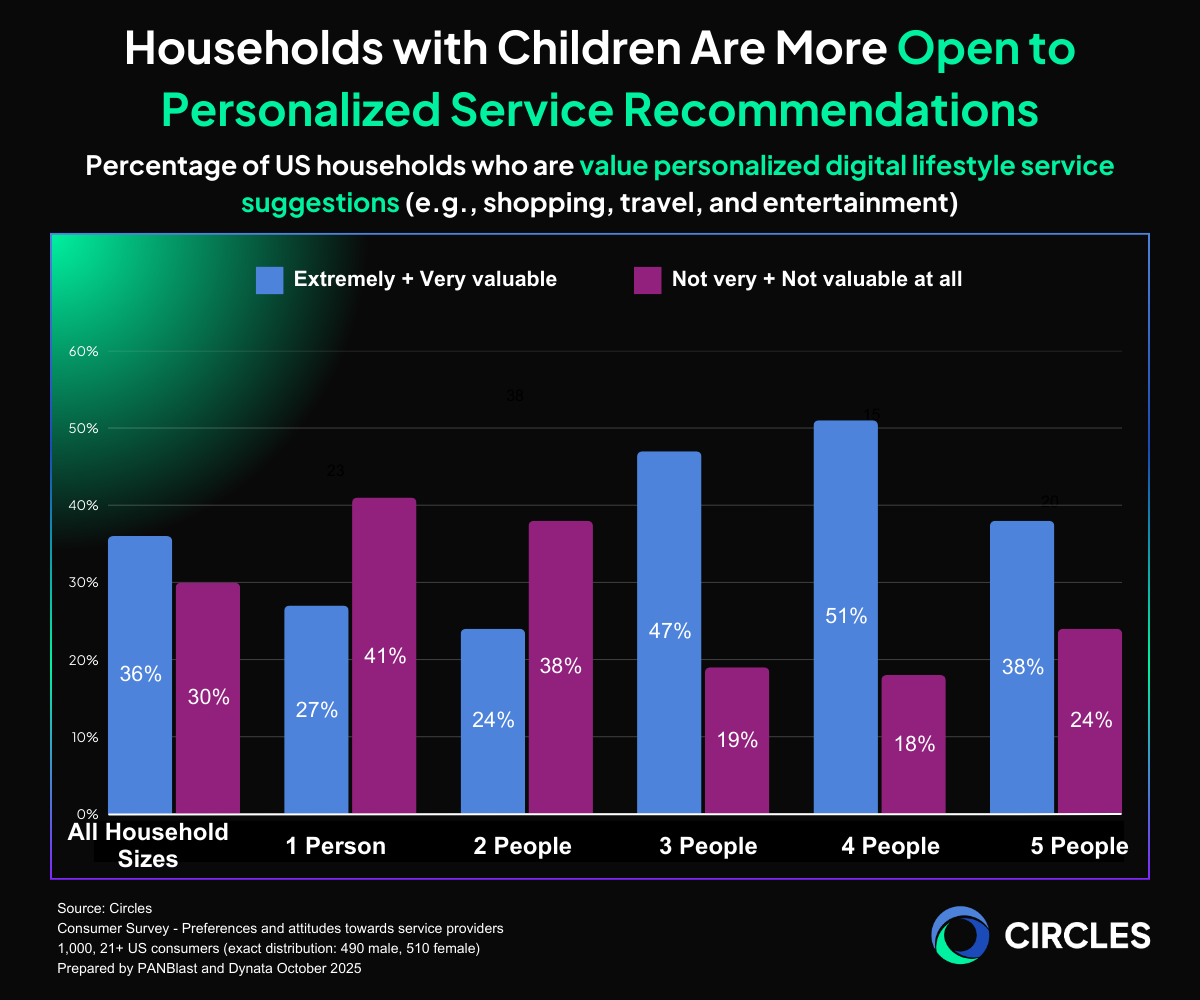
For telcos, families are primed for a “life hub” telco app, one that extends beyond connectivity into everyday spending and lifestyle management. Combining great user experiences for connectivity while providing non-telco rewards and services could be rewarded with greater engagement from larger households.
Bundles: Simplicity Sells in Complex Households
The survey confirmed that bundles matter more for certain segments, and the family lens makes this concrete. 60.4 percent of parents say having mobile and home internet from the same provider is very or somewhat important, compared with 38.2 percent of non-parents. Among non-parents, 54.0 percent say this is “not important,” versus 34.4 percent of parents.
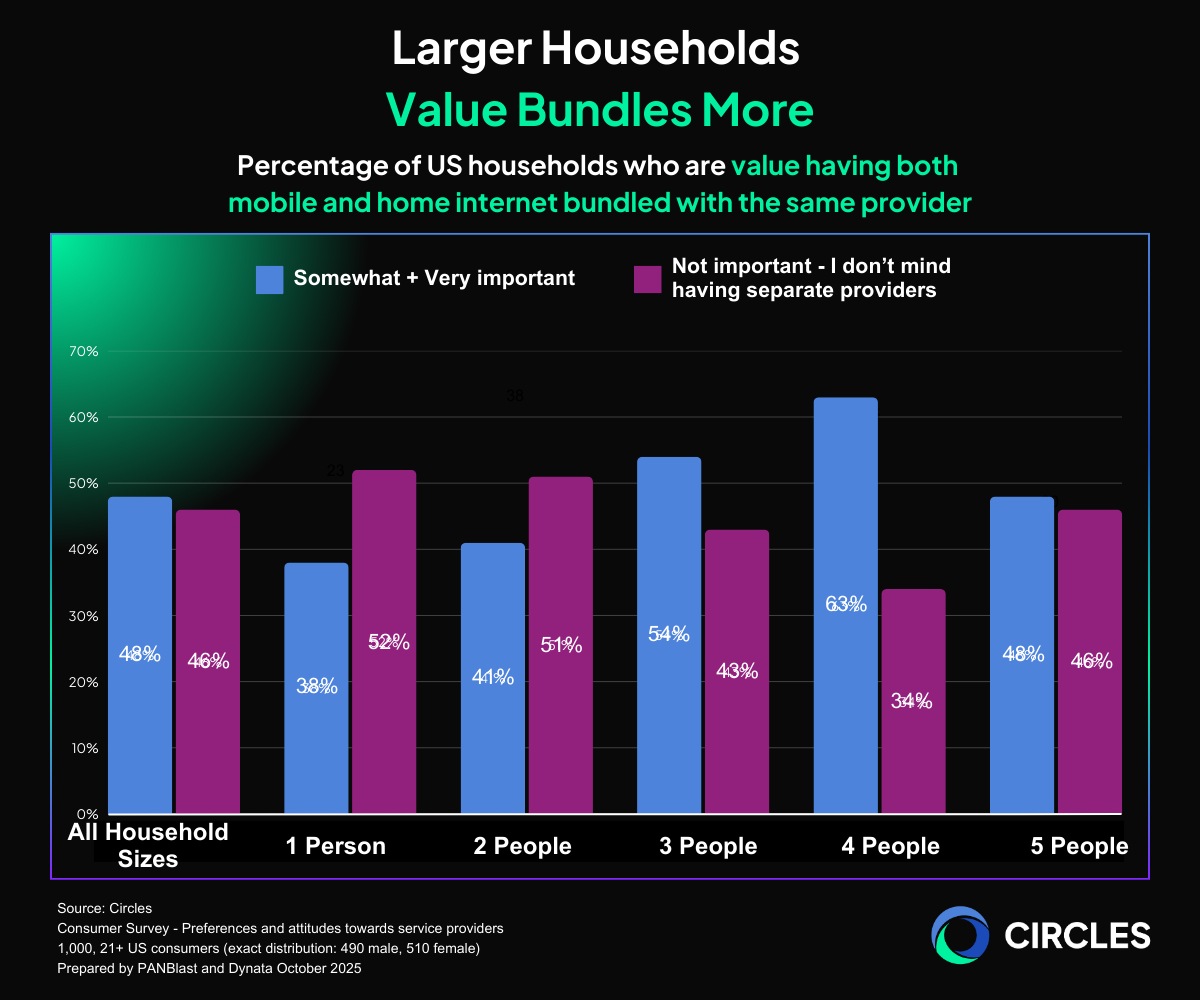
As household size increases, so does the perceived importance of bundling. Slightly more than half of households with 1 or 2 people don’t mind having separate providers for home and mobile internet, while interest in bundles grows for households with 3 or more people in them.
For families, bundles help out with logistics like consolidated billing, simplified troubleshooting, and single-provider accountability. With more to manage, having everything under one roof is highly valued by families.
Service Channels and Trust: Slightly Less Human-Dependent, More AI-Ready
While the broader survey confirmed that human support is still preferred overall, with 65 percent of respondents favoring a human agent to resolve issues, the family segment reveals a shift in channel mix:
57.3 percent of parents prefer speaking to a human agent, compared with 70.1 percent of non-parents.
When we combine chatbot/AI and mobile app/self-service, 35.1 percent of parents prefer digital-first resolution versus 22.2 percent of non-parents.
This means that families are more open to blended support models and are more comfortable resolving issues in-app when the experience is well-designed. One possible reason for this is that these digital methods could provide solutions faster without needing to wait for customer service agents to be available.
Families are More Open to Influencer Endorsements
The survey showed that families are more open to celebrity influencers. Below are some insights drawn from respondents’ responses to the question “How does celebrity or influencer involvement with telecom brands (e.g., Ryan Reynolds with Mint Mobile or Will Arnett with SmartLess Mobile) impact your likelihood of choosing these brands over traditional telecom brands?”
The average respondent was slightly less likely to be influenced by celebrity endorsements (51 percent said these endorsements don’t factor into their telco decision making)
26.3 percent of parents say celebrity or influencer involvement makes them more likely to consider a telco brand, versus 5.3 percent of non-parents.

For telco digital sub-brands (DMOs) or co-branded offers, families and larger households form a receptive audience as long as the brand promise connects back to real product performance and value.
Families Continue To Be a Vital Customer Segment for Telcos
Families continue to be an important consumer segment for telcos. They are high-value and high-risk customers who have a higher appetite for digital innovation and love bundles. However, despite being more satisfied, they will churn faster if competitors offer better experiences.
Household complexity is another potential segmentation layer. Household size and the presence of children can be strong predictors of behaviors like app usage, digital lifestyle ecosystem interest, and likelihood to switch telco brands.
The growth battleground will be including digital differentiation, on top of network reliability and pricing. Competing purely on price could win more transactional customers, but segments like families are signalling that they favor more holistic packages: bundles, easing family bill management and logistics, digital experiences, and even lifestyle value embedded in their telco relationship.
Connect, Delight, and Beyond: A Playbook for Family-Centric Telcos
Based on experience managing digital mobile operator (DMO) brands around the world, the Circles team noticed that a more holistic approach is needed for telcos to transform into ideal DMOs to attract and retain higher value, digitally-savvy consumer segments. Larger households showing greater favor to personalized digital experiences and discounts even on non-telco services, further adds credibility to that idea.
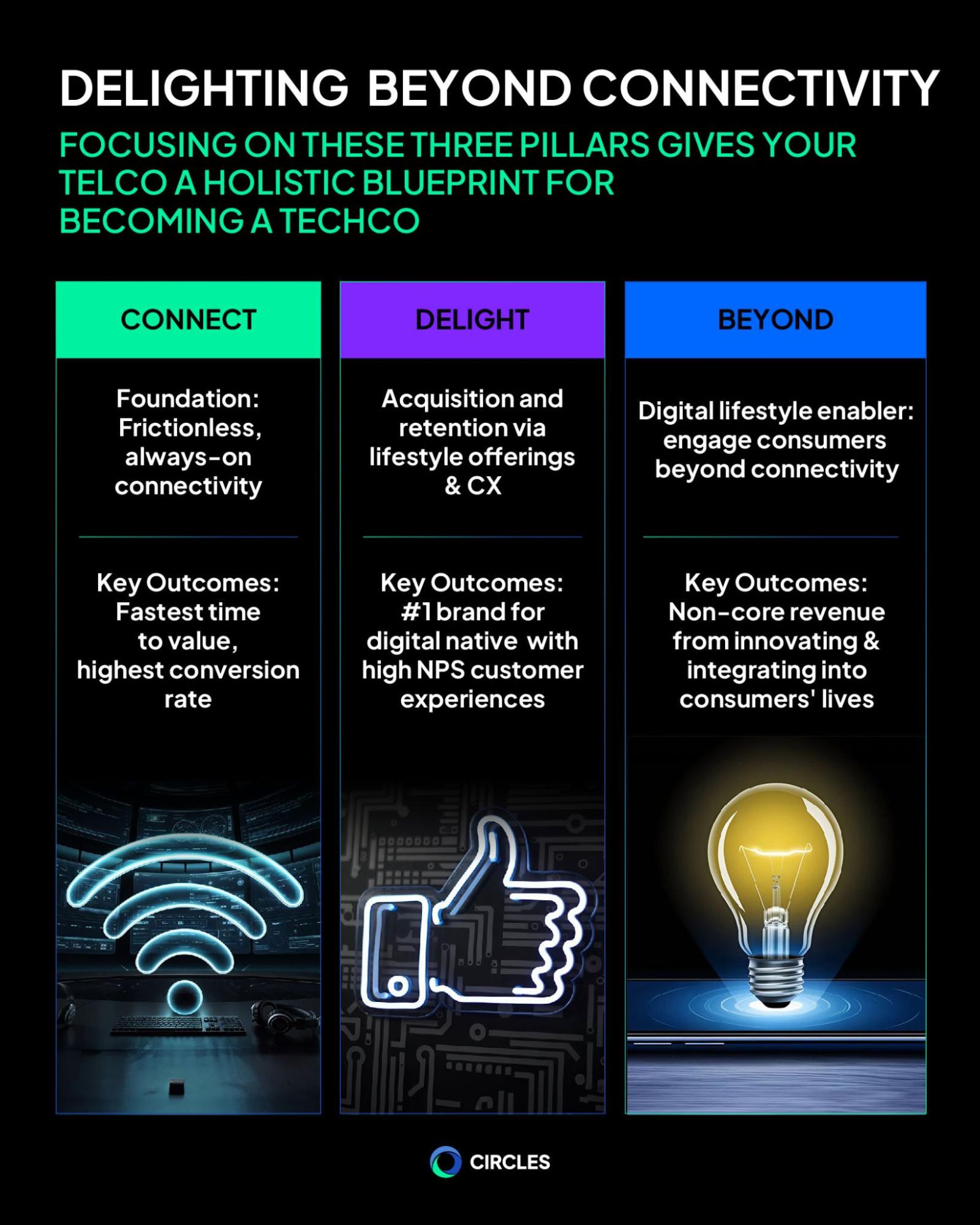
To capture these higher value digital natives, also known as digital pioneers, telcos can apply the Connectivity, Delight, and Beyond playbook which covers everything from basic connectivity needs, delightful experiences that create loyalty to innovations beyond traditional connectivity:
Connectivity
Connectivity is about providing frictionless and ‘always-on’ core offerings such as voice calls and mobile internet to meet basic telecommunications needs to give power back to consumers.
Apart from ensuring network reliability, power can be given back to consumers in the form of value-for-money plans and a great digital experience that is optimized for fastest time to value and high conversion rates. Mobile plans should be simple and easy to understand while digital onboarding experiences should be quick and free of frustration.
Tying this back to larger households:
Delight
Delight is about paving the way for high customer satisfaction, measured in Net Promoter Score, with strong acquisition and retention of digital pioneer customers with lower customer acquisition costs and higher customer lifetime value.
This is achieved by adding value beyond what other telco competitors provide. Telcos can anticipate and serve people’s digital lifestyle needs by expanding the scope of what telcos can do, ensuring superior customer experiences, and loyalty rewards that digital pioneers will come back for.
Tying this back to larger households, this includes providing discounts for or bundling non-traditional telco digital services that are optimized for family experiences like food delivery like foodpanda in some countries, and partnerships with streaming entertainment like Paramount+ and even in-person activities like Bigbox’s food, spa & massages, and hotels. These can then be supported by AI-powered personalized recommendations delivered at just the right time.
Meanwhile, the CX of the website and apps should also be optimized to reduce friction, with self-service and AI options that let customers choose their customer service channel, and personalization tuned to household composition and not just individual usage.
Beyond
The Connect and Delight pillars focus on what’s possible today, while the Beyond pillar focuses on taking what telcos can do to the next level.
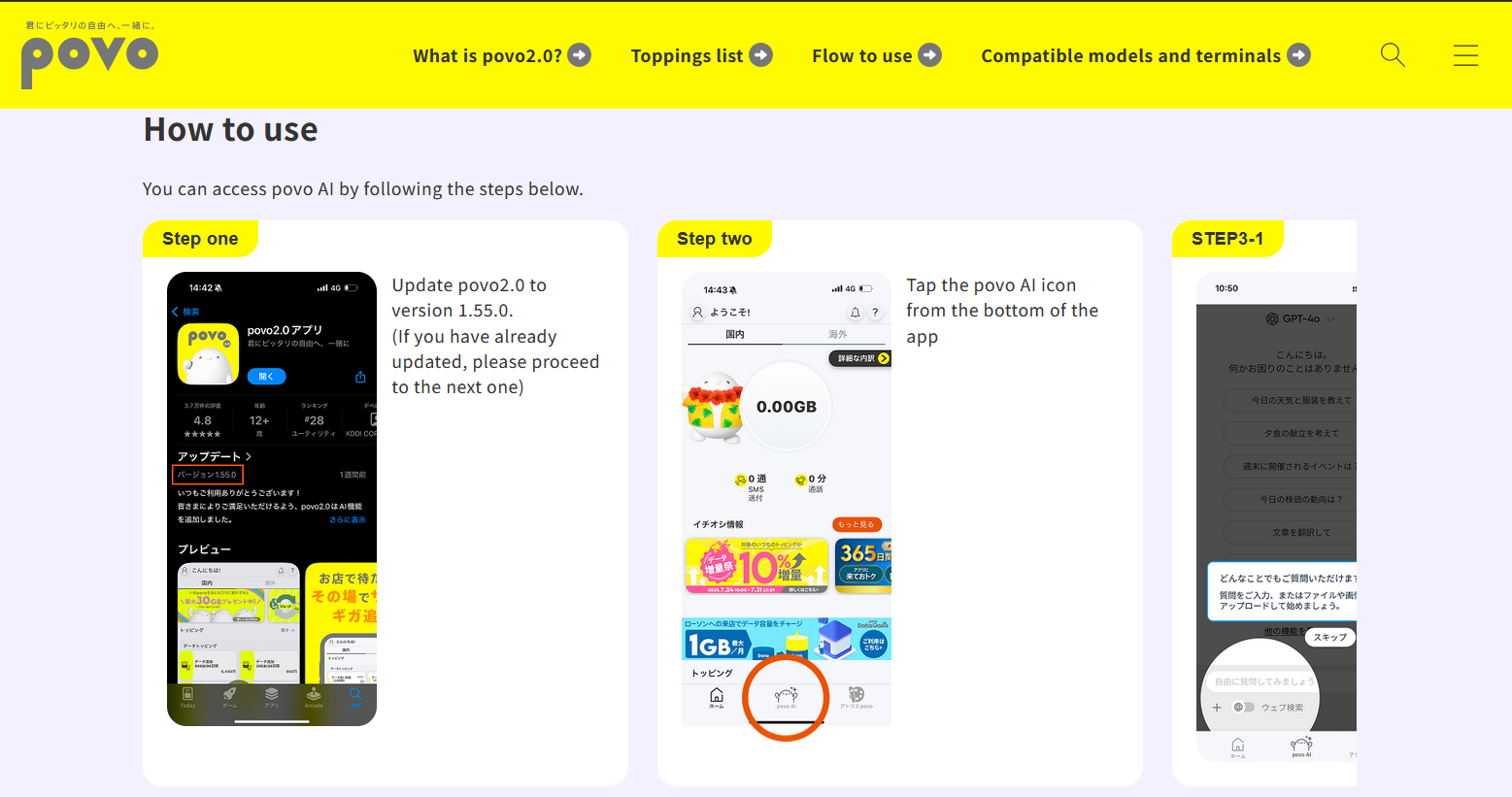
Innovation is both a mindset and a process. The ideal telco can collaborate with partners to develop improvements to the experience and product offerings. Circles partners like povo in Japan are pushing the boundaries of what telcos can do by launching AI assistants accessible directly on the app on top of achieving high NPS scores.
To ensure that telco customers are given the best experience possible, initiatives like Xplore, an innovation sandbox, that can optimize for metrics like time on app are being run. These initiatives are supported by analysing the depth of user data that Circles and its partners have through app and site user activities to develop personalized marketing journeys and innovative new products.
Tying this back to families, initiatives like these can include families in the test cohorts, helping telcos develop a deeper understanding of what works and what can be developed for digitally-savvy families.
The world’s leading telcos have been unearthing consumer data and innovating for digital pioneers such as KDDI’s povo. Circles has been with partners like KDDI with the Connectivity, Delight, and Beyond playbook to turn telcos into anticipatory techcos that can interpret customer needs in real time and orchestrated experiences across connectivity, apps, and ecosystem partners.
For US telcos, families are a potential market share gold mine, and the operators who can connect, delight, and go beyond for them can potentially reap great rewards.
Curious about how the playbook has been working for telco brands in the Americas, East Asia, and Southeast Asia or want to book a demo of Circles telco SaaS in action?
Contact us today!