

Knowledge Hub
5
min read
AI in OSS/BSS Transformation: How It Improves Telecom Operations
The real transformation in telecom is happening where AI enters OSS/BSS and starts reshaping the systems behind every activation, service issue, billing event, and customer interaction.
AI in OSS/BSS means using artificial intelligence inside the systems that manage telecom operations, service delivery, billing, and customer support to improve speed, accuracy, and customer experience.
In this article, you will see how AI is reshaping OSS and BSS, where it delivers practical value, and what operators need to make it work.
Let’s get into the changes that are already redefining telecom.
What Are OSS and BSS?
OSS and BSS together manage the full service lifecycle. When both layers share data and work in sync, AI can support decisions across fulfilment, assurance, charging, and customer-facing operations.
Why Traditional OSS/BSS Struggle Today
Many operators still run OSS and BSS on systems built for a slower and less connected telecom model. That becomes a problem when customers expect instant activation, clear billing, and consistent support across apps, websites, and contact centres.
According to the World Economic Forum and Accenture1, telecom data consumption is expected to increase from 3.4 million petabytes in 2022 to 9.7 million petabytes by 2027, which adds even more pressure on legacy systems that were not built for this level of scale and service complexity.
This is why the issue sits at the centre of many telco digital transformation challenges. Common pain points usually show up in the same places:
These limits do not just slow operations down. They also make it harder to launch digital services quickly, personalise offers, and respond to service issues before customers notice them, which is why they continue to surface in broader telco digital transformation challenges.
What AI in OSS/BSS Transformation Actually Means
AI in OSS/BSS transformation means adding intelligence to the systems that already run telecom operations and commercial workflows.
In OSS, AI can read alarms, spot unusual traffic patterns, predict failures, and suggest the likely cause of a service issue before teams start digging manually. In BSS, it can flag billing anomalies, recommend relevant plans, estimate churn risk, and support faster customer support responses.
The goal is not to bolt on a flashy tool. The goal is to make everyday processes such as activation, assurance, charging, and care faster, cleaner, and easier to manage at scale across modern telecom teams today.
This shift is already well underway across the sector. According to the NVIDIA Annual Telecom AI Study 20252, 97% of telecom organisations were assessing or adopting AI in 2025, up from 90% in 2024.
6 Core Transformations AI Brings to OSS/BSS
Now that you have seen where traditional OSS and BSS start to struggle, the next question is how AI changes those systems in practical ways across network operations, service delivery, billing, and customer experience.
With that said, here are 6 core transformations that show where the shift becomes real.
1. Predictive Maintenance and Fault Prevention
AI helps you spot trouble before customers feel it. It can read fault logs, monitor temperature swings in radio units, flag battery weakness at cell sites, and detect unusual packet loss across backhaul links.
Predictive maintenance and reduced downtime go together here, because teams can fix unstable equipment before it triggers dropped calls, slow data sessions, or wider service disruption during busy periods for users.
According to a study by Veritis in 2025, as cited in Team International’s The Innovative Impact of AI in Telecom3, AI-driven predictive maintenance in telecom can decrease network downtime by up to 40%, which shows why earlier intervention matters so much in live network environments.
2. Network Optimisation and Traffic Forecasting
Traffic does not rise evenly across a network, and AI helps you see where pressure is building before congestion spreads. By reading usage patterns from busy train lines, stadium zones, and evening residential peaks, it can forecast demand, recommend capacity shifts, and fine-tune 5G slice allocation.
That also helps you protect service-level agreement performance, especially when enterprise traffic and consumer traffic compete for the same resources.
3. Service Assurance and Quality Monitoring
When service quality starts slipping, the warning signs usually appear in different places at once. AI helps bring them together by matching network alarms, fault tickets, and customer complaints that point to the same issue.
For example, it can connect dropped calls in one area with failed handovers, transport faults, and a rise in support messages, so teams can see the real cause sooner and fix it before more users are affected.
4. Customer Behaviour and Personalised Experiences
You probably hold useful signals across billing records, app activity, plan changes, top-up history, and day-to-day usage. AI helps make sense of that mix by showing who may leave, which services fit certain users, and when an offer is more likely to land well.
In practice, that could mean surfacing a roaming add-on for frequent travellers or flagging a retention offer before contract renewal.
5. Fraud Detection and Revenue Protection
Fraud detection and prevention get sharper when you can see odd behaviour as it starts, not after the damage is done. AI can catch repeated SIM swaps, strange roaming jumps between countries, bulk sign-ups from reused identities, or traffic spikes that do not match normal use.
That helps teams step in early, check accounts, and limit revenue loss before patterns spread too far across services.
6. Policy, Charging, and Decision Automation
When evening traffic surges in one area, policy rules, charging logic, and service priorities cannot wait for manual decisions. In that moment, AI can rebalance bandwidth, apply the right usage thresholds, update charging in real time, and trigger the next operational step across OSS and BSS.
That closed-loop flow keeps premium traffic protected, limits congestion, and ties network actions more closely to commercial rules.
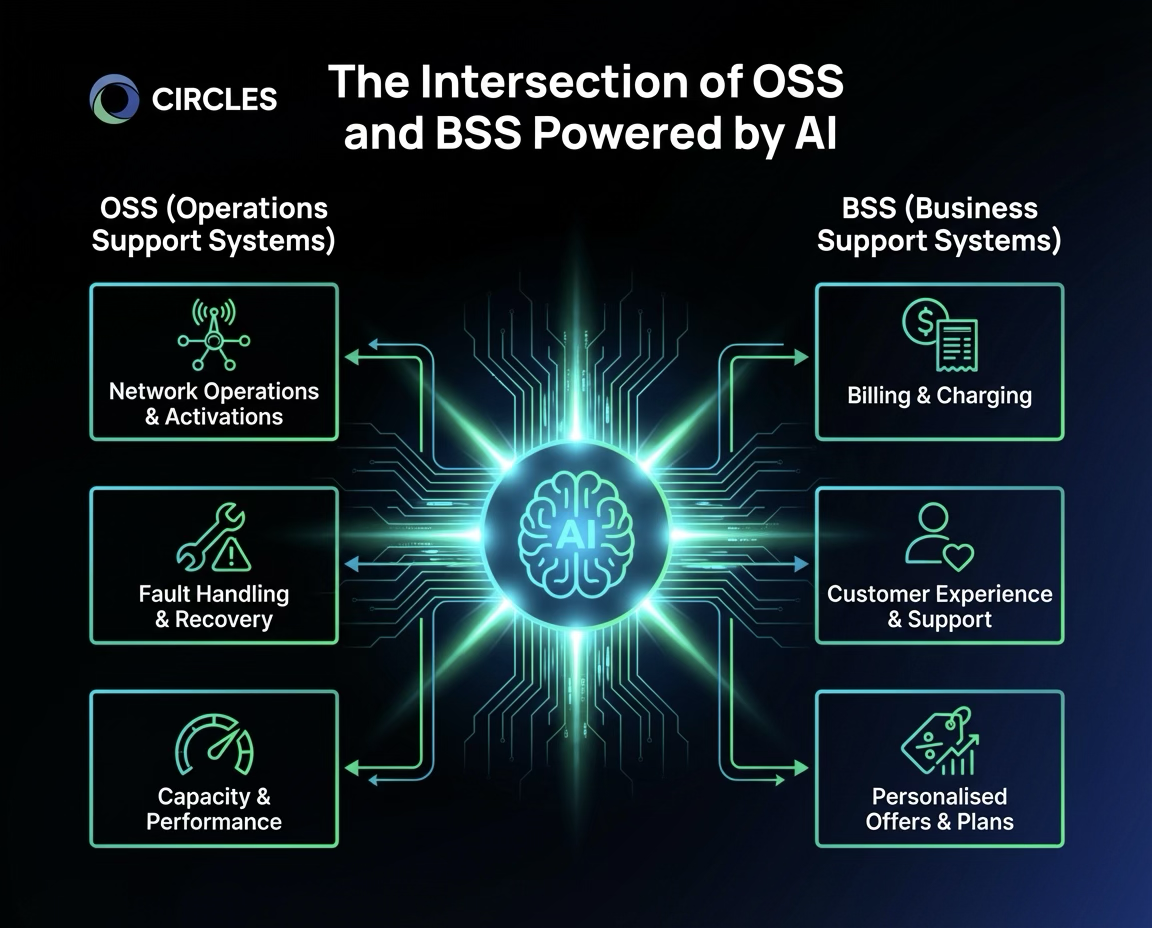
How AI Improves OSS Functions
In OSS, AI helps you spot trouble earlier and cut through the usual noise. Teams no longer have to piece everything together by hand from separate alarms, tickets, and dashboards, because AI can surface the patterns that matter while there is still time to act.
Here are a few practical ways AI improves OSS functions:
How AI Improves BSS Functions
BSS sits close to the customer, so when something goes wrong here, people notice it quickly. A confusing bill, a badly timed offer, or a slow response to a payment issue can easily turn into frustration, which is why operators use AI to make these everyday decisions more accurate and more timely.
Here are a few practical ways AI improves BSS functions:
According to research by IBM and NVIDIA from 2024 to 20254, 53% of telecom respondents are already deploying or optimising AI for customer service, while 54% of telecom executives using or assessing generative artificial intelligence have already launched their first application.
5 Key Benefits of AI in OSS/BSS Transformation
Now that you have seen how AI improves both OSS and BSS functions, it is worth looking at the wider gains you can unlock when those improvements start working together.
With that in mind, here are 5 benefits that show why AI in OSS/BSS transformation matters beyond individual use cases.
1. Higher Operational Efficiency
When AI takes over repetitive checks, teams spend less time sorting alarms, reviewing tickets, or tracing the same fault across separate systems.
Incidents move faster because likely causes surface earlier, and that helps cut overtime, reduce manual workload, and lower operational expenditure across network operations, care teams, and service support.
2. Better Customer Experiences
Customers feel it when support stops being reactive. AI can spot service issues in one postcode, trigger an update before complaints climb, and surface a roaming pass when travel patterns shift.
That makes care feel more useful, lifts Net Promoter Score, and helps reduce churn caused by friction over time.
3. Improved Scalability for 5G, IoT, and Emerging Services
As you take on more connected services, the workload grows far beyond voice and data. AI helps manage that shift by tracking service levels, spotting unusual device activity, and supporting more complex 5G use cases in telecom without forcing operations teams to grow at the same pace.
That becomes especially useful when networks also need to support smart meters, fleet trackers, and partner-led services at scale.
According to ResearchAndMarkets, in 20255, next-generation OSS/BSS for Internet of Things platforms is projected to reach $25.2 billion globally by 2030, which shows how quickly the need for scalable, intelligent support systems is growing.
4. Stronger Revenue Growth and Protection
AI helps you earn more from the customers you already have while closing gaps that quietly drain revenue.
It can surface add-ons for heavy roamers, suggest plan upgrades for data-heavy users, catch missing charges, and flag suspicious account activity before fraud, billing leakage, or avoidable losses grow over time significantly.
5. Enhanced Competitive Positioning
The market is crowded, and basic connectivity is no longer enough on its own.
When AI is built into OSS and BSS, you can roll out services faster, respond to customer needs with less delay, and shape a smoother digital experience. That gives them more room to stand out beyond price alone.
5 Common Challenges in AI-Led OSS/BSS Transformation
AI can improve OSS and BSS in practical ways, but getting there is rarely simple. Many operators run into the same problems when they try to add new models, automation layers, or decision engines on top of systems that were never built to work that way.
Some of the biggest roadblocks tend to look like this:
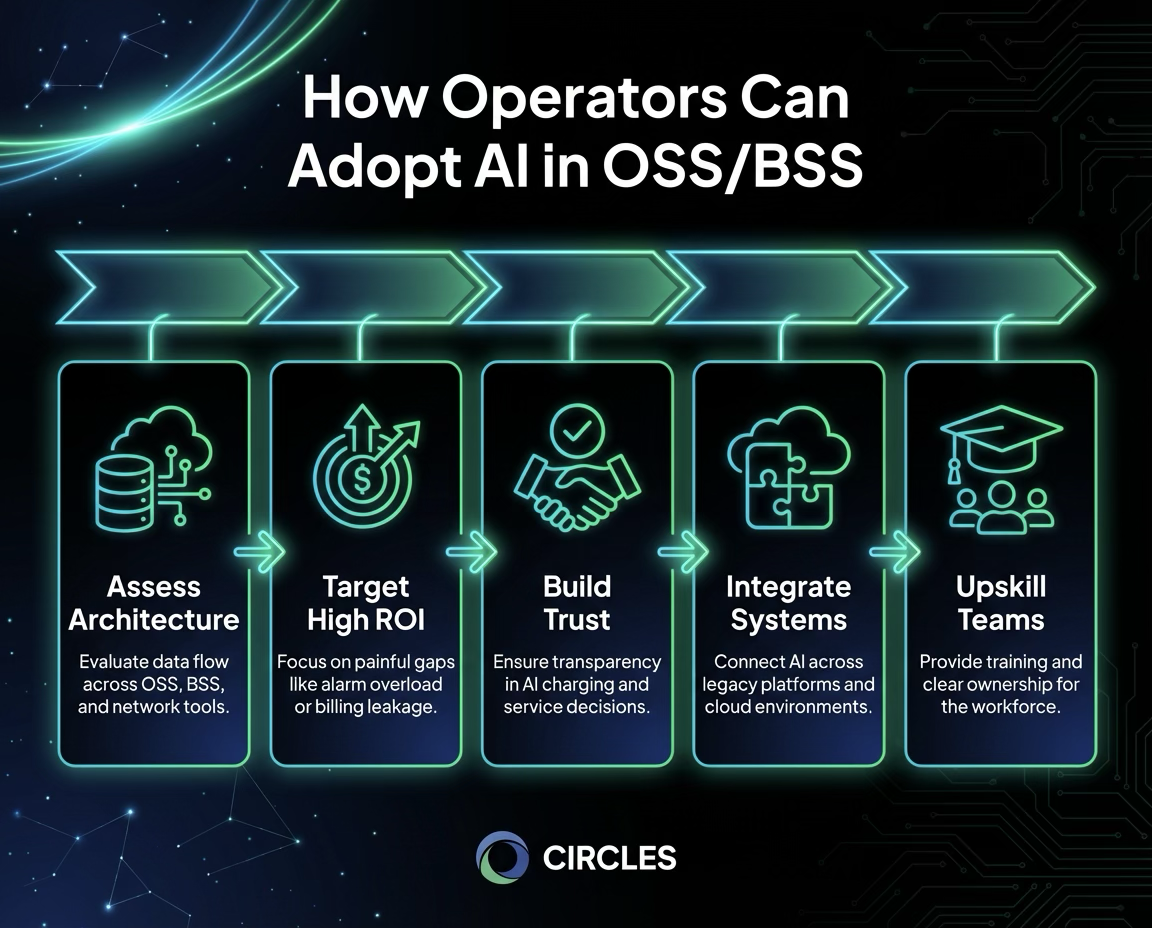
How Operators Can Adopt AI in OSS/BSS
Bringing AI into OSS and BSS usually works better when you treat it as a working change across the business, not just a new tool to install. You are more likely to see useful results when you start with the basics, focus on the most painful gaps first, and build out from there once your systems and teams are ready.
Here are some practical steps you can take to make the process easier to manage.
FAQs
How Is AI In OSS Different From AI in BSS?
AI in OSS supports network operations and service assurance, while AI in BSS supports billing, customer decisions, offers, and revenue management.
Do Operators Need To Replace Legacy Systems Before Implementing AI?
No. You can start by integrating AI with existing systems, although older platforms may limit speed, data access, and automation depth.
What Are The Main Risks When Deploying AI in OSS/BSS?
The main risks include poor data quality, weak oversight, unclear use cases, low trust in outputs, and difficult integration across systems.
How Long Does It Usually Take To See Value From AI In OSS/BSS?
It depends, but focused use cases such as alarm triage or churn prediction can show value within a few months.
Conclusion
Telecom growth gets harder to manage when your network, billing, and customer systems move in different directions, and that is exactly where smarter operations start to matter.
Real progress shows up in OSS/BSS transformation when AI starts improving the systems behind your fulfilment, assurance, charging, and customer support.
When you apply it to the right problems first, you can reduce manual effort, respond to issues faster, and create a steadier experience for both your teams and your customers.
To turn that shift into something practical, explore how Circles helps you launch, run, and transform digital mobile services with software built for scale.
References:
- WEF / Accenture - Artificial Intelligence in Telecommunications White Paper (February 2025)
- NVIDIA Annual Telecom AI Study 2025
- Veritis - Cited in Team International’s The Innovative Impact of AI in Telecom
- IBM Global Telecom Survey + NVIDIA Annual Telecom AI Study
- ResearchAndMarkets - Next Generation Network OSS and BSS Market 2025-2030