

Knowledge Hub
5
min read
AIOps for Telcos: A Guide to Smarter, Faster, and More Resilient Networks
AIOps for Telcos starts to matter when your network is changing every second, but your operations model still depends on tools built for a slower, simpler telecom world.
Traditional network operations cannot keep pace with 5G complexity, cloud-native systems, and rising customer expectations. Manual processes, static thresholds, and siloed tools slow decision-making, which makes it harder to detect issues early or respond before service quality slips.
In this guide, you will learn how AIOps helps telecom operators improve detection, prediction, and automation across increasingly complex network environments.
Let’s get into it.
What Are AIOps for Telcos?
AIOps for Telcos uses AI to help run telecom operations so you can better manage networks that change quickly and have a lot of traffic.
It combines AI, meaning artificial intelligence, with operations to improve how you detect issues, correlate events, predict risks, and automate responses.
In telecom, AIOps goes beyond standard enterprise IT monitoring. Enterprise implementations often focus on applications, servers, and internal systems. Telecom AIOps must work across multi-domain networks such as radio access, core, transport, cloud, and service layers, where data volumes are higher and service impact spreads faster.
At its core, AIOps unifies telemetry analysis, AI-driven analytics, data correlation, predictive modelling, and automation. It helps you put alarms, logs, metrics, and network signals together into a clearer picture of how things are running, so teams can respond more quickly and with more information.
In practice, AIOps helps telecom companies go from monitoring their networks reactively to doing so more intelligently and proactively.
Why AIOps Matters Now for Telecom Operators
AIOps is important now because telecom networks are becoming increasingly difficult to manage using manual processes alone. What once felt optional now solves a real operational problem.
According to the 2024 5G AIOps Operator Survey by Heavy Reading and RADCOM, only 6% of telecom operators say they currently identify and resolve all network issues with AI systems, which shows how wide the gap still is between growing network complexity and actual operational maturity.1
5G is a big part of that shift. It adds more service layers, more dependencies, and more network behaviour that changes in real time.
Customer expectations have changed too. People expect stable service, quick recovery, and consistent performance, even when networks are under pressure.
At the same time, device growth keeps adding more signals, more alerts, and more noise. That makes it much harder for teams to investigate issues manually and still move quickly.
Hybrid cloud adds another layer of complexity. When services run across network, cloud, and edge environments, it becomes harder to connect symptoms to the real source of a problem.
Competition makes the stakes even higher. Operators need to protect service quality, control costs, and respond faster, and that is exactly where AIOps starts to matter.
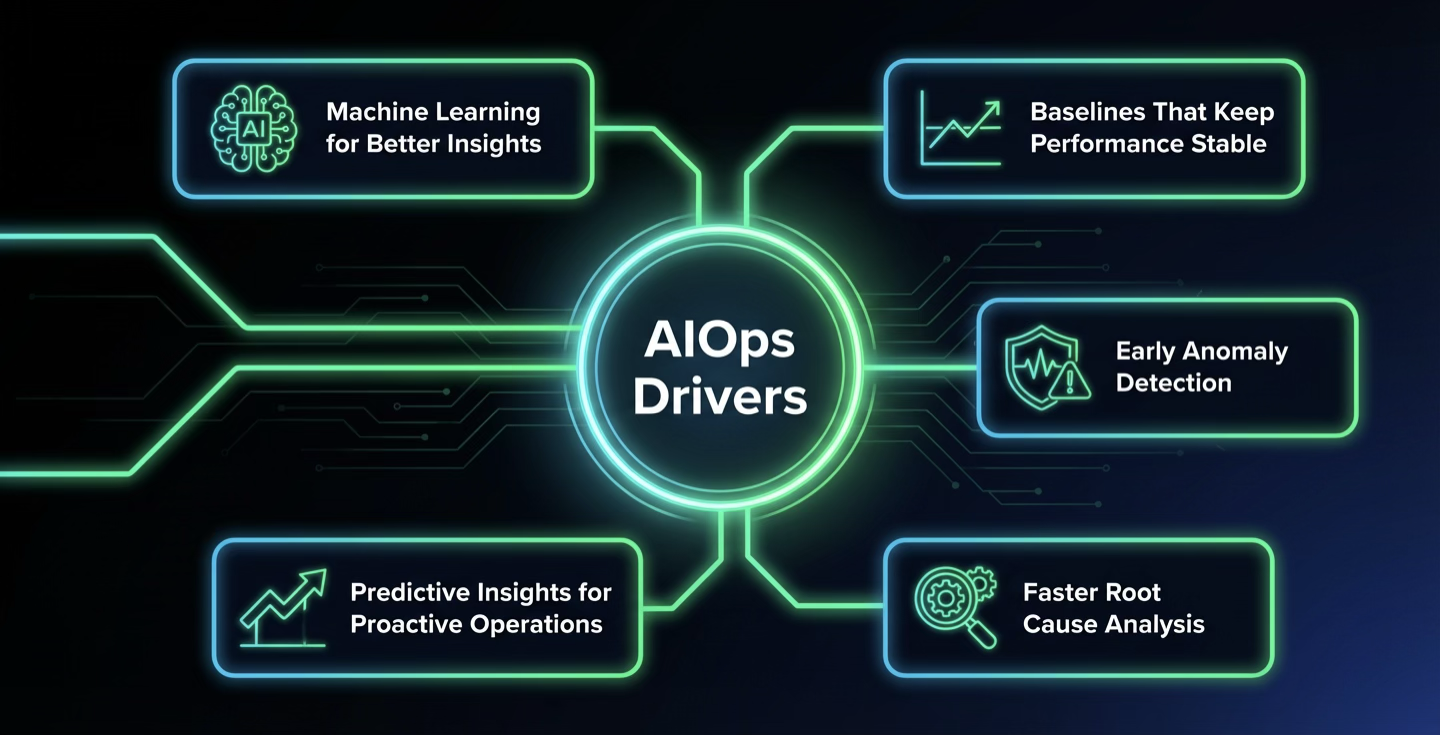
5 Main Drivers Behind AIOps Adoption
AIOps adoption is picking up because telecom operators are running into operational limits that older ways of working cannot handle well.
Below are the main drivers pushing AIOps from a useful idea into a practical priority:
1. Machine Learning for Better Insights
Machine learning helps operators read logs, events, key performance indicators, and telemetry at a scale no team can review manually. It can spot patterns such as recurring congestion, alarm clustering, or traffic surges during seasonal peaks and major live events.
That matters because network issues rarely appear as one clean signal. More often, the real story sits across many small events that only make sense when you connect them.
2. Baselines That Keep Network Performance Stable
AIOps uses dynamic baselines that adjust to normal network behaviour over time. That gives operators a more accurate reference point than static thresholds, which often break down in 5G and hybrid environments.
A fixed threshold may look sensible on paper but fail during a major streaming release or a city-wide event. Dynamic baselines make it easier to tell the difference between expected fluctuation and real degradation.
3. Early Anomaly Detection Across the Network
Anomaly detection helps operators catch unusual behaviour early, before users start feeling the impact. That could include packet loss, jitter changes, sudden CPU spikes, or patterns that support proactive threat detection when suspicious activity starts to build in the background.
Customer experience usually slips before the outage becomes obvious internally. The earlier those weak signals appear, the more time teams have to step in.
4. Faster Root Cause Analysis With Automation
AIOps helps reduce Mean Time to Identify, or MTTI, by grouping related alarms and tracing likely cause-and-effect chains. Instead of asking engineers to sort through noisy alerts one by one, it narrows the search much faster. That kind of improvement is not just theoretical either.
A 2025 study on AI-driven service assurance found that automated root cause analysis reached 97.2% accuracy and helped reduce Mean Time to Resolution, or MTTR, from 5.8 hours to just 8.5 minutes.2
For example, dozens of separate alarms may all tie back to one fibre cut or a misconfigured virtual network function. That saves time and reduces wasted investigation effort.
5. Predictive Insights for Proactive Operations
Predictive models help operators see risks before they become incidents. That early visibility can make a measurable difference.
A 2025 study on AI in telecom network automation found that predictive maintenance models reached 89% accuracy in forecasting equipment failures up to 96 hours in advance, which helped reduce unplanned downtime by 58%.3
They can forecast likely faults, capacity pressure, service-level agreement risks, or inefficient power use based on past and current patterns. That changes the rhythm of operations. Instead of reacting after something breaks, teams can take action earlier and prevent more problems from reaching customers.
Key Challenges Telcos Face Today
A lot of telcos recognise the benefit of AIOps, but getting there isn't always easy. Below are the main challenges that slow adoption and make it harder to turn AIOps into something that works well in day-to-day operations:
7 Benefits of AIOps for Telecom Operators
AIOps can improve telecom operations in ways that last beyond day-to-day incident handling. Over time, it helps operators run networks more smoothly, make better decisions, and stay more competitive.
Here are the main benefits.
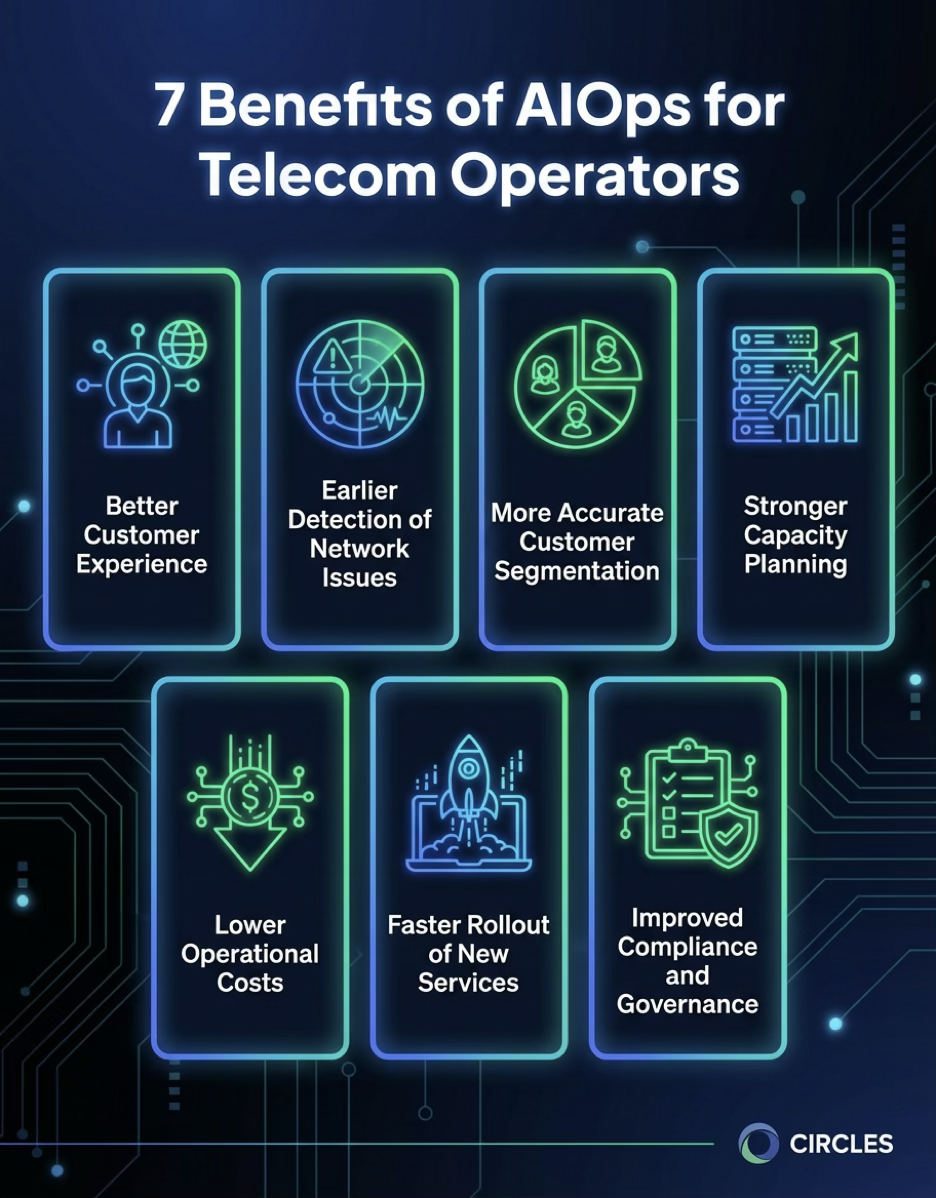
1. Better Customer Experience
AIOps helps operators spot problems early and resolve them faster, which reduces the impact on subscribers. In practice, that can mean fewer dropped calls, quicker broadband recovery, and more stable 5G sessions when demand starts to rise.
2. Earlier Detection of Network Issues
Continuous monitoring makes it easier to catch weak signals before they turn into visible service problems. A sudden rise in packet loss, jitter, or CPU usage may look small at first, but early detection gives teams more time to act before customers notice.
3. More Accurate Customer Segmentation
AIOps can reveal how different customer groups actually use services across devices, locations, and time periods. That helps operators shape more relevant offers, improve retention, and plan networks more accurately around real behaviour patterns.
4. Stronger Network Performance and Capacity Planning
Forecasting helps operators place resources where they are most needed instead of reacting too late. Network demand keeps growing, while the cost of building and maintaining capacity remains high. Operators need to plan more carefully so they can support rising traffic without overcommitting resources in the wrong areas.
According to GSMA Mobile Economy 2024, cited in the SoftBank AI-RAN Whitepaper, global mobile data traffic is expected to grow by 23% each year from 2023 to 2030 and exceed 465 exabytes per month by 2030.4
That makes stronger forecasting and capacity planning more important, especially when operators need to protect service quality while managing long-term investment pressure.
5. Lower Operational Costs
AIOps reduces the time spent on repetitive investigation, manual alarm correlation, and recurring operational tasks. Telecom operating costs often rise through repeated manual effort, slower troubleshooting, and engineering time spent working through the same issues again and again.
This is where automation-led efficiency starts to matter, especially when teams need to reduce wasted effort without losing operational control.
According to Infosys Knowledge Institute, agentic AI can help telecom operators cut manual labour and lower operating expenses by more than 30% when applied to areas such as network optimisation, predictive maintenance, and customer service automation.5
Over time, that gives technical teams more room to focus on improving service performance instead of staying stuck in reactive work.
6. Faster Rollout of New Services
New services are easier to introduce when testing, onboarding, and assurance are more automated. This becomes especially useful for 5G and enterprise services, where operators need to move quickly without creating extra operational strain.
7. Improved Compliance and Governance
AIOps makes it easier to trace what happened, why it happened, and what action followed. That gives operators stronger oversight, more consistent policy enforcement, and clearer records when audit or governance checks come into focus.
Essential Features of a Strong AIOps Platform
Not every AIOps platform is built for telecom. The platforms that work well at telecom scale need to handle far more data, more domains, and more operational complexity than a typical enterprise setup.
Here are the features that matter most:
6 Best Practices for Telco AIOps Deployment
AIOps usually works best when operators roll it out with clear priorities and room to learn along the way.
Below are the practices that tend to make adoption smoother, more useful, and easier to scale over time:
1. Set Clear Goals and Expected Outcomes
Start with goals that are specific enough to measure. That could mean reducing Mean Time to Resolution, or MTTR, by 40 percent, cutting alarm noise by 60 percent, or improving service-level agreement performance in a network area that regularly causes trouble.
2. Start With Small, High-Impact Projects
It is often better to begin with a contained use case than to push for a full rollout too early. Service assurance, anomaly detection, and event correlation are usually good starting points because they solve visible problems and make early progress easier to see.
3. Leverage Existing Tools and Data
Most operators are not starting from scratch. They usually already have useful systems in place, whether that is operational support systems, network management systems, security information and event management tools, telemetry pipelines, or existing dashboards that can feed valuable data into AIOps.
4. Integrate AIOps Into Daily Operations
AIOps becomes far more useful when it fits into everyday workflows. That might mean giving network operations centre teams clearer alert context, adding likely root causes into tickets automatically, or triggering approved actions before an issue spreads wider.
5. Encourage Learning and Skills Development
The platform is only part of the picture. Teams also need to understand what the system is doing and how to work with it, which is why practical learning in machine learning basics, automation frameworks, and observability engineering often makes a real difference.
6. Track Performance and Optimise Continuously
AIOps is not something you set once and leave alone. Regular review helps operators see what is working, where false positives are still causing friction, and which workflows need refining as network conditions keep changing.
A phased rollout usually feels more practical than trying to scale everything at once.
Below is a simple roadmap that shows how adoption often moves from early assessment to broader optimisation.
FAQs on AIOps for Telecom Operators
Does Aiops Replace Human Operations Teams?
No. It takes repetitive work off their plate, but people still matter. Engineers still need to make judgement calls, handle unusual cases, and decide how automation should work in real network conditions.
How Soon Can Operators Expect Measurable Results?
Usually within a few months, if the starting point is focused. Teams often see early gains in alarm reduction, faster triage, or better incident handling before wider operational improvements show up.
Can Smaller Operators Adopt Aiops Effectively?
Yes. Smaller operators do not need a massive rollout to benefit. Starting with one clear problem and using the data and tools already in place is often the more sensible approach.
What Prerequisites Should Be In Place Before Starting?
You need a clear starting point, usable data, and enough visibility across the systems that matter most. It also helps when the workflows are already defined and success is easy to measure, so the rollout stays grounded and manageable.
Conclusion
AIOps for Telcos starts to matter even more when day-to-day network operations become harder to manage with manual work, disconnected tools, and slower decisions.
The real value starts to appear when operators use AIOps to detect issues earlier, connect signals more clearly, and respond across complex network environments with more confidence.
When it is applied to the right operational priorities, AIOps can ease day-to-day pressure, improve service stability, and help operators prepare for 5G, IoT, and cloud-native demands without losing control of quality.
If you are now thinking about how that shift takes shape in the real world, Circles is worth looking at more closely.
References:
- Heavy Reading / RADCOM - 2024 5G AIOps Operator Survey
- IJSAT - AI-Driven Service Assurance Architecture
- IJSRA - Collaboration between Humans and AI in Telecom Network Automation
- GSMA Mobile Economy 2024 - cited in SoftBank AI-RAN Whitepaper
- Infosys Knowledge Institute - How Agentic AI in Telecom Can Boost Efficiency in Operations