

Knowledge Hub
5
min read
Build vs Buy: Should Your Telco Build AI Agents In-House or Partner?
The Complete Guide to Telecom AI Agent Sourcing Models
This guide compares three sourcing paths: build and integrate internally, buy agentic capabilities for the existing environment, or evaluate a broader platform transformation. The categories describe sourcing choices; individual vendors offer different product combinations. NVIDIA's February 2026 survey summary reports that 90% of operator respondents saw revenue and cost benefits from AI. Across the wider survey, 89% expected AI budgets to rise over the following year, compared with 65% in the previous survey. Those findings establish investment momentum, not the best sourcing model for every operator.
What Are the Types of Telecom AI Agent Sourcing Models?
Operators sourcing agentic AI capability are choosing between building it themselves, buying an overlay onto what they already run, or buying a platform where AI-native is the architecture itself, three distinct commitments with different cost, speed, and risk profiles.
Key Differences: Build vs Buy Explained
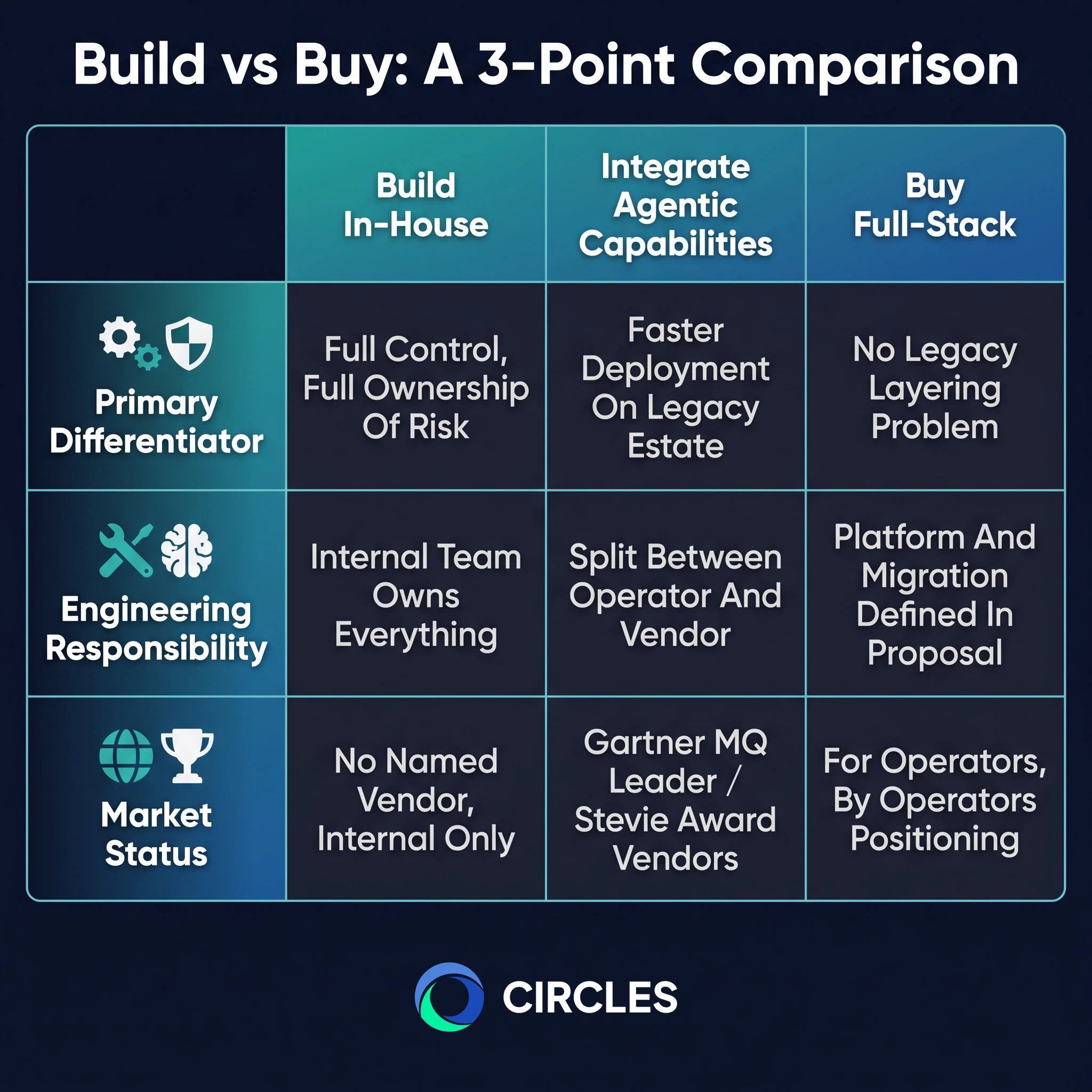
Building AI agents in-house gives an operator full control over the roadmap; buying (whether an overlay or a full-stack platform) trades some of that control for speed and vendor-carried architectural risk. The decision resembles choosing between running your own network operations centre from scratch or contracting a specialist to run it, in-house control is real, but so is the specialist's accumulated operational experience across many other networks. In a March 2026 TM Forum Member Insights article, Comviva President and COO Manish Agrawal argues that agentic AI is "not an incremental enhancement but a strategic necessity." Deloitte's June 2025 announcement projected US$150 billion in telecom-industry value from agentic AI over five years, across multiple operational functions, a scale that makes the build-vs-buy decision a genuinely strategic one, not a procurement footnote.
Performance
Vodafone Germany's first-contact resolution rose from 16% to 44%, per the same March 2026 TM Forum Member Insights article by Comviva President and COO Manish Agrawal; this figure is cited here at republication level. McKinsey's February 2024 article describes two separate gen-AI examples: a European telco increased marketing conversion by 40%, and a Latin American telco increased call-centre agent productivity by 25%. These examples do not establish a build-versus-buy performance ranking. In-house builds carry no equivalent industry-wide performance benchmark, since results depend entirely on the specific team and architecture built, which is itself part of the risk calculation.
Resource
An in-house build requires sustained internal engineering investment with no fixed ceiling, the team, the infrastructure, and the ongoing maintenance burden all sit inside the operator's own cost structure indefinitely. A vendor-bought overlay (Amdocs, Netcracker) or full-stack platform (Circles) shifts a substantial share of that ongoing engineering burden to the vendor, in exchange for licensing or subscription cost and reduced architectural control.
Architecture
In-house builds are designed around the operator's own architecture from the outset, with the scope and constraints set entirely by the internal team. Overlay vendors (Amdocs' Cognitive Core, Netcracker's Agentic AI Solution) bring proven agent orchestration but inherit the constraints of whatever core they sit on top of. Full-stack platforms (Circles) bring AI-native architecture as the foundation itself, with no separate legacy core to reconcile against.
What Is the Difference Between Building In-House and Buying an AI Agent Platform?
Building in-house means the operator owns the entire roadmap, cost structure, and risk; buying means a vendor carries the architectural and operational burden in exchange for reduced control, with the overlay-vs-full-stack choice determining how much of that burden the vendor actually absorbs.
Which Type Is Right for Your Situation
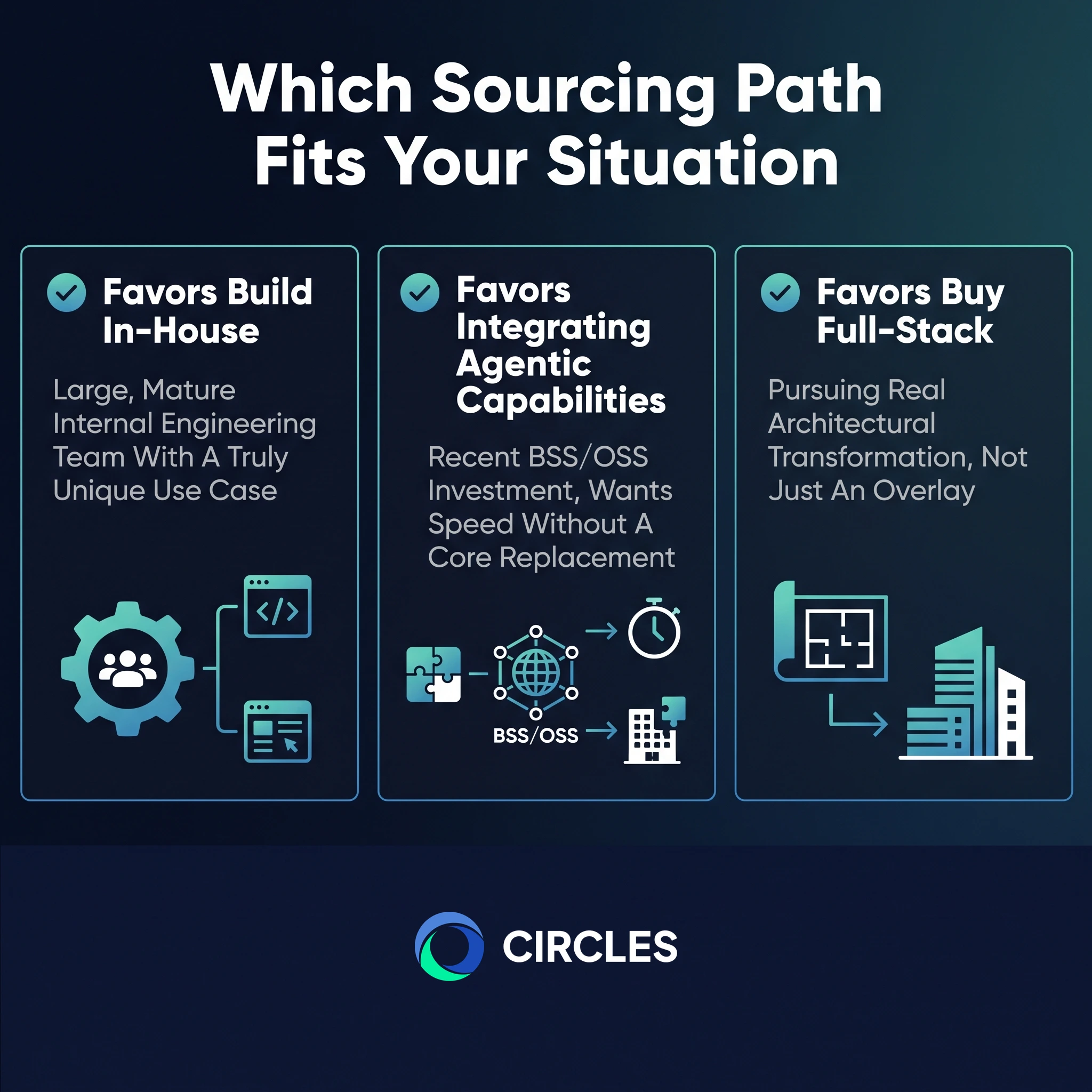
Favors Build In-House: operators with a large, mature internal engineering organisation and a genuinely unique use case not served by any vendor's roadmap.
Favors Integrating Agentic Capabilities: operators with substantial recent investment in an existing BSS/OSS estate (Amdocs- or Netcracker-based) who want agentic capability added quickly without a core replacement project.
Favors Buy-Full-Stack: operators pursuing genuine architectural transformation who want to avoid the overlay's inherited-legacy-constraint problem entirely, and who value a platform built "For Operators, by Operators" from inception.
Excludes: in-house builds rarely make sense for operators without an already-substantial AI/ML engineering function. NVIDIA's 90% revenue/cost-benefit figure and 89% spend-increase figure reflect momentum across surveyed operators broadly, not a claim that every respondent is already deploying AI at scale.
When Should an Operator Build In-House vs Buy?
Build in-house only when the use case is genuinely unique to that operator and internal engineering capacity is already mature; buy (overlay or full-stack) when speed to a proven, benchmarked outcome matters more than full architectural ownership.
Compatibility and Integration
Are Build and Buy Approaches Compatible with the Same Operator Environments?
Not equally: an in-house build must be designed around the operator's specific existing environment from scratch, an overlay vendor is explicitly engineered to interconnect with existing systems, and a full-stack platform is designed to replace the interconnect problem entirely rather than solve it.
Making the Call: Build, Buy, or Evaluate a Full-Stack Platform
Build in-house: Retain greater control over the roadmap and integration, while taking responsibility for engineering, evaluation and maintenance. Reusable models and components form part of the available toolkit.
Buy: Evaluate delivery scope, integration obligations, governance and ongoing support in the vendor proposal.
Evaluate a Full-stack platform when: the brief includes broader operating-model and platform transformation. Compare Circles' operator-led proposition against the same business outcomes and deployment requirements.
Manage the risks: For internal builds, budget for integration, evaluation, maintenance and skills. For purchased capabilities, define vendor dependencies, data access and support obligations. For platform transformation, define migration sequencing and acceptance criteria. These are evaluation priorities, not claims about the most common cause of failure.
How Should an Operator Manage Build vs Buy Risk?
Match the risk-management approach to the sourcing path chosen: internal builds require budgeting for integration, evaluation, maintenance and skills; purchased capabilities require clear vendor dependencies, data access and support obligations; platform transformation requires defined migration sequencing and acceptance criteria.
The Full-Stack Buy Case for AI-Native Transformation
"There is a seismic shift underway in the telecom industry driven by AI," said Sebastian Barros, managing director of Circles, in NVIDIA's 2026 State of AI in Telecommunications survey. "Communication service providers are converging on a new realisation. Their role in society extends beyond moving bits across networks toward moving intelligence across local and regulated infrastructure." Operators weighing a multi-year in-house build against a proven, full-stack platform are the audience Circles is built for. Explore the full AI in Telecom pillar, or compare Circles directly against Amdocs Cognitive Core and Netcracker's Agentic AI Solution.