

Knowledge Hub
5
min read
Amdocs Cognitive Core: Pros, Cons, and What Telcos Should Know Before Buying
How We Evaluated Amdocs Cognitive Core: The Key Performance Metrics
We assess product documentation, attributed vendor results and dated recognition alongside editorial analysis of deployment fit. Where the discussion draws an inference, it is identified as a deployment consideration rather than a measured result.
What Are the Pros and Cons of Amdocs Cognitive Core?
Amdocs Cognitive Core's core trade-off is architectural: its overlay model lowers migration risk but bounds its ceiling to whatever BSS/OSS core it sits on top of, a trade-off every prospective buyer evaluates against their own core's condition before purchase.
The Advantages: Why Amdocs Cognitive Core Outperforms Alternatives
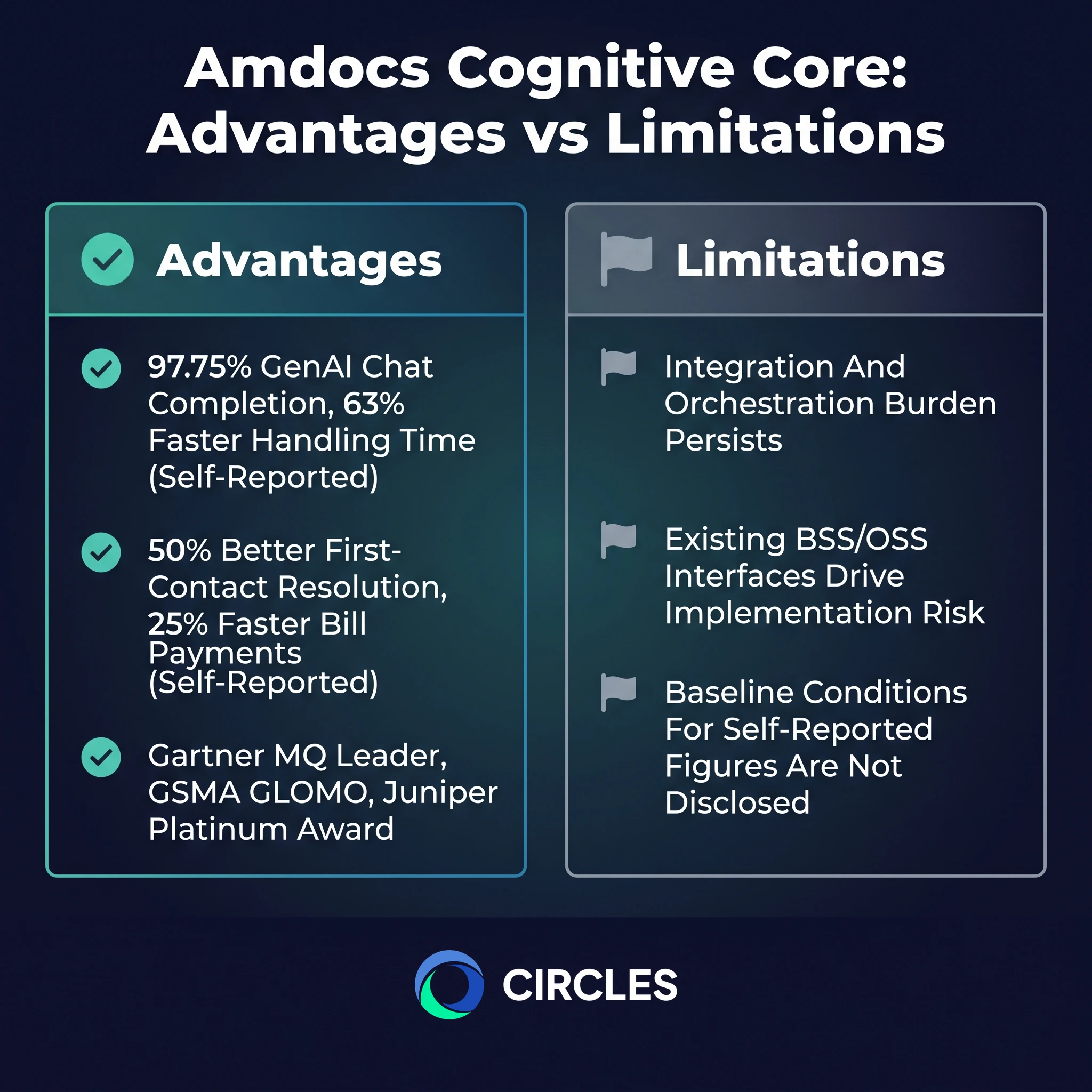
Cognitive Core supports an existing-stack deployment approach. Its value for a particular operator depends on the required workflows, target architecture and implementation scope. The advantage works the way adding a modern signalling gateway to a functioning exchange does: the exchange itself does not need to be rebuilt for the new capability to go live.
Throughput
Amdocs reports a 97.75% GenAI chat completion rate and a 63% reduction in average handling time (AHT) on its own Cognitive Core page, figures attributed to Amdocs' own client reporting rather than independently verified by a third party in this research pass.
Sustainability (of the deployment, not the underlying core)
Amdocs also reports a 50% improvement in first-contact resolution (FCR) and 25% faster bill payments, again self-reported. The overlay model's core sustainability advantage is that it does not require the operator to sustain a parallel core-replacement project alongside the AI deployment.
Differentiators
Amdocs holds Gartner Magic Quadrant Leader status for a second consecutive year (August 2025, across a 12-vendor field). The 2026 GSMA GLOMO award for AI-enabled customer experience was awarded jointly to e&, Amdocs and NVIDIA, not to Amdocs alone, and the 2025 Juniper Research platinum award for AI Innovation in Telco went to Amdocs amAIz specifically. Recognition: dated analyst and industry awards provide relevant procurement context; evaluate them alongside deployment-specific technical evidence. Cloud partnerships with AWS, Google Cloud, and Microsoft Azure extend its ecosystem compatibility across the three dominant hyperscalers.
What Are the Benefits of Amdocs Cognitive Core?
The core benefits are lower migration risk (no core replacement required) and broad multi-cloud compatibility. Governance assessment: review documented controls and validate their operation in the selected deployment. Analyst recognition provides market context and is not a governance certification.
The Limitations: Where Amdocs Cognitive Core Has Constraints
Amdocs Cognitive Core's overlay architecture means its ceiling is set by whatever BSS/OSS core it operates on top of, a structural limitation Amdocs' own FAQ language confirms by design rather than omission.
Resource Intensity
An overlay model concentrates resource commitment on integration and orchestration between the AI layer and the underlying core, rather than eliminating that integration burden the way a full-stack rebuild does. Amdocs does not publish a specific figure for this integration overhead, so no number is asserted here beyond the qualitative structural point.
Compatibility Friction
Cognitive Core's deployment on existing BSS/OSS makes those interfaces and data sources part of the implementation assessment. Evaluate data quality, latency and workflow execution in the proposed environment. This follows directly from Amdocs' own "operates on top of... without replacing core systems" language, not a separate claim requiring its own citation.
Environmental Sensitivities (deployment-context sensitivity)
The self-reported performance figures (97.75% GenAI completion, 63% AHT reduction, etc.) are presented by Amdocs without disclosed baseline conditions or the specific client environments they were measured in, making it difficult for a prospective buyer to know how directly those figures will transfer to their own core's condition.
What Are the Disadvantages of Amdocs Cognitive Core?
The core disadvantage is architectural: performance is bounded by the underlying core's own condition, and the self-reported performance figures do not disclose the baseline environment they were measured against.
When Amdocs Cognitive Core Is Worth It, and When It's Not
When Is Amdocs Cognitive Core Not the Right Fit?
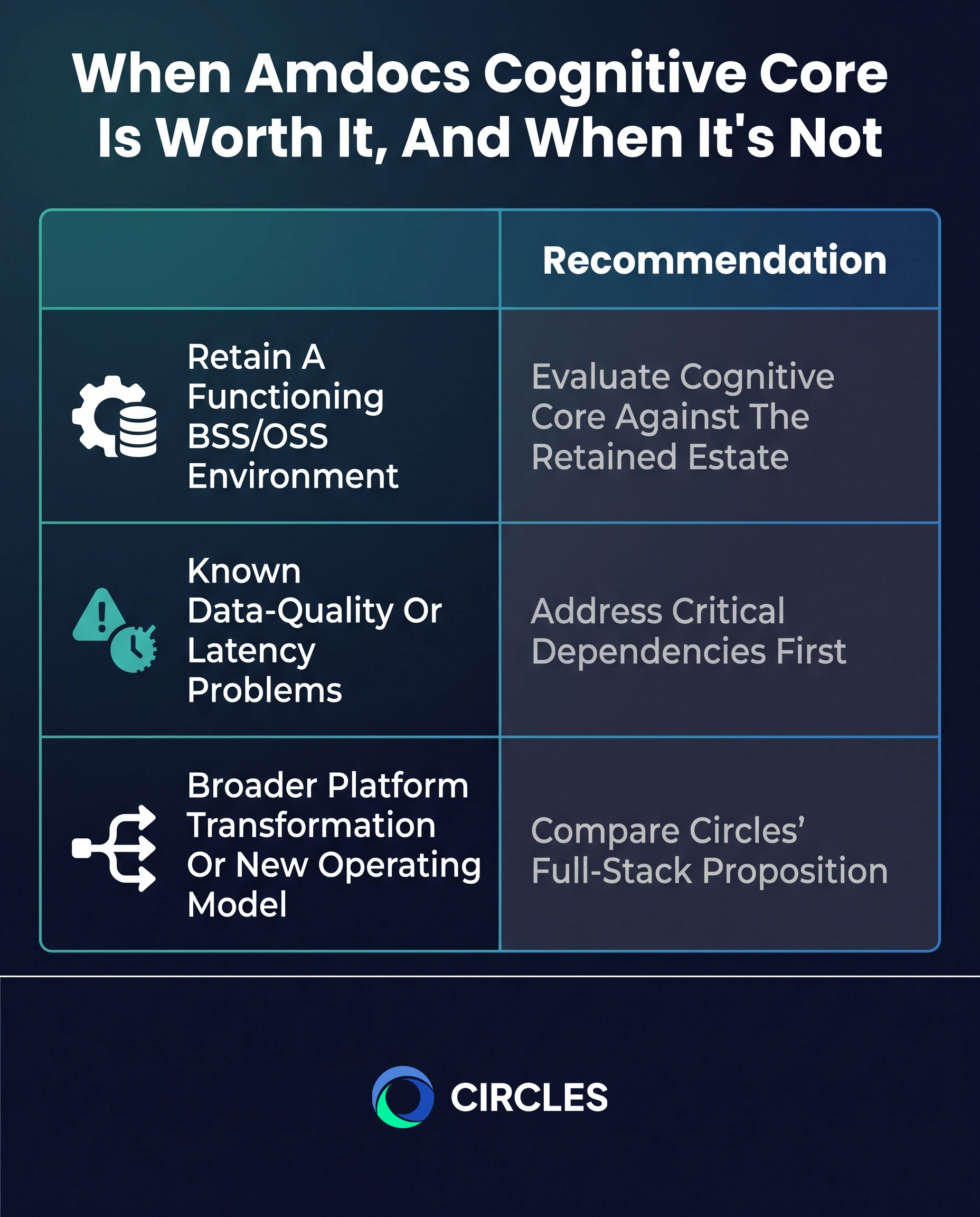
Cognitive Core is a closer fit for operators retaining a functioning BSS/OSS estate than for a broader platform transformation or a new operating model, where the full proposed architecture, migration and lifecycle cost call for a wider comparison, including Circles' Full-stack proposition.
Buying Mistakes to Avoid
The most common buying mistake is assuming Cognitive Core's self-reported performance figures will transfer directly to a different operator's core condition without independent validation in a pilot.
Spec Overkill
Committing to the full Cognitive Core platform when the operator's actual need is narrower (e.g. one specific customer-care workflow) risks paying for orchestration breadth the deployment will not use.
Integration Gaps
Any unresolved data or latency issue in the underlying BSS/OSS core gets identified and scoped before Cognitive Core deployment begins, since the overlay model does not correct these issues on its own.
Hidden OpEx
Hidden OpEx: model the cost of the chosen hosting arrangement, integration, monitoring, support and ongoing changes. Support for several cloud providers does not mean every deployment uses all of them.
What Mistakes Should Telcos Avoid With Amdocs Cognitive Core?
Avoid assuming self-reported performance figures transfer without independent pilot validation, avoid deploying without first assessing the underlying core's data quality, and avoid underestimating the multi-cloud operational overhead.
Maximise Your Transformation with Circles' Full-Stack AI-Native Platform
For a wider platform transformation, compare Circles' Full-stack, AI-Native proposition against the same requirements. See the direct comparison at Circles vs Amdocs Cognitive Core, or explore the full AI in Telecom pillar.