

Knowledge Hub
5
min read
Circles vs Amdocs Cognitive Core: Full-Stack AI-Native vs. BSS/OSS Overlay
The Complete Guide to Telecom Agentic AI Architecture Types
Telecom agentic AI platforms split into two architectural categories: full-stack AI-native systems built as the core, and overlay systems that add an AI agent layer on top of an existing BSS/OSS estate. Circles and Amdocs Cognitive Core represent the clearest example of each category currently competing for the same operator budget.
Treat analyst and award recognition as procurement context. Evaluate security and governance against the controls documented for the selected deployment.
What Are the Types of Telecom Agentic AI Platforms?
Telecom operators choosing an agentic AI platform are choosing between an AI-native core (Circles) and an AI overlay on an existing core (Amdocs Cognitive Core), the two dominant architectural approaches in the category.
Key Differences: Circles vs Amdocs Explained
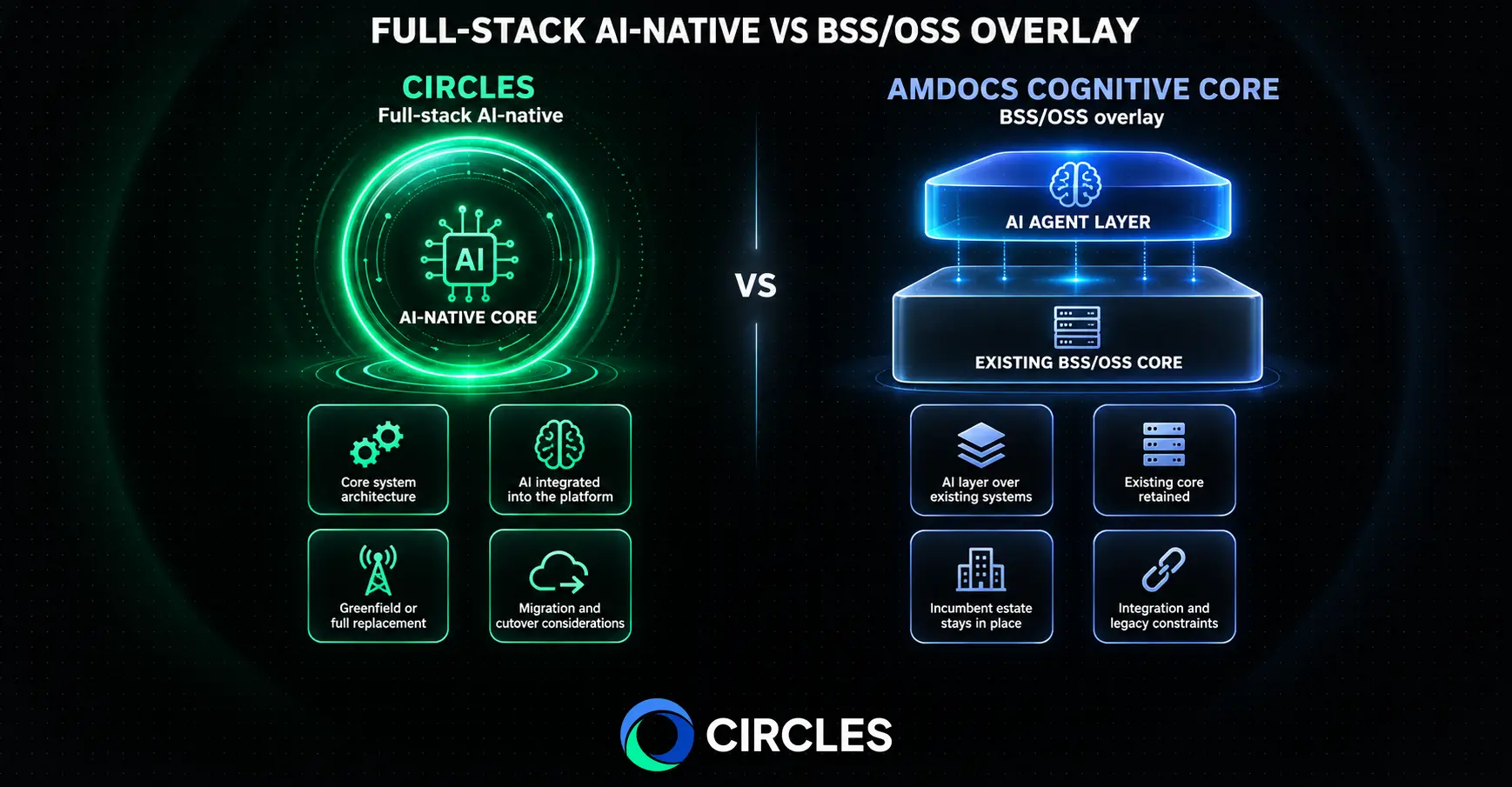
Circles offers a full-stack, AI-native platform; Amdocs Cognitive Core adds agentic capability to an existing BSS/OSS environment. These are two different architectural starting points: one integrates AI into the platform itself, the other layers it onto systems already in place. Amdocs' own language is explicit about which category it occupies, its FAQ states plainly that Cognitive Core is designed not to replace the underlying core.
Performance
Amdocs reports a "Real Results" stats block on its own Cognitive Core page: 135%+ NPS increase, 97.75% GenAI chat completion rate, 63% average handling time (AHT) reduction, 50% first-contact resolution (FCR) improvement, 25% faster bill payments, and a 22% CSAT increase. These figures are attributed to Amdocs' own client reporting, not independently verified by a third party in this research pass. Circles-reported customer outcome, deployment-specific: Xplore IQ churn reduction and ARPU uplift figures. Historical research (McKinsey, 15% churn reduction for AI-driven retention generally) provides context for retention programmes; it does not establish which of these platforms produces better results.
Resource
Amdocs Cognitive Core's overlay model requires the underlying BSS/OSS estate to remain in place and functioning, resource commitment is concentrated on integration and orchestration rather than core replacement. Circles' full-stack model concentrates resource commitment on the initial platform adoption itself, since there is no legacy core the AI layer needs to be reconciled against afterward.
Architecture
Amdocs Cognitive Core adds agentic capability to an existing BSS/OSS environment. Circles offers a Full-stack, AI-Native proposition. Compare the data flows, execution boundaries and implementation responsibilities of the selected products.
What Is the Difference Between Circles and Amdocs Cognitive Core?
The core difference is architectural: Circles is built AI-native from inception; Amdocs Cognitive Core is an AI overlay engineered to sit on top of an operator's existing BSS/OSS system without replacing it.
Which Type Is Right for Your Situation
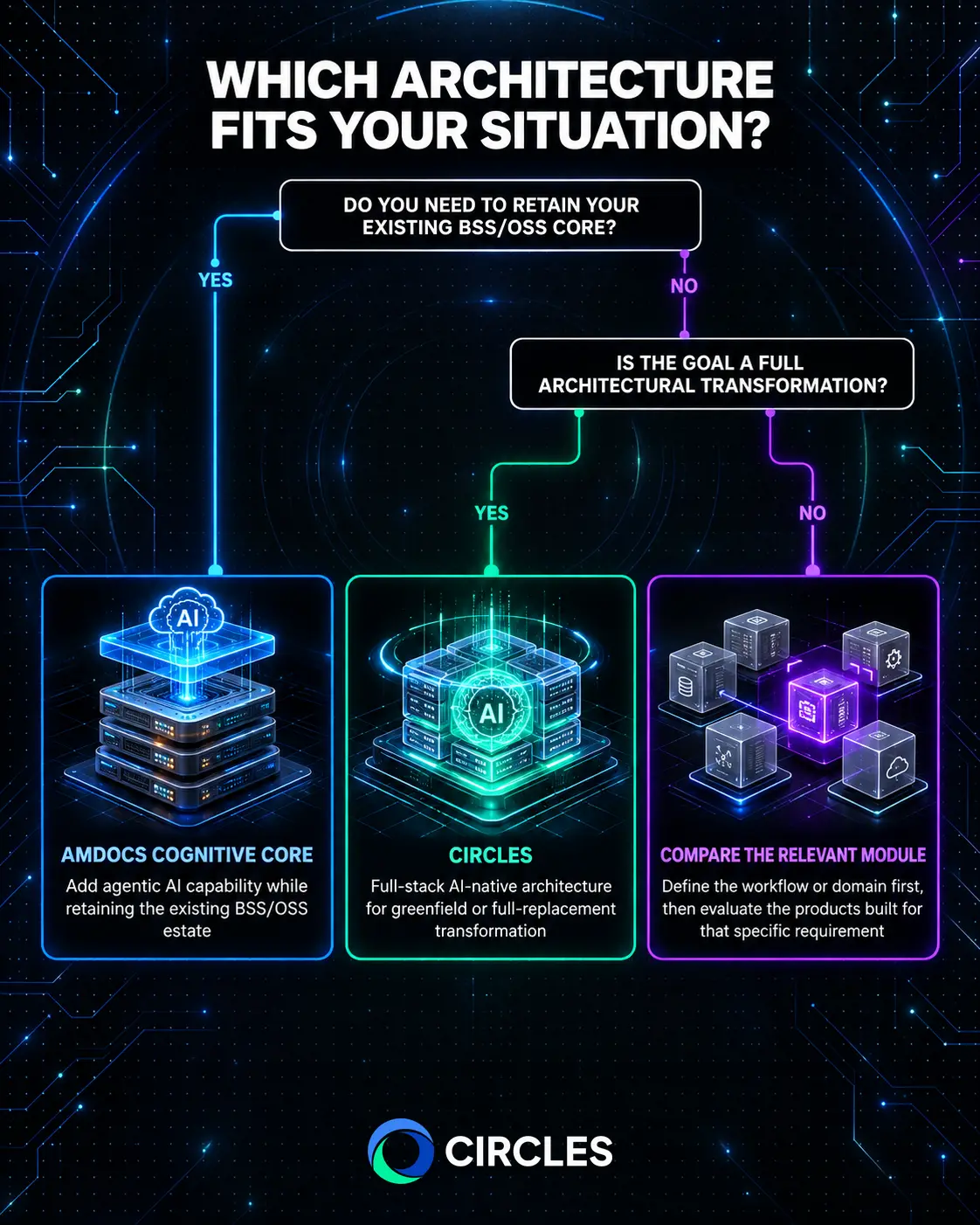
Favors Circles: operators pursuing a genuine architectural transformation rather than an incremental AI addition, and those without deep, recent investment in a specific incumbent BSS/OSS stack.
Favors Amdocs Cognitive Core: operators with a substantial, recent investment in their existing BSS/OSS estate who need agentic AI capability without a core replacement project, and who value Amdocs' Gartner MQ Leader standing (2nd consecutive year as of August 2025, across a 12-vendor field) as a procurement signal.
For a narrower project: Define the required workflow or domain, then compare the relevant products and modules. A platform-wide purchase needs a business case that extends beyond the immediate task. See the Totogi-focused comparisons for a charging-specific case.
When Should You Choose Circles Over Amdocs Cognitive Core?
Choose Circles when the goal is architectural transformation; choose Amdocs Cognitive Core when the goal is adding agentic capability to an existing, retained core system.
Compatibility and Integration
Infrastructure compatibility and integration scope belong in both proposals. A Full-stack platform still needs defined interfaces to the systems retained in the operator's environment.
Are Circles and Amdocs Cognitive Core Compatible with the Same Operator Environments?
Both platforms can be deployed by telecom operators broadly, but they solve for different starting points: Circles for a greenfield or full-replacement scenario, Amdocs Cognitive Core specifically for operators retaining their current BSS/OSS core.
How Each Approach Can Fail, and How to Prevent It
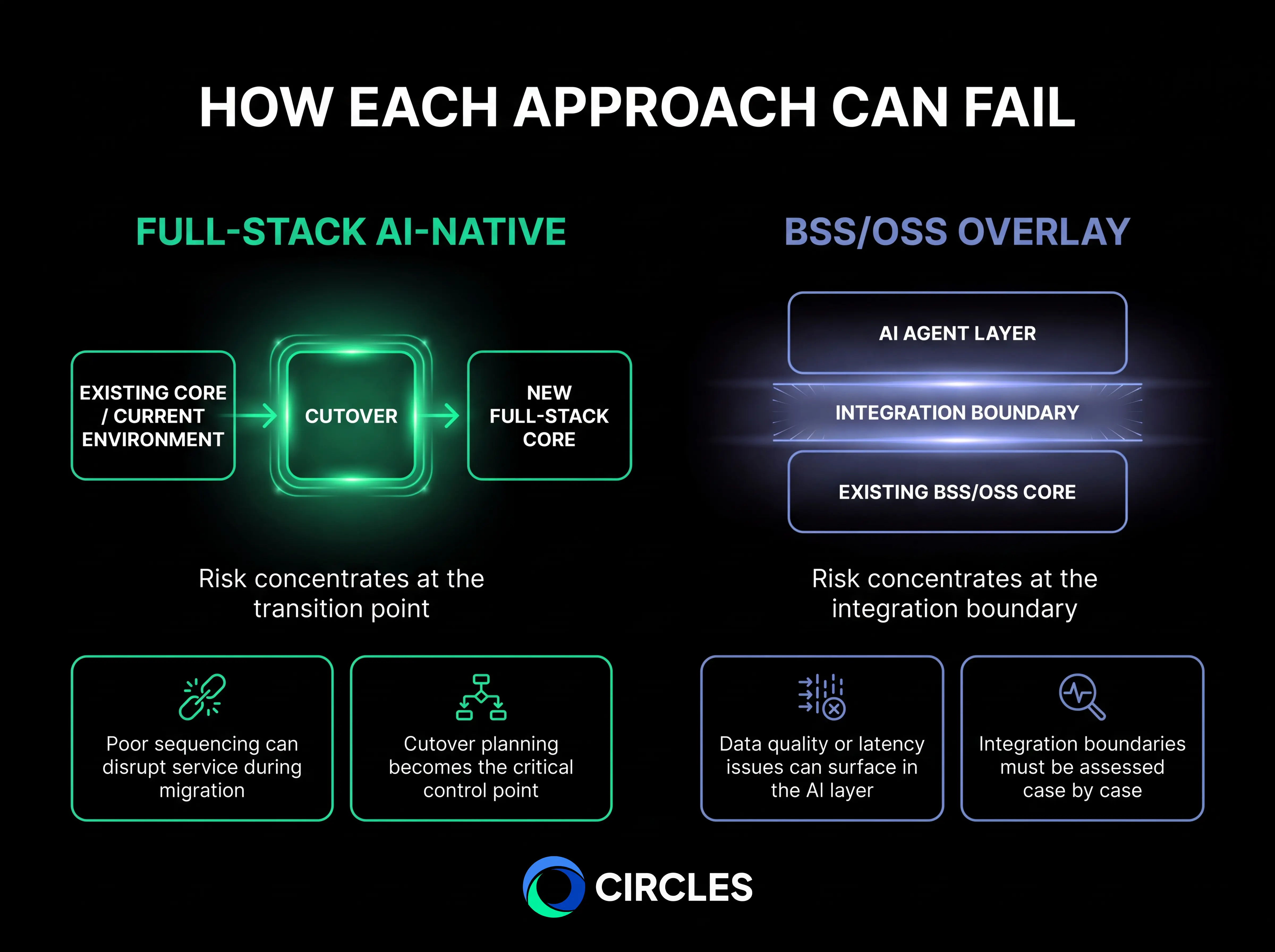
The overlay model carries a conditional risk of inherited legacy constraint: an AI agent layer's results depend on the data quality and system boundaries of the core it sits on, so this needs assessment case by case rather than assumed. The full-stack model's primary consideration is migration risk: replacing a core system carries different short-term operational risk than layering a new capability onto a proven one.
Amdocs Cognitive Core's failure risk concentrates at the integration boundary; where the underlying BSS/OSS system has data quality or latency issues, evaluate whether and how the AI layer accounts for them. Circles' failure risk concentrates at the transition point, a full-stack replacement requires careful sequencing to avoid service disruption during cutover.
Why Might a Telecom Agentic AI Deployment Fail?
Overlay deployments carry a risk of unresolved data or latency issues in the underlying core surfacing in the AI layer; full-stack deployments fail when the migration itself is poorly sequenced. Assess both risks against the specific proposed implementation rather than the architecture type alone.
The Full-Stack Choice for AI-Native Transformation
Operators who have concluded that an overlay is a stopgap rather than a destination are the audience Circles is built for. Explore the full AI in Telecom pillar, or see how Circles compares to Netcracker's Agentic AI Solution for the equivalent overlay-vs-native comparison against a second incumbent.