

Insights
9
5
min read
The Four Reasons Driving Non-Telco MVNO Strategies:
Richer Data, Loyalty, Revenue Expansion, Profitable Niches
Executive Summary: Why Ecosystem Leaders Are Embedding Mobile Services
In recent years, the telecommunications industry has seen some interesting mobile virtual network operator (MVNO) entrants from digital banks, supermarkets, and even energy drinks like Red Bull, and all have been seeing a measure of success in their selected niches.
MVNOs provide wireless connection services without needing to own or maintain mobile network infrastructure. These operators gain access to the infrastructure they need by entering business arrangements with traditional MNOs to use their resources at wholesale rates. MVNOs compete by innovating unique service experiences for target customer groups.
Red Bull gained 1 million subscribers within 16 months1; Tesco Mobile is one of the UK’s largest MVNOs2, while Revolut reported that its eSIM was their number one non-banking product in 2024.3
For brand owners with large, monetizable followings and strong digital ecosystems, this raises a key question:
The answer lies in how connectivity changes the economics and capabilities of digital platforms. When integrated effectively, mobile services introduce new data signals, strengthen ecosystem loyalty, expand monetization opportunities, and enable companies to target niche audiences with greater precision.
According to Mehul Vora, VP of Sales at Circles Aspire, four structural advantages consistently explain why ecosystem players are embedding mobile services:
The importance of data in personalizing experiences and introducing new services, along with the ease of offering mobile services, illustrates why connectivity is becoming a strategic layer within digital ecosystems rather than a standalone telecom product.
Mobile Connectivity as a Data Intelligence Layer
Most digital businesses already capture valuable customer data. Banks see financial transactions, and retailers observe purchasing behavior, while marketplaces track browsing activity. Mobile connectivity introduces a new dimension: continuous behavioral insight into how customers interact with the digital world throughout their day.
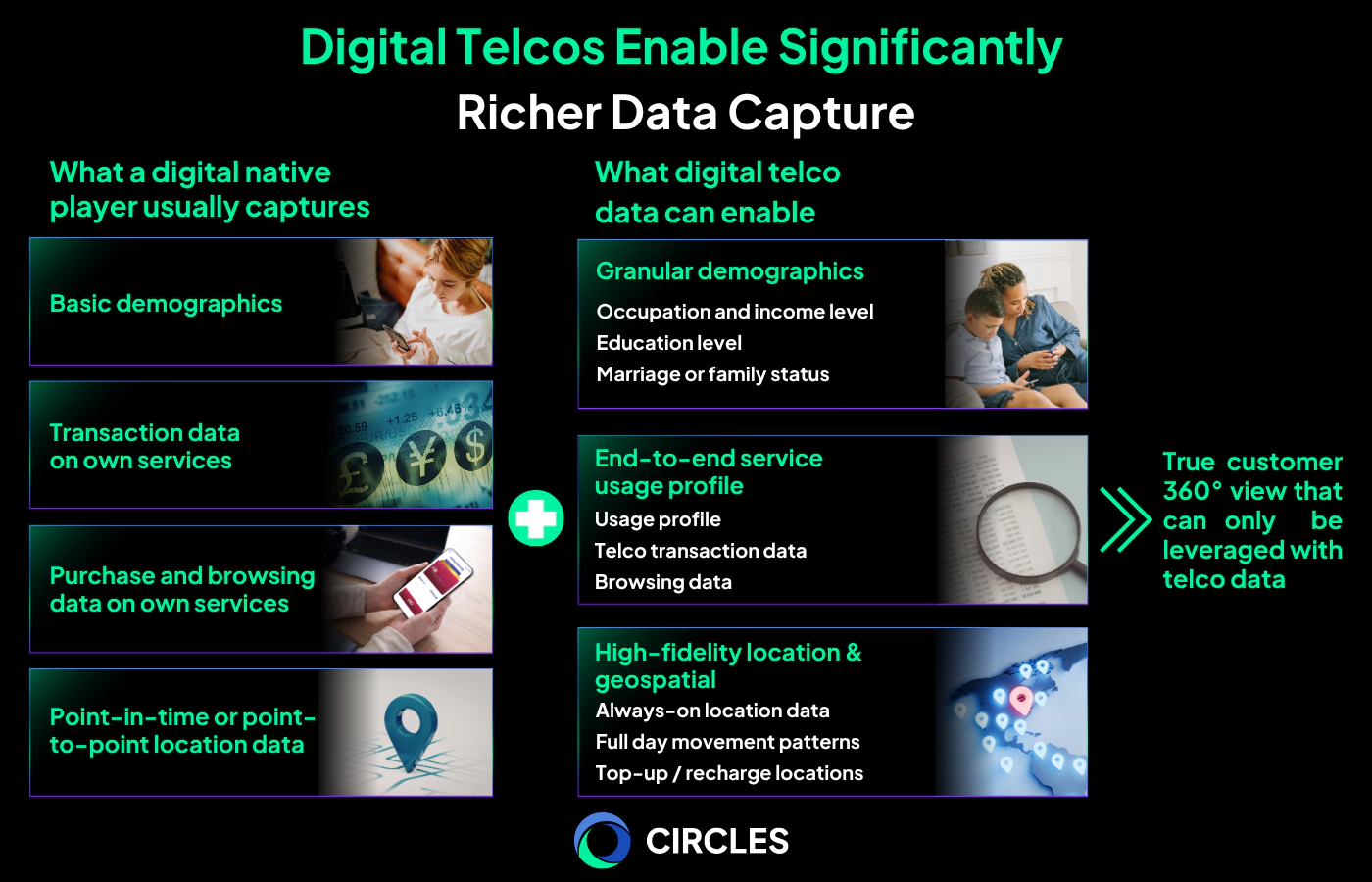
Unlike transactional data captured within a single application, mobile networks generate signals that reveal broader patterns of digital activity, including application usage patterns, browsing behavior, digital engagement timing, mobility and location trends, and device connectivity habits. Information collected during MVNO registration can also include more granular demographic information.
When layered onto existing customer datasets, mobile connectivity enables what many ecosystem companies ultimately pursue: a unified, high-fidelity view of the customer.


For example, a digital bank, like South Africa’s Capitec Bank, may already understand where customers spend money, such as via debit or credit card transaction data. In 2022, Capitec Bank launched Capitec Connect, their MVNO brand. In April 2025, Capitec Connect reached 1.6 million subscribers, growing 73.7% year-on-year.4
By adding mobile services, players like Capitec can observe how those customers interact with digital services more broadly, especially anonymized browsing habits and where their data is used, such as in apps or entertainment streaming. This detailed visibility into their users’ day-to-day lives enables them to create additional value-added services, more precise personalization, cross-service targeting, and more.
The right MVNO enabler partners, like Circles Aspire, have platforms that collect relevant telco data that brands can use to build these data intelligence-powered virtuous cycles. The right platforms can also further monetize targeted consumer insights by embedding first-party or third-party digital services that consumers love directly onto the mobile app.
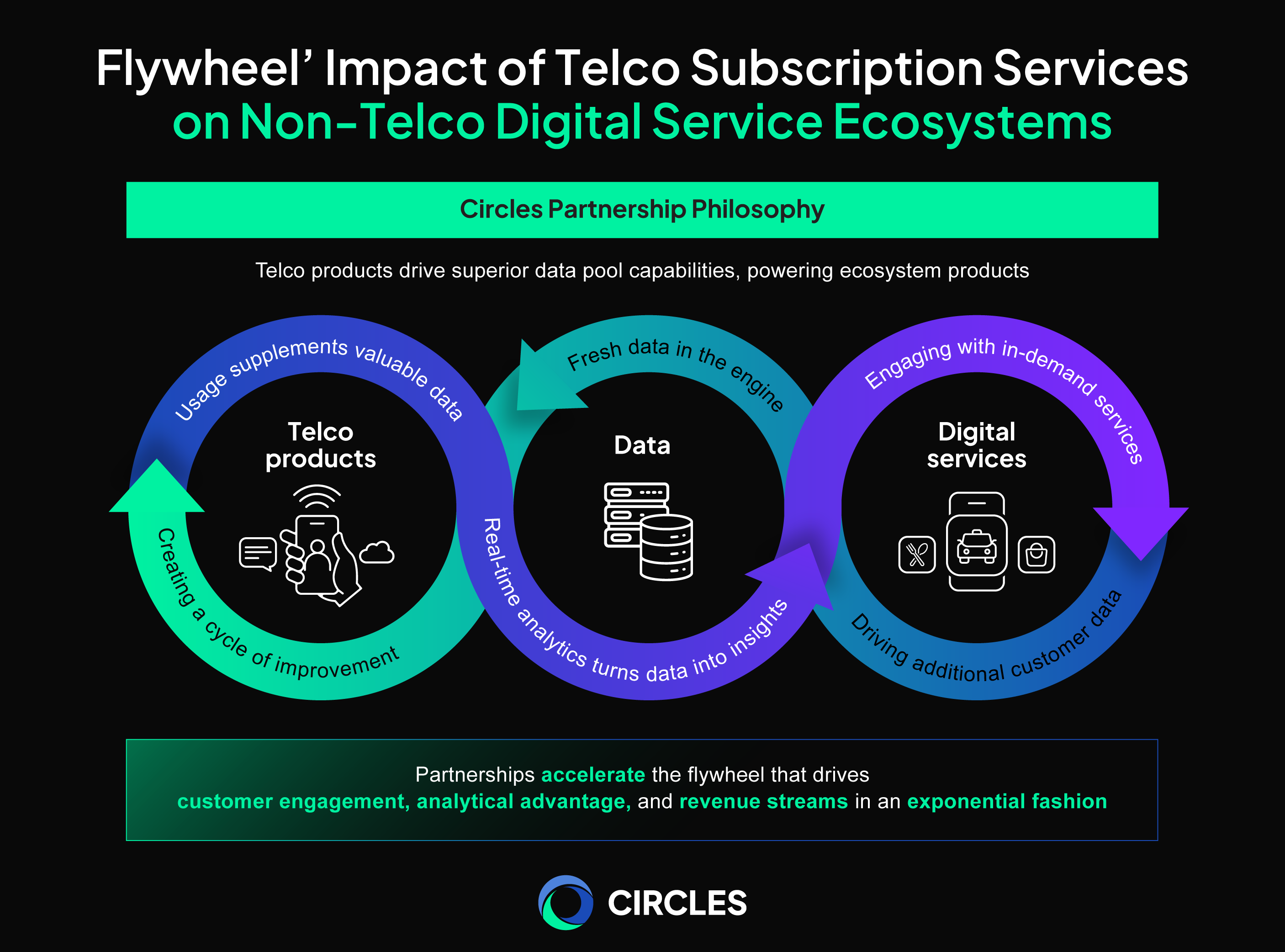
When brands offer connectivity services, they gain access to a data amplification layer that enhances the value of the brand’s existing ecosystem services. Many brands and digital ecosystem players are, therefore, exploring mobile services not primarily for telecom revenue but for the data intelligence advantage it creates across the broader platform.
Loyalty Loops and Digital Moats That Reinforce the Ecosystem
Mobile connectivity services have consistent daily engagement, unlike retail purchases or occasional fintech transactions. This makes MVNO offerings a useful addition both for adding to OTT players’ digital moats and anchoring loyalty programs for retailers.
Instead of competing purely on price, companies can also embed connectivity into loyalty structures. This ‘digital moat', which locks in an increasingly larger share of the customer’s lifestyle, makes it increasingly costly, both economically and behaviorally, for customers to leave the ecosystem.
Tesco Mobile is one of the UK’s biggest mobile providers. At the end of FY 2024, Tesco Mobile expanded its user base by 3.6% to 5.7 million while growing its revenue by 4.7% to £1.11 billion.2 Back in 2023, Tesco Mobile added over 200,000 new pay-monthly subscribers and boosted its pay-monthly market share by 12% with 5.5 million customers.5
Tesco’s brand is built on providing value for money, and Tesco Mobile builds on that philosophy. Tesco Mobile integrates with Tesco’s Clubcard benefits, which provides Clubcard Prices on mobile devices and adds rewards points for every pound spent on Tesco Mobile bills. These Clubcard points can then be redeemed for discounts on mobile phones and plans or vouchers for partner rewards. In this way, Tesco Mobile feeds into Tesco’s retail ecosystem and encourages shoppers to stay within a powerful reinforcement loop.
For ecosystem leaders, connectivity, therefore, becomes a daily engagement engine, a customer lifetime value amplifier, and a loyalty multiplier. The right MVNO enabler partner’s platform should also support loyalty campaigns, such as promotional codes, omnichannel marketing campaigns, and personalized notifications.
Recurring Revenue and ARPU Expansion
For many digital ecosystem companies, one of the biggest strategic challenges is revenue predictability. Retail purchases fluctuate with consumer demand, fintech transactions depend on spending behavior, and subscription services often face churn cycles. Mobile connectivity, on the other hand, offers stable recurring revenue tied to an essential service.
For ecosystem players such as retailers, fintech platforms, or digital marketplaces, embedding connectivity, therefore, creates an additional layer of predictable income alongside their existing businesses, stabilizing revenue forecasting.
At the same time, mobile services also expand the average revenue per user (ARPU) within the ecosystem. By bundling connectivity with other digital offerings, companies can increase customer lifetime value while strengthening engagement across multiple services.
Revolut provides a strong example of this approach in action. In 2024, the fintech platform launched a global eSIM service for its premium users, offering cost-effective data plans directly within the Revolut app. The service quickly gained traction, with Revolut later reporting that its eSIM became the company’s most-used non-banking product that year.3
Building on this momentum, Revolut announced full MVNO plans in the UK and Germany by mid-2025, offering unlimited domestic calls, texts, and data along with generous roaming allowances. Customers can remain connected across more than 100 countries, while additional features such as airport lounge access and loyalty integration through RevPoints reinforce Revolut’s travel-focused ecosystem.
In this way, connectivity services strengthen ecosystem engagement while introducing a predictable stream of recurring revenue that complements the platform’s broader financial services.
In summary, mobile connectivity helps brands and companies expand ARPU, stabilize revenue streams, and create new opportunities for cross-selling services across the ecosystem.
Targeting Profitable Niche Segments Overlooked by Incumbents
MVNOs ultimately become successful because they are able to tap into niche user segments that the other operators aren’t targeting. While MNO flagship brands need to cater to the wider market, Revolut targets digital bank users who travel frequently, while Red Bull and FC Barcelona’s MVNOs target sports fans.
These players focus on high-affinity communities with shared behaviors, identities, or lifestyle interests. They have studied the size, profitability, and demands of the markets they are targeting, designing mobile services that align closely with their audience’s identity and usage patterns. These can range from the following:
One good illustration of this is what Red Bull Mobile is doing in Saudi Arabia. Red Bull launched its Red Bull Mobile, its MVNO, in 2022 with rewards aimed at sports fans and frequent travelers, powered by its eSIM offers. Subscribers could convert data into “gigacoins” for F1 meet-and-greets and exclusive experiences.6
Within 16 months, Red Bull Mobile hit 1 million subscribers in the 2023-2024 period, becoming the fastest-growing MVNO in the Middle East as shown in this video:1
One example of Red Bull Mobile leveraging its sports branding is its partnership with the Al Hilal football club. Through this partnership, Red Bull Mobile users who subscribe to the new Al Hilal prepaid and postpaid plans can win match tickets, unlimited benefits, and football club merchandise. These users can also earn points from attending matches as well as priority access for special Red Bull Mobile events in Saudi Arabia.
Red Bull Mobile subscribers enjoy a variety of exclusive perks, including a chance to win match tickets, unlimited benefits, Al Hilal merchandise, signed merchandise, enhanced digital engagement, points earned from attending matches, and extra Gigacoins as well as priority access for special Red Bull MOBILE in Saudi events. These benefits are designed to ensure fans remain connected and engaged with their favorite team at all times.7
Red Bull Mobile’s strategy demonstrates a broader structural advantage: ecosystem owners understand their communities better than traditional operators do. As a result, they can design incentives, bundles, and engagement models that resonate far more effectively with their target audience.
The right MVNO brand enabler can also advise brands on how to plan for a successful MVNO launch along with go-to-market strategies to ensure the new MVNO brand can stand the test of time. Enablers like Circles Aspire can support brands through structured project management, collaborative planning, and risk management planning, helping MVNO brands stand the test of time with experience supporting over 80 MVNO brands around the world.
Strategic Implications for Executives
Not all brands need to provide mobile services in their ecosystem strategy. But for those who are considering it, one key takeaway is that providing mobile connectivity services in their ecosystems can help carve successful niches through insights gained from richer data, ecosystem expansion, and monetization strategy.
To recap, mobile connectivity can function as the following:
Companies that have successfully launched mobile connectivity as MVNOs or as part of their ecosystems are using connectivity as a strategic infrastructure layer within their broader digital platforms. As digital ecosystems continue to expand, this integration of connectivity into non-telco services is likely to accelerate.
However, this success wouldn’t be possible if the mobile connectivity they provide were low-quality or the experiences they provide their customers were poor. Failing to consider the quality of the connection and the customer experiences are just two potential pitfalls that brands can face when building MVNOs.
Stay tuned for the next article in the series that highlights the pitfalls that MVNOs have to avoid and how an experienced digital mobile operator brand enabler can make the difference in the launch of your company’s mobile plans.
With over 80 MVNO brands and counting and a presence across 9 different markets, Circles Aspire has both the expertise of an MVNE combined with the experience of an award-winning digital mobile operator of Circles. As experienced operators ourselves, our experienced team can guide you through the tough questions you need to consider for the business side of your MVNO, supported by tried-and-tested MVNO operations, infrastructure, and software.
Curious as to how we can help you build an MVNO brand in your market?
Contact us today!
References:
- YouTube: How Did Red Bull MOBILE KSA Success in an Extremely Competitive Market?
- Tesco Mobile delivers on growth despite ‘highly competitive’ conditions | Financial & Performance | TelcoTitans.com
- Revolut to launch Mobile Plans in a direct challenge to traditional network providers
- Capitec's headline earnings grow by 30% | 2025
- Tesco Mobile customer base swells to 5.5 million following impressive 2023 growth
- Red Bull Mobile
- Red Bull MOBILE in Saudi Unveils Exclusive Al Hilal Prepaid and Postpaid Plans – merimedia.net