

Insights
9
5
min read
Telco Personalization Trends in Southeast Asia: How Mobile Offers Are Evolving
Southeast Asia (SEA) is home to a wide mix of cultures, preferences, and economies, resulting in different preferences for mobile services and usage behaviors. Monitoring each telco’s personalization approach and their outcomes can provide observers with useful strategic insights on what problem each model is designed to solve and whether its underlying economics make sense for their market’s specific preferences and economic realities.
To win greater market share and loyalty, some telcos are personalizing the core mobile package, with some employing AI and machine learning in notable ways that are worth observing closely.
One Region, Very Different Economic Situations
Different SEA countries have different preferences for subscription types, price sensitivities, and even data usage, reminding telcos that strategies need to be tailored to market realities, such as preferences for postpaid or prepaid. These differences become clear when comparing a sample of four major SEA economies:
🇮🇩 Indonesia
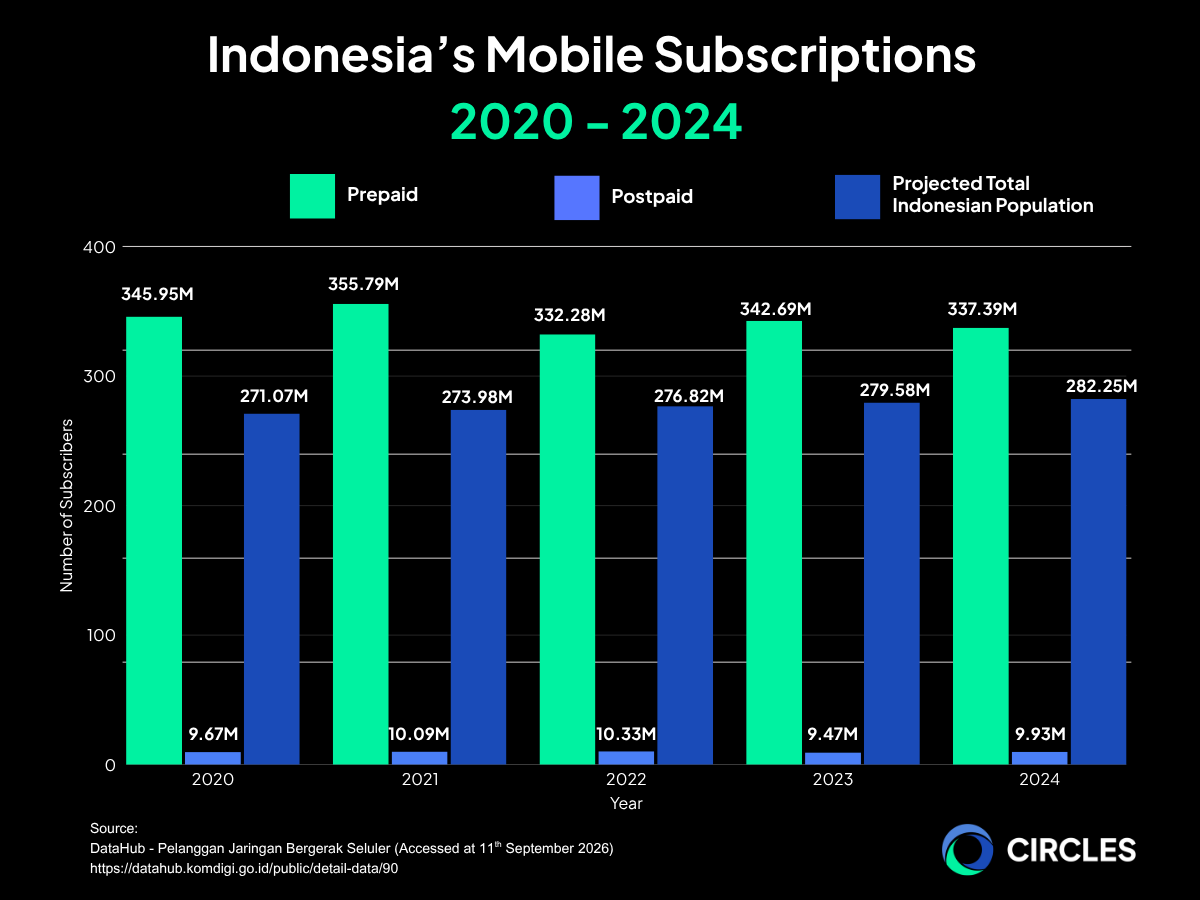
At the end of 2024, Indonesia had 337,388,863 prepaid subscribers while only having 9,926,224 postpaid subscribers. Indonesia has high digital penetration, considering the total number of mobile numbers is higher than its 2024 population of 282,246,600 people in Indonesia.1
At the same time, one of Indonesia’s biggest telcos, Telkomsel, was also pursuing fixed-mobile convergence, with its parent company Telkom reporting convergence penetration of 56 percent in its 2024 annual report. A subsequent year-end release reported 57 percent penetration as of December 2024.2
🇵🇭 Philippines
The Philippines is also heavily prepaid, based on figures from two of its largest telcos, PLDT and Globe.
🇸🇬 Singapore
Singapore’s population largely subscribes to postpaid plans. IMDA recorded approximately 7.81 million postpaid 4G and 5G subscriptions in December 2025, compared with approximately 2.02 million prepaid subscriptions.5
This is just the tip of the iceberg when it comes to how varied SEA country telco markets can get, and telcos have been trying different methods to personalize their telco packages or make bundles more relevant to their customers.
Personalizing The Core Offer and Making Connectivity Itself Contextual
One innovation that SEA telcos are trying is to personalize the core connectivity offer itself: getting the core offer, price, and timing right for each customer’s individual connectivity needs.
For example, prepaid users value their flexibility, and new technology could even provide high-quality priority network slicing for customers in response to what they are doing and when they need it.
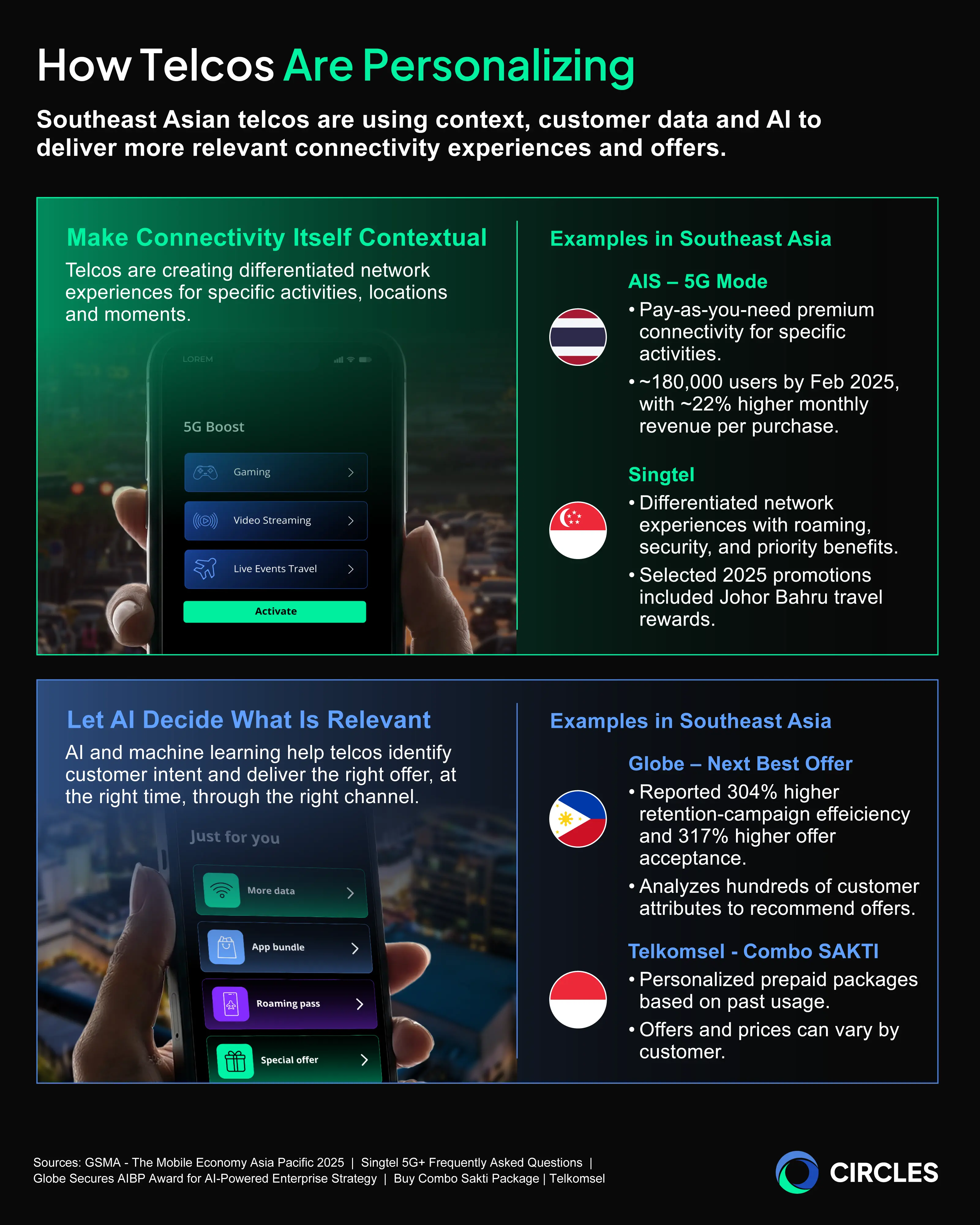
Thailand’s AIS and Singapore’s Singtel 5G+ Let Customers Access Premium Network Experiences
AIS introduced 5G Mode in Thailand as a pay-as-you-need add-on that provides premium connectivity for particular activities and moments, including social media content creation and online gaming. By February 2025, AIS reported approximately 180,000 users, with each purchase increasing monthly revenue per customer by approximately 22 percent.6
In Singapore, Singtel’s 5G+ Enhanced plans combine 5G standalone connectivity with differentiated network experiences, roaming, and security. The higher-tier 5G+ Priority proposition includes a network slice that Singtel markets as a dedicated priority lane, alongside roaming, security, and service benefits.7
This approach broadens the meaning of personalized or contextual propositions to also include tailoring the network experience itself to what customers currently need the bandwidth for.
Indonesia’s Telkomsel Personalizes Prepaid Packages Through Usage Data
Indonesia’s Telkomsel’s Combo SAKTI provides an example of personalizing the core prepaid offer. SAKTI, which means magic or divine, is a personalized package where individual prepaid customers can receive different offers and prices based on their average usage over the last 3 months. Telkomsel’s Combo SAKTI’s FAQ states:
Some eligible customers can also receive additional quotas for internet, voice, and SMS.8 This package isn’t available to all Telkomsel users, and personalized packages are sent via SMS to selected numbers.
While AI usage has not been explicitly mentioned to be used in Combo SAKTI, it shows that some SEA telcos are experimenting with personalized core offers where prepaid mobile packages don’t have to be uniform across all prepaid subscribers. This approach is worth monitoring to see if loyalty can be boosted through this level of personalization.
These SEA telcos illustrate how 5G capabilities can be used to provide operators more options to personalize and monetize connectivity around experience and context, representing a departure from packages that have pre-set data volume, speed tiers, and subscription periods.
Levelling Up: Letting AI Decide What Is Relevant
While the earlier approach included some elements of consumer choice in selecting the right bundles for themselves, some SEA telcos have gone one step further by incorporating AI-powered offer and bundle recommendations.
With the number of possible products, benefits, and experiences growing, telco customers could get overwhelmed by choice fatigue. Telcos across SEA have been employing AI to help deal with this choice overload.
The Philippines’ Globe Is Applying AI to Next-Best-Offer Decisions
In the Philippines, Globe’s in-house Next Best Offer engine uses machine learning and reinforcement learning to analyze hundreds of customer behavior attributes and tailor offers in real time.9
In a press release, Globe reported a 304 percent improvement in efficiency for retention campaigns compared with its previous methods and a 317 percent increase in offer acceptance for upsell campaigns.9 Globe also later mentioned that the platform was generating five billion scores each week and delivering 2.5 billion personalized offers twice a week.10
Globe has continued developing this approach. Its 2025 integrated report says its Just For You implementation uses data analytics and AI-driven offer recommendations to present relevant promotions across platforms, including GlobeOne and GCash.11
Circles Has Progressed from Microsegmentation to Intent-Based Recommendations
Circles’ own Singapore operations provide another example of personalization.
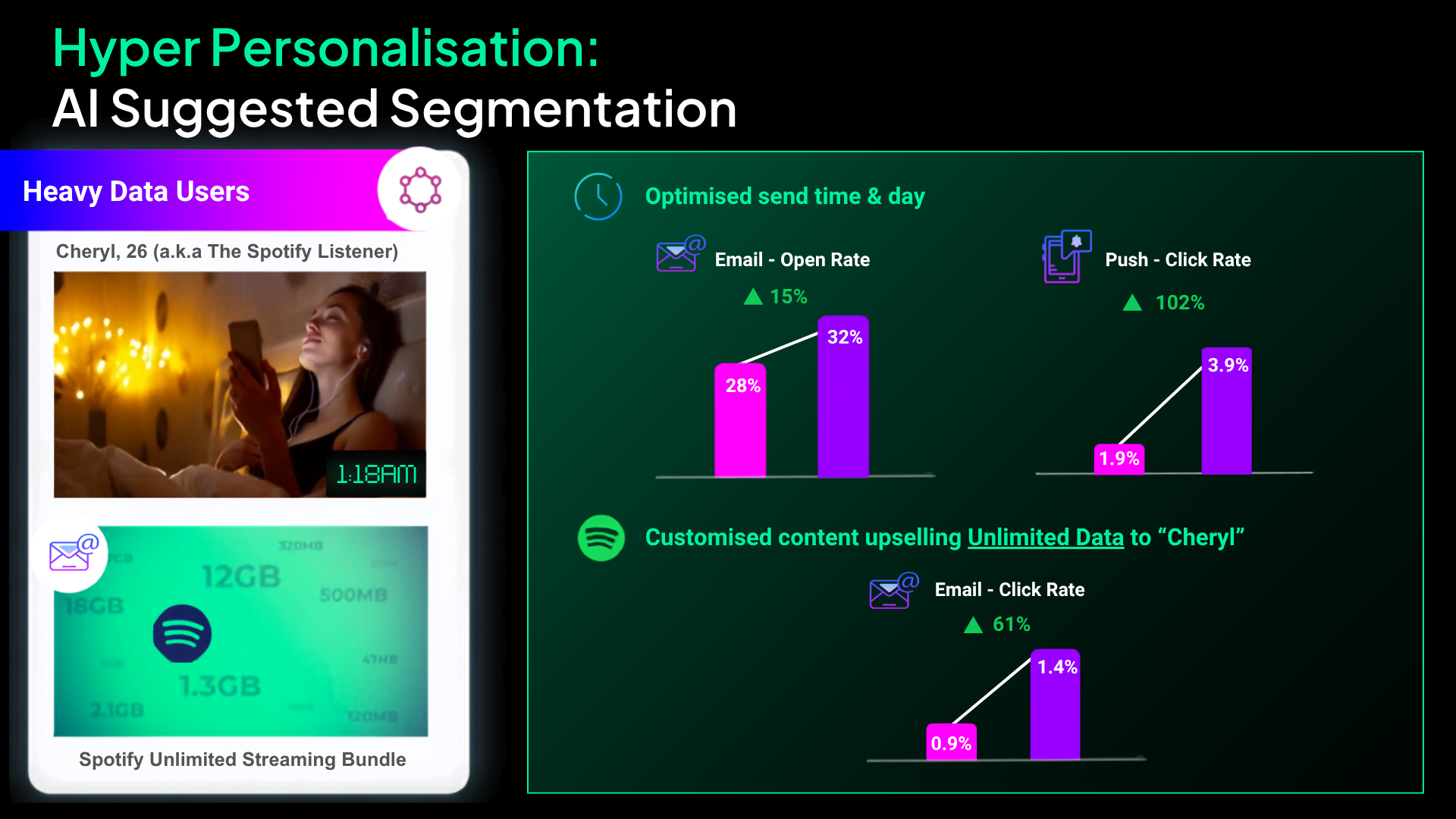
In a 2022 campaign, Circles.Life identified heavy-data Spotify listeners who were particularly active around Friday at 1am. Sending targeted emails and push notifications to this segment to provide a Spotify streaming offer at the time they were most likely to use the music streaming service produced approximately a 15 percent improvement in email open rates and a 102 percent improvement in push-notification click rate.
Meanwhile, a related unlimited-data upsell to this segment produced a 61 percent increase in click-through rate. The underlying tool that powered this personalization campaign analyzes more than 200 customer attributes to identify microsegments.12
More recently, Circles has been developing XploreIQ, an AI-powered monetization engine that uses intent classification to anticipate customers’ needs, matches them with hyper-personalized offers, and can then execute transactions such as plan changes for customers. They also reported a 22 percent ARPU uplift during the initial Circles.Life Singapore phase, while hyper-personalized offers were also associated with a 9 percent reduction in churn.13
Indosat Has Put AI Hyper-Personalization into Its ARPU Strategy
Indosat provides another example of AI-powered personalization, but with some caveats. In 2025, Indosat mentioned AI-powered hyper-personalization initiatives as one of their primary contributors to building ARPU momentum, alongside the rationalization of freebies and discounts to customer experience.14
In Q1 2026, Indosat subsequently reported a blended ARPU of IDR45,000, up 15 percent year-on-year, while management again attributed performance partly to AI hyper-personalization and other customer-value initiatives.15
However, care needs to be taken when interpreting these results, as these results cannot be attributed to AI usage alone. A safer takeaway for this finding is that AI-powered hyper-personalization has moved from experimentation into a major part of Indosat’s commercial and ARPU strategy.
Southeast Asia’s Range of Personalization Methods Are Worth Watching
These examples across Southeast Asia represent a wide variety of personalization approaches, from personalizing the connectivity experience to using AI-powered suggestions. With how nascent many of these approaches are, they are worth observing to see how they can impact profitability and long-term loyalty.
AIS and Singtel are experimenting with differentiated network experiences. Telkomsel varies prepaid propositions according to past usage. Globe and Circles are applying AI and machine learning to make decision making increasingly granular, while Indosat has made AI-powered hyper-personalization part of its wider ARPU strategy.
There is no silver bullet telco personalization trend that SEA telcos are following, but the common thread that they do have is the attempt to make the core telecom proposition more relevant to the individual customer and the context in which they are using it.
Meanwhile, connectivity is only one part of the opportunity. Across Southeast Asia, telcos are also expanding the range of services they can put in front of customers, from entertainment and digital subscriptions to travel, payments, and cashback. That creates a different strategic question: if the telco relationship extends beyond connectivity, which additional services belong in it, and how should operators decide which ones create real customer and commercial value?
We explore those emerging models in the next article: How Telcos Are Expanding Beyond Connectivity in Southeast Asia.
About Circles
Founded in 2014, Circles is a global technology company reimagining the telco industry with its innovative SaaS platform, empowering telco operators worldwide to effortlessly launch innovative digital brands or refresh existing ones, accelerating their transformation into techcos.
Today, Circles partners with leading telco operators across 14 countries and 6 continents, including KDDI Corporation, Etisalat Group (e&), AT&T, and Telkomsel, creating blueprints for future telco and digital experiences enjoyed by millions of consumers globally.
Circles is backed by renowned global investors, including Peak XV Partners (formerly Sequoia), Warburg Pincus, Founders Fund, and EDBI (the investment arm of the Singapore Economic Development Board), with a track record of backing industry challengers.
To learn more about how Circles enables digital transformation for leading telcos worldwide, contact us below:
References:
- DataHub - Pelanggan Jaringan Bergerak Seluler
- Telkom Indonesia - 2024 Annual Report
- PLDT Inc. - Annual Report 2025 | Financial Filings
- Globe Definitive Information Statement Covering 2025
- Statistics on Telecom Services for 2025 (Jul - Dec) | IMDA
- GSMA - The Mobile Economy Asia Pacific 2025
- 5G+ Mobile Plans Singapore | Singtel 5G+
- Buy Combo Sakti Package | Telkomsel
- Globe Secures AIBP Award for AI-Powered Enterprise Strategy
- Globe Wins Big at Two Stevie® Award Competitions
- Globe 2025 Integrated Report
- Building a Winning DMO: How Full-stack SaaS Enables Personalization at Scale
- Circles and OpenAI Announce Major Milestone in Building the World’s First AI-Native Telco Stack
- Becoming an AI-native telco: Indosat Ooredoo Hutchison reimagines the telecom of the future
- Indosat attributes highest ever quarterly revenue to AI personalisation