

Insights
10
5
min read
Telco Bundling Trends: How AI Is Making Offers More Relevant
Bundles and Personalization Need to Be Tailored By Country
Trend: The Bundle Catalog is Getting Much Wider
Trend: Operators Are Giving Customers More Control Over Bundle Composition
Trend: Some Operators Are Beginning to Let Machine Learning and AI Narrow the Choice
Trend: The Bundle May Become Contextual, Not Merely Personalized
What Are the Early Results Telling Us?
Telcos around the world have been experimenting with various bundles and personalized offer innovations to improve ARPU and retention, including applying machine learning and artificial intelligence to provide personalized recommendations.
With such a wide range of approaches to bundling and personalization undertaken by telcos to cover, this report provides a snapshot of real actions taken by telcos today and how far the industry has moved towards personalized and dynamic propositions.
Bundles and Personalization Need to Be Tailored By Country
Each market has its own preferences which leads to telcos tailoring their bundling and personalization strategies to each market. Convergence, where multiple connectivity types are bundled together with the same telco brand, remains important in some countries, for example in Spain and France. Meanwhile, digital service catalogs are widening, modular bundles are becoming more visible, and a smaller group of telcos is beginning to apply AI to offer design and recommendations.
Convergence’s Importance Varies by Country, and Different Countries Respond to Churn Factors Differently
In France and Spain, convergence bundles are still important. In 2022, Orange’s deputy CEO reported that faster fiber rollouts were valuable to their strategy’s success, resulting in greater loyalty and higher ARPU.1 Convergence bundles are also still actively pushed in Italy.
While convergence bundling’s effect on loyalty has been slightly weakening from 20232 to 20243, this form of bundling is still important in countries where convergence penetration is high. On the other hand, there are countries where the convergence has very little observable effect on customer loyalty, such as the UK and Germany.
Different countries respond to factors such as price and convergence differently and also have varying degrees of loyalty and churn propensity. You can find out more about how telco loyalty differs among European countries in this article.
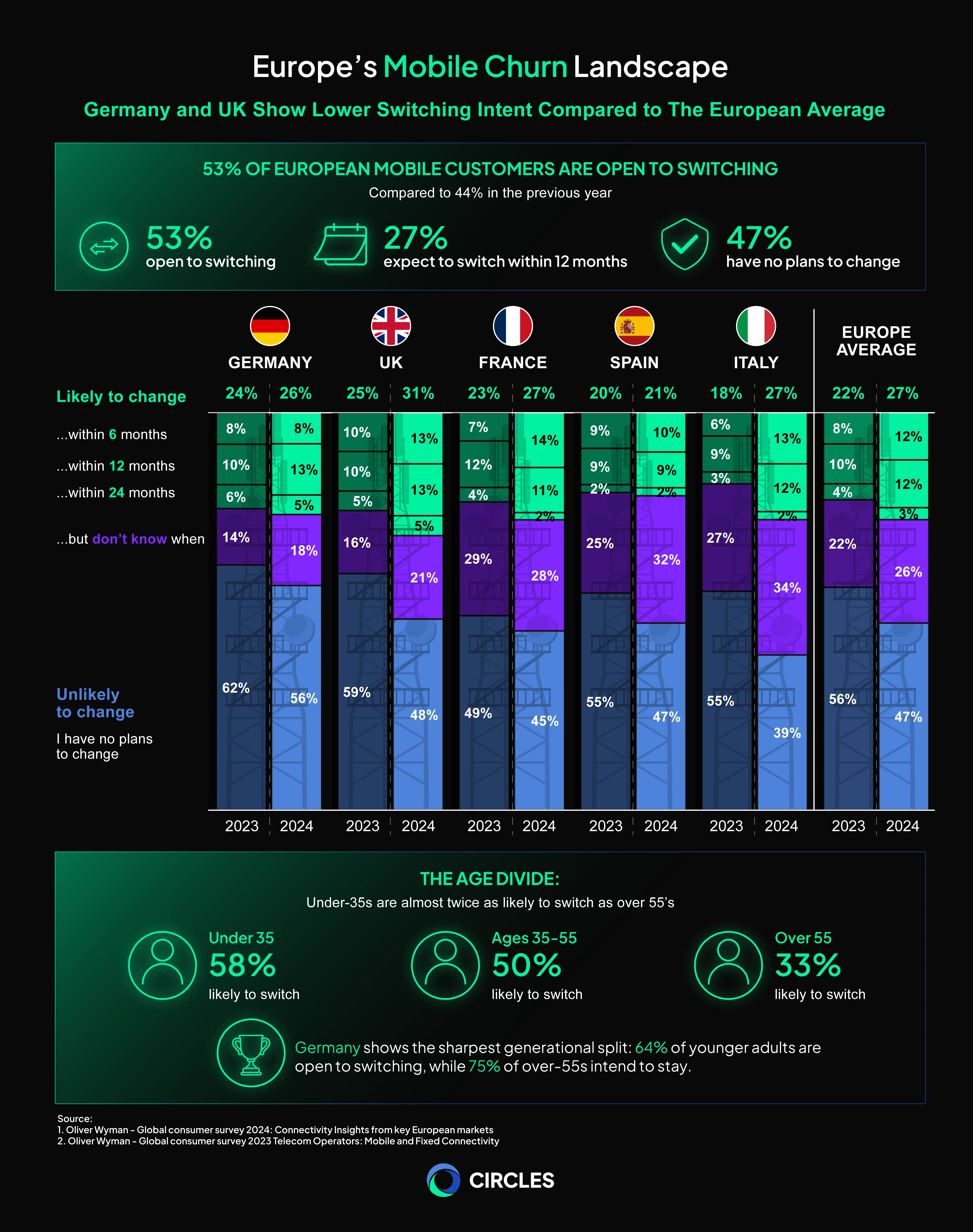
Meanwhile, what is common across markets is not the decline of convergence, but the increase in the number of things operators can combine with connectivity.
Trend: The Bundle Catalog is Getting Much Wider
Streaming and entertainment have been a key part of telco bundles, but today’s telcos can now offer an even greater variety of services.
AI Services Are Entering the Bundles
Telcos are increasingly adding AI subscriptions to their plans. Verizon added Google AI Pro to its modular myPlan and myHome perk catalog in 2025, alongside its existing entertainment, productivity, travel, and protection benefits.4 Verizon also gave its customers the option to add or remove the AI service instead of making it a permanent part of their mobile plans. Telkomsel also launched an Indonesian package combining connectivity, dedicated mobile data for ChatGPT and a ChatGPT Go subscription.5
Circles.Life in Singapore also offers CirclesAI as part of its value-added services:
Super Apps Show How Telcos Can Enter the Digital Lifestyle Space
In Indonesia, Telkomsel’s MyTelkomsel Super App features digital lifestyle services such as health, travel, payment, entertainment, and commerce all within a single app,6 showing that telcos are increasingly positioning themselves around customers’ everyday digital lives.
5G Bundling and Pay-As-You-Go
There is greater interest in 5G bundling, with 5G users showing a greater desire than 4G users to add digital content such as video streaming, services like cloud storage, and devices like wearables to their mobile contracts. In Singapore, Singtel offers free subscriptions to services like Bookful and MelodyVR for 5G customers on higher-tier plans, while in Australia Optus provides free streaming subscriptions, such as to Netflix, for 5G home broadband plans.7
In Thailand, AIS implemented 5G Mode, a pay-as-you-need add-on that offers its customers the flexibility to access premium connectivity for specific activities and during specific times, such as live content creation on social media platforms or online gaming sessions.7 In February 2025, AIS reported that 5G Mode reached 180,000 users, with each purchase increasing monthly revenue per customer by around 22 percent.7
Around the world, the telco bundle catalog is expanding from products the telco owns towards an ecosystem of connectivity, third-party content, services, and non-telco experiences. But as the catalog gets larger, finding the relevant combination for each person gets hard.
Trend: Operators Are Giving Customers More Control Over Bundle Composition
As the number of services that telcos can bundle grows, some operators are giving customers more flexibility to decide what goes into their plans.
A 2025 survey of 5,000 US subscribers found that 62 percent preferred buying a bundle instead of multiple individual subscriptions.8 More importantly, 80 percent said they would rather choose which subscriptions were included in their bundle than receive a preset package. Mobile operators were also the largest indirect subscription channel in the survey, with 55 percent of respondents receiving at least one subscription through their mobile provider.
KDDI’s povo Uses a ‘Topping Menu’
In Japan, KDDI Digital Life’s povo takes a modular approach. Instead of subscribing to a conventional fixed mobile plan, customers can select “toppings” in the povo app that include data, voice minutes, and entertainment services such as DAZN. Customers are also able to change these toppings according to what they need.9
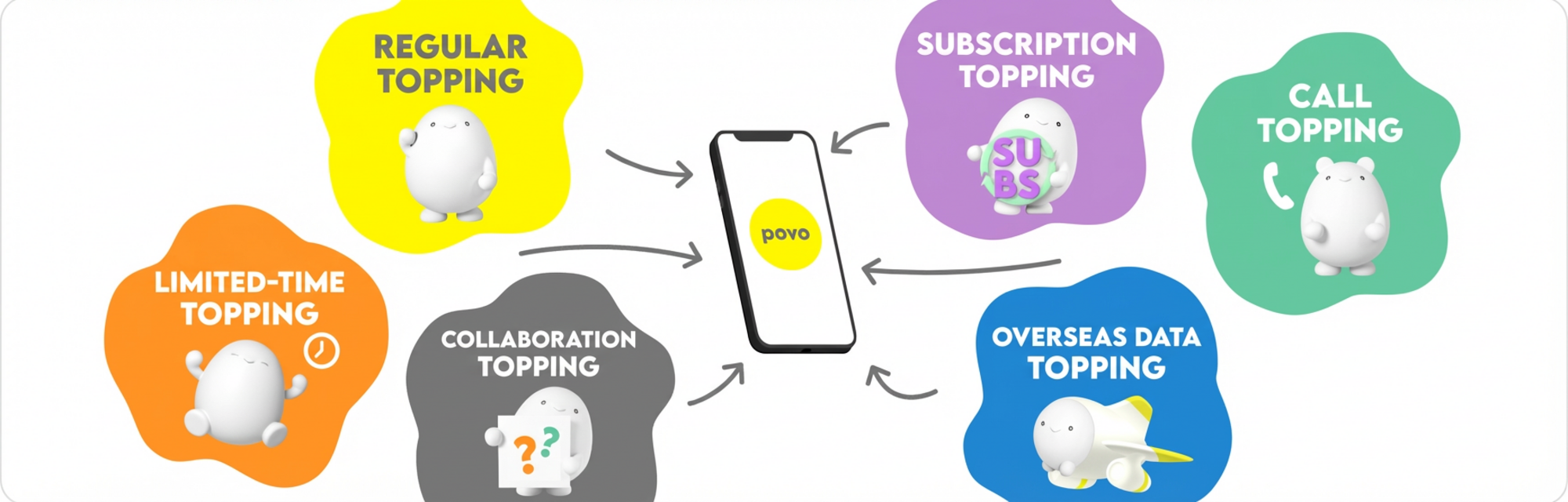
KDDI expanded what this model provides in 2026 by introducing new annual and monthly subscription toppings, including a one-year data offer bundled with Amazon Prime. KDDI has also experimented with collaboration toppings that combine mobile data with third-party benefits such as DMM points and retail vouchers.10
Verizon Lets Customers Add and Remove Perks
In the USA, this approach is being taken by Verizon’s myPlan Unlimited Plus. Customers first select their connectivity plan and can then add optional perks such as entertainment subscriptions. Different mobile numbers on the same plan can have different perks, such as Disney+, Hulu, ESPN+, etc., which can be added and removed through My Verizon.11
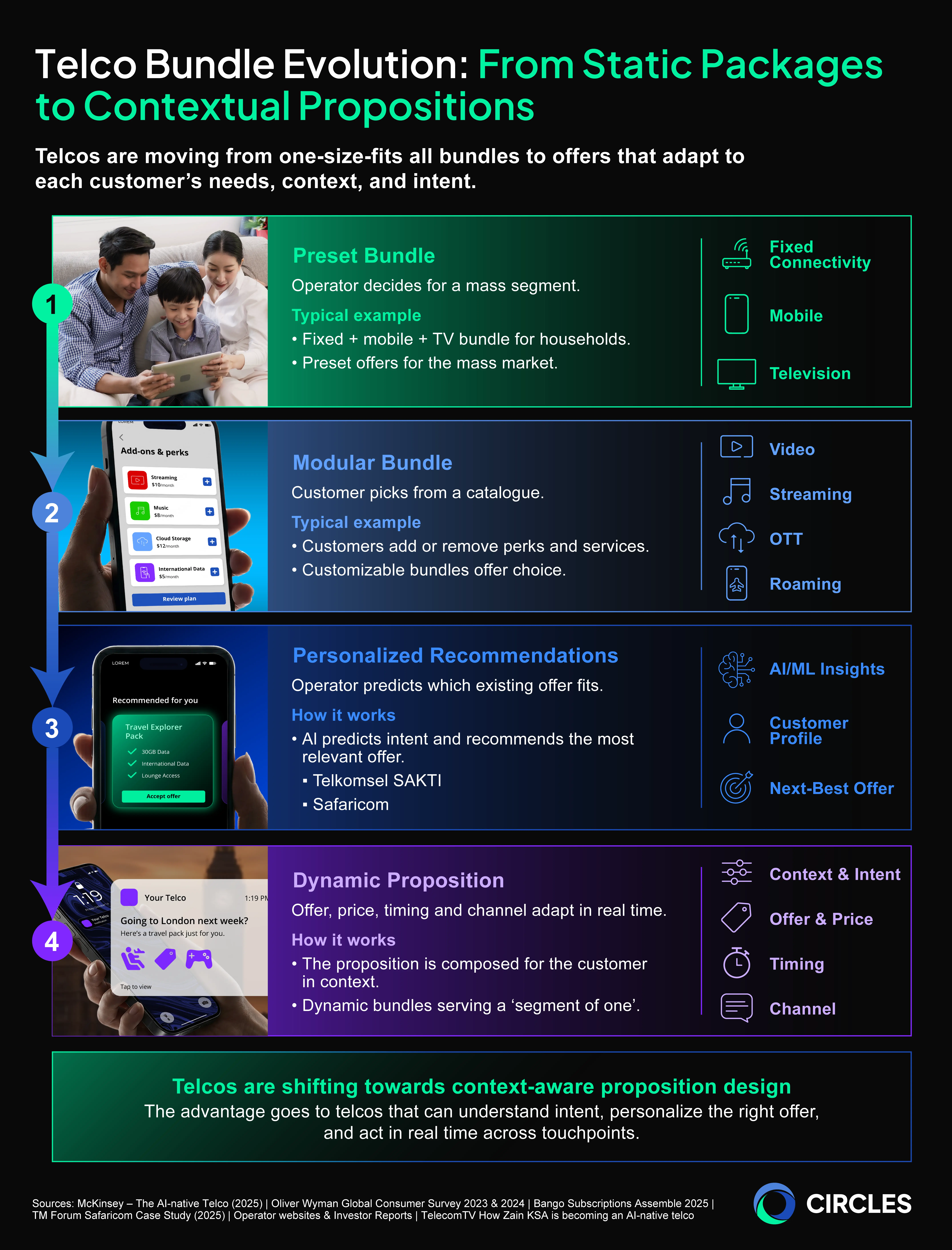
These modular models represent an important intermediate step between traditional preset bundles and AI-powered personalization. The operator still defines the catalog, but the customer has more control over what items go into their personal bundle.
However, as the number of connectivity options, entertainment services, lifestyle benefits, and other add-ons increases, customers also have more choices to work through themselves. This raises another question: should the customer always have to decide which combination is best for them?
Trend: Some Operators Are Beginning to Let Machine Learning and AI Narrow the Choice
Giving customers more flexibility solves one problem, but it can create another. A larger catalog increases the number of possible combinations, which makes identifying the most relevant offer harder in a phenomenon called choice overload.12 Some telcos are therefore beginning to use customer data, analytics, and AI to narrow the choice.
Some telcos, such as Zain KSA, envision moving away from segmentation to individualization, where AI and machine learning can dynamically tailor offer components, price, timing, and method of delivery, all personalized to individual consumers.13
Safaricom is Reporting Results from AI-Assisted Personalized Offers
Safaricom previously used static bundles where different customers would see the same products regardless of their usage profiles. Safaricom has since introduced Idea-to-cash, an AI-assisted system that allows product and marketing teams to generate and configure propositions and then match them with customers using richer profiles and real-time context providing the following returns:14
Telkomsel Uses Customer Behavior to Personalize Packages
Telkomsel’s Combo SAKTI is a personalized package where prepaid customers can receive different prices and benefits based on their average usage over the last few months. Some customers can also receive additional application allowances, and offers can differ between customers.15
While these early results do not yet form an industry benchmark, they provide evidence that AI-assisted personalization is moving beyond experimentation and can bring in commercial results.
Trend: The Bundle May Become Contextual, Not Merely Personalized
Taken together, these examples show that telco offer personalization is developing at different levels:
In a dynamic proposition, a customer who regularly uses fitness apps, travels frequently, and uses an advanced 5G network could receive a plan recommendation that combines premium network access, a fitness subscription, and international data.16
The value in dynamic propositions comes from the combination being relevant to what the telco understands about the customer, while providing relevant offers that can break the barrier of choice overload. Instead of deciding that all customers within one broad segment should receive the same offer, more customer signals can influence what is offered, when it appears, and how it is priced.
Not every operator is at the dynamic proposition stage yet, and the market appears to be moving along this spectrum at different speeds.
What Are the Early Results Telling Us?
The commercial evidence of these different approaches is also at different levels of maturity:
In a Circles.Life campaign in Singapore: customer usage data identified a microsegment of heavy data users who used Spotify and were particularly active on Friday at 1 AM.
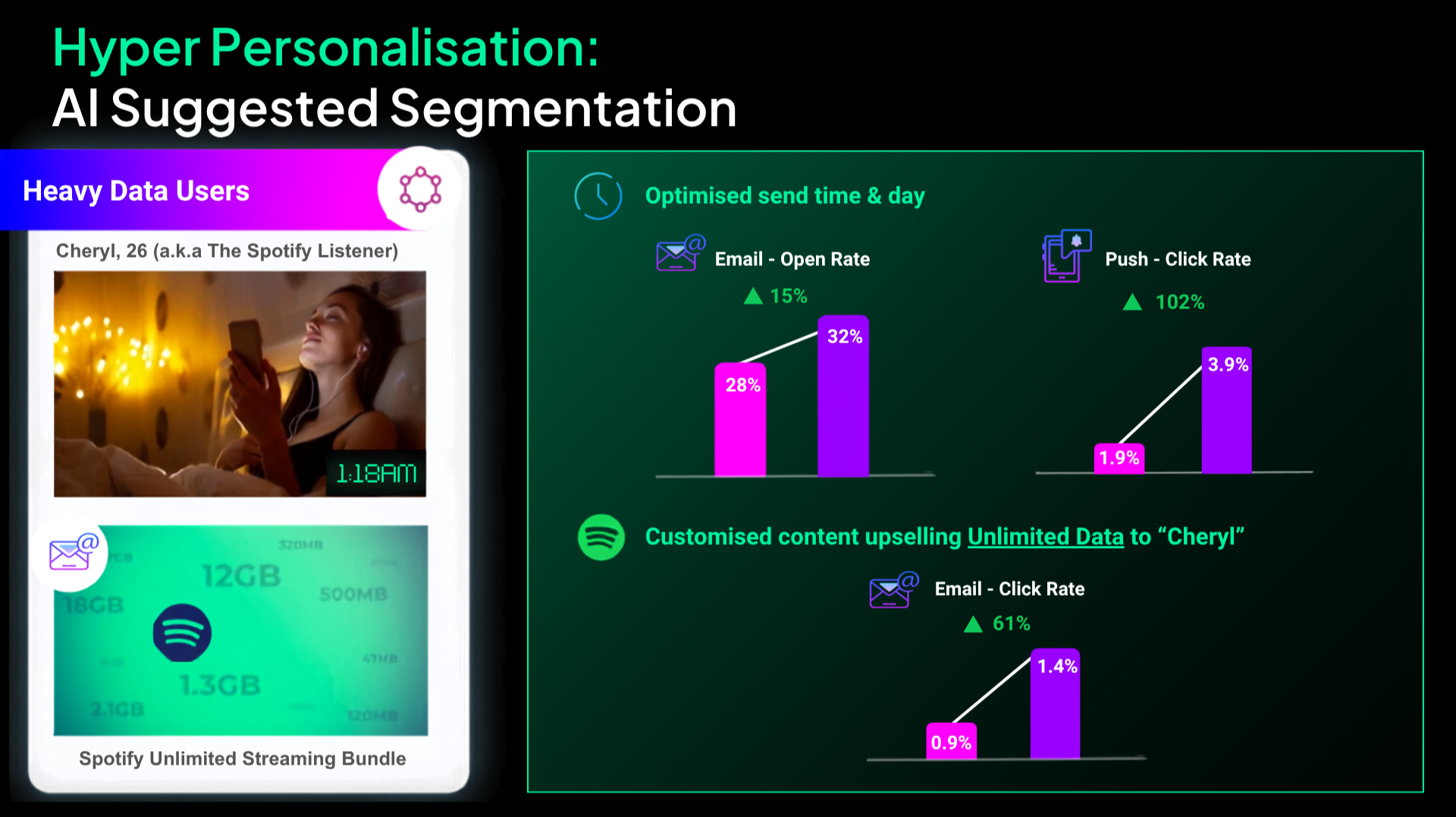
This led to a targeted Spotify streaming offer, which produced around a 15 percent improvement in email open rates and a 102 percent improvement in push notification click rates. A related unlimited data upsell to the same segment produced a 61 percent increase in click-through rate. You can read more about that case here.
More recently, Circles reported that Xplore IQ uses intent classification to anticipate customer needs, matches those needs with personalized offers and can execute transactions such as plan changes. During its initial phase with Circles.Life Singapore, Circles reported a 22 percent ARPU uplift and a 9 percent reduction in churn associated with its AI-driven personalized offers, which you can read about here.
Taken together, the early evidence is stronger for targeted personalization and recommendation than it is for fully dynamic AI-generated bundles. But the future could show the potential that AI-generated bundles really have as more experiments and results come in.
The Telco Bundle is Becoming a Spectrum
There is unlikely to be one future telco bundling strategy that works worldwide. Convergence remains important in some markets. Other operators are expanding digital and lifestyle services, while propositions such as myPlan and povo give customers greater control over what they buy. At the more experimental end of the spectrum, telcos like Safaricom and Zain KSA show different stages of the move towards AI-assisted recommendations and more contextual product design.
The next development worth watching is whether today's targeted recommendations evolve into genuinely dynamic propositions, where the right combination of connectivity and other services can be assembled for a customer at the right moment.
Technology is beginning to make that possible. The more important test facing telco leaders today is whether the economics behind this are repeatable.
About Circles
Founded in 2014, Circles is a global technology company reimagining the telco industry with its innovative SaaS platform, empowering telco operators worldwide to effortlessly launch innovative digital brands or refresh existing ones, accelerating their transformation into techcos.
Today, Circles partners with leading telco operators across 14 countries and 6 continents, including KDDI Corporation, Etisalat Group (e&), AT&T, and Telkomsel, creating blueprints for future telco and digital experiences enjoyed by millions of consumers globally.
Circles is backed by renowned global investors, including Peak XV Partners (formerly Sequoia), Warburg Pincus, Founders Fund, and EDBI (the investment arm of the Singapore Economic Development Board), with a track record of backing industry challengers.
To learn more about how Circles enables digital transformation for leading telcos worldwide, contact us below:
References:
- Success of Lead the Future 2023-2025 strategic plan; 2025 objectives fully achieved | Orange
- Oliver Wyman - Global consumer survey 2023 Telecom Operators: Mobile and Fixed Connectivity
- Oliver Wyman - Global consumer survey 2024: Connectivity Insights from key European markets
- Google AI Pro perk with select mobile and home plans FAQs | Verizon Support
- Telkomsel & OpenAI Hadirkan Promo Bundel ChatGPT Go yang Lebih Terjangkau Mulai Rp50.000 di Indonesia, Pertama di Asia Tenggara
- MyTelkomsel Emerges as a Super App, Simplifying Transactions and Enhancing Customers' Digital Lifestyle | Telkomsel
- GSMA - The Mobile Economy Asia Pacific 2025
- New Bango subscriber research: 2025 is the year of the bundle economy
- KDDI Digital Life explores partnerships for community connectivity services
- povo - povo refreshes its "Regular Topping" lineup, adding a 1-year Topping with 110GB per month for ¥3,270, the largest capacity povo
- myPlan - Unlimited Plus mobile phone plan FAQs | Verizon Support
- (PDF) The Impact of Choice Overload on Consumers
- How Zain KSA is becoming an AI-native telco | TelecomTV
- Safaricom makes efficiency and CX gains with AI-assisted personalized offers
- Beli Paket Combo Sakti | Telkomsel
- The AI-native telco: Radical transformation to thrive in turbulent times | McKinsey