

Insights
7
5
min read
The AI Token Economy: Why It Will Reshape the Telecommunications Industry
The Emergence of the AI Token Economy
Telecommunications has always converted digital activity into measurable units of consumption, from voice minutes and SMS messages to mobile data; in the AI era, the next unit could be the token, the fundamental unit through which large language models process information.
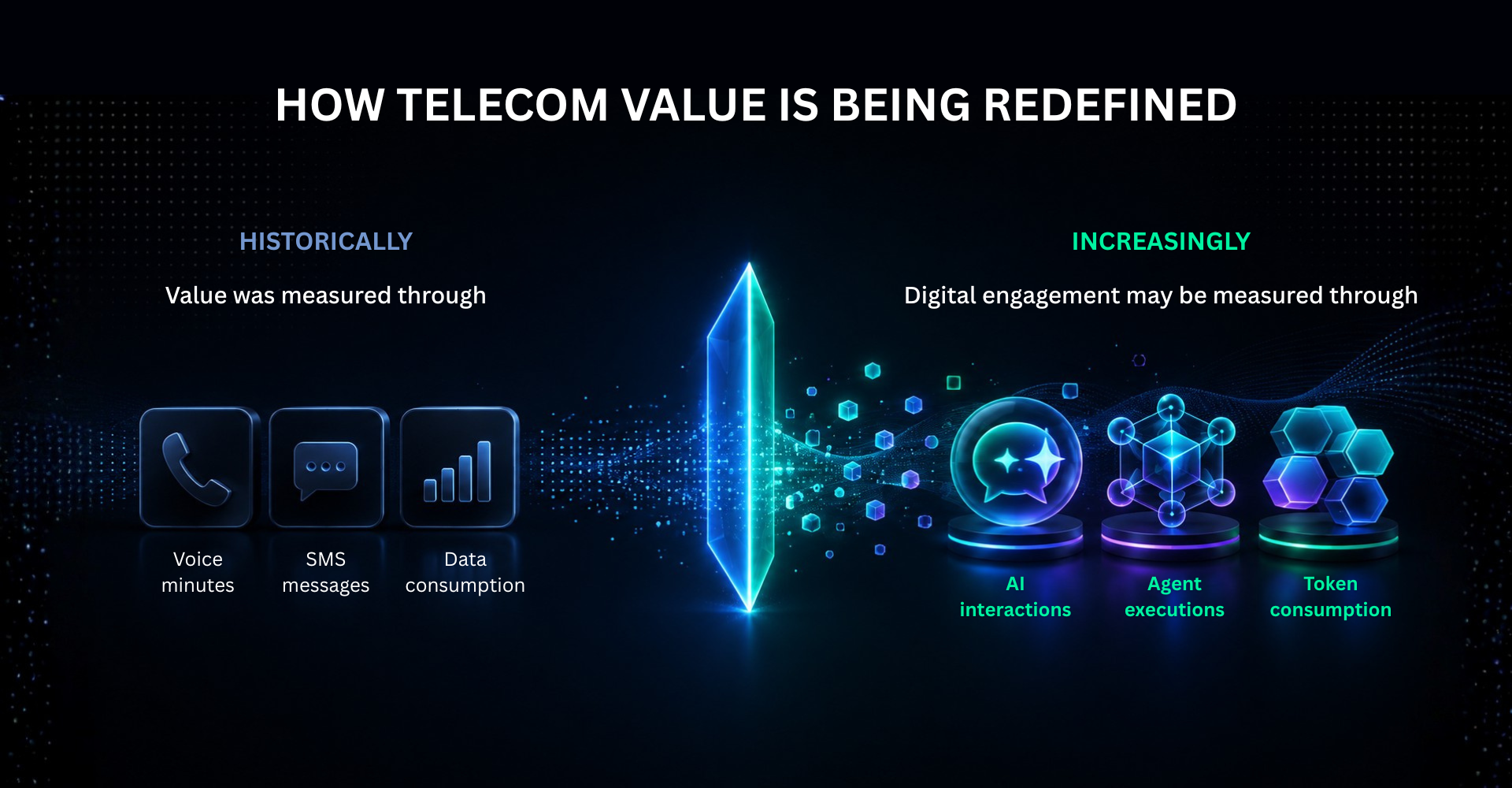
As AI becomes embedded across everyday services, these new measures could provide operators with a framework for understanding engagement, managing consumption and monetizing intelligence.
From Search to Agents: A New Economic Model
In the 1990s and 2000s, Yahoo and Google helped turn web search from a novel technology into an everyday utility. Consumers rarely paid to search directly. Instead, platforms monetised their attention, intent and behavioural data through advertising.
AI is now driving a similar shift in how consumers access digital services:
Search → Chat → Assistant → Agent
Each stage involves deeper engagement and materially greater token consumption. The economic exchange may also become more explicit. Rather than paying indirectly with \ attention to advertisements, consumers may increasingly pay directly for the intelligence they use, with tokens serving as the underlying unit of consumption.
As Reliance Jio President Mathew Oommen put it, “The telecom currency is going to be rapidly changing from minutes to bytes to tokens.” This transition could create a new role for operators, not simply carrying AI traffic, but packaging, metering and monetising access to intelligence.
B2C AI Adoption: Where Is the Market Heading?
One of the most common questions from telecom executives is whether consumers will adopt telco-provided AI services when dedicated providers such as OpenAI, Gemini, Claude and other standalone services are already widely available and more “dedicated AI” than what telcos are able to provide.
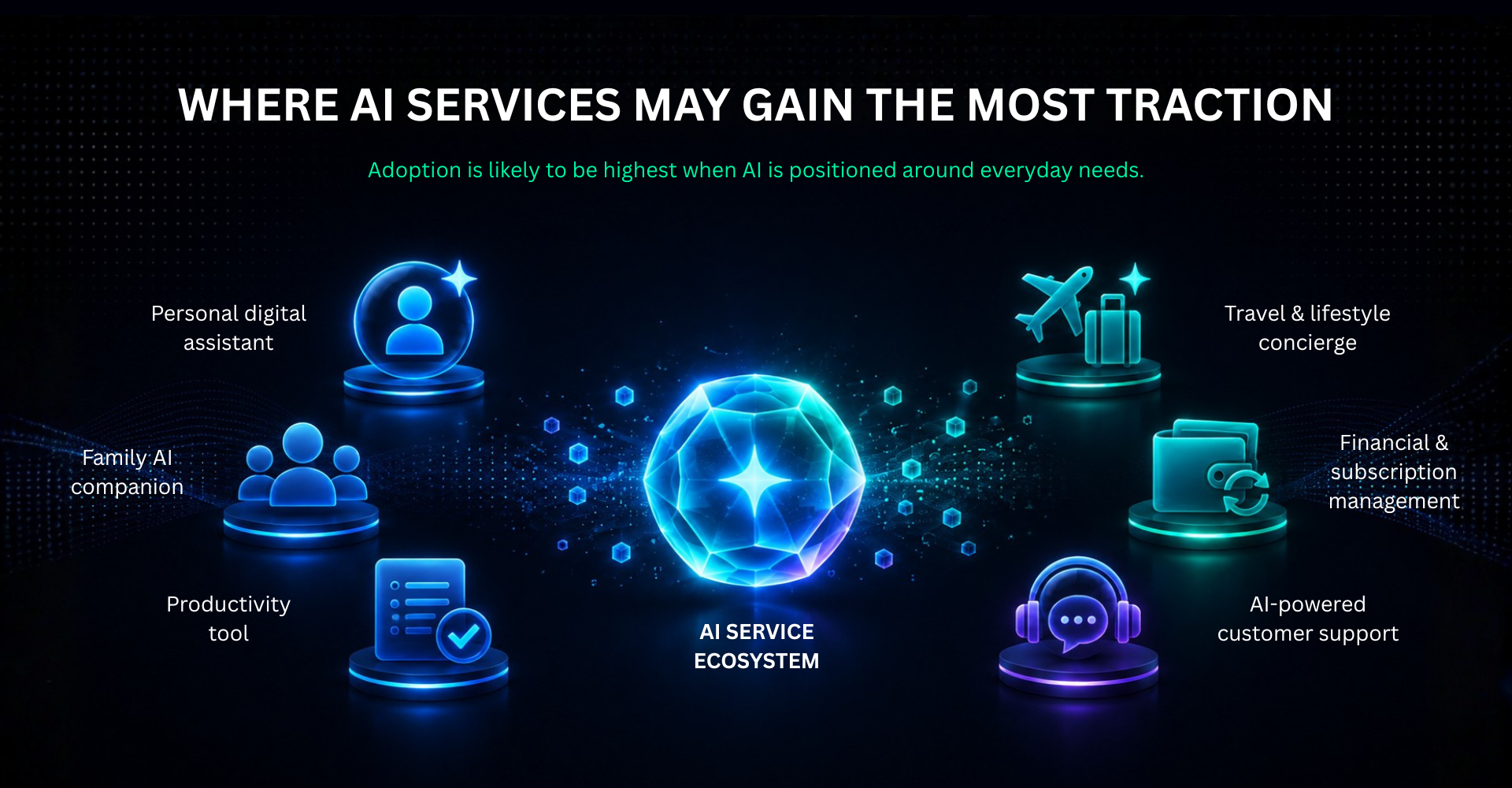
The short answer is yes, but not because telcos will replace established AI platforms. Early evidence suggests that the opportunity lies less in replacing these platforms and more in making useful AI capabilities easier to discover, access and pay for. Consumers may have little reason to change operators for another chatbot, but the proposition becomes more compelling when AI is integrated into the mobile plan, operator application, device experience or customer journey they already use.
The winning proposition is unlikely to be “another chatbot.” It will be an AI layer embedded within the services consumers already use, capable of understanding context, anticipating needs and taking action across family life, productivity, travel, finances and customer support. For telecom operators, the opportunity lies in bringing these fragmented use cases together through the existing subscriber relationship, turning AI from a standalone destination into an intuitive part of everyday life.
Token Consumption: A New Consumption Curve
Token consumption is unlikely to be distributed evenly across AI users. It will vary according to how frequently consumers use AI, how much context they provide, whether their interactions involve text, voice, images or documents, and how many reasoning and execution steps each task requires.
Early enterprise evidence demonstrates how concentrated this demand can become. McKinsey reports that approximately 10% of users account for around 65% of token consumption across its internal AI programme. Although enterprise behaviour cannot be mapped directly onto consumer usage, it provides a useful directional model for telecom operators planning consumer AI services.
At the consumer level, this could produce three broad usage profiles, as illustrated below.
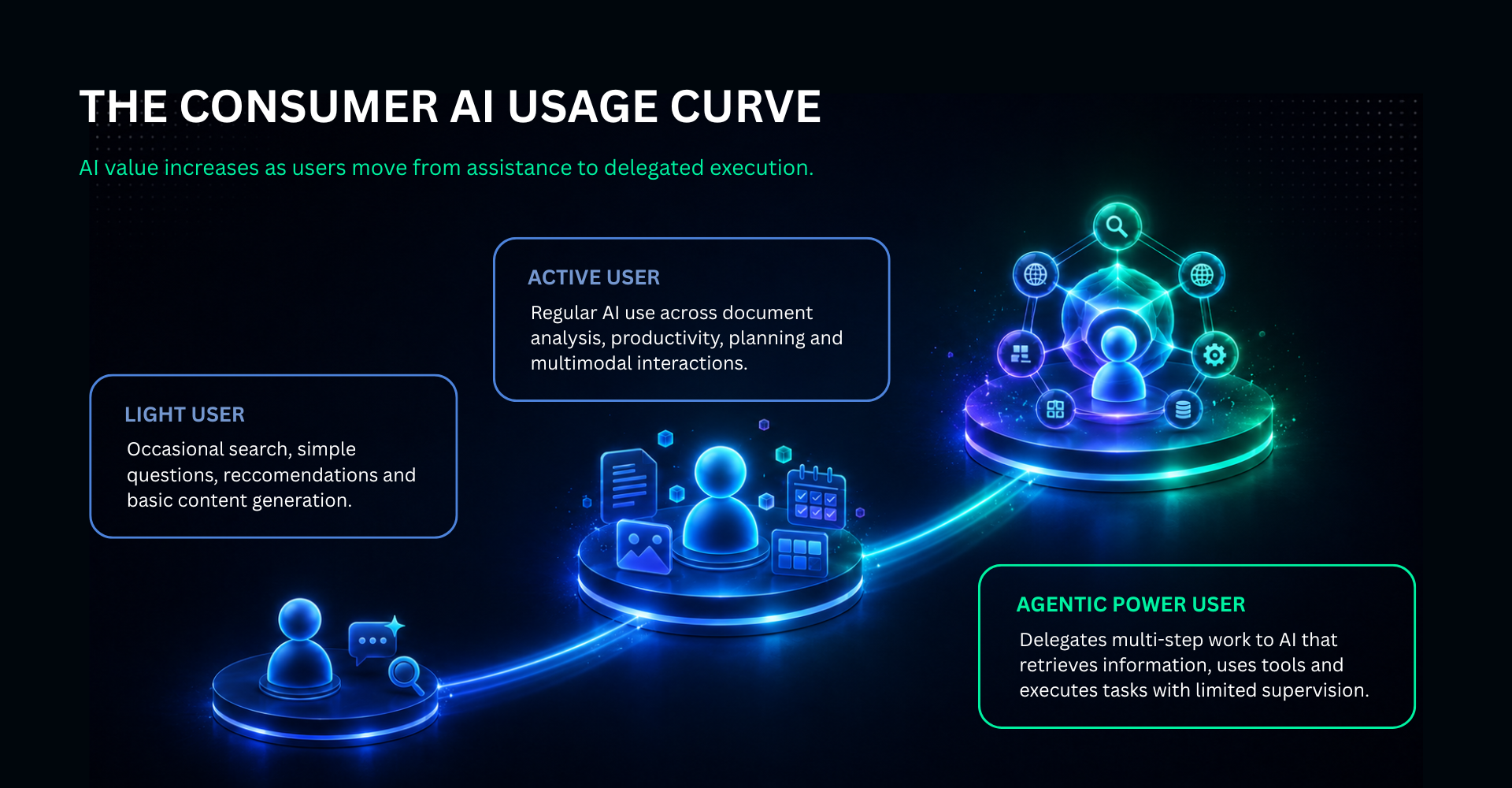
Moving from light to agentic use involves more than simply sending additional prompts. Each autonomous task can require repeated planning, context retrieval, reasoning, tool calls, validation and correction. A 2026 study of agentic coding workloads found that agentic tasks consumed approximately 1,000 times more tokens than comparable chat or single-turn reasoning tasks. While this benchmark should not be treated as a consumer forecast, it illustrates how autonomy can fundamentally change the scale and variability of token demand.
For telecom operators, the implication is that future consumption may be driven disproportionately by a relatively small segment of highly active users and the agentic services operating on their behalf. Token demand will therefore grow not only as more consumers adopt AI, but also as each user entrusts AI with more complex, multimodal and autonomous activities. Rather than relying on a single average per subscriber, operators should plan for a range of consumption scenarios shaped by both the breadth and depth of AI engagement.
The Rise of Agentic AI
Drawing on its experience operating digital telco brands, Circles expects the next phase of the AI economy to be defined by systems that move beyond conversation to take action: agentic AI.
Unlike traditional chatbots, agents can:
These tasks are not completed through a single prompt and response. They require the system to plan, reason, retrieve information, interact with APIs, validate results and sometimes retry unsuccessful actions before reaching an outcome. This increased autonomy creates a fundamentally different consumption profile. As outlined in Splunk’s analysis of AI tokenomics, a simple conversational interaction may use a few thousand tokens, while a complex agentic workflow can consume tens or even hundreds of thousands. This shift fundamentally changes the economics of AI.
Why Telcos Have a Unique Advantage
As the GSMA notes, telecommunications operators can draw on a distinctive combination of infrastructure, data, APIs and trusted customer relationships, providing a foundation for AI services that few technology companies can replicate at comparable scale:
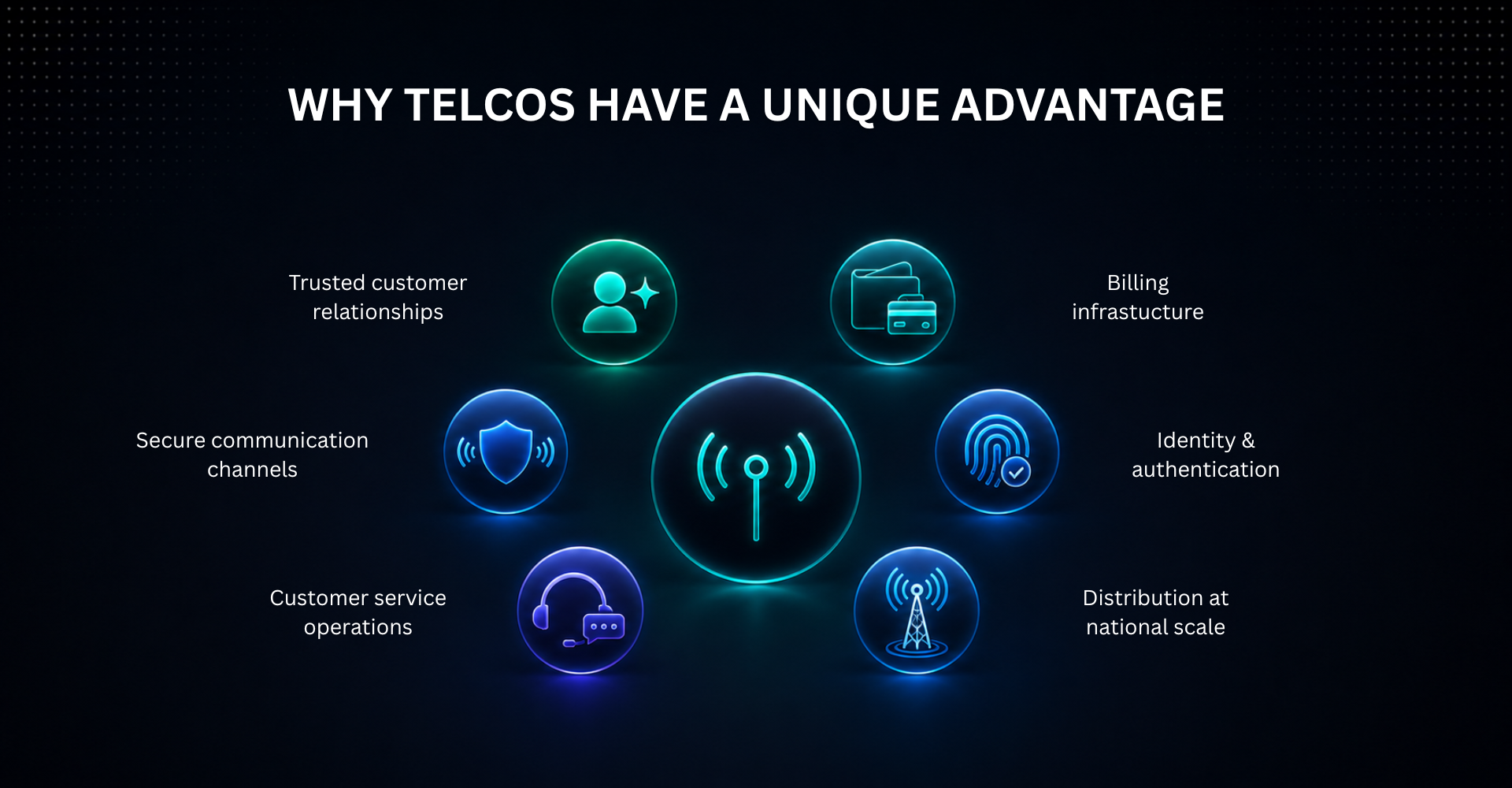
These capabilities create a powerful foundation for consumer AI services.
A telco AI agent could eventually help customers manage subscriptions, arrange roaming and travel, resolve service issues, optimize household connectivity and spending, and securely verify their digital identity. In many markets, telecom operators remain among the most trusted digital service providers, creating a potential advantage over pure technology platforms.
The Economics of Falling Costs and Rising Consumption
A common misconception is that declining AI costs will reduce the size of the market. History suggests the opposite: when the cost of a technology falls, adoption broadens and usage often increases.
These effects reinforce one another. Bain & Company found that average token costs fell by half between December 2024 and December 2025, while token consumption increased 4.5 times. Bain attributes this divergence to two related effects: agents consume more tokens as they undertake increasingly complex, multistep work, and organizations introduce additional workflows as they discover new applications for AI.
The telecommunications industry is already beginning to commercialize this demand. GSMA Intelligence reports that China’s three largest operators have introduced token-based AI plans structured similarly to mobile data bundles, signaling a broader shift toward monetizing AI, cloud and compute services. As unit costs fall, the overall opportunity can still expand through broader adoption, more sophisticated interactions and a growing volume of AI activity.
Strategic Implications for Telecom CEOs
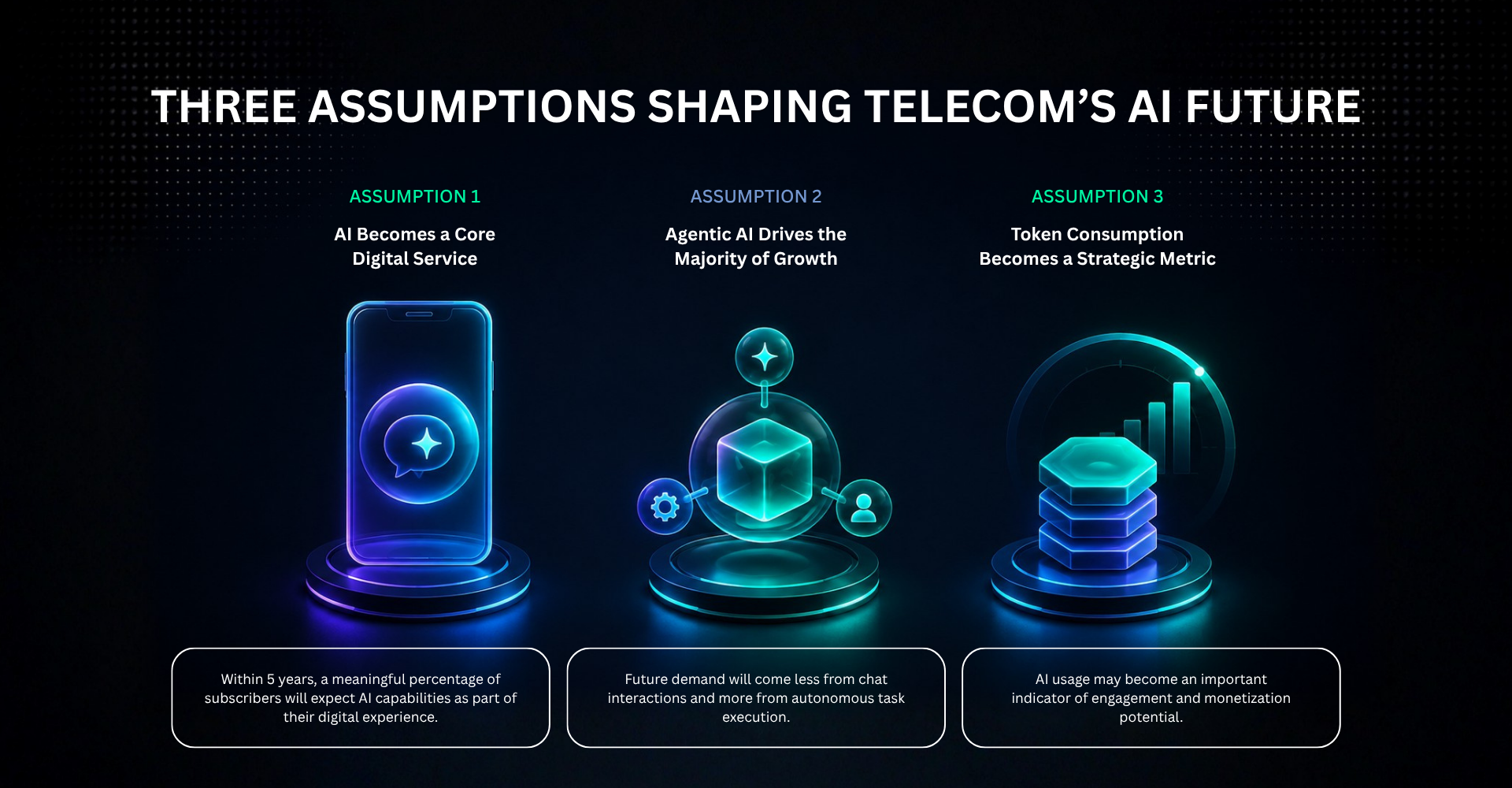
The next decade may see AI become as fundamental to consumer behavior as mobile data is today.
Telecommunications operators should begin planning around three key assumptions:
Conclusion
Circles believes the next major transformation in telecommunications will be from data to intelligence. As AI evolves from chat into assistants and autonomous agents, token consumption could become a new measure of engagement and a foundation for service design and monetization. Operators that combine connectivity with their distribution, billing and customer relationships will be better positioned to capture new growth as intelligence becomes embedded in everyday digital life.
Sanjay Kaul
Chief Revenue Officer
Circles Group