

Knowledge Hub
5
min read
How Much Does AI-Native Telecom Transformation Cost? A Budgeting Guide for CTOs
AI-native telecom transformation cost depends on six budget components: legacy support, platform consolidation, data and AI foundations, delivery speed, cloud approach and AI scope. Published benchmarks measure IT spend as a share of revenue, and Circles scopes every engagement per operator.
None of the public sources reviewed for this guide (McKinsey, TM Forum, NVIDIA and vendor pages, checked on 14 October 2026) publishes a standard price for an AI-native telecom transformation, and Circles does not publish a price list either. This guide gives CTOs what is published: dated benchmarks, the cost drivers behind them and the questions that make vendor proposals comparable.
What Drives the Cost of AI-Native Telecom Transformation?
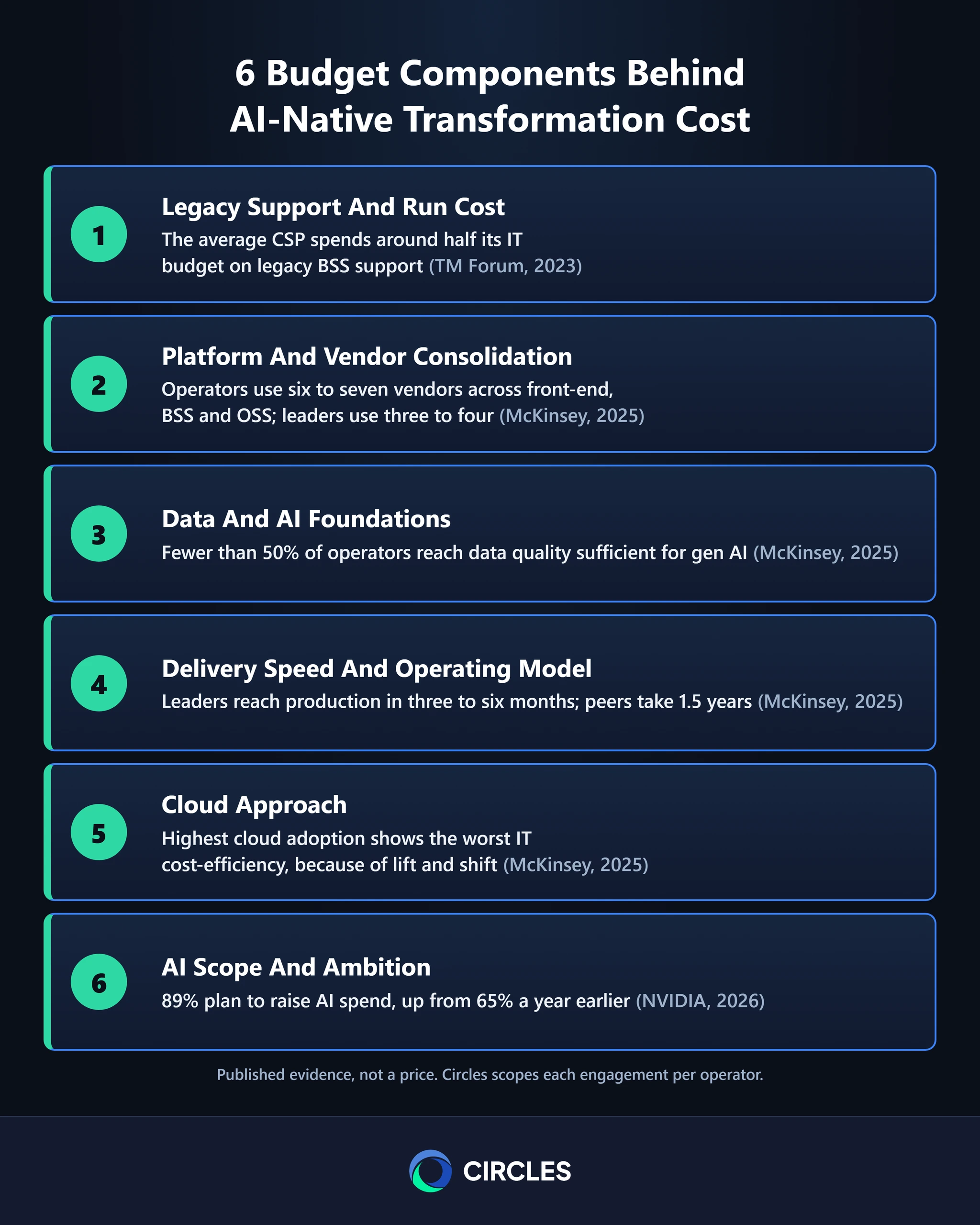
Six components drive the budget, and each one has published evidence behind it. The table maps every component to its driver, its evidence and the question that exposes it in a vendor proposal.
What does a phone bill teach about transformation budgets?
A transformation budget works the way a phone bill does: the plan fee is the visible line, but overage charges and device instalments decide the final total. The visible licence fee in a proposal is the plan fee. Integration, migration, data remediation and parallel running are the overage lines, and they sit outside the headline price unless the vendor itemises them.
Which published benchmarks anchor an AI-native transformation budget?
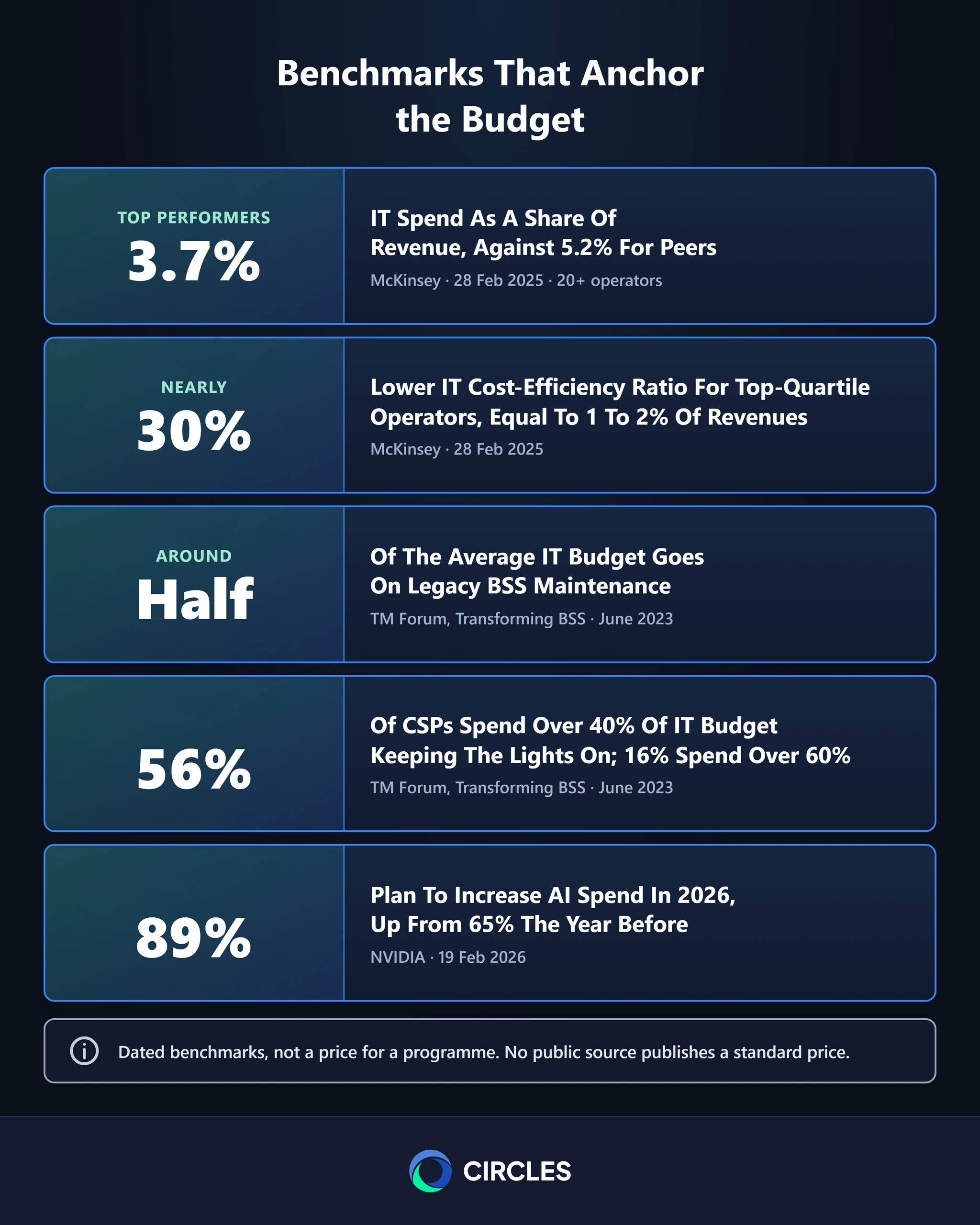
Three dated, primary-source benchmarks anchor the budget: IT spend as a share of revenue, legacy maintenance as a share of IT budget and AI budget direction. None of them is a price for a programme, and this page presents none as one.
Why Does Circles Scope Each Engagement per Operator?
Circles scopes each engagement per operator, so this page publishes no Circles price or range. Circles builds and operates its own digital telco brands, and its published model is "For Operators, by Operators": a Full-stack, AI-native platform shaped to each operator's brand, systems and markets.
Circles publishes two AI-native routes, a digital sub-brand route and a full-scale migration route, and each carries a different cost profile. A sub-brand route starts small and tests with defined KPIs. A full migration route prepares legacy systems, moves customers in cohorts and keeps legacy access during the move. Commercial terms for either route come from a scoped proposal. (Source: circles.co/techco-solutions/ai-capabilities, fetched 14 October 2026.)
Circles also publishes that digital telcos with strong digital quotient scores operate at lower operating cost, though the page does not publish the calculation method. (Source: circles.co/in-the-loop/increase-digital-quotient-telco, fetched 14 October 2026.) Treat it as a Circles-reported direction, not a budget input.
What does a cost-per-route comparison need?
Ask every vendor, Circles included, to price the same four items so proposals compare like for like.
The sub-brand column holds planning assumptions, not Circles commitments: a new brand can still need interfaces to legacy systems or shared data, and Circles scopes the actual boundaries per operator.
The Numbers That Matter: What Published Data Shows About Cost
Operational, financial and risk evidence each point to the same planning rule: budget for the run-cost overlap, not only the licence.
What is the operational cost evidence?
McKinsey's benchmark finds that 55% of operators run three or more tech stacks, and that most plan to consolidate them. Consolidation reduces integration lines, so a proposal that adds an AI layer without reducing stacks keeps the integration cost in the budget. (Source: McKinsey, 28 February 2025.)
What is the financial cost evidence?
TM Forum's survey of 53 operators (May 2023) found that more than half of CSP respondents (56%) spend in excess of 40% of their IT budget just keeping the lights on, and 16% spend in excess of 60%. Retiring that run cost funds a large part of the transformation business case. (Source: TM Forum, Transforming BSS, June 2023, p. 14.)
What is the risk cost evidence?
McKinsey finds that one operator reduced IT spending by as much as 40 percent by transforming programmatically across all capabilities, and that cost-only programmes risk being self-defeating. Budgets that fund one capability alone carry the risk of stalling. (Source: McKinsey, 28 February 2025.)
Which AI return evidence supports funding?
NVIDIA's survey of more than 1,000 telecom professionals ranks the top use cases for return: autonomous networks (50%), improved customer service (41%) and internal process optimisation (33%). Rank use cases by return before funding them. (Source: NVIDIA, 19 February 2026.)
Getting Started: What a Budget Needs Before Vendor Selection
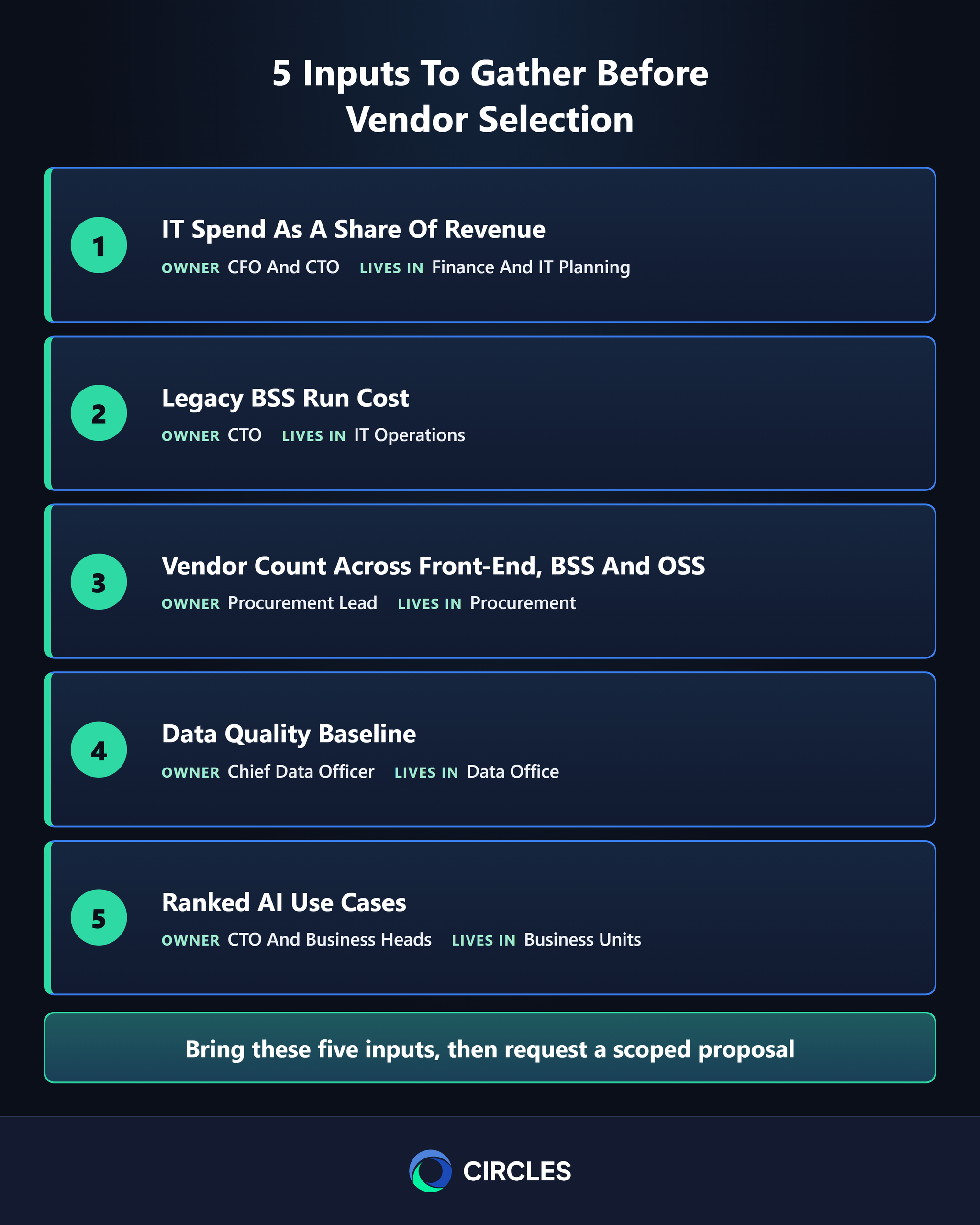
A credible budget needs five inputs before any vendor conversation: current IT cost-to-revenue ratio, legacy run cost, vendor count, data quality baseline and a ranked AI use-case list.
Circles offers a published entry point for the first assessment: the Digital Quotient Assessment, a quick diagnostic that benchmarks an operator's digital maturity across Customer Experience, Innovation and Business Enablement. Circles also publishes Digital Advisory Support Services for strategic planning and operational support. The commercial terms of each entry point come from a scoped proposal. (Source: circles.co/techco-solutions and dq.circles.co, fetched 14 October 2026.) For the stages after assessment, see the Circles AI-Native Transformation Framework.
Governance and Compliance Costs to Include
Governance lines belong in the budget from the first draft: data residency, audit evidence, model oversight and security review. Ask every vendor to itemise certifications and attestations with evidence, and compare the evidence, not the claim. This page makes no certification claim for Circles; Circles supplies compliance evidence on request through the scoped proposal. For the full platform criteria, see the AI-native telecom platform checklist.
What questions make vendor proposals comparable?
1. Which cost lines are one-off, and which recur? 2. Which legacy run costs end, and on what date? 3. How many vendors does the target state hold? 4. Which data sources does the platform read natively? 5. What reaches production in the first quarter, and how is it measured? 6. Which items sit outside the headline price?
Budgeting Questions CTOs Ask About AI-Native Transformation Cost
How much does AI-native telecom transformation cost?
Published sources give no single price. McKinsey's 2024 benchmark of more than 20 operators puts total IT spend at 3.7% of revenue for leaders and 5.2% for peers, and Circles scopes each engagement per operator without a published price list.
What drives the cost of an AI-native telecom transformation?
Six components drive it: legacy support and run cost, platform and vendor consolidation, data and AI foundations, delivery speed and operating model, cloud approach, and AI scope. TM Forum reports that the average CSP spends around half its IT budget on support and maintenance of legacy BSS.
Does Circles publish pricing?
No. Circles does not publish a price list on circles.co as of 14 October 2026, and it scopes engagements per operator.
Take the Next Step: Request a Scoped Proposal
Because Circles scopes every engagement per operator, a proposal starts with the operator's own numbers. Bring the five inputs above, then request a scoped proposal. To compare platform approaches first, see AI-native telecom transformation platforms and the broader case in AI in Telecom. Request a scoped proposal from Circles.