

Insights
8
5
min read
Consumer Insights: Customer Stickiness & Loyalty in European Telecommunications
Tier 1, Tier 2 & MVNO Operators - Country-Level Opportunity Analysis
The European Loyalty Landscape
Across 5 markets in Europe (France, Germany, Italy, Spain, and the UK), nearly 1 in 2 survey respondents expressed a likelihood to change their telco operator, although drivers differ by generation and by market maturity.1
53% intend to switch mobile provider1
50%+ of switchers plan to act within 12 months1
58% of under-35s open to switching2
67% of over-55s intend to stay with current provider2
Younger consumers are more prone to switching operators, while seniors aged 55 and older exhibited greater loyalty, with 67 percent intending to stay with their operators. Germany illustrates the generational split most starkly: 64 percent of young German adults say they are open to switching operators, compared with 75 percent of German seniors who intend to remain loyal.2
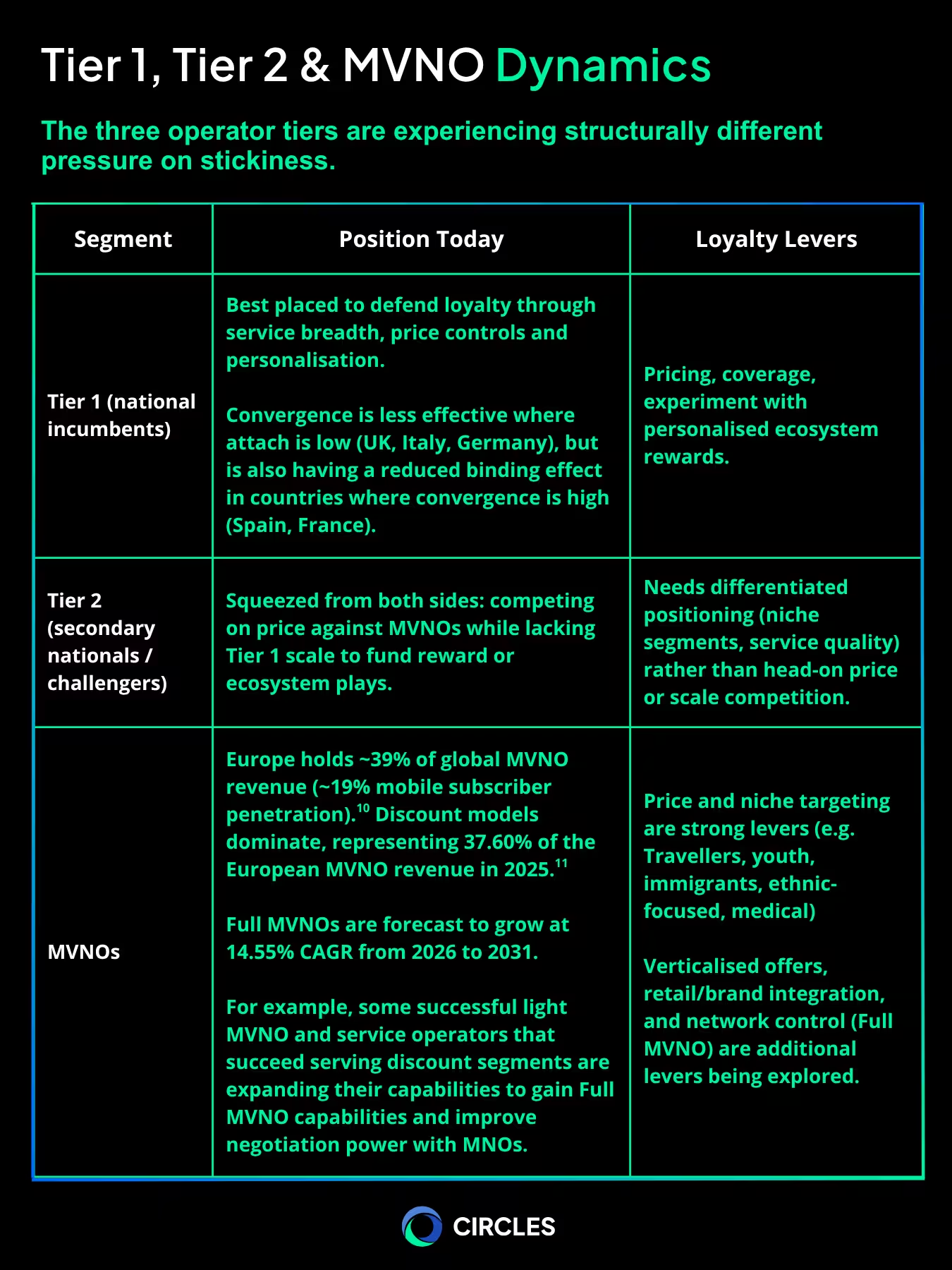
Low-cost operators have also established a foothold among consumers of all age groups among the 5 markets surveyed, and it is particularly true for seniors in Germany and the United Kingdom. Discount services also commanded 37.60 percent of the Europe MVNO market size in 2025, primarily driven by inflation.4
Price Remains A Key Driver for Switching
Across these five European markets, price was noted to be the most important factor when deciding a new mobile service purchase.5 The same survey reported that 53 percent of intentional churners across the five markets who were currently with traditional operators wanted to switch to low-cost telcos. The survey also highlighted the percentage of total respondents in each market who were planning to switch from their current operator to a low-cost provide1:
In the Netherlands, 49% of digital-subscription cancellations, including telco subscriptions, were price-related. Younger generations showed lower loyalty.3
This focus on price was also shown in terms of willingness to pay more for 5G, with only 37 percent of consumers from France, Germany, Italy, Spain, and the UK willing to do so. Country results ranged from 33 percent in the UK and 35 percent in France to 43 percent in Italy. Among respondents who would pay more, most accepted only a modest premium.5
In addition to price, the top 5 decision factors for switching mobile phone operators across Europe included connectivity and service reliability, highlighting that the fundamental connectivity quality is still vital to consumer loyalty1:
- Price
- Network performance or speed
- Signal coverage
- Service reliability
- Cell phone discount
Convergence is Not a Universal Loyalty Lock-in
A common assumption is that bundling fixed and mobile services under one provider, known as convergent bundles, drives loyalty. Data provided by the 5-country survey complicates this: convergent bundles did not prevent churn in the UK, Italy, and Germany where fewer than 43 percent of consumers hold both fixed and mobile services with the same operator.2
Even in countries with higher convergence rates such as Spain (87 percent), the country’s intention to switch aligns with the 5-country average at 46 percent, indicating that convergence offers could be gradually losing their binding power.5
Fixed Broadband Churn Intent
42 percent of Europeans are considering switching their home broadband provider, with Italy showing the highest willingness to churn at 48 percent, followed by the UK and France at around 45 percent.5
Price and Network Quality Are Still Important, But What Could Be The Next Loyalty Lever?
While network quality and speed remain key loyalty factors, mature markets could reach a point where performance improvements become less perceptible to consumers:
In countries where this network quality baseline is met, loyalty could shift towards the broader value customers receive from telcos. In the Netherlands and Belgium, rewards were the leading non-price churn consideration and the second-ranked consideration in the UK.6 This non-price value can include price certainty, useful rewards, service recovery, entertainment, device benefits, household convenience, and personalised treatment.
Globally, younger consumers are increasingly willing to switch brands and loyalty programs compared to older consumers.7 This was shown in the UK, where younger and higher-income subscribers are more receptive to reward-led propositions, making them ideal targets for testing personalised loyalty programs.8
Non-network perks such as retail discounts, grocery and dining programs, entertainment tie-ins, and cashback can also be tested.6 A 2025 survey found that the top 3 ways that global consumers enjoy earning and redeeming loyalty points include:9
However, there is also a real saturation risk: as banking, retail, and utilities roll out competing loyalty schemes, consumers may hit a ceiling for how many overlapping perks they value - diluting the differentiating power of any single scheme.6 In 2022, the average European was a member of around 9 different loyalty programs.8
Implication:
Telcos should target reward-based loyalty strategies by segment rather than deploy them as a blanket program. Price transparency still matters more than perks for price-sensitive segments.
Country-level Opportunity Themes
Country-level dynamics vary enough between European countries that a single pan-European loyalty strategy will underperform. Below is a summary of loyalty signals and the addressable opportunities in different markets.
Germany 🇩🇪
Market Insight and Customer Switching Signals
Largest MVNO market in Europe (around 21.85 percent of European MVNO share).11 Sharpest generational loyalty split: 64 percent of under-35s were open to switching, compared with 75 percent of over-55s who wished to stay with their operators.2
Operator Priority
Segment aggressively by generation: defensive retention for seniors and experiment with reward and flexibility plays to win over younger switchers.
Ensure competitive pricing, data allowances, and network performance, and test various rewards and loyalty propositions on different segments.
United Kingdom 🇬🇧
Market Insight and Customer Switching Signals
MVNOs already account for 19.7 percent of all UK mobile connections in 2024.12
31 percent of UK respondents were likely to change mobile operator within two years in 2024,1 6 percentage points more than in 2023. Fixed-mobile convergence was not materially driving switching behaviour, while rewards ranked second among non-price churn considerations in Deloitte’s UK research.6
Operator Priority
Identify and intervene with near-term switchers before they enter the comparison and porting process. Maintain competitive pricing and network performance, while testing distinctive rewards as an additional retention lever rather than relying on bundle ownership alone.
MVNOs can still win share via retail or community models (e.g. giffgaff-style).
Italy 🇮🇹
Market Insight and Customer Switching Signals
Italy recorded the largest year-on-year rise in two-year mobile switching intention, reaching 27 percent in 2024 from 18 percent in 2023.1 Italy also had the lower stickiness in 2024 with only 39 percent of respondents saying they were not planning to switch.1 Weak convergence effect on telco customer retention.2
Low-cost operators were the intended destination for approximately 75 percent of switchers, and low-cost customers reported particularly strong brand attachment.1 Low-cost MVNOs are showing growth and innovation (CoopVoce13, PosteMobile integrating telco services with postal and financial offerings14).
Operator Priority
Counter low-cost migration through a clear and credible core value proposition covering price, regional coverage and reliability. Traditional operators must strengthen brand and service attachment while recognising that additional bundling alone is unlikely to suppress churn.
France 🇫🇷
Market Insight and Customer Switching Signals
Bouygues Telecom’s acquisition of La Poste Mobile15 consolidated French MVNO ownership. Separately, Orange’s 5G Core Network-as-a-Service is lowering the infrastructure barrier for MNOs and MVNOs deploying 5G Standalone.
Twenty-seven percent of French respondents were likely to change operator within two years in 2024, four percentage points more than in 2023.1 Traditional operators remained relatively resilient, but the flow towards low-cost providers was accelerating and existing low-cost customers displayed strong attachment to their brands.
Operator Priority
MVNO/Tier 2 opportunity in Internet of Things (IoT) and private-network verticals as 5G access barriers become lower.
Treat retention as a broad customer-base issue rather than a youth-only problem. Strengthen price and network value while targeting high-risk customers with relevant benefits, and recognise that low-cost competitors increasingly compete on brand attachment as well as tariff.
Spain 🇪🇸
Market Insight and Customer Switching Signals
Spain combines very high fixed-mobile convergence with continuing mobility towards low-cost alternatives.2 Although only 21 percent of respondents expected to switch within two years in 2024, approximately 55 percent of intended destinations among switchers were low-cost operators, while convergence was described as increasingly commoditised.1
Operator Priority
Differentiate within the large converged customer base through clearer value, better service experiences and relevant benefits rather than relying on bundle ownership as the principal lock-in mechanism. Operators must also defend against low-cost challengers that increasingly offer credible brand propositions.
Netherlands 🇳🇱
Market Insight and Customer Switching Signals
Dutch consumers report high satisfaction with connectivity at 84 percent in 202616 while 36 percent do not know their internet speed, suggesting that network performance is increasingly experienced as an invisible utility. Rewards were the leading non-price consideration that could cause mobile churn in the Netherlands as of 2024.
However, price is still an important loyalty lever for digital subscriptions (including telco subscriptions). 49 percent of digital subscription cancellations are price-related, with Gen Z showing the lowest loyalty of any cohort.16
Operator Priority
Maintain the reliable network baseline and minimise price shocks while testing distinctive, targeted rewards and clearer recurring value. Avoid generic perk catalogues that can be easily replicated, and do not treat broader digital-subscription cancellation data as evidence of mobile churn.
Poland 🇵🇱 and Eastern Europe
Market Insight and Customer Switching Signals
Less competitive saturation, MVNO-friendly regulatory environment still evolving; rising disposable income and smartphone penetration.14
Some countries have varying levels of competitive saturation and switching behavior, and each country still needs to be evaluated separately. For example, Poland has a SIM penetration exceeding 127%17 and saw almost 1.7 million numbers ported in 2025.18 Other countries will have their own dynamics.
Operator Priority
Greenfield opportunity for new MVNO entrants and Tier 2 brand-backed launches (e.g., retail or bank-backed) ahead of Western-European-style market maturation.
Adjust plans based on incumbent and incoming telco entrants and analysis from available data like port-out behaviour and competitive landscape.
Strategic Recommendations
Defend The Core Proposition Before Adding Loyalty Mechanics
Price, network speed, signal coverage, and reliability remain the main switching considerations. Rewards should strengthen a credible core offer that provides competitive tariffs and consistent service. Price shocks should be avoided, as they are still one of the biggest churn triggers.
Segment Loyalty Strategies by Demographics and Customer Value, Not Just By Geography
Older segments (55 years old and above) can be targeted with defensive retention campaigns, while more affluent, younger segments (35 years old and below) can be targeted with personalised loyalty reward campaigns.
The Netherlands and UK provide signals that rewards can influence non-price switching decisions, but operators should test incremental retention, engagement, and customer lifetime value of each campaign and remember that programme participation may not immediately equal loyalty. Further research to uncover unique segments within each country is advised.

Measure Convergence by Its Effect on Churn
Convergence’s retention effect could be weakening in Europe, as it was not driving retention in Germany and the UK while showing a weaker retention effect in France and Spain. MNOs and MVNOs should compare the actual churn, satisfaction, and profitability of converged and non-converged customers before considering further bundle discounts.
Respond to Competition Differently by Market
Italy and Spain show the strongest intended movement towards low-cost operators, France shows accelerating pressure, and Germany and the UK showed greater traditional-operator resilience in 2024. A single European counter-MVNO strategy would therefore misallocate retention investment.
Tier 2 operators should consider avoiding competing head-on with MVNOs on price; sustainable differentiation lies in service niches, quality, or vertical specialisation rather than scale plays they cannot fund.
Poland and Eastern Europe can be watched as a greenfield window for MVNO and Tier 2 brand-backed launches before the market matures toward Western European consolidation patterns.
Conclusion
Europe’s telecommunications landscape consists of a variety of unique markets that vary at a country, segment, age, and proposition level. Similarly, these markets vary in their expectations of telco price, network experience, low-cost competition, and loyalty rewards engagement.
MNOs and MVNOs need to defend their customer loyalty through a strong fundamental connectivity experience first, then apply convergence, rewards, and personalisation loyalty strategies selectively across various segments.
“The value of these levers and opportunities depends on operators carefully understanding the needs of different customer segments and measuring the incremental effect of different loyalty campaigns and bundles on retention and customer value.”
Finally, telcos should look out for opportunities such as entering Internet of Things markets or greenfield opportunities in Eastern Europe.
Circles brings an operator’s perspective to this challenge. Our experience building and operating digital telco brands, combined with our AI-enabled SaaS capabilities, gives us a practical view of both the commercial decisions and technology required to turn customer insight into action. The opportunity for European telcos is to appreciate the differences across Europe’s various markets and build the intelligence and agility to adapt continuously.
Contact us today to explore how Circles can help telcos gather 360 customer insight and turn it into engaging experiences, stronger loyalty, and sustainable growth.
References:
- Oliver Wyman - Global consumer survey 2024: Connectivity Insights from key European markets
- Oliver Wyman - Analyzing Churn Challenges in the European Telecom Landscape 2023 (Global Consumer Survey, Telco: Mobile and Fixed Broadband Connectivity study)
- Deloitte Netherlands - "Dutch Digital Consumer Trends"
- Mordor Intelligence - Europe Mobile Virtual Network Operator (MVNO) Market Report 2031
- Oliver Wyman - Navigating Churn In A European Telecom Operators Landscape
- Deloitte - Gifts beat gigabits: Some mobile users rank rewards over network upgrades
- Comarch - Telco Loyalty in 2025: The Questions You Asked (And the Answers You Actually Wanted)
- CIGroup - The Psychology of Freebies: Why Small Rewards Yield Big Returns
- BCG - Loyalty Programs and Customer Expectations Are Growing
- Business Research Insights - MVNO Market Outlook, Size, Share, Industry Analysis, 2035
- Mordor Intelligence - Europe Mobile Virtual Network Operator (MVNO) Market Report 2031
- TM Forum - What’s fuelling the rise of new MVNOs?
- Coop Italia: stabile il bilancio 2024, giro d'affari a 16,6 miliardi di euro
- Intel Market Research Europe - Mobile Virtual Network Operator MVNO Market Outlook 2025-2032
- Bouygues Telecom acquires the MVNO La Poste Mobile and announces an exclusive distribution agreement with La Poste group
- Deloitte Netherlands Dutch Digital Consumer Trends
- Mordor Intelligence - Poland Telecom MNO Market Size, Trends & Growth Outlook 2031
- UKE Office of Electronic Communications - Number portability statistics for the fourth quarter of 2025 and the whole of 2025