

Insights
7
5
min read
Common Pitfalls In The MVNO Go-To-Market Blueprint
Thanks to advancements in telco software and infrastructure, the barriers to launching mobile virtual network operator (MVNO) services have never been lower. Improvements such as cloud-based enablement platforms, eSIM onboarding, and wholesale network agreements are enabling non-telco companies like banks, retailers, media brands, and digital platforms to introduce mobile services without building telecom infrastructure.
This shift has led to a new generation of ecosystem-driven MVNO entrants from fintech platforms and supermarkets to sports brands and global digital platforms, which you can read about in the first article in this series here. As explored in the second article of this series, this rise in non-telco MVNO entrants is driven by the potential returns that connectivity provides to expand their ecosystems, increase engagement, and unlock new revenue streams.
But while the technical barriers to launching an MVNO have decreased, the challenges of building a sustainable mobile brand remain high. Many MVNO launches struggle due to flawed strategic and go-to-market decisions made early in the planning process.
Circles Aspire’s global experience has revealed a set of common challenges that often hinder MVNO success. Understanding these pitfalls is the first step toward building a sustainable MVNO strategy.
Why MVNO Launches Fail: Four Strategic Pitfalls
Launching a sustainable MVNO brand needs to factor in both business and technical aspects. Customer acquisition, retention, pricing, software, and multiple partnerships including with the network operator who will provide the bandwidth. Many first-time MVNO operators underestimate this complexity.
Based on both observations of the MVNO brands across 14 countries and 6 continents, below are four of the most common strategic roadblocks that derail new MVNO launches.
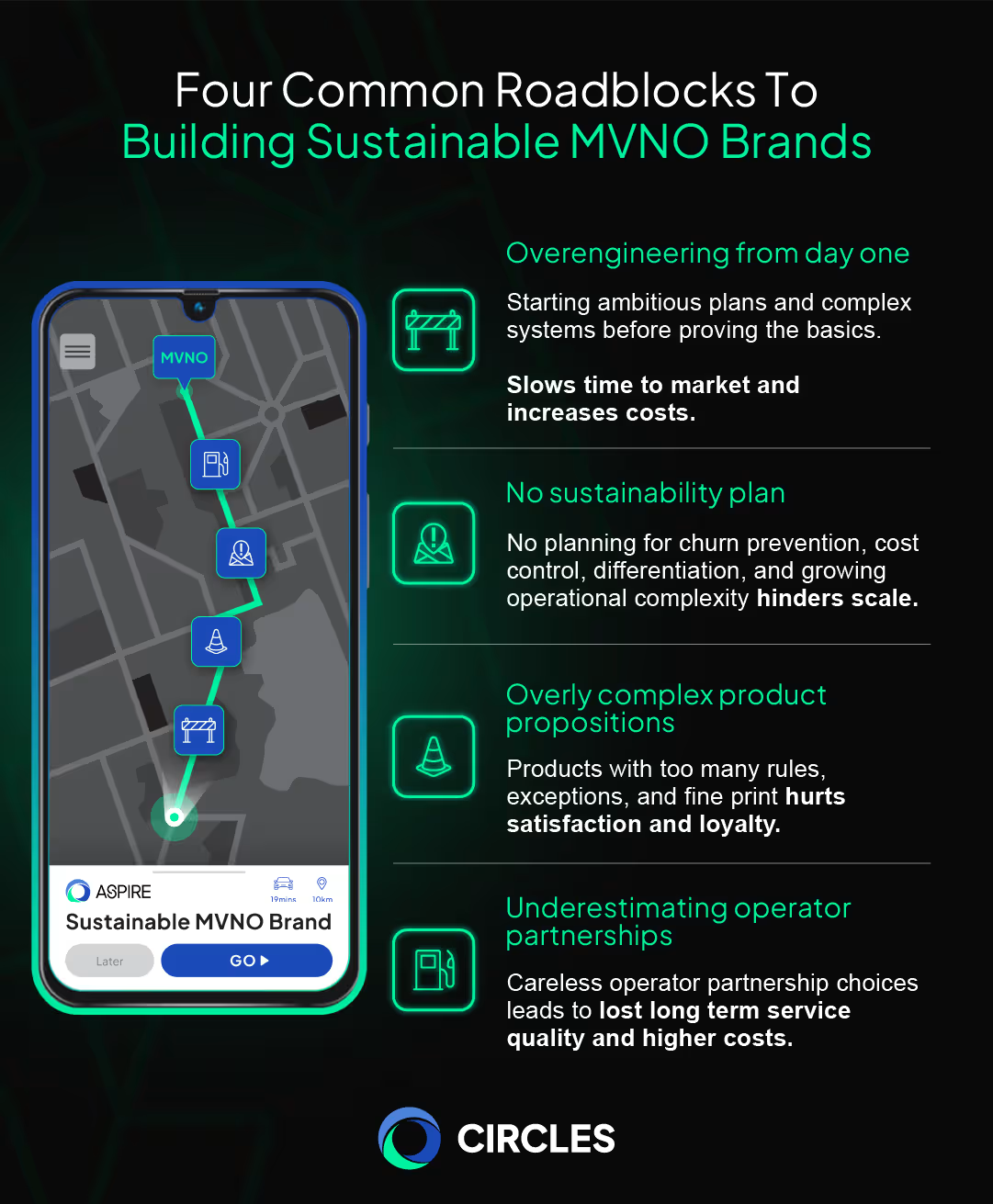
1. Overengineering the Platform From Day One
One common mistake is starting with an overly ambitious technology vision before the groundwork has been proven. Some new MVNOs attempt to build complex ecosystems and product offerings immediately, integrating multiple systems, launching advanced features, or building large operational processes before validating their core proposition.
While the ambition is understandable, this approach often leads to delayed launch timelines and significantly higher implementation costs. The higher costs especially could be dangerous for business models that have not yet been proven.
In many cases for today’s MVNOs, the underlying enablement platform already provides everything needed to start selling services quickly. However, new operators often overlook the advantages of starting with a simplified launch model and expanding capabilities gradually in favor of grander product designs.
The early 2000s provides an example of a brand that struggled to gain traction for its ambitious and overengineered value propositions before the smartphone era. This sports-based MVNO brand provided a Java-based sports application that shared original content that fit a phone format while receiving real-time scores for sports games that were faster than television broadcast updates.
While launching such a service would be easier with today’s powerful smartphones and web apps, the key insight remains the same: Speed to market and validating the basics is frequently a stronger competitive advantage than feature complexity in the early stages.
2. Not Having a Sustainability Strategy
Some MVNO brands achieve impressive early traction through aggressive pricing, strong marketing, or brand affinity and can quickly generate subscriber growth during the launch phase. However, early subscriber growth does not guarantee long-term success.
The business model can quickly become unsustainable without a clear strategy for:
Pricing-led growth often compresses margins while operational complexity increases as subscriber numbers rise. If customer retention and lifetime value were not built into the initial business model, scaling the operation becomes increasingly difficult.
One example of this is Amp’d Mobile, which launched in 2005 but filed for bankruptcy in 2007. It used original video content to attract its target market and successfully drove high data usage with an average revenue per user (ARPU) of $25 - $30. However, it fell short in areas such as billing, customer care, and operations, which contributed to its downfall.1
Successful MVNO brands remember to handle both the top and bottom lines, treating customer retention and margin design as well as cost control as launch priorities and not post-launch optimizations.
3. Overly Complex Product Propositions
Another recurring challenge lies in the product design itself. New MVNO operators sometimes create plans filled with conditions, exceptions, and fine print in an attempt to differentiate their offers.
For example, there have been some MVNO brands that provide free talk time and data but require fulfilling many conditions in order to access it. Other common 'red tape' frustrations that drive customers away include:
Telecom consumers generally respond best to simple, transparent propositions. When plans become overly complicated, customers get confused, customer support gets overloaded, and people leave in disgust.
Over time, these issues directly impact churn and brand perception.
Many successful MVNO brands, including those launched by retailers or digital platforms, have instead embraced simplicity as a core product principle. Clear pricing, simple bundles, and easy-to-understand offers often outperform more complicated propositions.
4. Underestimating Partnership and Cost Structures
Launching an MVNO requires a complex ecosystem of partners who help with operational and commercial capabilities. These include host network operators, enablement platform providers, software companies, and more.
For companies entering telecom for the first time, these cost structures are not always immediately obvious. A large portion of an MVNO’s operating expenses will ultimately come from these partnerships, particularly wholesale network fees and platform costs.
In 2014, Ovivo Mobile had a dispute with a software provider that was key to their service model. Their service model involved customers listening to advertisements in exchange for data and talk time. But without network software that could uniquely identify each user, the company could no longer operate.2
Without a clear understanding of these financial dynamics during the planning phase, it becomes difficult to build an accurate business case or return-on-investment model.
Strategic alignment with the right partners is therefore one of the most critical decisions in the MVNO launch process.
Building a Sustainable MVNO Go-To-Market Strategy
Avoiding these pitfalls requires a structured launch framework that connects strategy, product design, and operational planning early in the planning process. After supporting over 80 MVNO brands, the Circles Aspire team will validate a number of key go-to-market elements with companies who are planning to launch their first MVNO. These include, but are not limited to:
These questions and more form the foundation of a successful MVNO launch framework. When answered systematically, they allow operators to align commercial strategy with technical implementation before the service reaches market.
From Platform Provider to Strategic Launch Partner
With the barriers to offering a mobile connectivity service now lower than ever, the difficulty of building a sustainable MVNO brand remains high and should not be underestimated.
Successful operators launch with clearly defined target segments, a sustainable revenue model, simple, customer-centric product design, and well-structured partnerships.
Those that overlook these fundamentals often encounter difficulties once the initial launch momentum fades.
Some first-time brands and companies understand the complexity of launching a successful MVNO brand and elect to work with experienced MVNO enablers. But very few MVNO enablers are invested in your MVNO brand’s long-term success, and some choose not to go beyond providing software services.
It helps to work with partners who are invested in your MVNO brand’s success. Particularly when a brand is launching its first MVNO brand, enablement partners like Circles Aspire become involved much earlier in the process, helping shape the go-to-market strategy, product design, and operational setup on top of providing MVNO enablement and software support.
Circles Aspire is part of the Circles group, which includes digital native telco software provider Circles and its award-winning proprietary digital mobile operator brand Circles.Life. With Circles Aspire’s experience running 80+ MVNOs and Circles Group’s field-tested experience running high net promoter score MVNO brands, your brand’s go-to-market strategy will be supported with proven insights about what helps real-life MVNO brands remain sustainable.
As the MVNO ecosystem continues expanding across industries, from fintech to retail to digital platforms, the brands that succeed will be those that approach connectivity not as a standalone telecom product but as a carefully designed extension of their broader ecosystem strategy.
Curious to know how we can help? Contact us today!