

Insights
5
min read
Telco AI Readiness: Does Data Readiness Matter When AI Overlays Exist?
Telcos across the industry are working to scale up their adoption of AI, but some are struggling to scale AI’s gains within their organizations. In 2026, more than half of surveyed telcos that had tested AI use cases said AI was still driving less than 2 percent of total revenues.1 This is balanced by 47 percent of respondents reporting that they experienced some impact from AI initiatives.
Despite these numbers, telco leaders remain optimistic about AI’s value: 64 percent of leaders expect AI to contribute more than 5 percent of revenues in the near future, while 40 percent expect AI-driven cost reductions to exceed 10 percent once fully scaled across their organizations. The challenge facing telcos now is how they can scale AI’s benefits across their organizations.
Data readiness is among the key barriers to scaling AI in telcos, with 54 percent of telco respondents in a 2025 survey mentioning that data-related issues are their biggest barrier to achieving AI goals.2 To solve this problem, telcos have been exploring various options, including bolting on stack-agnostic AI overlays.
AI Overlays Can Help Telcos Move Fast, But They Are Not a Magic Bullet
For some telcos, wrapping their legacy software with a stack-agnostic AI overlay is an attractive starting point to AI adoption. In this article, "stack-agnostic AI overlays" refers to an AI execution layer that sits above an operator’s existing BSS, OSS, network, and customer systems. This layer can connect AI agents, models, data, tools, and approved system capabilities to enable AI workflows and automation without committing to a broader modernization program.

This approach benefits telcos that value fast time-to-market, as telcos won’t need to upgrade major portions of their tech stack before deploying AI. Agents can take on repeatable work, reveal process failures, and help operators create impact before full transformation is complete.
However, the AI overlay relies on integrations and APIs to draw data from the rest of the organization. That means that the quality of its AI output is still dependent on the data quality within legacy systems like BSS and OSS and the integration quality.
If customer data is duplicated, billing logic is inconsistent, or handoffs between teams remain broken, the overlay inherits those constraints. Multi-agent systems have been noted to repeatedly stall or malfunction when there is inconsistent data, weak integrations, unclear policies, or unnecessary steps.3
In other words, AI overlays may make legacy systems easier to interact with, but it does not automatically make the enterprise more coordinated. The scale of AI’s benefits still relies on high-quality data.
Data Readiness Is Still an Important Obstacle for Telcos to Overcome
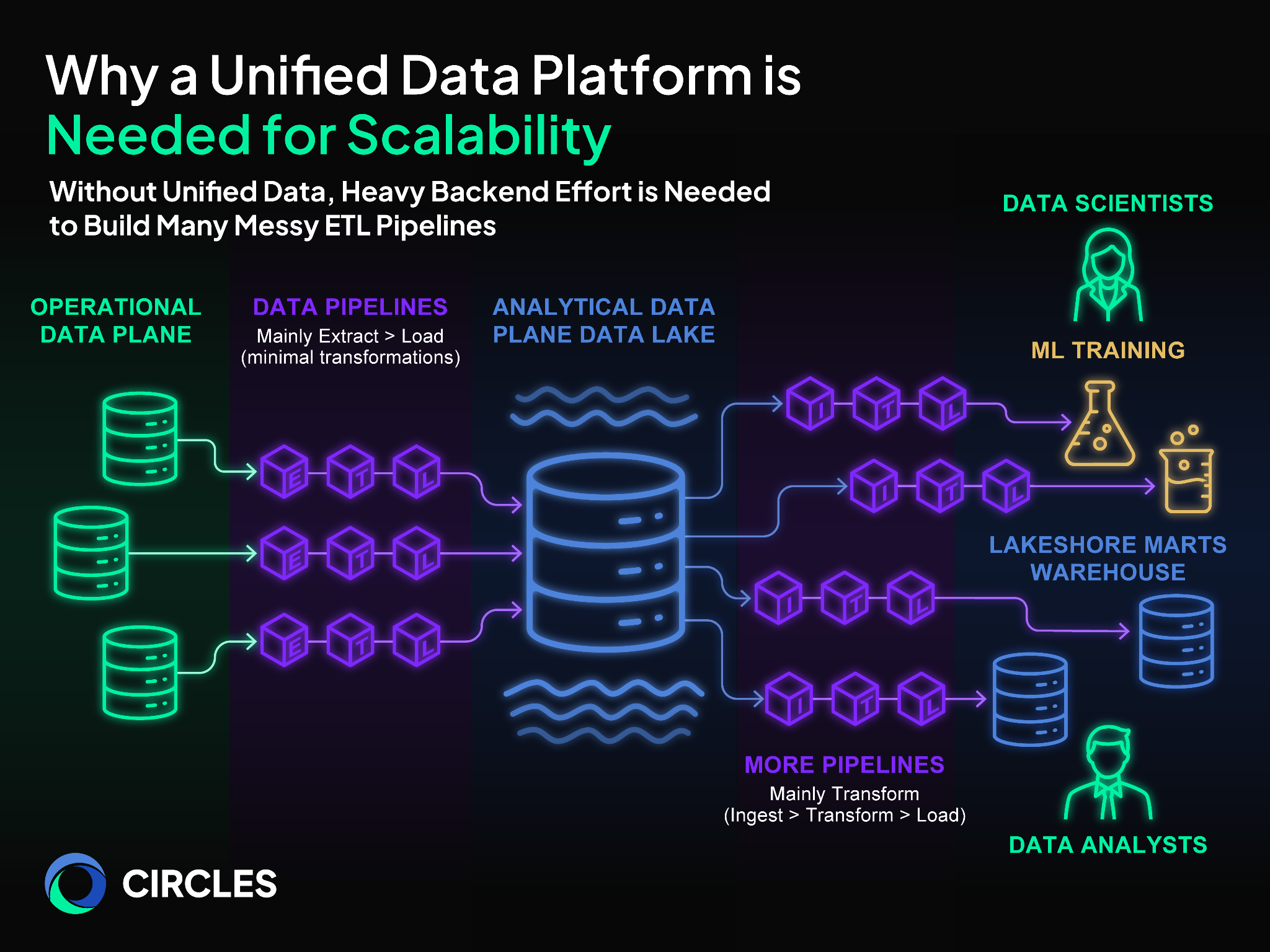
Circles’ whitepaper, The AI Readiness Gap in Telecom, makes a similar argument: telcos can add AI into individual workflows to enable automation and improve response times and customer interactions, but if the data quality and legacy integrations prevent real-time data, the AI’s true value cannot be realized.
For enterprise-wide gains, AI needs 360-degree customer data, including billing, usage, network, and more, to work together. If this data is siloed or low quality, the organization cannot consistently generate accurate insights nor translate those insights into coordinated action, leading to siloed AI gains.
Data readiness can be solved with proper planning and leadership. Telco leaders are increasingly noting that data and data architecture are foundational to scaling AI-first programs.4 Solving this requires a two-pronged approach: the first part is having the right technology, and the second part involves readying the organization in terms of ownership, team structure, domains, and governance.
This notion is reinforced by findings in a 2025 survey related to autonomous network adoption.5
While 20 percent of operators have reached Level 4 or 5 maturity in selected domains, technical debt, interoperability issues, AI talent gaps, organizational silos, and cultural resistance remain major barriers to adoption at scale.5
In many cases, on top of readying the human aspect of their organizations, telcos need to decide which parts of their tech stack to wrap, modernize, or replace, or whether a full-stack transformation is needed.
Solving AI Readiness and Data Readiness Requires Clear Priorities
Savvy telco leaders understand that improving their telcos’ AI readiness requires careful consideration at the organizational level and technological level, and won’t oversimplify the transformation as a choice between quick wins with AI overlays or rushing into a full transformation.
In some telco transformation cases, overlays are a useful bridge that can deliver near-term impact and reveal where the operating model breaks. But these need to be balanced with a broader plan to upgrade other legacy tech stacks so as not to incur further technical debt.
In some cases, the right question that telco leaders ask shouldn't stop at “Which AI model should we deploy next?” but is “Which readiness gap is preventing AI from scaling?”
These gaps could sit in places like data infrastructure, governance, product speed, customer feedback loops, operating model design, or even decision-making.
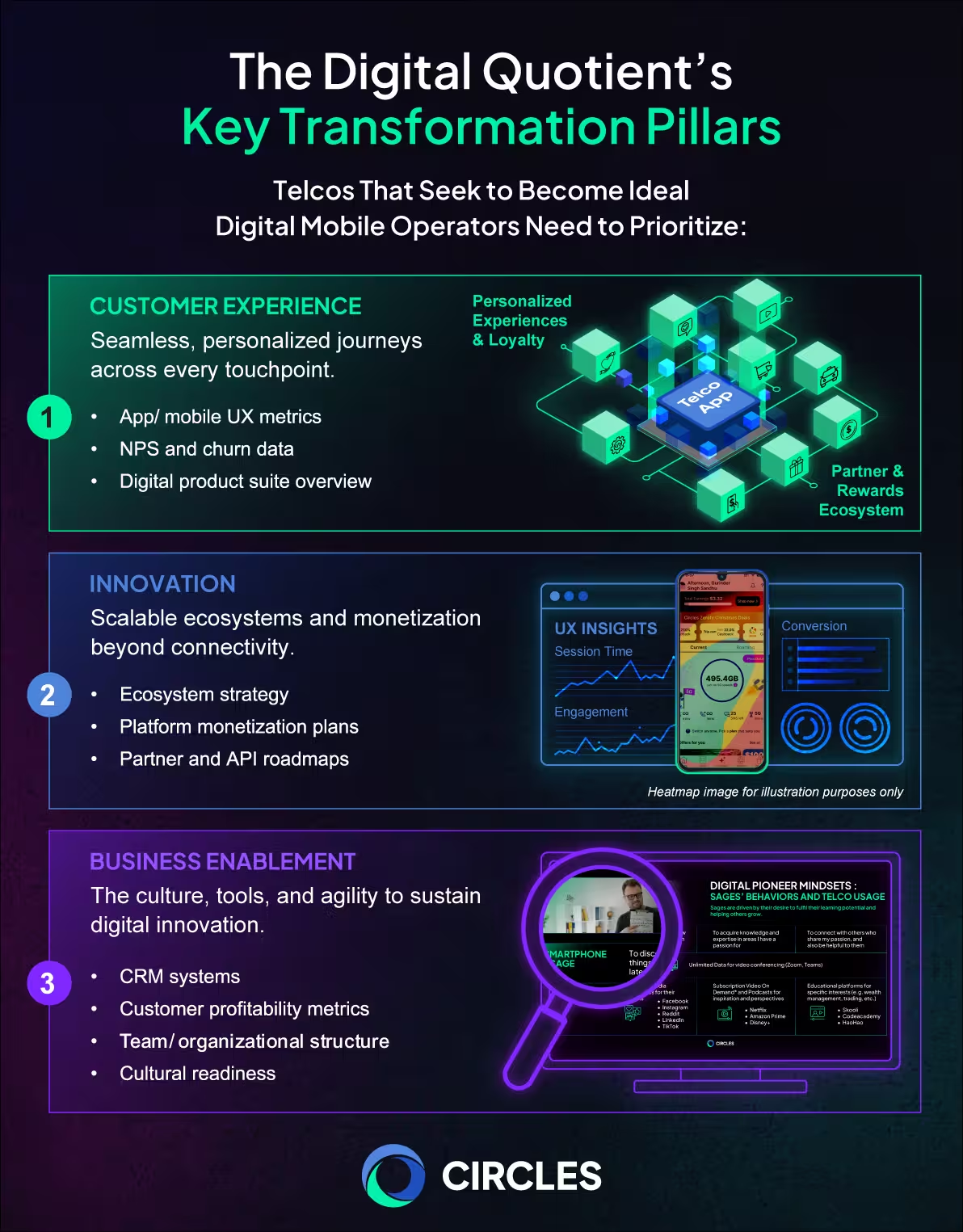
Circles’ Digital Quotient is an assessment tool designed to give telco leaders a baseline to identify where such gaps could exist. It assesses whether the organization has the commercial, technical, and customer-facing foundation needed to become the ideal telco operator, using 18 questions across areas such as digital revenue share, product launch speed, and data infrastructure quality. Telcos can then make improvements across different dimensions such as customer experience, innovation, and business enablement.
Large-scale transformation has its risks, but investing in AI without identifying if the underlying business is ready to scale AI brings its own dangers.
Download The AI Readiness Gap in Telecom to understand how data readiness, operating model readiness, and modernization risk shape whether AI can create enterprise-wide value, and use the Digital Quotient Assessment to identify where your telco should focus first.
References:
- McKinsey (March 2026) - The telco reinvention: How AI can fuel value creation
- NVIDIA - State of AI in Telecommunications: 2026 Trends
- AI and modernization for telecom transformation: PwC
- Telenor lays the foundations of a modern data architecture
- Accelerating Autonomous Networks: A Reality Check for Telcos | Bain & Company