

Knowledge Hub
5
min read
12 Features Every AI-Native Telecom Platform Needs Before You Sign an RFP
What Makes an AI-Native Telecom Platform Qualify: The Twelve Criteria
An AI-native telecom platform embeds AI as an inherent capability of its architecture, and twelve checkable features separate that claim from a bolt-on feature list. ETSI's terminology report (GR ENI 004 V4.1.1, June 2026) defines "AI native" as integrating "AI as an inherent capability within network architecture". TM Forum's AI-Native Blueprint Project (page last modified 27 November 2025) describes its aim as defining the capabilities and principles needed "to embed AI natively into the architecture and operations" of communications service providers.
The twelve features are this guide's editorial RFP framework, built from the cited standards and programmes; neither ETSI nor TM Forum publishes a twelve-feature qualification, and the certification gates are this guide's recommendations, not a mandate. Where a feature cites a TM Forum project workstream, the cited objective is what TM Forum states the project aims to do, not evidence that any vendor has implemented it.
Buyers are already organising around open architecture. A TM Forum survey of more than 200 IT executives at 117 operators (reported in a Tecnotree-sponsored TM Forum Inform article, 2 March 2026) found that one in three named Open Digital Architecture (ODA) as the core guiding principle of their transformation, and a further 55% had embedded elements of it.
This checklist is vendor-neutral and unweighted. It does not score vendors or rank them. Each feature carries a plain-language definition, a question to put to every bidder, the evidence a credible answer contains, and a red flag.
What criteria define a credible AI-native telecom platform?
In this guide's twelve-feature framework, a credible AI-native telecom platform shows AI inside its architecture, certified open-standard conformance, an AI-ready data layer, secured agent interactions, governed operations and measured outcomes, each backed by dated documentary evidence.
Why an "AI-Native" Label Fails Without Evidence
A label classifies nothing; an architecture diagram, a certificate and a measured baseline classify everything. A phone plan sold as "unlimited" tells a buyer little until the fair-use terms are read, and "AI-native" works the same way until the architecture and evidence are read. The practical step for procurement teams is direct: ask for the artefacts behind the word, not a definition of the word.
TM Forum's March 2026 survey describes the gap. Operators report progress deploying "bolt-on" AI use cases, but little progress deploying AI for larger business use cases that span multiple systems.
Why do AI-native claims fail in RFP responses?
AI-native claims fail when a response names the label without the artefacts: operators report progress on bolt-on AI use cases but little on use cases that span multiple systems, so a response needs architecture, certification and baseline evidence to hold up.
Warning Signs by Feature: Definition, Question, Evidence and Red Flag
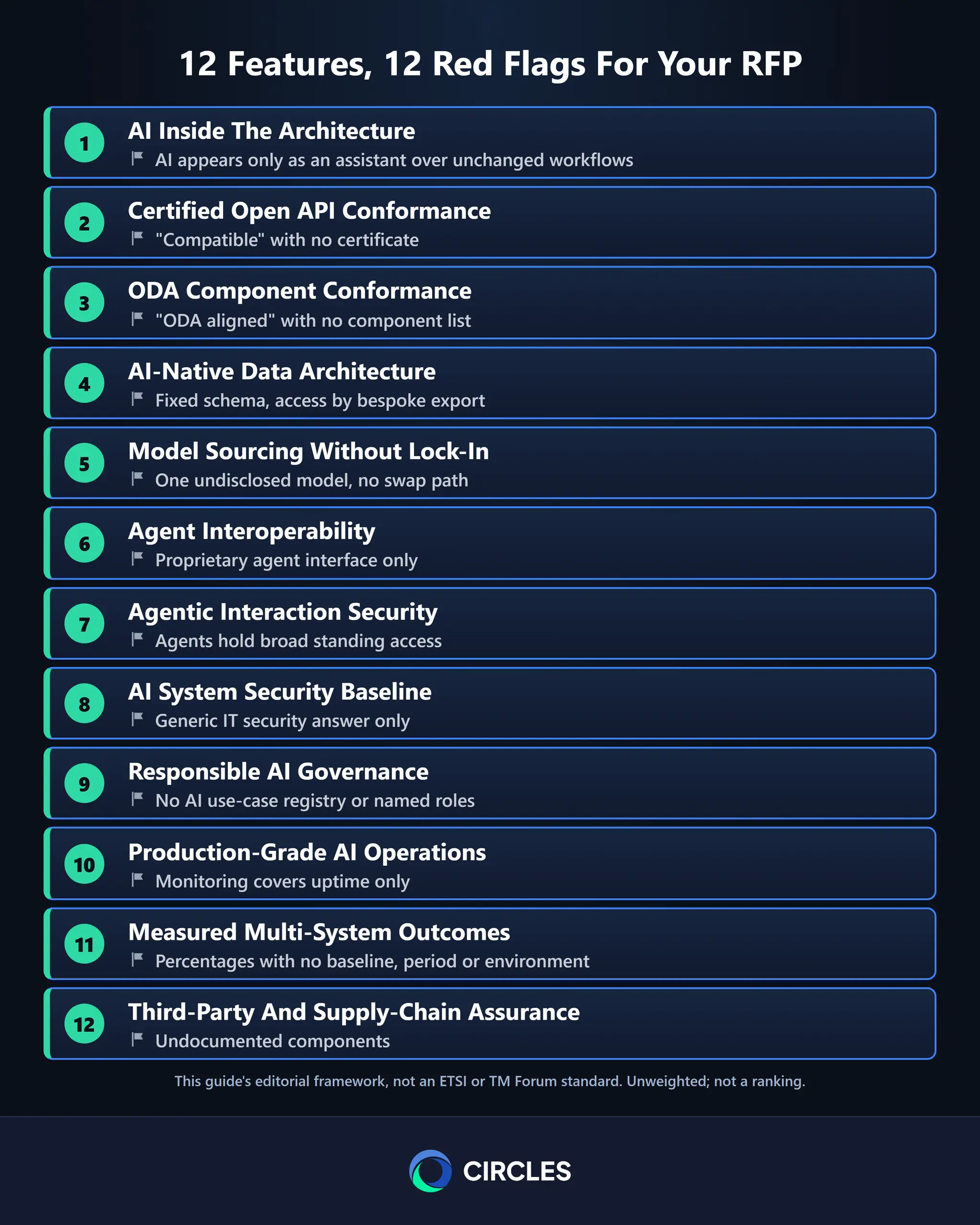
Each entry below follows the same four parts. The buyer sets which red flags disqualify a response; the checklist records them.
1. AI inside the architecture
Definition: AI sits in the platform's data and decision path as a core capability, matching ETSI's "AI native" definition (June 2026). Question to ask: Which decisions does AI make inside the platform, and which run in separate tools? Credible evidence: An architecture diagram that places models, data and agents inside the core flow, plus a description of a reference deployment. Red flag: AI delivered only as an assistant or dashboard layered over unchanged workflows.
2. Certified Open API conformance
Definition: The product exposes and consumes TM Forum Open APIs and holds conformance certification. TM Forum reported on 17 June 2025 that around 100 companies had completed Open API certification, covering more than 1,500 Open API deployments. TM Forum's ODA Manifesto records service-provider signatories committing to make Open API and ODA support "a preferred requirement in all relevant RFPs". Question to ask: Which Open APIs does the product expose and consume, at which versions, and which are certified? Credible evidence: A TM Forum certification listing that names the product, the API and the version. Red flag: "Open API compatible" with no certificate or version number.
3. ODA component conformance and deployment
Definition: Components follow ODA definitions and run on a standard ODA Canvas. TM Forum launched ODA Component Conformance Certification on 17 June 2025, with 15 certifications completed at launch. Question to ask: Which components are ODA conformant, were they deployed on a conformant Canvas, and which existing systems does the product replace or sit beside? Credible evidence: A component certificate, Canvas deployment results and an integration map of retained systems. Red flag: "ODA aligned" with no component list.
4. AI-native data architecture
Definition: A data layer that serves real-time, contextual and evolving data to AI, with data managed as discoverable products. TM Forum's IG1424 (v1.1.0, 21 July 2025; v1.2.0 is now the production version) states that conventional data architectures lack the real-time analytics, continuous learning and contextual awareness that autonomous operations need. TM Forum's Data Products Lifecycle Management project (2 March 2026) defines domain taxonomies, data contracts and metadata standards so agents access data products consistently. Question to ask: How are data products defined, contracted and made discoverable to models and agents? Credible evidence: A data-product catalogue extract, a sample data contract and a lineage description. Red flag: A fixed data model, or data access through bespoke exports.
5. Model sourcing without lock-in
Definition: The platform sources, operates and scales multiple AI models as managed services across cloud, edge and on-premises environments, whoever supplies the model. TM Forum's MODaaS blueprint (2 March 2026) describes a common control plane that reduces fragmentation and avoids lock-in. Question to ask: Which models run in the platform, who hosts them, and how is one replaced? Credible evidence: A model inventory, hosting options and a documented replacement procedure with service expectations. Red flag: A single undisclosed model with no replacement path.
6. Agent interoperability
Definition: Agents connect to data, tools and each other through open protocols. TM Forum Inform (2 March 2026) reports support for the Model Context Protocol (MCP) within ODA components, intent models, ontologies and autonomous closed-loop domains. Question to ask: Which agent protocols does the platform support, at which versions, and how do external agents call platform functions? Credible evidence: A protocol list, a tool and API catalogue and a worked integration example. Red flag: A proprietary agent interface with no open alternative.
7. Agentic interaction security
Definition: Guardrails govern what agents do to each other and to operator systems. TM Forum's Agentic Interactions Security project (2 March 2026) defines a framework, a common policy language and an ontology for machine-readable governance. ETSI EN 304 223 (December 2025), provision 5.1.2-6, requires that permissions granted to an AI system on other systems are limited to what its functionality needs and are risk assessed. Question to ask: How are agent permissions defined, enforced and audited? Credible evidence: A permission model, policy examples and a sample audit log. Red flag: Agents with broad standing access to production systems.
8. AI system security baseline
Definition: The product meets baseline security requirements written for AI. ETSI EN 304 223 (published 14 January 2026 as V2.1.1, 2025-12) defines 13 principles across five phases: secure design, development, deployment, maintenance and end of life, and names AI-specific risks including data poisoning, model obfuscation and indirect prompt injection. Question to ask: Which of the 13 principles does the vendor document and test, and who verifies it? Credible evidence: A principle-by-principle mapping, the audit trail provision 5.1.2-3 describes, and test records. Red flag: A generic IT security answer with no AI-specific controls.
9. Responsible AI governance
Definition: Governance covers vision, operating model, technical controls, third-party ecosystem, and change management. The GSMA Responsible AI Maturity Roadmap (page last modified 26 May 2026) defines four maturity levels (Foundational, Evolving, Performing, Advanced) across five dimensions and 20 sub-dimensions, with a self-assessment tool. The Foundational level includes established AI principles, defined roles and a basic registry of AI use cases. Question to ask: Where does the vendor sit on the roadmap, and what evidence supports that placement? Credible evidence: Published AI principles, named roles, an AI use-case registry and a completed self-assessment. Red flag: No registry, no named accountable roles.
10. Production-grade AI operations
Definition: The vendor runs AI in production with monitoring beyond uptime. TM Forum's AI-Native Blueprint has an AIOps workstream that covers production-grade AI operations. ETSI EN 304 223 principle 12 requires logging of system and user actions and analysis of logs for drift, poisoning and unexpected behaviour. Question to ask: How are model behaviour, drift and incidents monitored, and how is a model rolled back? Credible evidence: A monitoring design, a drift-detection description and a rollback record. Red flag: Monitoring that covers availability only.
11. Measured multi-system outcomes
Definition: Results come from live use cases that span several systems, reported with baseline, period and environment. TM Forum's March 2026 survey found little progress in AI for business use cases that span multiple systems. Question to ask: Which live use cases span several systems, and what baseline, period and environment sit behind each result? Credible evidence: Named references, measurement method and customer-confirmed figures. Red flag: Percentages with no baseline, period or environment, or results from a demonstration treated as results from a live network.
12. Third-party and supply-chain assurance
Definition: The vendor documents every third-party model and component inside the product. ETSI EN 304 223 principle 7 requires secure software supply chain processes and documented justification for using models or components that are not well documented. The GSMA roadmap treats the third-party ecosystem as one of its five dimensions. Question to ask: Which third-party models and components sit inside the product, and how are they assessed? Credible evidence: A component and model inventory, supplier assessment records and a justification for any weakly documented component. Red flag: Undocumented components or an unwillingness to name suppliers.
The Compliance Checklist: Documents to Request From Every Bidder
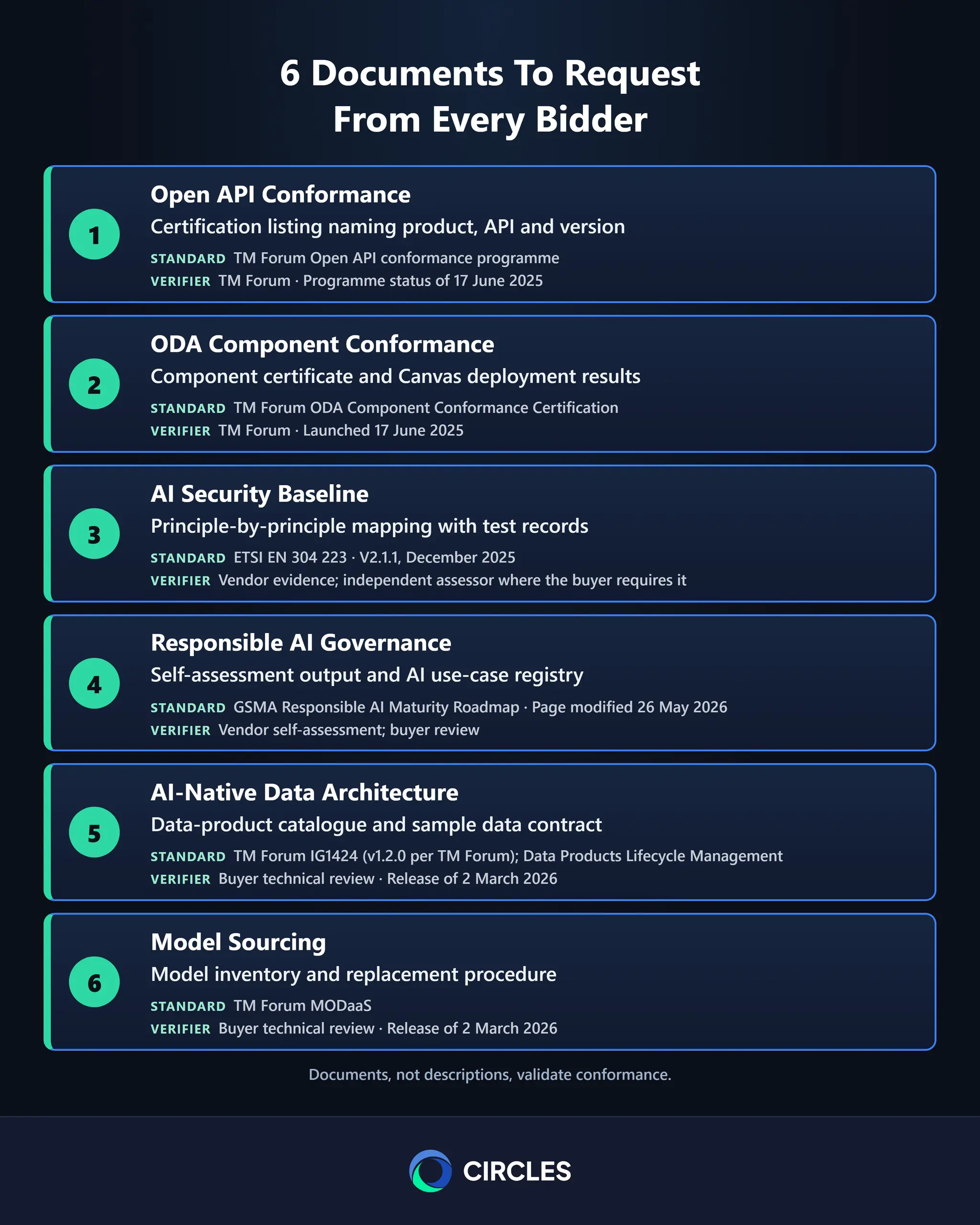
A procurement team validates conformance by requesting documents, not descriptions. The table maps each request to the standard it verifies.
What certifications does an AI-native telecom platform need?
This guide's RFP framework asks buyers for Open API and ODA component certificates, a mapping to ETSI EN 304 223, a GSMA Responsible AI roadmap self-assessment, and the data-product and model-sourcing documents listed above; each names a standard and a version.
Common Selection Errors and How the Checklist Corrects Them
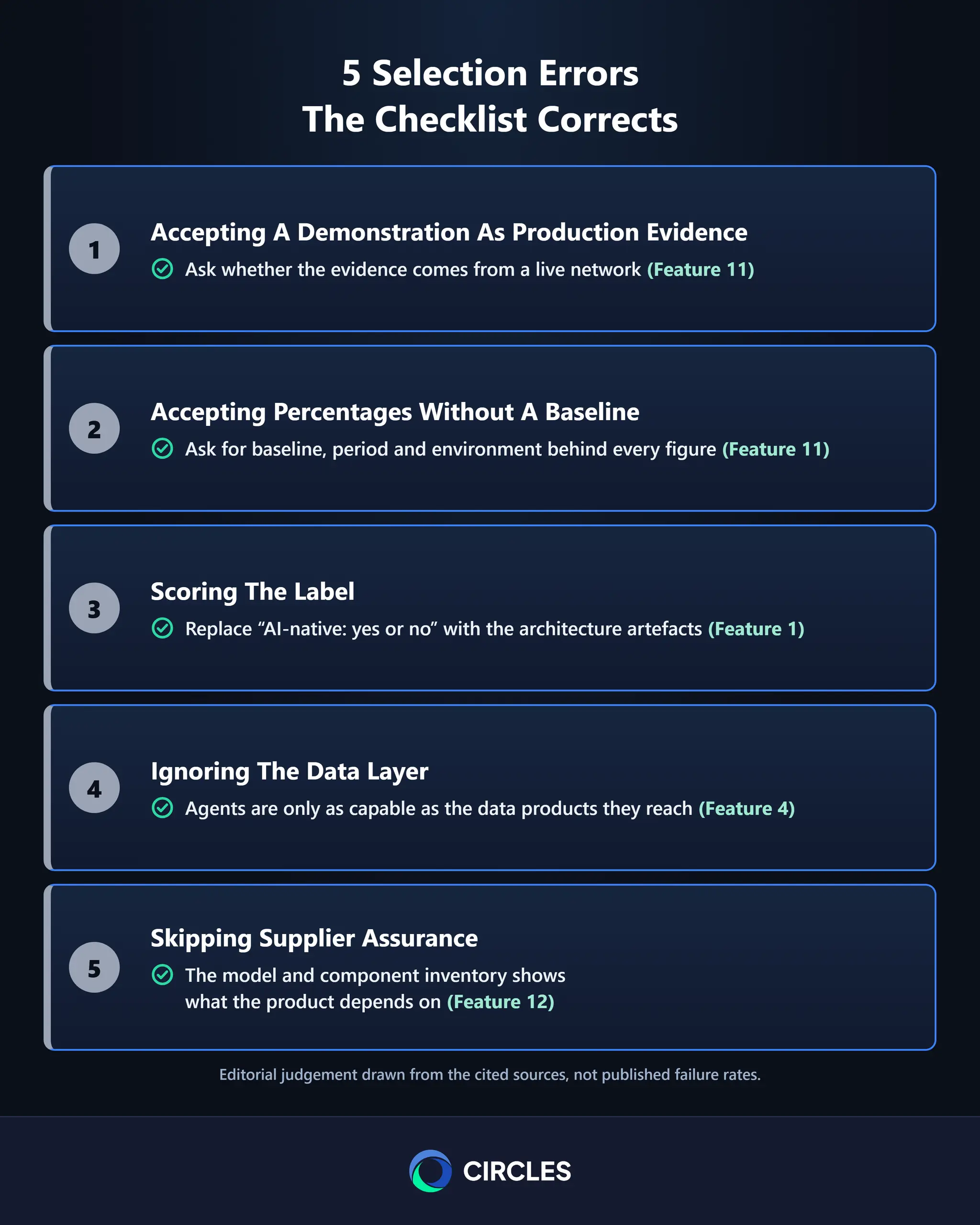
These errors reflect editorial judgement drawn from the sources above, not published failure rates.
What mistakes do buyers make when selecting an AI-native telecom platform?
Buyers accept demonstrations as production evidence, accept percentages without a baseline, score the label instead of the architecture, ignore the data layer and skip supplier assurance.
How Circles Describes Its Own Approach (Labelled Bridge)
*This section reports how Circles describes itself, using only circles.co pages fetched on 14 October 2026. It is not an evaluation of Circles, and it does not claim that Circles meets all twelve features. The same twelve questions apply to Circles as to every other bidder.*
Circles describes itself as "a SaaS company built by operators for operators" and states that its platform works with existing OSS and BSS systems. Circles' published Multi-AI Agent Fabric for Telcos, MAXIM, is described as built on TM Forum Open Digital Architecture and Open APIs, with agents exchanging context through the Model Context Protocol; its public status is a TM Forum Catalyst project. Those statements touch features 1, 2, 3 and 6, and public sources do not state certification status for features 2 and 3.
Read the MAXIM capabilities guide for the published detail, then put the twelve questions to Circles directly. For cost and sequencing context, explore the AI-native telecom transformation cost guide, and for the wider architecture, the AI in telecom pillar.