

Knowledge Hub
5
5
min read
What Is Data Science in Telecom: The Predictive Foundation Beneath the Network
Data science in telecom is the predictive foundation, not a reporting function. See the models, the data stack, and why prediction beats hindsight.
What Data Science in Telecom Actually Is
Data science in telecom is the discipline that turns network and subscriber telemetry into predictions that act before an event manifests, not a reporting function that explains it afterward. It reads the live data the network already emits, builds models over it, and triggers a decision while the operator can still change the outcome. Reporting tells an operator a cell degraded last night. Data science flags the cell while it is still carrying calls.
The distinction is operational, not academic. A reporting function staffs dashboards and explains yesterday. A predictive foundation staffs models and changes tomorrow. The first is a cost centre; the second is the layer every other AI capability sits on.
Is data science in telecom the same as analytics or reporting?
No. Analytics and reporting describe what happened. Data science in telecom predicts what will happen and triggers the intervention. The output of reporting is a chart; the output of data science is a decision the network executes.
Why Prediction Beats Reporting
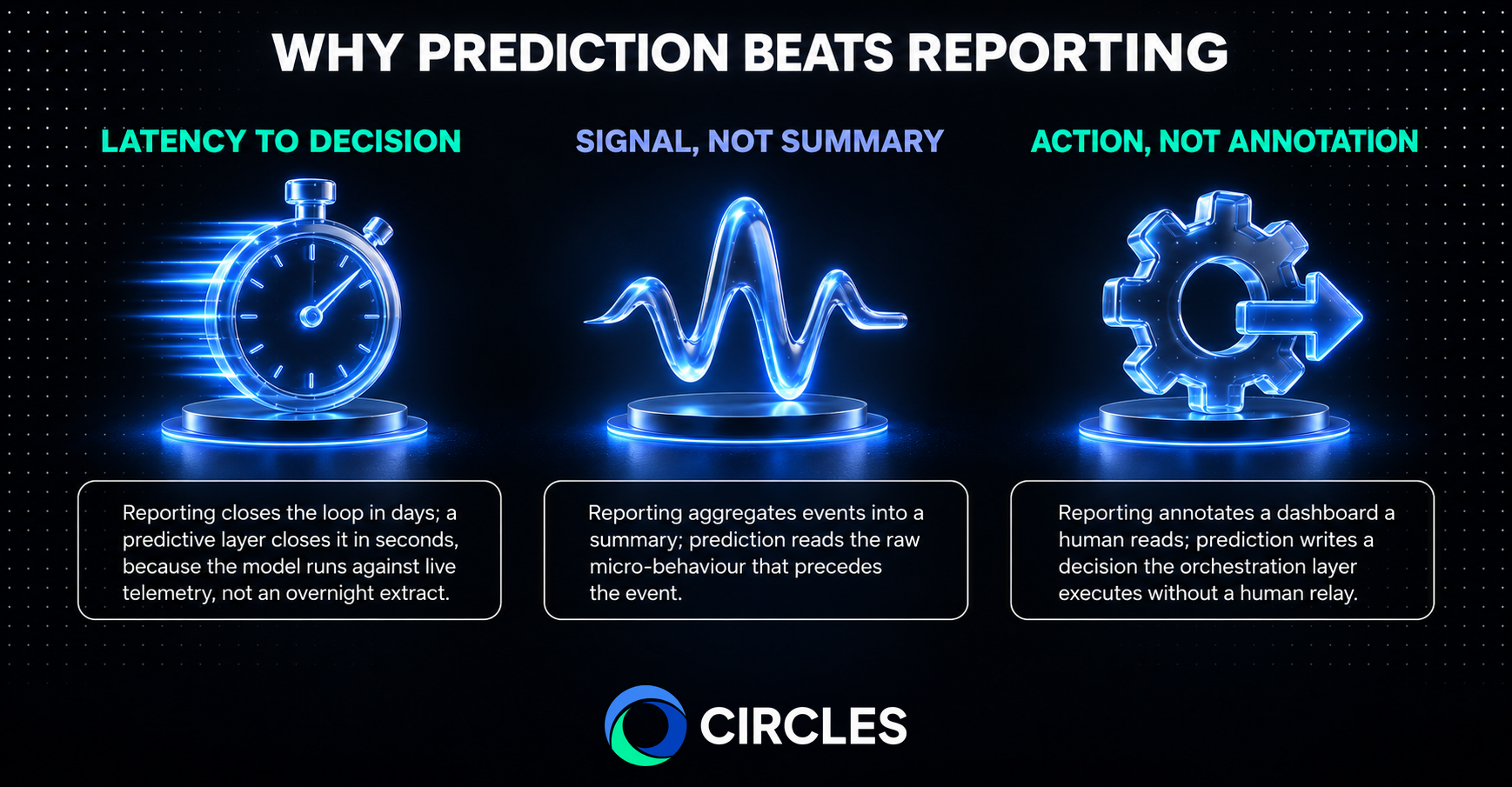
Telco data science works like the network's fault-management plane: it reads telemetry continuously and flags the degrading cell before a single call drops, rather than logging the outage after subscribers feel it. The fault-management plane does not wait for a complaint; it reads the signal and acts. A predictive data layer applies the same principle across the whole operator, from radio to billing. The operator who treats data science as reporting is reading the alarm log after the call has already failed.
Three properties separate a predictive foundation from a reporting stack.
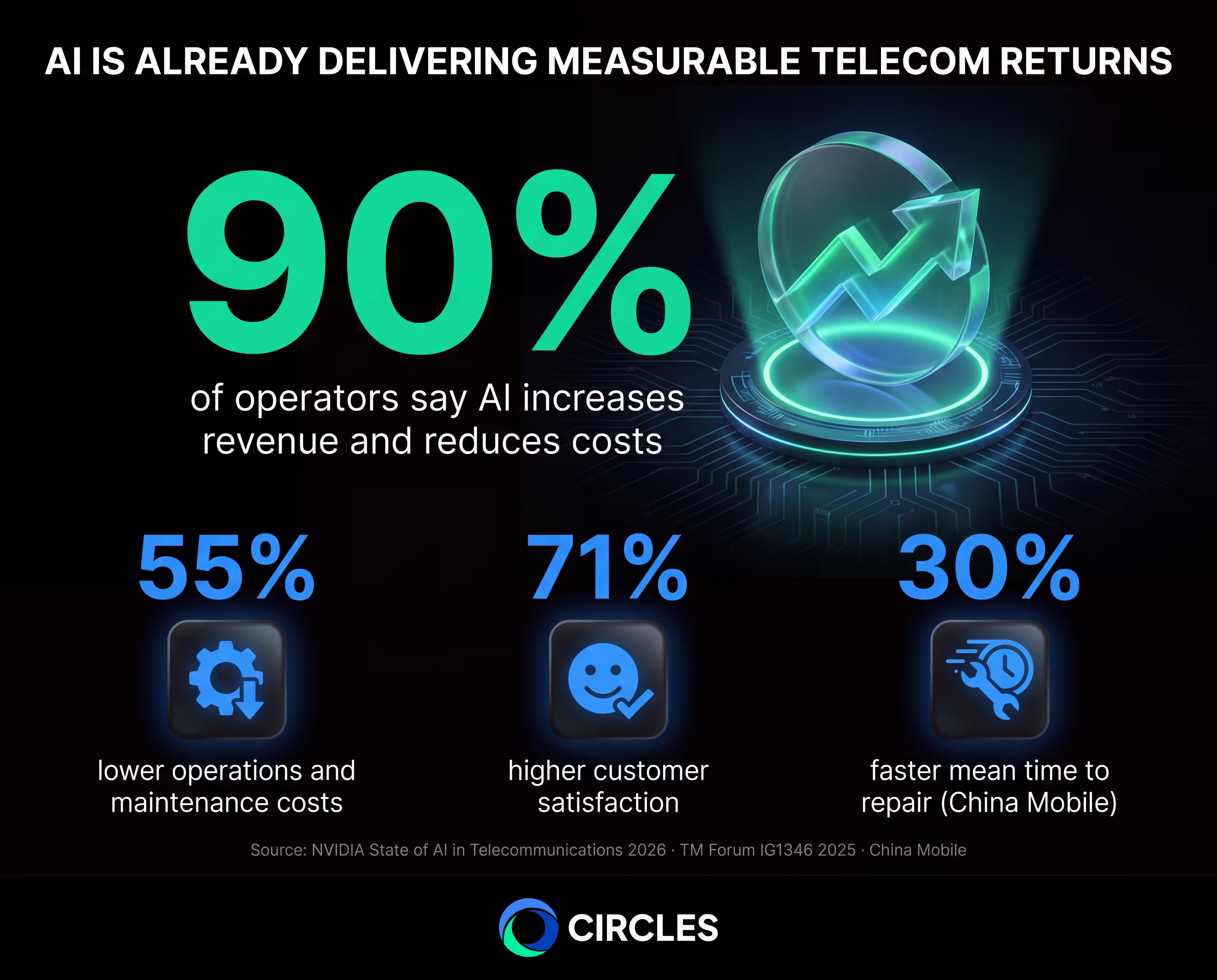
The industry has moved decisively to this footing. NVIDIA's fourth annual State of AI in Telecommunications survey (February 2026) found that 90% of respondents say AI is helping increase revenue and reduce costs, with autonomous networks the top return-on-investment use case at 50%, ahead of customer service at 41%. Adoption keeps accelerating: 65% say network automation is now AI-driven, and 60% are using or assessing generative AI, up from 49% a year earlier. Across operators, around 60% of AI deployments are already live and 40% remain in trial or planning. The payoff scales with maturity: TM Forum's *2025 Autonomous Operations Maturity Industry Insights* (IG1346) research, previewed via TM Forum's autonomous operations coverage, reports network maturity cuts operations and maintenance costs by up to 55%, raises customer satisfaction by 71%, and saves 21% of energy, and China Mobile records a 30% reduction in mean time to repair after reaching Level 4.
The measurable gains come from the models, not the dashboards. Peer-reviewed 2025 work on telecom churn reports a CatBoost classifier reaching 0.9554 accuracy, and an optimisation framework cutting churn from 49.5% to 24.78% (AbdelAziz et al., *Information*, 2025). Those are prediction outcomes, not reporting outputs.
Why does reporting fail operators in the AI era?
Reporting fails because its loop closes after the event. By the time a report shows churn, the subscriber has left; by the time it shows a degraded cell, the call has dropped. Prediction moves the decision ahead of the event, the only place an operator still changes the result.
The Data Science Stack: From Telemetry to Decision
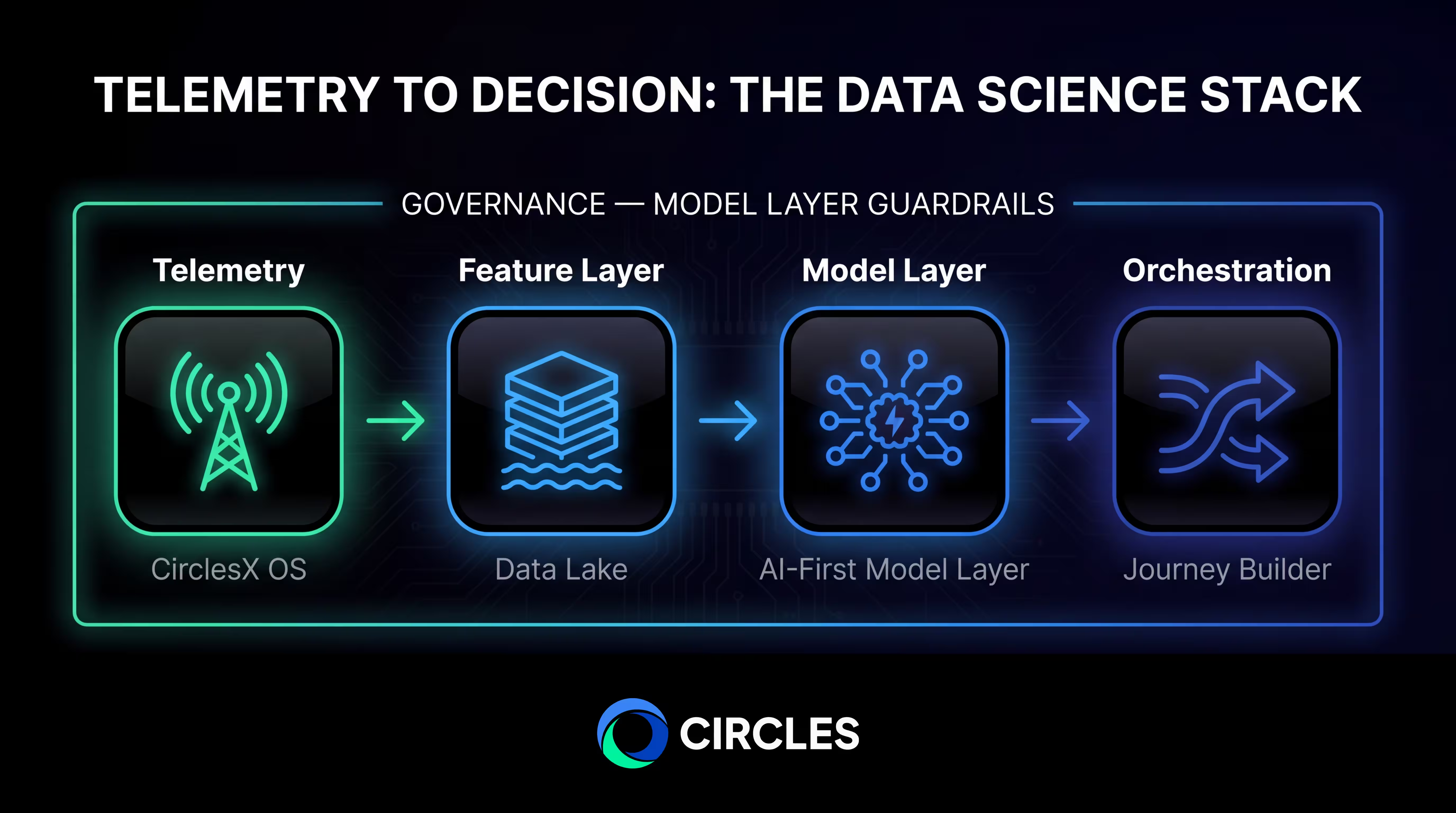
Data science in telecom runs as a stack, from the raw telemetry layer to the decision layer, with each stage anchored to a distinct function and entity. A model is only as good as the data layer beneath it and the orchestration layer above it.
Does data science in telecom need a unified data lake?
Yes. A model that reasons over an exported sample reflects a stale network. A unified data lake gives the model the live, joined behaviour signal it needs, which is why the feature and model layers sit directly on it rather than on a reporting warehouse.
The Models That Run a Telco
Telco data science is defined by the prediction problems it solves: churn, network failure, revenue yield, and anomaly, each a distinct model class running against live telemetry. The use cases differ; the predictive foundation under them does not.
Each model class is a value-bearing entity in its own right, which is why the operator that builds one predictive foundation can run all four on the same data layer rather than buying four point tools. The global market reflects the consolidation: Grand View Research values the global AI-in-telecommunications market at $4.6 billion in 2025, projected to reach $46.2 billion by 2033 at a 32.5% compound annual growth rate.
Which model matters most for a telco?
No single model wins; the predictive foundation that hosts all of them does. An operator that runs churn, maintenance, ARPU, and anomaly models on one data layer compounds value that four siloed tools cannot, because each model reuses the same engineered features.
Where Data Science Sits in the AI-Native Telco
Data science is the predictive foundation the AI-Native telco stack is built on, feeding the model layer that powers generative reasoning, agentic workflows, and real-time customer experience. Remove the data science layer and the stack above it reasons over nothing.
The foundation connects upward, not sideways. It feeds the AI-First Model Layer, which serves generative AI and agentic execution; and it feeds the experience layer, which serves real-time personalisation. Generative AI without a predictive data foundation is a wrapper on legacy reporting; with it, every service inherits prediction by default. International standards now codify the role: ITU-T Recommendation Y.3142 specifies how AI and machine learning optimise network capacity, topology, and routing to meet service-level agreements. Data science is the foundational layer beneath AI in telecom, the discipline every other capability in the operator's AI strategy depends on.
Is data science separate from AI in a telco?
No. Data science is the foundation AI runs on. Generative and agentic AI are reasoning layers; they reason over the features and predictions the data science layer produces. The order is fixed: data foundation first, reasoning layer second.
Build Your Predictive Foundation with Circles
A predictive data foundation catalyses the move from reactive reporting to an AI-Native operator, because every higher capability inherits the prediction the foundation produces. The build starts at the data and model layers, not the dashboard.
Operators that classify their telemetry into a unified predictive foundation stop explaining outages and start preventing them. The commercial difference between a data science layer and a reporting warehouse is that the data science layer converts customer, billing, usage, and behavioural data into measurable customer lifetime value growth, delivered across every product team from a single stack rather than requiring each team to build its own point tool. The next step is to map the predictive architecture that turns that telemetry into automated decisions.