

Insights
5
min read
From AI Pilots to Profit: Building the AI-Native Telco
Telecoms World Asia 2026 Keynote Summary - a Circles perspective
The telecom industry has spent the last few years asking what AI can do. That is no longer the most important question.
The conversation at Telecoms World Asia 2026 made the next challenge increasingly clear: What economic value can AI actually deliver, who captures that value, and how quickly can operators scale it responsibly?
This marks an important shift. AI is moving beyond experimentation, copilots and isolated automation into the commercial and operational core of the telco.
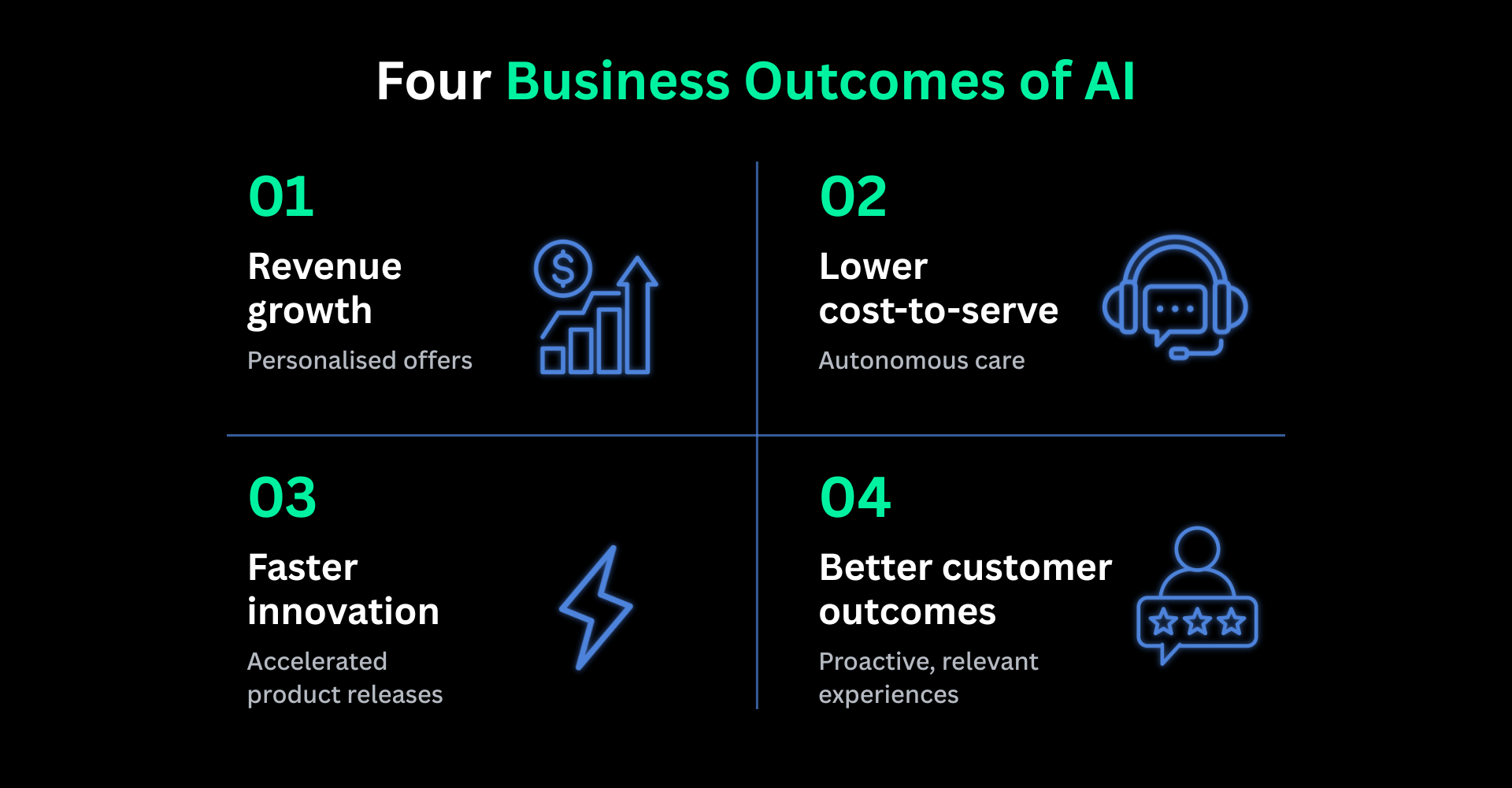
The winners will not necessarily be the operators with the largest AI budgets or the most pilots. They will be those that can systematically convert intelligence and autonomy into revenue growth, lower cost-to-serve, faster innovation and better customer outcomes.
AI needs to change the economics
The strongest AI opportunities in telecom are increasingly those directly connected to measurable business outcomes.
In customer engagement, next-best-action, propensity modelling, personalised propositions and churn prediction can improve conversion, retention, ARPU and lifetime value.
In customer care, conversational and agentic AI can increasingly resolve interactions without human intervention, improving customer experience while reducing cost-to-serve.
Across marketing, AI can improve targeting, reduce acquisition waste and shorten the distance between identifying a customer signal and taking commercial action. And within technology and operations, AI-assisted engineering, testing and incident management can improve productivity and accelerate product releases.
But there is an important distinction between AI activity and AI value.
A successful pilot, higher model accuracy or more automated interactions does not necessarily mean economic value has been created. Value is realised when those improvements translate into incremental revenue, avoided costs, improved cash flow or better customer outcomes.
That requires operators to start with the business outcome - not the AI use case.
From AI that recommends to AI that acts
The transition from generative AI to agentic AI has the potential to fundamentally change this equation.
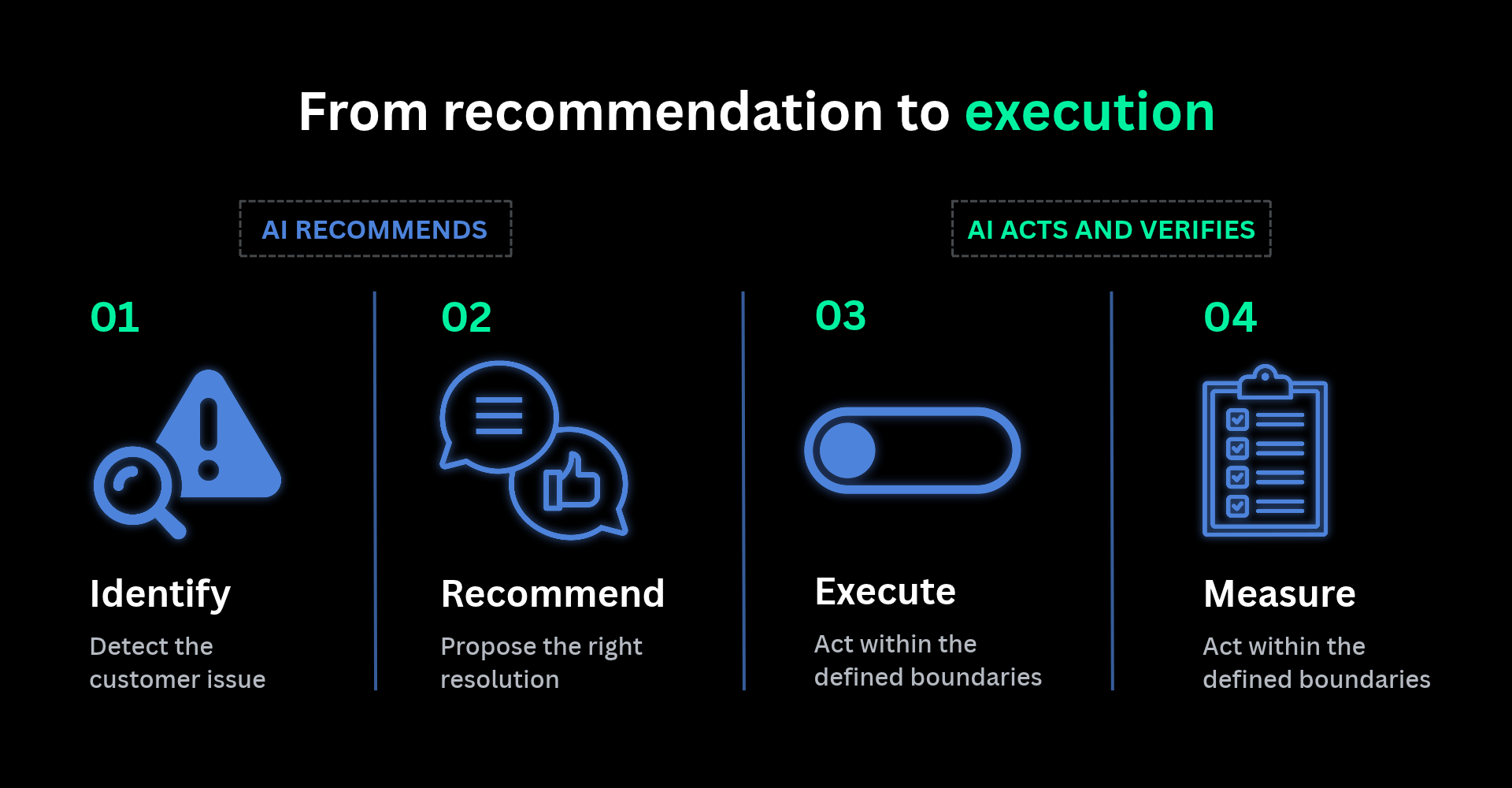
Generative AI dramatically improved our ability to understand, create and interact with information. Agentic AI takes this further, enabling systems to execute workflows, coordinate across platforms and make decisions within defined boundaries.
For telecom operators, this opens the possibility of rethinking traditional customer journeys.
Instead of forcing customers through predefined menus and processes, an AI-native experience can understand intent and orchestrate the appropriate actions across care, billing, subscriptions, offers and other systems.
The same shift can happen internally. AI moves from simply telling an employee what should happen next to increasingly executing those actions.
But the goal shouldn't be maximum automation.
It should be economically valuable.
If an AI agent can resolve a customer issue end-to-end, improve the experience and lower cost-to-serve, there is genuine value. But if extensive human supervision, remediation and exception handling are still required, those economics can quickly disappear.
Operators therefore need to measure the net value of autonomy, not simply the percentage of interactions automated.
You cannot build an AI-native telco on a legacy foundation
This leads to one of the most important realities facing operators.
You cannot build an AI-native telco on fragmented legacy systems and disconnected data.
Scaling AI across customer engagement, network operations, product development and commercial decision-making requires an API-first, cloud-native architecture, unified and accessible data, and intelligence embedded into the core technology stack.
Without that foundation, AI risks becoming another technology layer sitting above existing complexity.
Increasingly, the constraint isn't the sophistication of the AI model. It is the ability to integrate AI into legacy environments, connect fragmented data, redesign business processes and establish clear ownership of commercial outcomes.
This is why the AI conversation ultimately becomes an operating-model conversation.
From customer data to intelligence to action
Operators already possess one of their greatest potential AI advantages: rich proprietary customer data and direct customer relationships.
The opportunity isn't simply to monetise that data externally. Potentially greater value comes from activating it within the core business.
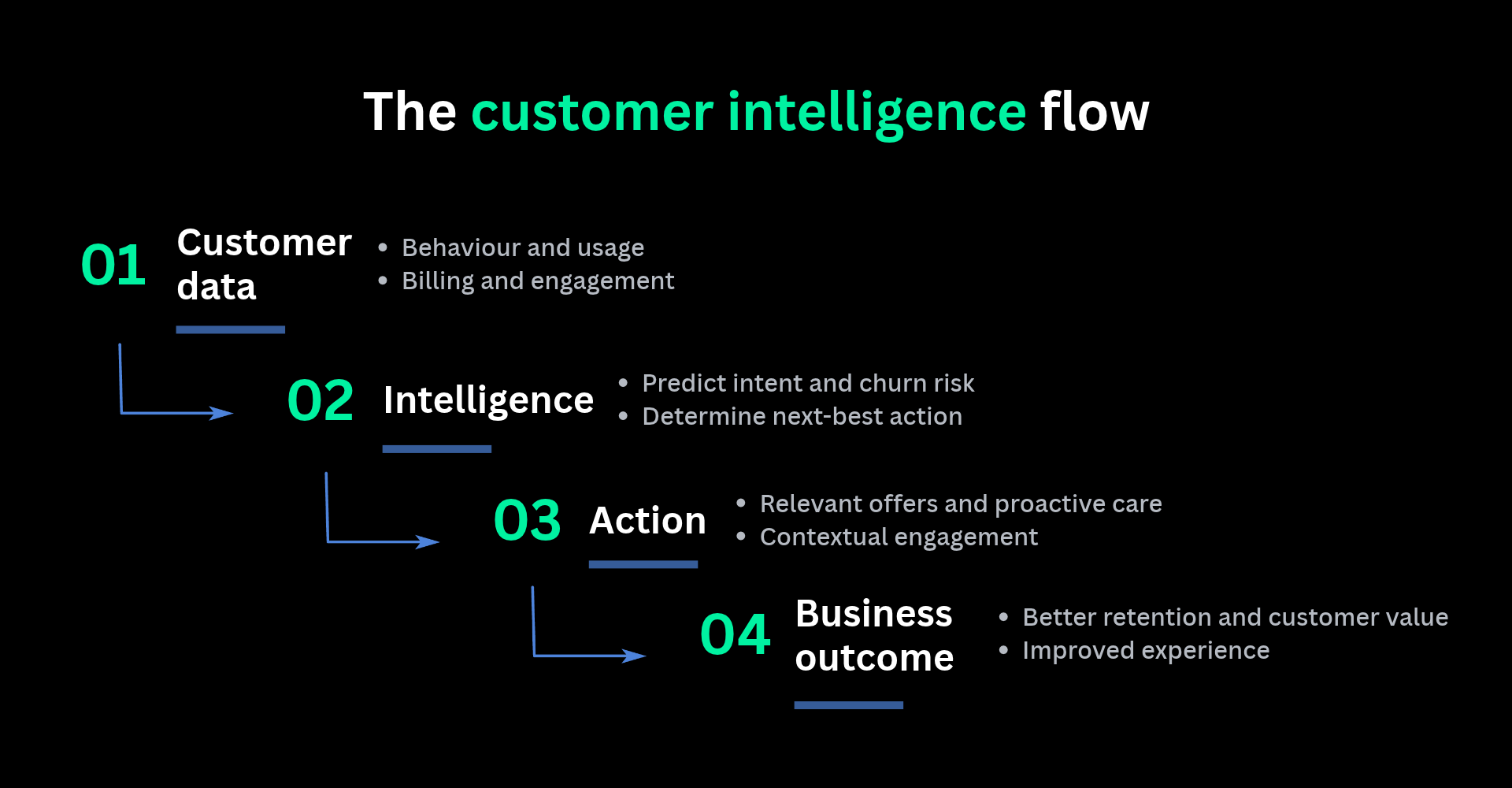
Combining behavioural, usage, billing and engagement signals enables operators to better understand customers, predict intent, identify churn risk and determine the next-best proposition or action.
AI then makes it possible to interpret those signals at scale and increasingly act on them in real time.
The opportunity becomes:
Customer Data → Intelligence → Action → Business Outcome
Importantly, operators need to retain control of the customer relationship, customer data and the intelligence that differentiates their proposition. Otherwise, they risk funding AI capabilities while allowing much of the resulting economic value to accrue elsewhere in the technology ecosystem.
What we're learning at Circles
At Circles, our experience operating digital telcos as well as building technology for operators gives us an opportunity to test AI against real-world commercial and operational outcomes.
Across the business, we're already seeing the potential:
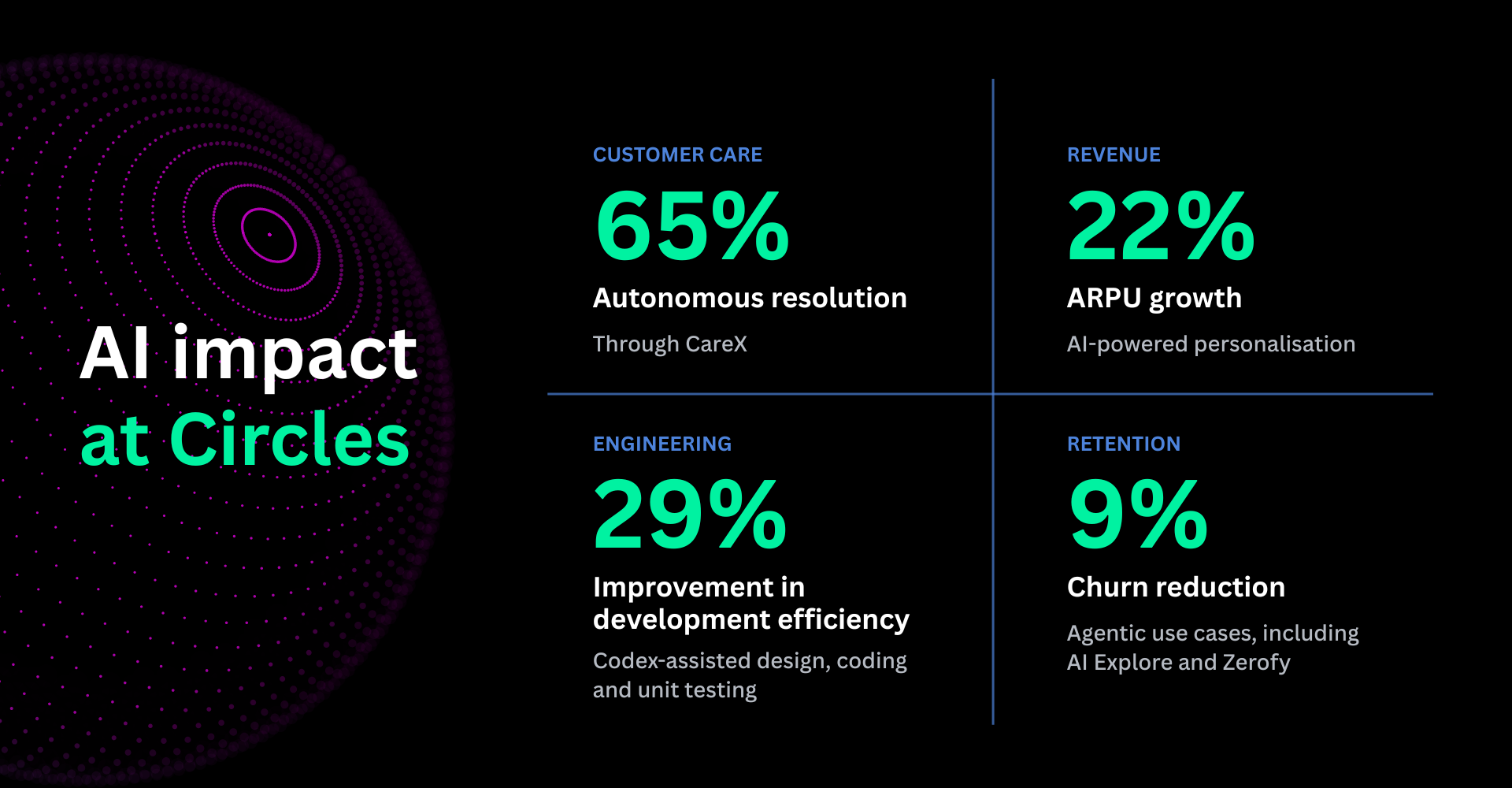
65% autonomous resolution through CareX, demonstrating the potential to resolve customer interactions without human intervention.
29% improvement in development efficiency through Codex-assisted design, coding and unit testing.
22% ARPU growth through AI-powered personalisation, illustrating the commercial opportunity when intelligence translates into more relevant customer propositions.
And 9% churn reduction through agentic use cases, including AI Explore and Zerofy.
These represent very different value pools - operational efficiency, engineering productivity, revenue growth and retention.
The challenge now is not simply proving that individual AI applications work. It is operationalising and scaling intelligence across the telco.
From AI use cases to an AI-Native Telco Operating System
This is where we believe the industry needs to think differently.
An AI-Native Telco Operating System isn't simply a traditional telco technology stack with AI capabilities added on top.
It connects data, intelligence, customer experience and operational workflows so that AI can become part of how the business continuously senses, decides and acts.
That means moving:
And, most importantly, from measuring AI activity to measuring business outcomes.
The next phase of telecom transformation
AI initiatives should ultimately be treated as investment theses rather than technology experiments.
Establish the baseline. Prove incremental economic value. Demonstrate that it can be repeated at scale. Validate security, privacy, governance and operational readiness. Then make a disciplined decision to scale, redesign or stop.
The next generation of telecom transformation will not be about adding AI to the existing operating model.
It will be about redesigning the operating model around AI, data and automation.
Ultimately, AI is not a technology investment alone. It is an operating-model transformation - and increasingly, a capital-allocation decision.
The competitive advantage will not come from having the most AI pilots.
It will come from embedding AI into the operating model, giving it the right degree of autonomy and consistently converting that autonomy into measurable business value.