

Knowledge Hub
5
min read
Generative AI Customer Support & CX Automation: Beyond the Scripted Chatbot
Generative AI support reads live billing and account context to resolve subscriber questions without a scripted decision tree or human queue.
What Generative AI Support Actually Changes
Generative AI customer support synchronises real-time subscriber billing and account context with LLM-orchestrated responses, so the system answers the specific question a subscriber has, not the closest matching branch in a decision tree. A scripted chatbot matches keywords to a fixed script and hands off the moment the conversation leaves the script. Generative AI support reads the live account state and reasons over it in natural language, which is why it resolves questions a scripted system typically escalates.
Generative AI support works the way an agent who already has the subscriber's account pulled up does: answering the specific question they have, not reciting a generic policy. It reads the subscriber's plan, billing history, and recent account activity before generating a response, so the answer accounts for that subscriber's actual situation rather than a generic policy statement.
What is generative AI customer support in telecom?
Generative AI customer support in telecom answers by reasoning over a subscriber's live account state rather than matching the query to a fixed script or FAQ tree. Because the response is grounded in that specific account, it resolves questions a scripted chatbot cannot.
Scripted Chatbot vs Generative AI Support
.avif)
The difference between a scripted chatbot and generative AI support is not conversational polish; it is whether the system reasons over the subscriber's actual account state or matches the query to a fixed decision tree. Both can sound conversational. Only one produces an answer that reflects what is actually on this subscriber's account.
The escalation point is the commercial signal. A support system that escalates because the subscriber phrased a question differently than the script expected is a scripting-coverage problem, not a genuinely hard case. Generative AI support collapses that category of escalation because it reasons over context instead of matching phrasing.
How is generative AI support different from a rules-based chatbot?
A rules-based chatbot matches a subscriber's phrasing to the closest branch in a pre-written decision tree and cannot answer outside that tree. Generative AI support reads the subscriber's live billing and account context and generates a response grounded in that specific data, so it answers questions the original script never anticipated.
What Generative AI Support Requires
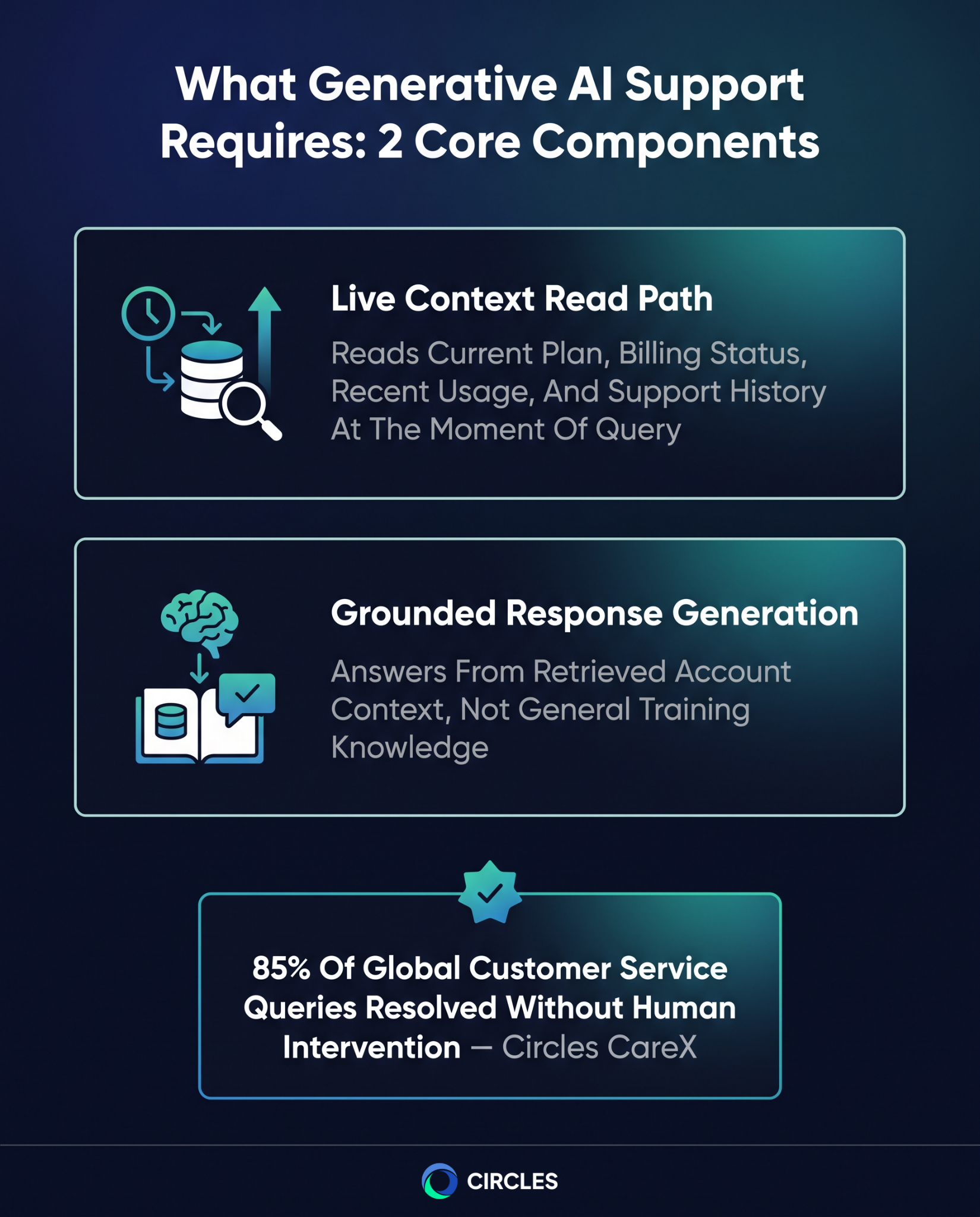
Generative AI support requires two things a scripted chatbot does not: a live read path into the subscriber's billing and account systems, and a language model constrained to answer only from that grounded context. Without the first, the model has nothing current to reason over. Without the second, a fluent model produces a confident answer that is wrong for this subscriber's account.
Live context read path: the system reads current plan, billing status, recent usage, and support history at the moment of the query, not a nightly extract. A subscriber asking about a charge from three days ago needs an answer grounded in that specific charge, not a general billing policy.
Grounded response generation: the model answers from the retrieved account context rather than general training knowledge, so the response is specific to this subscriber rather than a plausible-sounding generic answer. This is the same governance boundary the AI-First Model Layer enforces at every inference call across the platform.
Does generative AI support replace human agents entirely?
No. It removes the category of contact that exists only because a scripted system had no answer available, and it routes genuinely complex cases (disputes, fraud flags, account changes requiring judgement) to a human agent with the full context already assembled. The subscriber-facing effect is fewer contacts that need a human at all, not zero human involvement.
Build Generative AI Support with Circles
The Circles AI-Native Platform Synchronises live billing and account context with LLM-orchestrated response generation, so support resolves against this subscriber's actual state rather than a shared script. Circles' CareX architecture resolves 85% of global customer service queries without human intervention, grounded in exactly this pattern: live account context, not a fixed decision tree.
Operators that synchronise support with live subscriber context stop measuring support quality by how well the script covers common questions and start measuring it by how rarely a subscriber needs a human at all. Where this capability goes next, from answering questions to executing account actions directly, is at agentic AI for telecom.